How to start a mushroom farming business in Delhi (2026): investment, profit and licences
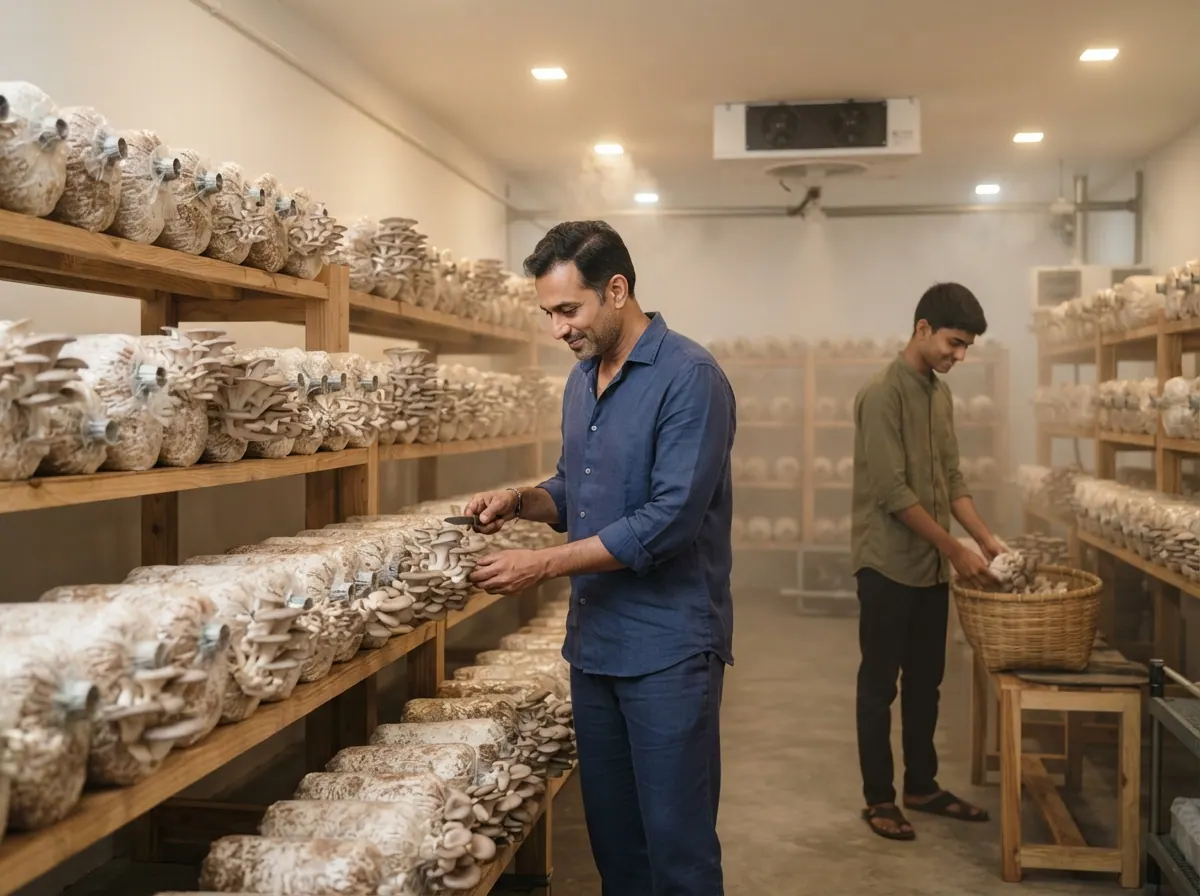
A mushroom farming business in Delhi needs about ₹47,500–₹28.5 lakh to set up, depending on the format. Run well in a city like Rohini, it typically nets ₹19,500–₹85,000 a month. The numbers below are India-wide research rescaled to Delhi's own wages, shop rents, power tariffs and street prices.
How much investment do you need in Delhi?
- Cheapest start
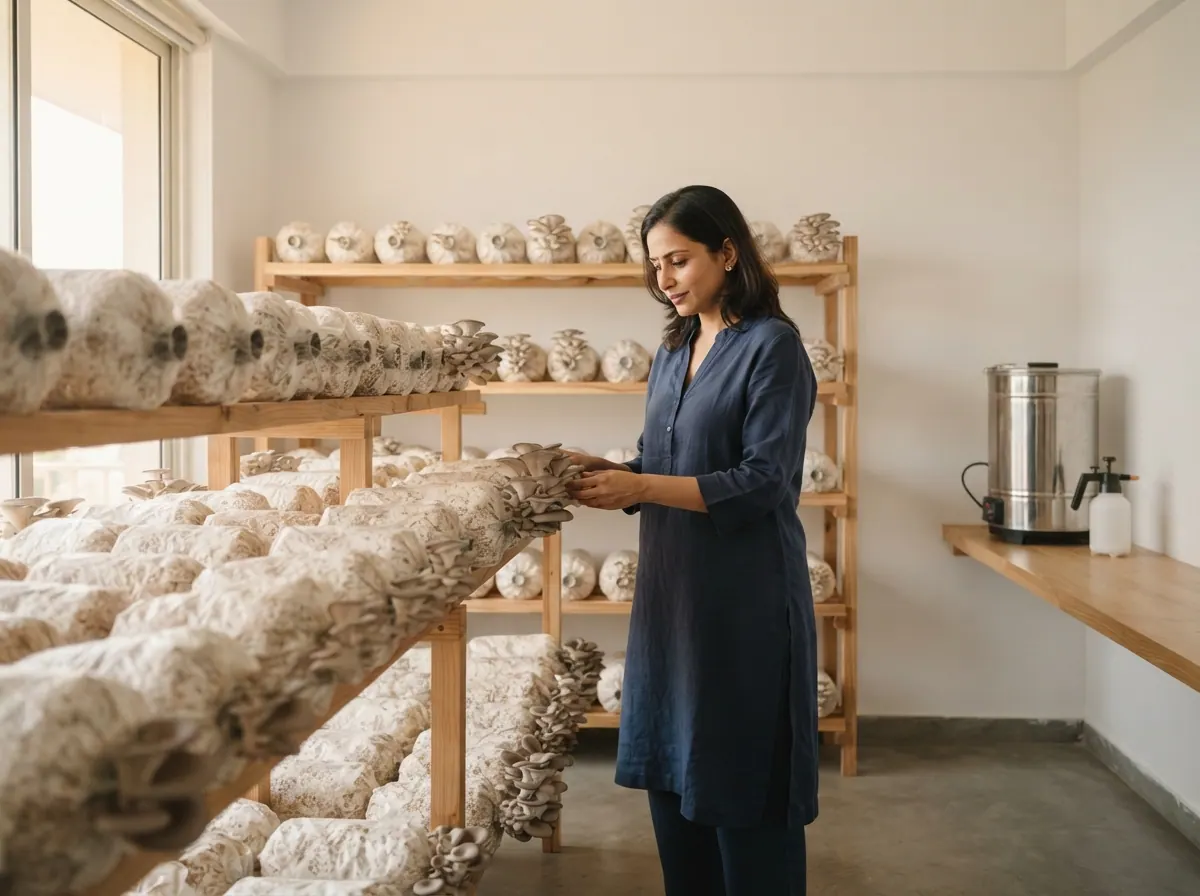
Home oyster, spare room
300–500 oyster bags, racks, a sprayer and a hot-water drum. 25–40 kg a week and 1–2 hours a day.
Setup cost₹47,500Suggested budget (with working capital): ₹52,000 Oyster room, 1,000 sq ft
1,000–1,500 bags, foggers and exhaust fans, an owner and a helper. 200–250 kg a week.
Setup cost₹2.4 lakhSuggested budget (with working capital): ₹2.7 lakh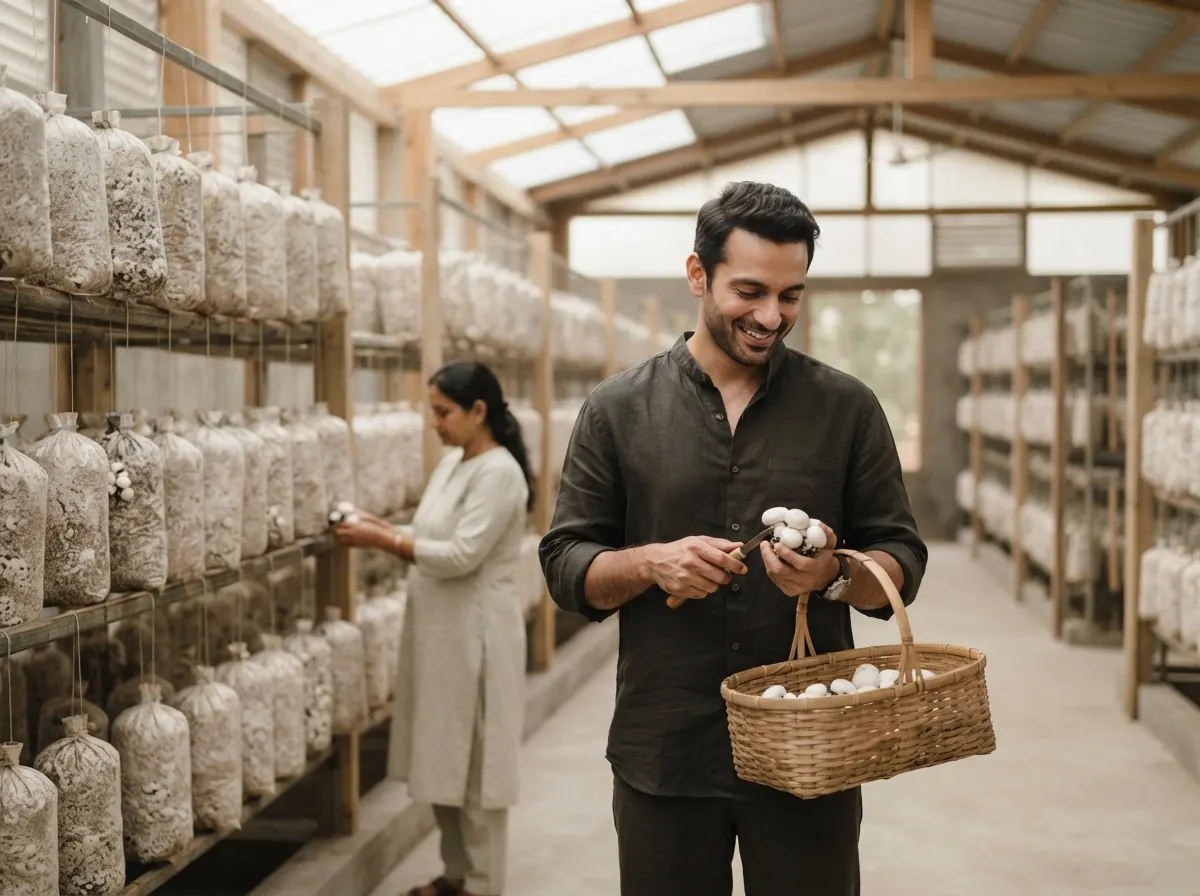
Seasonal button shed
3,000–4,000 button bags from November to March, oyster in summer. Cheap to run, but you sell into the winter glut.
Setup cost₹5.8 lakhSuggested budget (with working capital): ₹6.1 lakh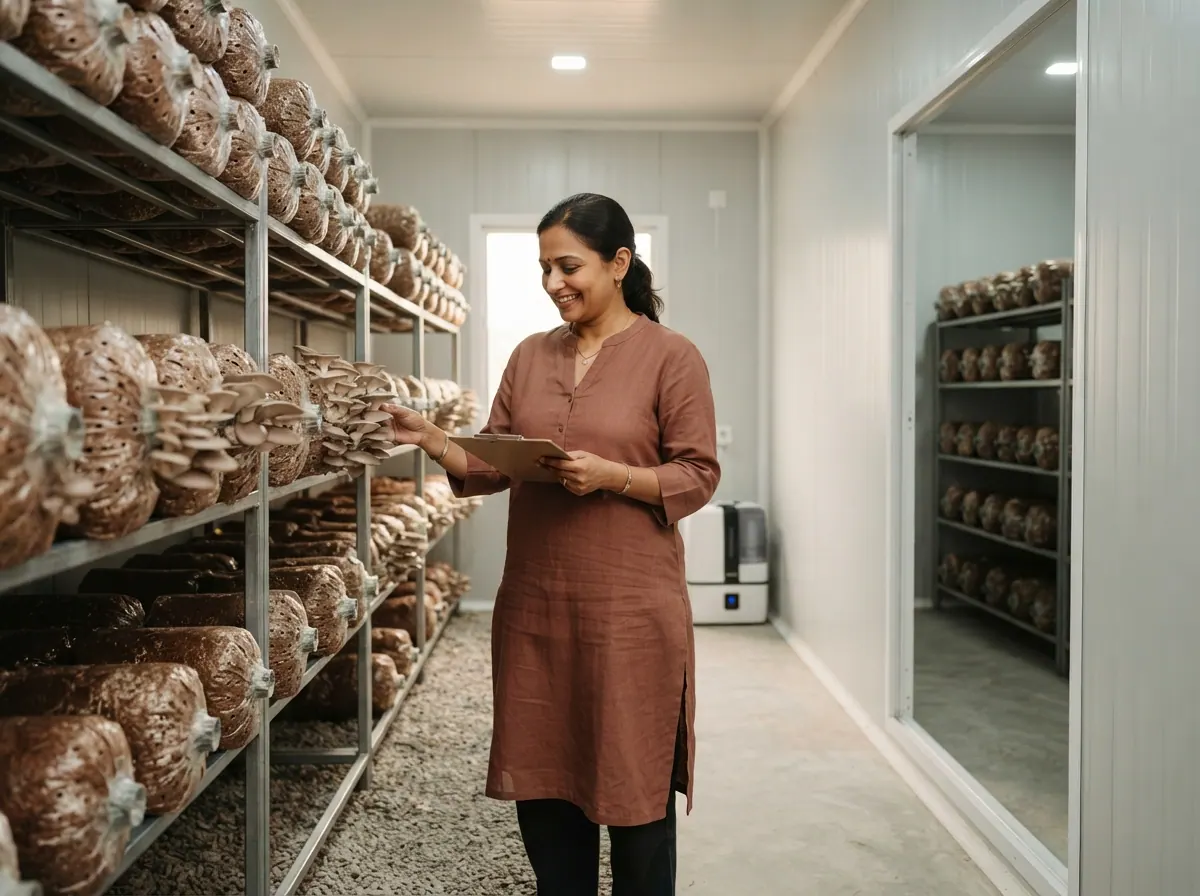
AC button unit, 2 rooms
About 3,000 bags in two insulated rooms, year-round, compost bought in. About 1,150 kg a week, big power and loan bills.
Setup cost₹28.5 lakhSuggested budget (with working capital): ₹30.3 lakh
How to start a mushroom farming business, step by step
- Choose your format and budget: Start with Home oyster, spare room: about ₹47,500 to set up, or ₹52,000 with working capital.
- Pick the location: Compare the rent with the number of customers who pass by, at the hours you will be open.
- Get your licences: Commonly needed: 0% GST on fresh and dried mushrooms (HSN 0709, 0712), No FSSAI needed for loose fresh produce sold by the grower (estimate), FSSAI basic registration (₹100/year) for dried or packed product, MIDH subsidy: 40% of a ₹20–30 lakh norm, credit-linked and paid later. Rules vary by state and city, so confirm with your municipal office.
- Arrange stock, staff and prices: Check local prices first, and keep money aside for the first months of rent, wages and stock.
- Plan for the risks: Watch for: green mould and contaminated spawn, summer heat cutting oyster yield, winter button glut pulling prices to ₹80–100/kg, a 2–3 day shelf life, nematodes and flies in unclean sheds, buy-back scheme frauds.
- Practise before you invest: Run it day by day in the free simulator to see where the money goes.
How much profit can you make in Delhi?
A well-run mushroom farming business in Delhi typically nets ₹19,500–₹85,000 a month in a mid-size city: about ₹24,500–₹1.7 lakh in the metro and ₹3,000–₹9,500 in a small town. A casually run one can make far less or lose money.
| City | Net profit per week | Net profit per month |
|---|---|---|
| New Delhi (South/Central Delhi) | ₹5,640–₹39,480 | ₹24,500–₹1.7 lakh |
| Rohini | ₹4,460–₹19,623 | ₹19,500–₹85,000 |
| Narela | ₹714–₹2,231 | ₹3,000–₹9,500 |
Ranges are for a well-run business of the typical format in each city size, from public sources and estimates. Your results depend on location and how you run it.
What changes in Delhi
The researched local factors that move this business’s numbers.
| Here | India | vs India | |
|---|---|---|---|
| Minimum wage, monthly | ₹18,456 | ₹12,500 | +48% |
| Unskilled day wage | ₹700 | ₹500 | +40% |
| Shop rent, metro (per sq ft/month) | ₹250Estimate | ₹150 | +67% |
| Shop rent, mid-size city | ₹120Estimate | ₹60 | +100% |
| Shop rent, small town | ₹60Estimate | ₹25 | +140% |
| Commercial power, per kWh | ₹10.5Estimate | ₹9.5 | +11% |
| Commercial LPG cylinder | ₹2,810 | ₹2,810 | ≈ |
| Petrol, per litre | ₹102 | ₹102 | ≈ |
| Cup of tea / coffee | ₹15Estimate | ₹12 | +25% |
| Simple meal | ₹120Estimate | ₹80 | +50% |
| Men's haircut | ₹150Estimate | ₹100 | +50% |
| Milk, 1 litre | ₹60 | ₹60 | ≈ |
| Bread loaf | ₹50Estimate | ₹45 | +11% |
| Factor | Typical value in India | Source |
|---|---|---|
| Minimum wage, unskilled, shops (Delhi, all-Delhi rate) | ₹18,456/month (₹710/day), semi-skilled ₹20,371, skilled ₹22,411 | employsome.com |
| Conflicting later figure for Delhi unskilled | ₹19,846/month (₹764/day) claimed from 1 Oct 2025; WageIndicator still shows ₹18,456 as valid in June 2026. Engine uses ₹18,456; treat ₹19,846 as upside risk | zimyo.com |
| Delhi revises minimum wage twice a year (Apr and Oct DA) | April/October DA cycle; a fake Oct 2025 order circulated, so check the Labour Dept site | wageindicator.org |
| Typical shop helper pay (informal), Delhi | ₹12,000–16,000/month, often below the legal floorEstimate | Est.: national kirana presets put T1 h… |
| Casual daily labour rate (market) | ₹700/dayEstimate | Est.: ₹710/day legal floor; loaders/he… |
| High-street benchmark (Khan Market / Connaught Place) | Khan Market ₹1,700–1,800/sq ft/month; CP Inner Circle ₹1,250–1,300 (Apr–Jun 2026) | outlookbusiness.com |
| Neighbourhood market shop rent by tier | T1 (South/Central Delhi local market) ₹250; T2 (Rohini/Laxmi Nagar) ₹120; T3 (Narela/urban village) ₹60 per sq ft/monthEstimate | outlookbusiness.com |
| Commercial (non-domestic) electricity, effective rate | about ₹10.5/kWh all-in for a small shopEstimate | solarquarter.com |
| Power purchase surcharge applied monthly | PPAC 15.99% (Tata Power-DDL, from 1 May 2026); FPPAS for May 2026 17.94% BRPL / 17.43% BYPL / 12.21% TPDDL | tatapower-ddl.com |
| Commercial LPG 19 kg, Delhi | ₹2,810 (25 Oct 2026); domestic 14.2 kg ₹942 | goodreturns.in |
| Shops & Establishments registration (Delhi S&E Act 1954) | Online with Labour Dept; fee ₹200–5,000 by headcount (blog ranges; some say ₹0 for small shops); within 30 days of opening | clearlycomply.org |
| NCR is split across three laws | Delhi S&E Act 1954 vs Haryana (Gurugram/Faridabad) vs UP (Noida/Ghaziabad) acts; same 'Delhi' metro, different rules | india-briefing.com |
| MCD health trade licence (eateries) and general trade licence | Required for eating houses, sweet shops, salons; fee depends on area (about ₹1,000–5,000/yr typical for small premises), 2–6 weeksEstimate | Est.: MCD trade licence fees are sched… |
| Street vending: Certificate of Vending via Town Vending Committee | Needed for PM SVANidhi and protection from eviction; TVC surveys slow, many vendors unlistedEstimate | newsonair.gov.in |
Festivals and demand
- Karva Chauth (29 Oct 2026) · salon/mehendi and sweets spike 3–5× for women's services; evening eateries busy after moonrise
- Diwali (Dhanteras 6 Nov, Lakshmi Puja 8 Nov, Bhai Dooj 11 Nov) (6–11 Nov 2026) · sweets, gifts, clothing, salon and kirana demand 1.5–3× in the run-up; most small shops shut or half-day on Diwali itself
- Chhath Puja (about 14–15 Nov 2026) · puja items, fruit and sugarcane surge near ghats; Purvanchali workers travel home before it, labour short
- Holi (about 22 Mar 2027) · colours, sweets, thandai and snacks up the week before; most shops shut on Dhulandi morning
- Eid ul-Fitr (end of Ramzan, Ramzan from about 8 Feb) (about 9–10 Mar 2027 (moon-dependent)) · Ramzan evening iftar trade up for a month; clothing, sewai, meat and sweets demand peaks the week before Eid
- Christmas–New Year (24 Dec 2026–1 Jan 2027) · cafés, bakeries and malls 1.5–3× on NYE
Licences and rules
Rules vary by state and city: confirm with your municipal office.
- 0% GST on fresh and dried mushrooms (HSN 0709, 0712)
- No FSSAI needed for loose fresh produce sold by the grower (estimate)
- FSSAI basic registration (₹100/year) for dried or packed product
- MIDH subsidy: 40% of a ₹20–30 lakh norm, credit-linked and paid later
- Shop & Establishment registration (Delhi S&E Act 1954) · ₹200–5,000 by headcount (blog ranges; small shops at the bottom) · Labour Department, GNCTD
- Health trade licence for eating houses / sweet shops (MCD) · about ₹1,000–5,000/yr by area (Est.) · Municipal Corporation of Delhi
- Certificate of Vending (street vendors) · nominal; via Town Vending Committee survey · MCD / NDMC Town Vending Committee
Run it day by day before you invest
Run a mushroom farming business day by day. Choose your city, budget and location, then make the decisions a real owner faces as they come up. Your advisor can test each choice on your next 3 months. The free simulator currently runs on India-wide numbers; a state preset is coming.
Play the simulator freeFrequently asked questions
How much does it cost to start a mushroom farming business in Delhi?
About ₹47,500–₹28.5 lakh, depending on the format. That is the India-wide setup cost rescaled to Delhi's rents and prices.
How much profit does a mushroom farming business make in Delhi?
A well-run one typically nets ₹19,500–₹85,000 a month in a city like Rohini. Casual owners earn far less.
What licences does a mushroom farming business need in Delhi?
0% GST on fresh and dried mushrooms (HSN 0709, 0712), No FSSAI needed for loose fresh produce sold by the grower (estimate), FSSAI basic registration (₹100/year) for dried or packed product, MIDH subsidy: 40% of a ₹20–30 lakh norm, credit-linked and paid later, Shop & Establishment registration (Delhi S&E Act 1954), Health trade licence for eating houses / sweet shops (MCD), Certificate of Vending (street vendors)
Which city in Delhi is best for a mushroom farming business?
Bigger cities bring more customers and higher bills but also higher rent and wages. The chart above compares metro, mid-size city and small town.