How to start a cement and building materials business in India (2026): investment, profit and licences
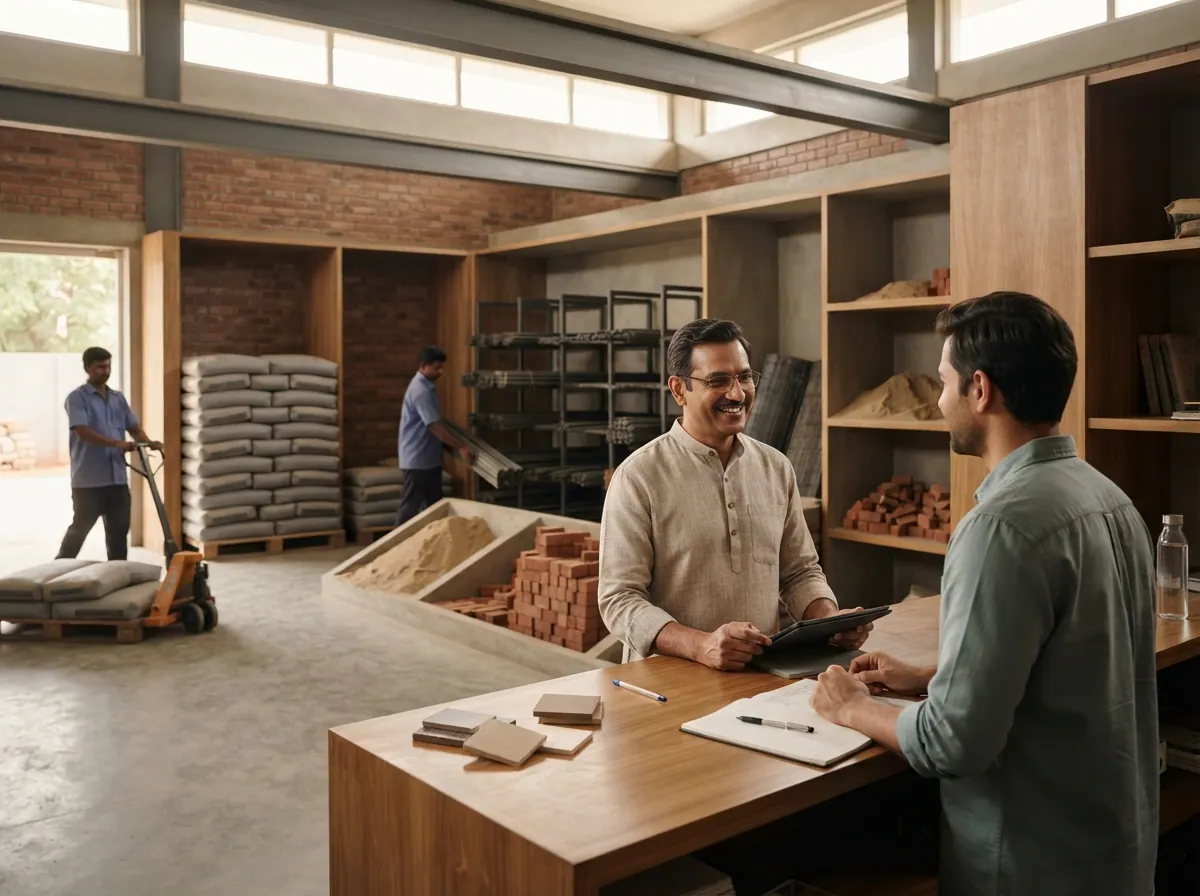
A cement and building materials business in India needs about ₹4 lakh–₹20 lakh to set up, depending on the format. A well-run one typically makes ₹8,500–₹1.3 lakh a month in profit. You usually need: GST registration (18% on cement and steel, 5% on natural sand), Shop & Establishment registration and local trade licence, only BIS-marked cement and steel, Legal Metrology stamp on the scale, royalty pass with every sand load.
How much investment do you need?
- Cheapest start

Counter with a small yard
Bags, sand and bricks for masons and home builders. Smaller bills, one or two helpers.
Setup cost₹4 lakhSuggested budget (with working capital): ₹7.3 lakh Shop with a rented godown
800–1,500 sq ft, two loaders, cement, steel, sand and bricks. The usual small dealer.
Setup cost₹9 lakhSuggested budget (with working capital): ₹15 lakh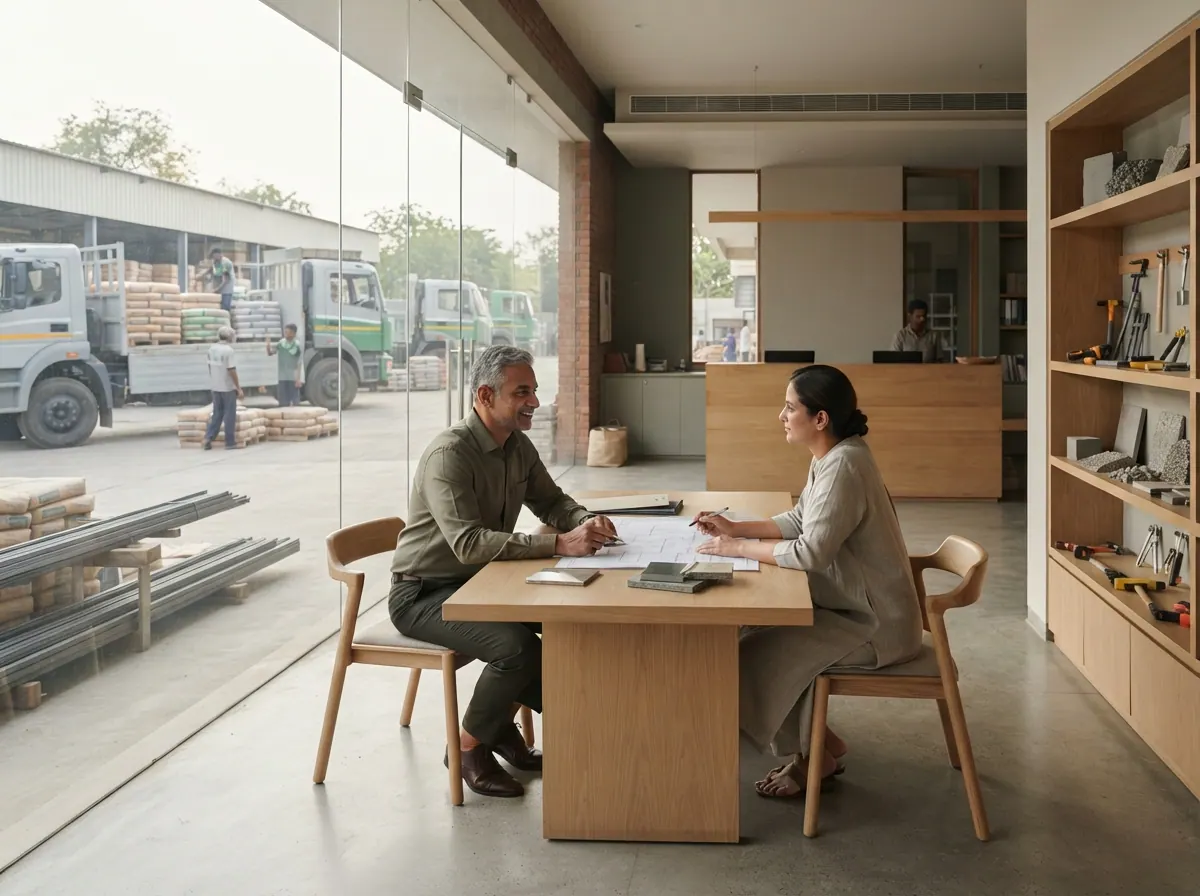
Large yard with own trucks
Truckload accounts with builders. Much more stock, rent and credit at stake.
Setup cost₹20 lakhSuggested budget (with working capital): ₹33.2 lakh
How to start a cement and building materials business, step by step
- Choose your format and budget: Start with Counter with a small yard: about ₹4 lakh to set up, or ₹7.3 lakh with working capital.
- Pick the location: Compare the rent with the number of customers who pass by, at the hours you will be open.
- Get your licences: Commonly needed: GST registration (18% on cement and steel, 5% on natural sand), Shop & Establishment registration and local trade licence, only BIS-marked cement and steel, Legal Metrology stamp on the scale, royalty pass with every sand load. Rules vary by state and city, so confirm with your municipal office.
- Arrange stock, staff and prices: Check local prices first, and keep money aside for the first months of rent, wages and stock.
- Plan for the risks: Watch for: contractors who pay late or never, very thin margin on cement, at most 1–2% by one dealer's account, cement going hard in a damp godown, steel rates falling after you buy, a slow monsoon quarter.
- Practise before you invest: Run it day by day in the free simulator to see where the money goes.
How much profit can you make?
A well-run cement and building materials business typically nets ₹8,500–₹1.3 lakh a month: about ₹26,000–₹1.3 lakh in a metro and ₹8,500–₹39,000 in a small town. A casually run one can make far less or lose money.
| City | Net profit per week | Net profit per month |
|---|---|---|
| Metro city | ₹6,000–₹30,000 | ₹26,000–₹1.3 lakh |
| Tier 2 city | ₹4,000–₹15,000 | ₹17,500–₹65,000 |
| Small town | ₹2,000–₹9,000 | ₹8,500–₹39,000 |
Ranges are for a well-run business of the typical format in each city size, from public sources and estimates. Your results depend on location and how you run it.
Profit calculator
Put in your own numbers for a quick monthly estimate. For a realistic run with festivals, rain, staff and stock, use the simulator.
Run it day by day before you invest
Run a cement and building materials business day by day. Choose your city, budget and location, then make the decisions a real owner faces as they come up. Your advisor can test each choice on your next 3 months.
Play the simulator free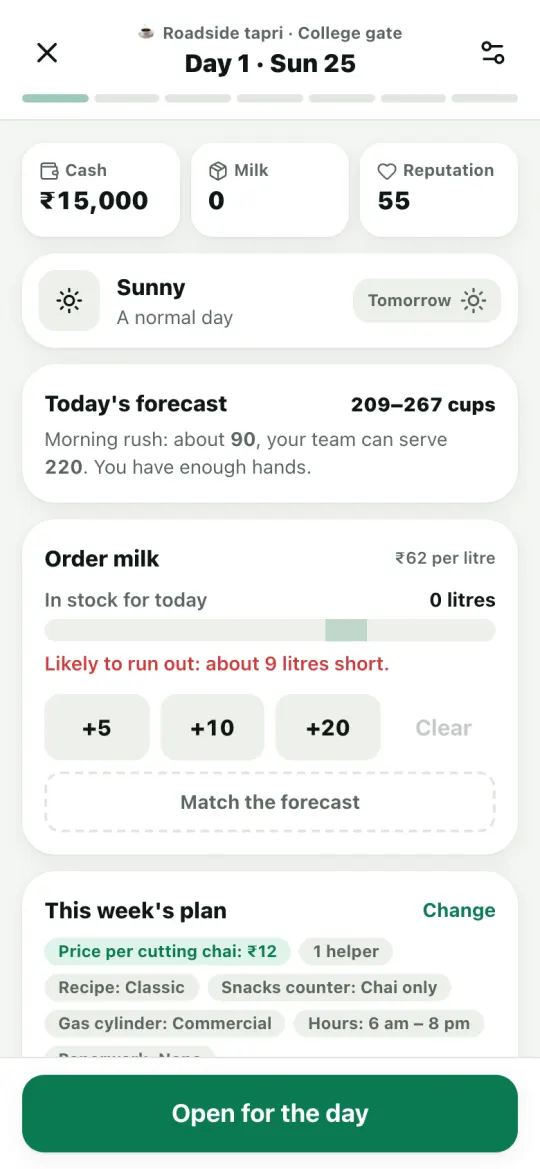
Key numbers (136 researched factors)
JSON · Source · Estimate
| Factor | Typical value in India | Source |
|---|---|---|
| No standard dealership investment | Companies set it per appointment; no public figure | startupflora.com |
| Mini truck ex-showroom | Tata Ace Gold ₹4.94–6.59 lakh by fuel, before RTO and insurance | 91trucks.com |
| Warehouse rent, national | ₹18–60 per sq ft a month, 2026 | addressadvisors.com |
| Shed rent, tier 2 asking | Lucknow about ₹20, Nagpur about ₹15–20 per sq ft a month (large sheds) | houssed.com |
| Cement dealer margin | At most 1–2% (Pune dealer, 2021) | indiancementreview.com |
| Cement and TMT margin, hardware trade | 2–5% | `hardware_shop.md` in these notes (Cal… |
| Dealer pays company | About 7–10 days from dispatch (2012) | indiancementreview.com |
| Steel runs on credit both ways | No days given | captainsteel.com |
| Monsoon quarter | Q2 is the weakest for cement | plindia.com |
| Peak months | Demand drops in monsoon, peaks in dry months | startupflora.com |
| Unskilled minimum, Bihar | ₹436 a day from 1 Apr 2026 | wageindicator.org |
| Unskilled minimum, cement, Daman | ₹501.50 a day from 1 Apr 2026 | wageindicator.org |
| Normal cement credit | 15 days; builders stretched to 30–45 (2008) | business-standard.com |
| RMC credit | 90–120 days given, 60–150 days to collect; bad debt up to 2.7% of revenue at one firm | rdc.in |
| Delivery radius | 5–15 km for small and town dealers | indiancementreview.com |
| Transport viable below | ₹15 a bag (2014) | indiancementreview.com |
| Bulk goes direct to RMC | Pune dealer: bulk to RMC rose from 30% to 45% | indiancementreview.com |
| Mumbai RMC share | About 70% of cement goes to RMC | indiancementreview.com |
| GST on cement | 18% from 22 Sep 2025 (was 28%) | tallysolutions.com |
| GST on steel | 18% | housing.com |
| Fake cement rackets | Amravati ₹3.43 lakh seized Jul 2026; Cuttack 500 bags and a truck | navbharatlive.com |
| Short weight trust | Signature on each delivery and a good scaleEstimate | BizGame guide `how-to-start-cement-bus… |
| Trust in deals | Deals rest on trust (2014) | indiancementreview.com |
| Other volumes seen | 1,000–1,200 bags a month up to 2,800 tonnes a month (2014) | indiancementreview.com |
Licences and rules
Rules vary by state and city: confirm with your municipal office.
- GST registration (18% on cement and steel, 5% on natural sand)
- Shop & Establishment registration and local trade licence
- Only BIS-marked cement and steel
- Legal Metrology stamp on the scale
- Royalty pass with every sand load
| Factor | Typical value in India | Source |
|---|---|---|
| GST on cement | 18% from 22 Sep 2025 (was 28%) | tallysolutions.com |
| GST on steel | 18% | housing.com |
| GST on natural sand | 5% | housing.com |
| GST on bricks | Sources conflict: 5% vs 12%; check with a CA | busy.in |
| GST registration | Effectively mandatory for a dealer | startupflora.com |
| Cement QCO | BIS mark compulsory under Cement (QC) Order 2003; dealers covered, officials may inspect | alephindia.in |
| Steel QCO | Steel and Steel Products (QC) Order 2024 | certification-india.com |
| BIS Act penalty | Up to 2 years or fine at least ₹2 lakh, up to 10× goods; repeat at least ₹5 lakh | calcguru.in |
Risks to plan for
- Contractors who pay late or never
- Very thin margin on cement, at most 1–2% by one dealer's account
- Cement going hard in a damp godown
- Steel rates falling after you buy
- A slow monsoon quarter
| Factor | Typical value in India | Source |
|---|---|---|
| Short weight trust | Signature on each delivery and a good scaleEstimate | BizGame guide `how-to-start-cement-bus… |
| On-time slab delivery | A late truck loses the contractorEstimate | BizGame guide `how-to-start-cement-bus… |
| Lumps blamed on the shop | Slab cracks get blamed on cement; a test settles itEstimate | Est.: from D05 |
Frequently asked questions
How much investment is needed to start a cement and building materials business?
It depends on the format: Counter with a small yard ₹4 lakh; Shop with a rented godown ₹9 lakh; Large yard with own trucks ₹20 lakh. Keep extra working capital for stock, wages and rent for the first months.
How much profit does a cement and building materials business make per month?
A well-run cement and building materials business typically nets ₹8,500–₹1.3 lakh a month: about ₹26,000–₹1.3 lakh in a metro and ₹8,500–₹39,000 in a small town. A casually run one can make far less or lose money.
Which licences do I need for a cement and building materials business?
Commonly: GST registration (18% on cement and steel, 5% on natural sand), Shop & Establishment registration and local trade licence, only BIS-marked cement and steel, Legal Metrology stamp on the scale, royalty pass with every sand load. Rules vary by state and city, so check with your municipal office.
Is a cement and building materials business profitable in a small town?
Yes, at a smaller scale. A well-run cement and building materials business in a small town nets about ₹8,500–₹39,000 a month, with lower rent and wages but fewer customers.
What are the biggest risks of a cement and building materials business?
The main ones are: contractors who pay late or never, very thin margin on cement, at most 1–2% by one dealer's account, cement going hard in a damp godown, steel rates falling after you buy, a slow monsoon quarter.
How can I practise running a cement and building materials business before investing?
Play the free BizGame cement and building materials business simulator. It runs day by day with Indian prices, festivals, weather and inspections, and shows how your money is doing after every decision.
how to start cement business in india · cement business · cement dealership · cement dealer profit · building materials shop business
More business ideas to simulate
 Kirana storeSetup from ₹2 lakh180 researched factors
 Mobile repair shopSetup from ₹45,000188 researched factors
 Medical storeSetup from ₹6 lakh161 researched factors
 Boutique businessSetup from ₹1 lakh175 researched factors
 Clothing storeSetup from ₹50,000160 researched factors
 Footwear shopSetup from ₹6 lakh158 researched factors
 Furniture businessSetup from ₹5 lakh205 researched factors
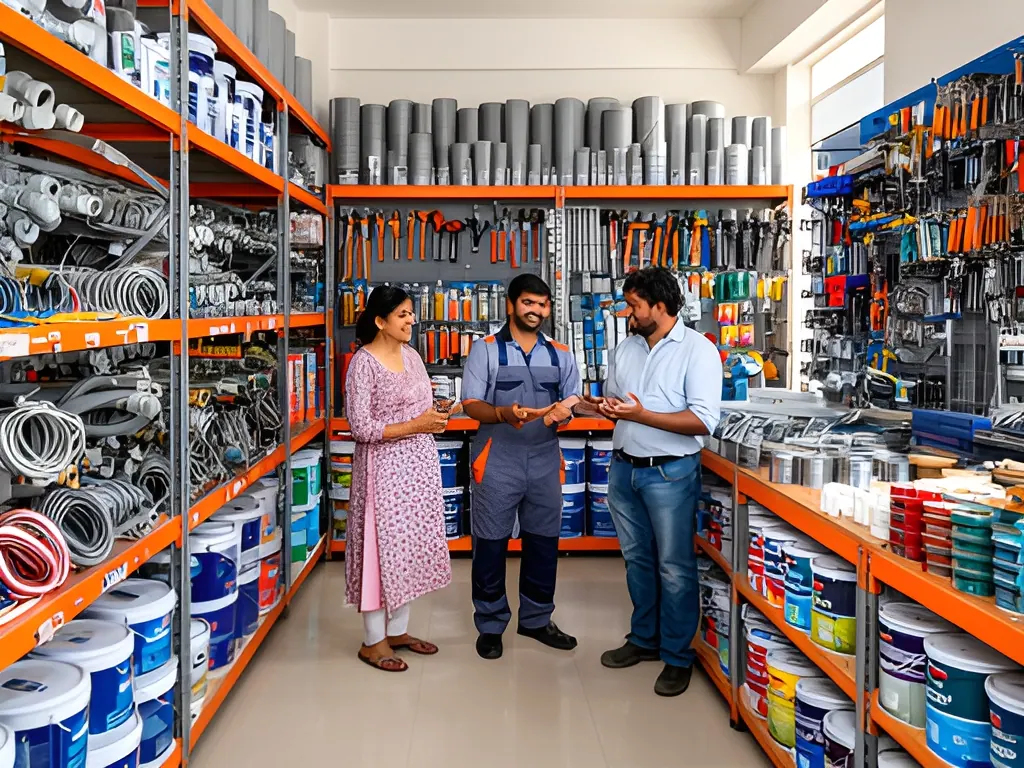 Hardware and paint shopSetup from ₹4 lakh186 researched factors
 Artificial jewellery businessSetup from ₹50,000159 researched factors
 Chicken shopSetup from ₹3.3 lakh188 researched factors
 Optical shopSetup from ₹2.5 lakh170 researched factors
 Saree shopSetup from ₹2 lakh176 researched factors