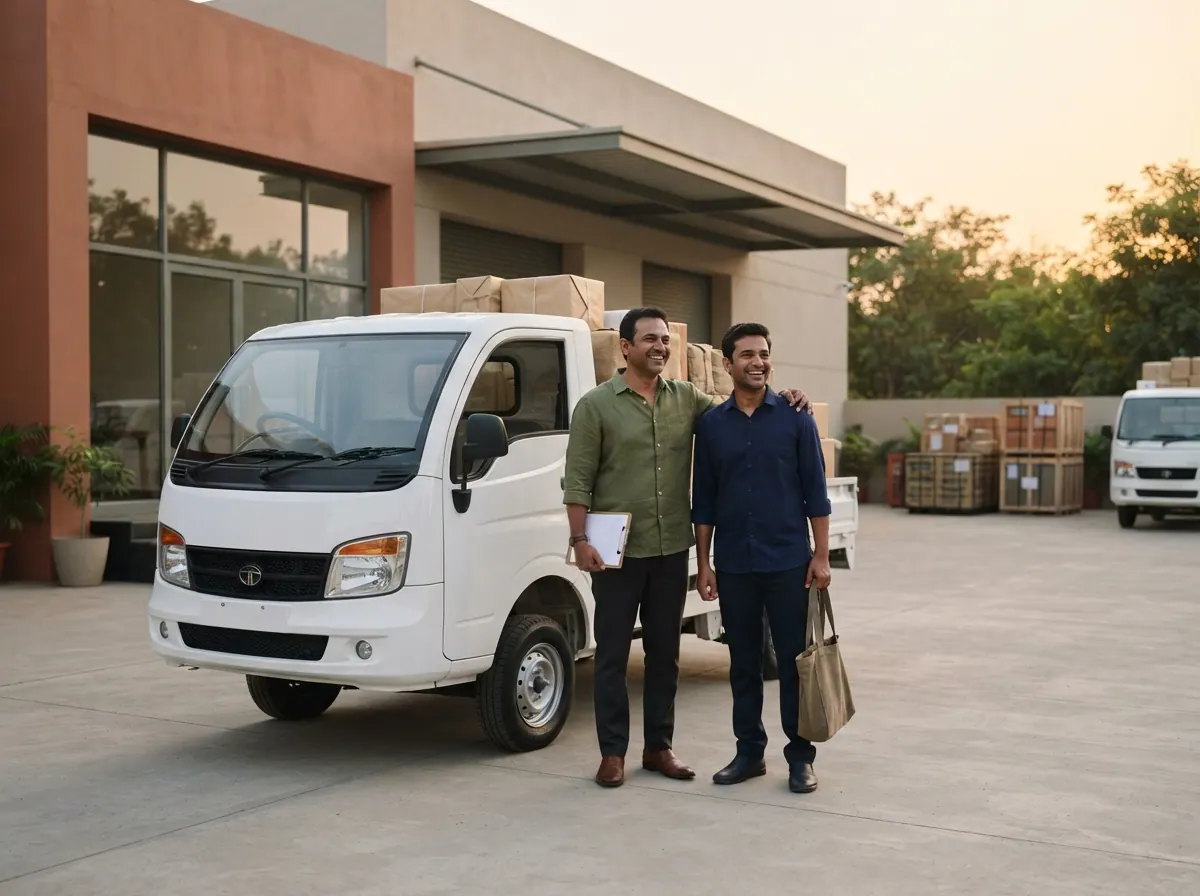
A goods transport business means you own a tempo, mini-truck or pickup and are paid per trip or per kilometre to carry loads for shops, traders, factories and families. One small vehicle costs about ₹6–9 lakh, a pickup about ₹9–11 lakh, and a larger truck up to about ₹25 lakh. An owner who drives can make a steady living from one vehicle. An owner who hires a driver and waits for loads often cannot.
All figures here are estimates. Check prices near you before you spend.
What does it cost?
For a Tata Ace-class small commercial vehicle, new:
| Item | Estimate |
|---|---|
| Vehicle, on-road (down payment plus loan) | ₹5–7 lakh |
| Commercial insurance, first year | ₹30,000–45,000 |
| Registration, permit, fitness certificate | ₹15,000–30,000 |
| Tarpaulin, ropes, jack, spare tyre, tools | ₹10,000–20,000 |
| GPS and FASTag | ₹3,000–5,000 |
| Working money: diesel, driver, minor fines | ₹60,000–1 lakh |
| Total | about ₹6.2–8.8 lakh |
A Bolero-type pickup runs about ₹9–11 lakh because it carries a heavier load. A 14-foot truck can reach ₹15–25 lakh. Choose the vehicle by what your area ships: vegetables and dairy want a small, fast tempo, bricks and sand want a pickup, and furniture and cartons want a covered body.
How much can it earn?
Assume a small diesel tempo, 22 working days in a busy month, 5 local trips a day at about ₹450 a trip, 100 km a day at 18 km per litre with diesel at ₹90 a litre, and a ₹5 lakh loan with an EMI of about ₹10,500.
A busy month, owner drives (22 days)
- Income: 22 × 5 × ₹450 = ₹49,500
- Diesel: 100 ÷ 18 = 5.6 litres × ₹90 = about ₹500 a day × 22 = ₹11,000
- EMI = ₹10,500
- Insurance and permit spread = ₹3,500
- Repairs and tyres = ₹3,000
- Loading help, parking, fines = ₹2,000
- Total costs = ₹30,000
- Left over: ₹49,500 − ₹30,000 = ₹19,500
A busy month, hired driver at ₹14,000
- ₹19,500 − ₹14,000 = ₹5,500
A slow month (18 days, 4 trips a day)
- Income: 18 × 4 × ₹450 = ₹32,400
- Diesel ₹9,000 + EMI ₹10,500 + insurance and permit ₹3,500 + repairs ₹2,000 + small costs ₹1,500 = ₹26,500
- Left over, owner drives: ₹32,400 − ₹26,500 = ₹5,900
- With a hired driver: ₹5,900 − ₹14,000 = −₹8,100
Over a year, owner drives (8 busy months, 4 slow)
- 8 × ₹19,500 = ₹1,56,000
- 4 × ₹5,900 = ₹23,600
- Total: about ₹1.8 lakh a year, or about ₹15,000 a month
That ₹15,000 is also your wage for driving. With a hired driver, a tempo in an average area barely pays. What lifts the numbers: more trips per day, a monthly contract with a dairy or wholesale trader, and return loads so you do not drive back empty. When the loan finishes, ₹10,500 a month stays with you.
What do you need before you start?
- A list of regular buyers of your transport. Talk to 10 or 15 shops, mandi traders, dairies, packers and small factories in your area. Ask who needs a vehicle every day.
- A driving licence for the vehicle class, valid for goods vehicles.
- A route you know. Knowing lanes, loading points, market hours and truck-entry timings saves hours.
- Savings for slow weeks and repairs. EMI does not wait for the monsoon.
- A phone and a notebook. Write every trip, load, weight, amount and who paid.
Step by step
- Ride along for a week with an owner-driver in the trade you want, and count paid trips against empty runs.
- Choose the vehicle by cargo and by local road conditions. Check the service network of the brand.
- Get commercial registration, a permit and a fitness certificate before you start carrying goods for hire.
- Compare two loan offers and the total interest paid. Some lenders ask for a loading contract.
- Fix your rates by trip, by kilometre and by waiting hour. Write them down and share them.
- Collect regular customers before you chase one-off loads. Three steady contracts are worth more than thirty phone calls.
- Always ask for the bill or load slip, and for goods of high value ask the sender about an e-way bill before loading.
- Service on schedule, and keep a spare tyre, tarpaulin and jack in the vehicle.
Which licences and papers apply?
- Commercial registration, fitness certificate and a goods carriage permit from the RTO. Local and interstate work need different permits.
- A driving licence of the correct class for goods vehicles.
- Commercial insurance, and check that it covers loads and third-party damage.
- E-way bill. For goods above a set value, GST rules can require one, usually made by the sender. Ask the sender, and check the current limit with a CA.
- Weight limits. Carrying more than the rated load is an offence and puts your insurance at risk.
- GST and income tax. Ask a CA about freight income and the loan interest.
What goes wrong?
- Customers who pay in a month, and never on time. A trader with a vehicle on contract may carry you for 60 days.
- Empty return trips that cost the same diesel and earn nothing.
- Overloading. A heavy load pays more and wears out springs and tyres, and a check or accident can cost much more.
- Breakdown. The vehicle sits, the EMI runs, and a regular customer calls someone else.
- A driver who sells diesel. Without trip logs and fuel checks, you cannot tell.
- Goods damage. A broken carton or spilled milk becomes your bill, and loaded goods without a slip become your word against theirs.
- Fines and local entry rules. Some cities restrict goods vehicles at certain hours.
Situations you will face
What would you do? Each choice costs something.
Getting started
A small tempo is cheap to run in tight lanes. A pickup carries heavier loads and earns more per trip, with a bigger EMI.
- Buy the pickup: Big EMI, heavier paying loads
- Buy the small tempo: Smaller EMI, lighter loads
A four-year-old tempo costs far less. The owner has few service papers, and the clutch feels a bit loose.
- Buy new: Big EMI, warranty, fewer breakdowns
- Buy the used tempo: Saves money, repair risk
A friend says nobody checks small tempos in your town. The RTO says hire work needs commercial papers from day one.
- Get commercial papers first: Cost and delay, work legal
- Start loads first: Earn now, fine risk
A dairy wants a daily milk run at a fixed price. Open loads pay more per trip but come and go.
- Take the dairy contract: Steady trips, lower rate
- Wait for open loads: Better rates, empty days
A driver costs ₹14,000 a month. If you drive yourself, trips are limited to your own hours and energy.
- Hire a driver: Monthly wage, more trips
- Drive it yourself: Saves wage, tiring days
A closed body keeps cartons dry and suits furniture and parcels. Open bodies carry bricks and vegetables more easily.
- Fit a covered body: Cost, access to parcel work
- Stay with an open body: No cost, fewer kinds of work
A trader asks to see where the vehicle is during a delivery. A tracker costs money but also shows a hired driver's route.
- Fit a tracker: Costs, better trust and control
- Skip it: Saves money, questions remain
First month
A trader gives you five loads a week but pays only after a month. Diesel has to be paid each day.
- Give credit, keep the loads: Cash tight, steady work
- Ask for cash on delivery: Money safe, lose the trader
A brick seller wants an extra row loaded and offers ₹300 more. Your vehicle is already at its limit.
- Refuse the overload: Lose money, vehicle and papers safe
- Carry the extra row: Extra money, wear and fine risk
You delivered a load 40 km away and must drive back empty. A return load costs time to find but pays less.
- Find a cheap return load: Cover fuel, wait for it
- Drive back empty: Save time, lose money
A trader says ten cartons broke on a rough road and wants ₹5,000. You had no loading slip noting their condition.
- Pay part and settle: Lose money, keep the customer
- Refuse, ask for proof: Keep money, lose the customer
Entry into the market area is closed to goods vehicles until 10 at night. Customers want morning delivery.
- Deliver at night: Long nights, steady customers
- Hand loads to a local cart: Easier, lower margin
Diesel rose, and your trip rates stayed the same. Other tempo owners are talking about raising rates together.
- Raise rates a little: Margin saved, some customers leave
- Hold rates: Keep customers, thinner margin
Running it
Traders want vehicles night and day for three weeks. You can take every trip and risk the vehicle or turn some down.
- Take every trip: Big money, wear and exhaustion
- Limit to regular customers: Less money, steady health
A WhatsApp group of owners shares return loads. Members expect you to help others in turn and keep to fixed rates.
- Join the group: Fewer empty runs, group rules
- Stay on your own: Freedom, more empty runs
After months of heavy loads, the springs sag and a tyre is bald. A good set is expensive, and a patch is cheap.
- Replace tyres and springs: Big bill, safe on the road
- Patch and keep driving: Cheaper, breakdown risk
A small factory offers a fixed monthly sum for daily pickups. It is steady, but you must be there every day, even in a slow week.
- Sign the monthly contract: Steady money, no free days
- Keep open loads: Freedom, uneven income
A family is moving across town and wants furniture loaded carefully. It pays well, but needs helpers and ropes.
- Take the house shift: Good fee, labour and care
- Decline, stay with trade loads: Easier, less money
Your tempo is using more diesel than the trips explain. The cause might be the engine, the driver, or leaks.
- Service the engine, check logs: Costs money, finds the cause
- Warn the driver only: Cheap, loss may continue
Someone nearby charges ₹50 less a trip with an old vehicle. Two of your regular traders asked about it.
- Match the rate: Keep traders, thinner margin
- Hold, promise on-time loads: Better margin, lose some
A dealer offers a yearly service pack at a fixed price. It saves worry, but you pay first even in a slow month.
- Buy the service pack: Costs now, fewer surprises
- Pay for repairs as needed: Cash kept, bigger risk
When things go wrong
The vehicle stopped on the highway with a load of vegetables for the mandi. The mechanic needs half a day.
- Hire another tempo for the load: Costs money, load saved
- Wait for the repair: Cheaper, load may spoil
At a junction, your loaded tempo grazed a scooter. The rider has a sore arm, and the family wants money.
- Use insurance and help the rider: Slow paperwork, record clean
- Settle privately in cash: Fast, bigger payment
A trader you have carried for months owes ₹18,000 and keeps saying next week. You still need that diesel money.
- Pause loads until paid: Chance of money, lose the work
- Keep carrying and ask politely: Keep the customer, debt grows
Officers find your fitness certificate expired last month. They ask you to stop until it is renewed.
- Renew and pay the fine: Lose days, papers right
- Argue and hope to continue: Risk of a bigger penalty
Heavy rain stopped construction and market loads for two weeks. Your EMI is due.
- Borrow to pay the EMI: Interest cost, record clean
- Pay the EMI late: Keep cash, late charges
Growing
You turn down loads every week. A second tempo needs a trusted driver and another EMI in slow months too.
- Buy a second tempo: New EMI, more loads at once
- Raise rates, keep one: Safer, limited growth
A 14-foot truck carries more per trip and opens longer routes. It also needs a heavier licence and bigger papers.
- Buy the bigger truck: Heavy EMI, longer routes
- Stay with the tempo: Light costs, local loads
A goods booking app brings steady loads but takes a cut of each trip and fixes the rate.
- Join the app: More loads, lower margin
- Stay with your customers: Better rate, fewer loads
A local warehouse wants a vehicle for its shop deliveries every morning. Rates are fixed and a little below spot rates.
- Take the warehouse work: Steady work, lower rate
- Keep free for spot loads: Better rate, uncertain
Is it right for you?
This suits you if you can drive long hours, know the lanes and market timings of your area, keep a notebook honestly, and can chase payments politely. It helps if you already have a few regular buyers who would use you.
It suits you less if you want to buy a vehicle and hand it to a driver without being around. Before you buy, spend two weeks with a working tempo owner and write down the trips, waits and dues. That page tells you more than a dealer's brochure.