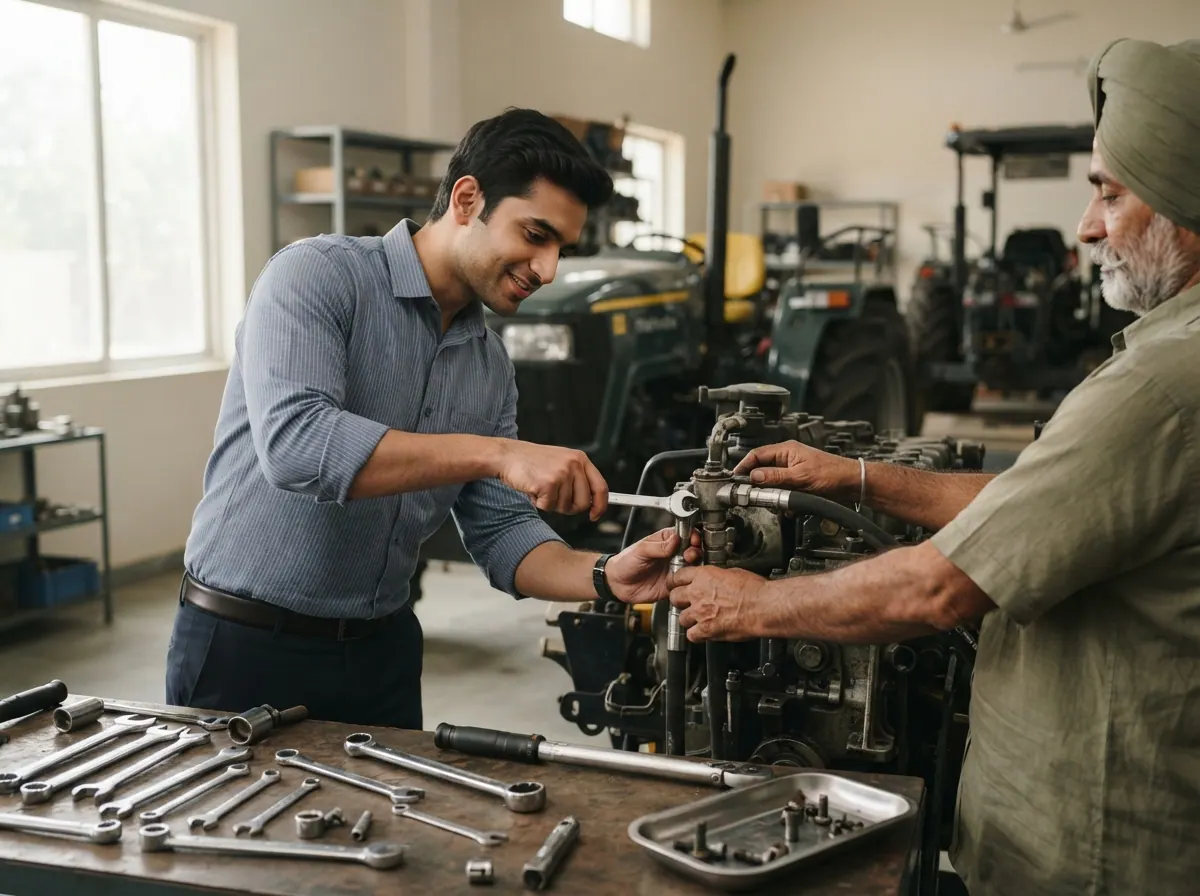
A tractor rental business means you own a tractor and implements, and farmers pay you by the hour or acre to plough, level, sow and haul. It takes from about ₹5 lakh with a used tractor and a rotavator, to about ₹11–16 lakh for a new 45–50 HP tractor with a working set. A bigger custom hiring centre can reach ₹30 lakh. The work is seasonal, and your EMI is not. The business depends on how many paying hours you can fill in a year.
All figures here are estimates. Check prices near you before you spend.
What does it cost?
| Item | Estimate |
|---|---|
| New tractor, 45–50 HP (ex-showroom) | ₹6.4–8.5 lakh |
| Rotavator | ₹1–1.25 lakh |
| Cultivator and plough | ₹40,000–70,000 |
| Seed drill | ₹50,000–75,000 |
| Trolley | ₹1.5–2.5 lakh |
| Shed, tools, spare parts kit | ₹30,000–70,000 |
| Registration, insurance, papers | ₹40,000–70,000 |
| Diesel and repair money for the first season | ₹50,000–1 lakh |
| Total | about ₹11–16 lakh |
Used tractors cost far less, but ask for the service history. Look at the hour meter, and take your own mechanic to check for oil leaks and engine smoke. Choose implements by what is grown around you. A wheat-paddy belt, a sugarcane area and a cotton area all need different machines.
How much can it earn?
Tractor work is not evenly spread, so look at busy and slack months separately. Assume a ₹10 lakh loan with an EMI of about ₹22,000, and a charge of ₹1,100 an hour with diesel at about 4.5 litres an hour × ₹95 = ₹428 an hour. Rates differ by place. One district in Himachal fixed ₹1,200 an hour in December 2025, and plains rates are likely lower, so check what owners near you charge. Studies put total tractor use at about 500–1,080 hours a year, and much of it is often the owner's own farm. This example uses about 810 paid hours.
A busy month (120 hours)
- Income: 120 × ₹1,100 = ₹1,32,000
- Diesel: 120 × ₹428 = ₹51,360
- Repairs and wear: 120 × ₹100 = ₹12,000
- Driver = ₹16,000
- EMI = ₹22,000
- Insurance and small costs = ₹3,000
- Total costs = ₹1,04,360
- Left over: ₹1,32,000 − ₹1,04,360 = ₹27,640
A slack month (30 hours)
- Income: 30 × ₹1,100 = ₹33,000
- Diesel ₹12,840 + repairs ₹3,000 + driver ₹16,000 + EMI ₹22,000 + small costs ₹3,000 = ₹56,840
- Left over: ₹33,000 − ₹56,840 = −₹23,840
Over a year (5 busy months, 7 slack)
- 5 × ₹27,640 = ₹1,38,200
- 7 × −₹23,840 = −₹1,66,880
- Total: about −₹28,700 a year
With a hired driver this loses money. Look at what changes it. If you drive yourself, you keep the driver's ₹16,000 × 12 = ₹1,92,000, so the year comes to about ₹1.6 lakh, or about ₹13,600 a month. Part of your EMI also builds ownership of the machine, and once the loan ends, the cash improves a lot. Slack-month work matters most of all. Each extra hour brings in about ₹570 after diesel and repairs.
What do you need before you start?
- A list of real bookings. Before buying, talk to 15–20 farmers within a short drive. Ask what they pay today, who ploughs for them, and whether they get a tractor on time. If nobody waits, your area may have enough tractors.
- A crop calendar. Sowing windows are short, and every farmer wants a tractor in the same two weeks after rain. Know how many acres you can really cover in those days.
- A driver who can be trusted with diesel and with farmers. Your driver is your shop counter.
- Money for a bad season. Lenders still expect payment if the rains fail.
Step by step
- Choose your horsepower for your heaviest implement. A rotavator needs enough power, and a tractor too small will wear out quickly and burn more diesel.
- Get quotes from two dealers, and compare after-sales service. Mahindra, Swaraj, Sonalika, John Deere and others all have local strength. A nearby service centre matters more than a small discount.
- Choose your loan repayment. Many tractor loans can be repaid half-yearly, in line with harvests. Compare this against monthly payments, and read the total interest.
- Fit an hour meter you trust, and write down a job slip for every booking: farmer, field, hours, diesel, amount paid.
- Fix your rates by looking at local rates and your diesel cost. Write them down and share them.
- Plan your slack months with work you are allowed to do, such as field levelling, threshing and farm haulage.
- Add implements only after you see the demand. Farmers often ask for a laser leveller, thresher or super seeder, but ask how many days a year you would use one before you buy it.
- Service on the hour schedule, before peak season rather than during it.
Which licences and schemes apply?
- RTO registration for tractor and trolley. Agricultural and commercial use are treated differently, so tell the RTO exactly what work you plan. Some states have begun drives against farm-registered trolleys carrying goods for hire, and fines up to ₹1 lakh are reported for commercial use without registration.
- Driving licence for your driver, valid for the vehicle class.
- Insurance, at least third-party, and check whether it covers paid hire and implements.
- Custom hiring centre support. The Sub-Mission on Agricultural Mechanisation has supported custom hiring centres and farm machinery banks, usually through state agriculture departments. Rules and amounts change, and some schemes favour groups or require a list of machines. Confirm with your district agriculture office, and do not buy machines before asking, because some schemes may require you to apply first.
- Tax. Ask a CA how your hire income and loan interest are treated.
What goes wrong?
- Pay-after-harvest credit. Most farmers ask for it, and then a poor crop or a family wedding comes first. Some of your diesel money ends up as old debts.
- Breakdown at peak season. A clutch failure in the sowing week loses bookings that will not come back. Farmers will not wait, because their window will not wait.
- Two farmers, one day. Choosing the bigger job over the one who booked first costs you trust in a village where everyone talks.
- Stones in the field. Rotavator blades break, and owners and farmers argue over who pays. Agree on this before the work starts.
- Diesel going missing. Without job slips and hour readings, you cannot tell a thirsty engine from a dishonest log.
- Hauling without the right papers. Off-season brick or sand work looks like easy money until there is an accident or a check, and the insurer questions your cover.
- Buying a costly machine because one farmer asked. A machine sitting in the shed for ten months still needs paying for.
Situations you will face
What would you do? Each choice costs something.
Getting started
The 50 HP runs a rotavator all day and costs lakhs more. The 35 HP suits small plots but struggles on hard land.
- Buy the 50 HP: Bigger loan, heavier jobs
- Buy the 35 HP: Saves money, misses big work
A five-year-old tractor costs far less than new. The seller has no full service records, and the meter may not be honest.
- Buy new from the dealer: Big EMI, warranty and service
- Buy the used tractor: Saves money, breakdown risk
You can afford one main implement this season. Farmers here ask about rotavators, but many still use cultivators.
- Buy the rotavator: Costs more, higher hourly rate
- Buy cultivator and plough: Cheaper, plainer work
The agriculture office says a hiring-centre scheme may apply, and to ask before buying any machine. Sowing starts in six weeks.
- Apply and wait: Fees and delay, possible support
- Buy now without it: Full price, ready for sowing
You plan some paid hauling in the slack months. An agent says agricultural registration is enough, but the RTO office is not so sure.
- Register for commercial use: Costs more, hauling allowed
- Farm work only: Cheaper, no hauling income
The lender offers payments after each harvest. Your income comes in the same way, but the total interest is higher.
- Pay monthly: Tight in slack months, less interest
- Pay half-yearly: Breathing room, more interest
You could manage bookings and diesel while a driver works. A driver also has to be paid in the slack months.
- Hire a full-time driver: Monthly wage, more hours worked
- Drive it yourself: Saves wage, fewer bookings
First month
A well-known farmer wants rotavating now and promises money after the crop. Your diesel has to be paid for today.
- Agree to harvest credit: Diesel from your pocket, goodwill
- Ask for cash today: Money safe, farmer annoyed
Farmers want a per-acre rate they understand. Your hard, dry fields take much longer, and you lose on them.
- Charge per acre: Easy to sell, loses on hard land
- Fit a meter, charge hourly: Costs money, fair on hard land
A farmer's field had hidden stones and four blades are gone. The farmer says this is your cost.
- Charge the farmer: Recover money, a sour neighbour
- Absorb the cost: Lose money, keep their trust
Your hourly rate was fixed before the price went up. Other owners are waiting to see who moves first.
- Raise the hourly rate: Protects margin, some leave
- Hold the rate: Thin margin, farmers stay
Soil moisture is right for only a few days. A 20-acre farmer offers more money, but a small farmer booked first.
- Keep the first booking: Smaller job, keeps your word
- Take the bigger job: More money, village talks
Your driver's slips show far more diesel than the hours explain. It may be the engine, or it may be something else.
- Fit a tank lock and logs: Stops the loss, driver feels distrusted
- Give only a warning: Driver stays, losses may go on
Running it
Everyone wants puddling for transplanting, and it pays well. Working in water wears out seals and bearings quickly.
- Take all the puddling: Big money, machine wears out
- Skip it this season: Lose the money, tractor rests
A kiln owner wants your trolley for two months. It covers your EMI, but the roads are rough and your papers need checking.
- Take the kiln work: EMI covered, more wear
- Stay with farm work: Less money, machine rested
Farmers keep asking at harvest time. You would use it only for a few weeks a year.
- Buy a thresher: Big spend, new harvest income
- Rent one in season: Lower cost, thinner margin
A laser leveller can earn well per hour, but few owners here have used one. It also needs training to run.
- Buy the leveller: Heavy cost, a rare service
- Partner with another owner: Share cost, share income
Your hour meter says service is due, but bookings are full this week. The dealer's workshop means losing a whole day.
- Service it now: Lose a day, tractor safe
- Push it past peak: Keep working, engine at risk
Someone with a new tractor in the next village is charging ₹100 less an hour. Two of your regulars called to ask.
- Match the rate: Thinner margin, regulars stay
- Hold, promise on-time work: Better margin, lose some jobs
A farmer producer group offers bookings for 200 acres at a lower rate. You get steady work, but less for the same hours.
- Sign with the group: Steady work, lower rate
- Keep your own customers: Better rate, uncertain hours
Wheat has to be sown soon after the paddy harvest, and farmers are asking for a super seeder. It costs a lot for one busy month.
- Buy a super seeder: Big spend, busy month paid
- Keep your present machines: Saves money, misses this work
Grip is poor in wet fields and season is near. New tyres cost a lot, and these might last one more season.
- Buy new tyres: Big bill, lasts for years
- Run them one more season: Saves now, may fail mid-season
When things go wrong
Your loaded trolley brushed a bike at dusk and the rider is hurt. The family wants money and the police are involved.
- Claim through insurance: Slow, paperwork, record clean
- Settle privately in cash: Faster, no official record
Six farmers are booked and the rain window is closing. The nearest mechanic wants double to come today.
- Pay for the urgent repair: Costly, keep your bookings
- Pass bookings to another owner: Cheaper repair, lose those jobs
A farmer owes ₹14,000 from sowing and has sold the crop. They keep saying next week.
- Ask the panchayat to help: Full money, some bad blood
- Accept half for now: Part money, peace kept
Fields are too wet for a week and your EMI is due on Friday. The driver still has to be paid.
- Borrow to pay the EMI: Interest cost, record stays clean
- Pay the EMI late: Keeps cash, late charges
You just found out the driver's licence ended months ago. Tomorrow's bookings are full, and an accident now could be a disaster.
- Stop till it is renewed: Lose bookings, papers right
- Keep working for now: Keep the income, heavy risk
Growing
You turned away work last season. A second tractor needs another driver, while more implements earn more from one machine.
- Buy a second tractor: New EMI, more jobs at once
- Add more implements: Smaller spend, one machine limit
Calls come in all day while you drive. A helper with a WhatsApp group could plan routes and cut the empty running between fields.
- Pay a booking helper: Monthly cost, better routes
- Keep taking the calls: Saves money, missed bookings
Five farmers want to pool money with you for a bigger hiring centre. You would have more machines but less control.
- Join the shared centre: Share cost, share decisions
- Stay on your own: Full control, slower growth
Is it right for you?
This works well if you farm yourself or come from a farming family, know the villages around you, can drive and do small repairs, and can stand long days during short seasons. It helps a lot if you already know who pays on time.
It suits you less if you are planning to stay away and leave it all to a driver, especially in an area where many owners already compete. Before you buy, spend one sowing season riding with a working owner and writing down their hours. That one notebook will tell you more than any dealer's brochure.