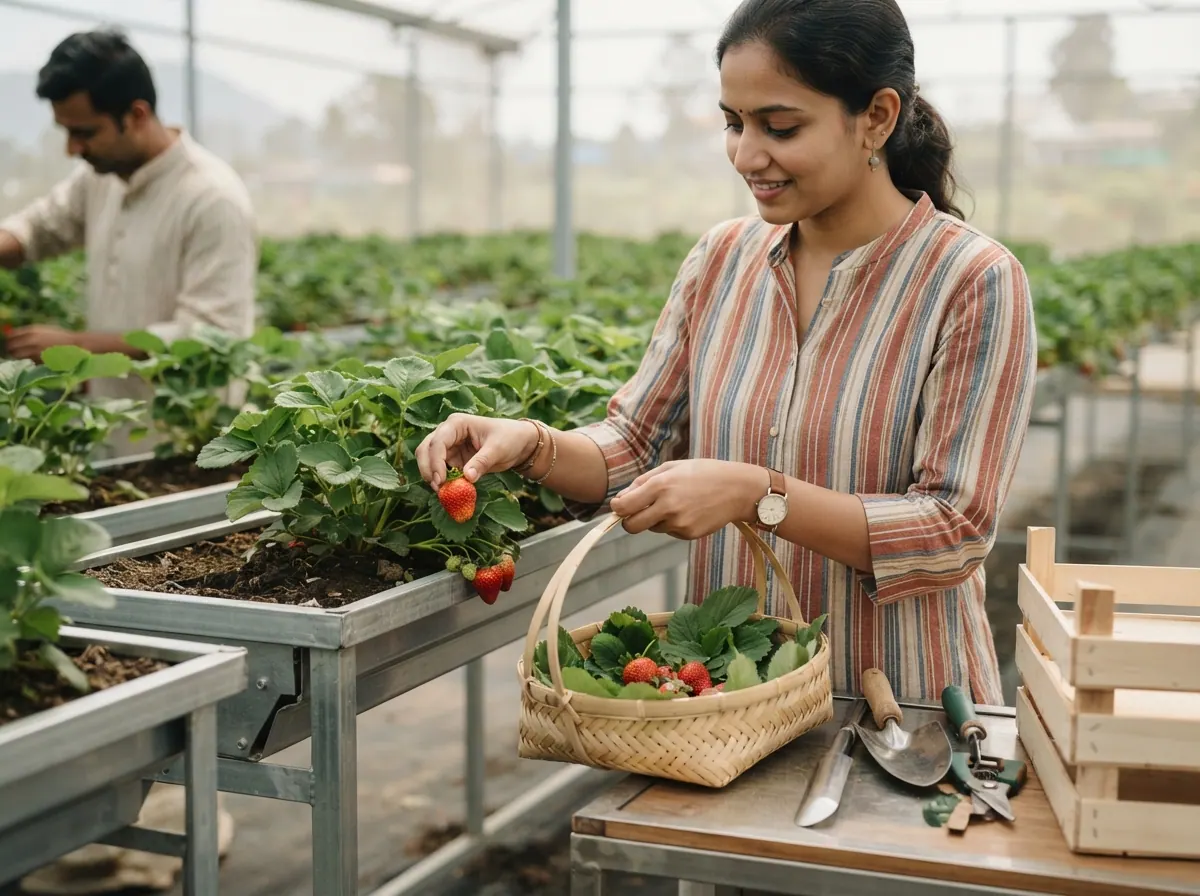
Strawberry farming in India usually costs about ₹1.8–3.3 lakh for half an acre and ₹3.3–5.8 lakh for one acre, if you have land and water. You need healthy plants from a good nursery, raised beds with plastic mulch and drip, a cool-season planting window, careful picking every other day, and a buyer for soft fruit that spoils fast. The money comes in a short harvest, about four months, and the plants are bought again every year.
All figures here are estimates. Check prices near you before you spend.
What does it cost?
| Item | Half acre | One acre |
|---|---|---|
| Plants (about 10,000 or 20,000 plants) | ₹40,000–70,000 | ₹80,000–1.4 lakh |
| Beds, plastic mulch, drip lines | ₹50,000–80,000 | ₹1–1.6 lakh |
| Manure, fertiliser, crop protection | ₹25,000–40,000 | ₹50,000–80,000 |
| Punnets, crates, small packing tools | ₹15,000–30,000 | ₹30,000–60,000 |
| Pump, tank or water connection | ₹20,000–40,000 | ₹30,000–60,000 |
| Working money for labour in the first months | ₹20,000–40,000 | ₹40,000–80,000 |
| Total | about ₹1.8–3.3 lakh | about ₹3.3–5.8 lakh |
Plants are bought every year in most farms, so plant cost is a yearly cost and not a one-time cost. Plastic mulch and drip lines may last a few seasons if handled with care.
Which variety and which season?
- Variety. Ask your nursery which variety does well in your region. Names often mentioned include Winter Dawn, Sweet Charlie, Camarosa, Nabila and Festival. Pick one your buyers like, because size, colour and firmness affect price.
- Plants from a reliable nursery. Weak or diseased runners make the whole crop fail. Ask for the source and look at the roots.
- Planting time. In the plains the usual window is in the cool season, around September to October, with fruit from about December to March. In cooler hill areas the calendar differs.
- Climate. Strawberry likes cool nights and sun. Heavy rain at fruiting and sudden heat reduce quality.
How much can it earn?
Take one acre in a good season, with the land and water already yours.
Income for the season
- Saleable fruit: about 5,000 kg from one acre, a careful estimate after losses
- Average price about ₹140 a kg across the season
- 5,000 × ₹140 = ₹7,00,000
Costs for the season
- Plants = ₹1,10,000
- Mulch and drip renewal = ₹40,000
- Manure, fertiliser, spray = ₹70,000
- Punnets and packing: 5,000 × ₹10 = ₹50,000
- Labour for beds, planting and picking = ₹2,00,000
- Transport: 5,000 × ₹5 = ₹25,000
- Water, power and repairs = ₹30,000
- Total = ₹5,25,000
Left over: ₹7,00,000 − ₹5,25,000 = about ₹1,75,000 for the season.
Spread over 12 months, that is about ₹14,600 a month. In the four harvest months, it is about ₹44,000 a month. This leaves out your own labour, so if you do the picking, the profit is higher. If the price averages ₹100 instead of ₹140, income is ₹5,00,000 and you make a loss. This is why a buyer and a steady quality matter.
What do you need before you start?
- Good drainage and clean water. Waterlogging kills strawberry roots fast.
- A buyer who values fresh fruit, such as a city fruit shop, a juice or ice cream maker, a hotel, or a direct sale to people who visit the farm.
- Cold chain, or a very short route. Fruit should be picked cool and sold the same day or the next. Without a nearby market, plan to carry it in a cool box.
- Trained pickers. Soft fruit bruises, and picking skill is a real cost.
Step by step
- Visit a working strawberry farm in your region and ask what went wrong last year.
- Test soil and water with the agriculture or horticulture office or a lab.
- Prepare raised beds with manure, lay drip lines and cover with plastic mulch.
- Order plants from a trusted nursery well before planting and plant at the right time.
- Water by drip and avoid wet leaves. Remove runners that grow where you do not want plants.
- Watch for pests and fungus, especially in wet weather, and take advice from the horticulture office before spraying.
- Pick every other day, grade by size and ripeness, and place the fruit gently in punnets.
- Sell fast and keep a record of price, quantity and what you lost.
Which licences apply?
A small farm has little paperwork compared with a shop, though it varies by state:
- Land and water permission as per your state, if you use a borewell or canal.
- Horticulture schemes. The National Horticulture Mission and state missions have supported fruit and vegetable crops. Ask your district horticulture office if strawberry or drip irrigation is covered, and do not plan around a subsidy before it is confirmed.
- Loans. Banks give crop and horticulture loans. Kisan Credit Card is one option. Confirm terms with your bank.
- Selling packed fruit or processing it into jam or juice needs food licences. Ask the food safety office.
- Tax. Ask a CA how farm income is treated when you start trading beyond the farm.
What goes wrong?
- Bad plants. A weak or diseased batch ruins the whole season.
- Rain at fruiting. Wet fruit rots, and fungus spreads fast.
- Heat in March. The fruit gets small and soft, and prices fall just as everyone else sells.
- Picking too late. Over-ripe fruit cannot travel. Pick on time even if the price is low today.
- Selling to one distant buyer. Fruit that spends a day in a hot truck loses its price and its shape.
- Copying a video's profit figure. Many videos show a yield and price from a perfect season, and leave out plant cost, labour and losses.
Situations you will face
What would you do? Each choice costs something.
Getting started
A nursery from the hills sells certified plants at a high price. A local dealer sells cheap plants with no papers.
- Buy certified plants: Costly, healthier crop
- Buy from the local dealer: Cheaper, disease risk
One variety tastes sweeter but is soft. Another is firmer and travels well but is less sweet.
- Plant the firm variety: Travels well, plainer taste
- Plant the sweet variety: Better taste, bruises easily
Drip lines cost a lot for an acre. Hand watering costs little but wets the leaves and wastes water.
- Install drip lines: Costly, healthier plants
- Water by hand: Cheaper, more fungus
Mulch film keeps fruit off the soil and stops weeds. Without it, fruit touches wet earth.
- Lay plastic mulch: Cost now, cleaner fruit
- Use straw instead: Cheaper, more weeding
It is still warm in September. Planting now gives early fruit, but the heat can kill young plants.
- Plant when nights cool: Safer plants, later fruit
- Plant now for early prices: Early fruit, plant loss risk
A fruit wholesaler in the city could take your whole harvest, but at a fixed price below the retail rate.
- Sign with the wholesaler: Sure sale, lower price
- Sell to shops and direct: Better price, more effort
A lab offers soil and water tests for a fee. The nearby farmer says it is not needed.
- Get the test done: Small fee, right fertiliser
- Skip the test: Free, guess the fertiliser
First month
Many plants droop in the afternoon sun. Shade net and extra watering will help but cost money.
- Cover with shade net: Costly, saves most plants
- Water more often: Cheaper, some plants die
Plants send out runners that take energy from fruit. Cutting them takes labour on every bed.
- Hire workers to trim: Labour cost, bigger fruit
- Leave the runners: Free, smaller fruit
You see grey mould on a few leaves after a cloudy week. The nearest shop sells a strong spray.
- Ask the horticulture officer: Time lost, right treatment
- Spray the shop's strong mix: Quick, wrong dose risk
A dealer says more fertiliser gives bigger fruit. The soil report suggests less.
- Follow the soil report: Cheaper, steady growth
- Use the dealer's dose: Costlier, soft fruit risk
Running it
New pickers pull fruit hard and drop it in baskets. Many berries are bruised by evening.
- Train pickers properly: Time and small cost
- Pay by weight picked: Faster, more bruising
A school and some city families ask if they can pick strawberries at your farm on Sundays.
- Open for farm visits: Extra work, higher price per kg
- Keep it a working farm: Simple, normal prices
Shops pay more for neat 250 g punnets than loose fruit in a crate. Punnets cost extra.
- Pack in punnets: Extra cost, better price
- Sell loose in crates: Cheaper, more bruising
Pickers say harvest work is harder than planting and want more. Other farms offer a little extra.
- Raise the picking rate: Higher cost, loyal workers
- Keep the rate: Saves money, some leave
Fruit sitting in the sun for an hour loses shelf life. A cool room or ice boxes cost money.
- Buy ice boxes: Small cost, fruit lasts longer
- Cool in the shade: Free, shorter shelf life
Another farm pays more and your pickers leave at the peak. Ripe fruit waits on the plants.
- Pay extra to bring pickers: Costly, fruit picked on time
- Pick less, sell less: Saves wages, fruit rots
Many berries are small or marked. Shops want only perfect fruit.
- Sell seconds to juice makers: Low price, nothing wasted
- Discard and keep quality: No income, shop trust
When things go wrong
Heavy rain is due for three days. You can pick everything now, even the half-ripe fruit, or wait.
- Pick early and sell cheap: Lower price, no rot
- Cover with plastic tunnel: Costly, protects ripe fruit
Everyone's fruit arrives together, and the mandi price drops by a third. You can still sell fresh or process.
- Sell to a jam maker: Lower price, nothing wasted
- Hold fruit for the next day: Spoils faster, price may rise
Your tempo stops halfway to the city with 300 kg of berries on board in the afternoon heat.
- Hire another vehicle now: Costly, fruit arrives
- Wait for the repair: Free, fruit may spoil
Tiny mites appear under leaves in the dry spell. Spraying near picking time may leave residue on fruit.
- Follow the officer's advice: Waiting period, safe fruit
- Spray and pick the next day: No waiting, residue risk
Temperatures rise earlier than usual. Fruit gets small and soft, and plants flower less.
- Add shade net and water more: Costly, saves late harvest
- End the season early: Saves cost, loses last picks
Growing
A neighbour offers one more acre for lease. It would double your crop and your risk.
- Lease and plant: Lease and plants cost money
- Stay on your plot: Safe, same income
Buying plants every year is a big cost. You could raise runners on a small plot, but it takes skill.
- Start a small nursery: Effort, lower plant cost
- Keep buying plants: Simple, higher yearly cost
Soft and small fruit goes cheap. A neighbour suggests small-batch jam for local shops.
- Start a small jam batch: Needs food licence, new income
- Sell seconds cheaply: No setup, low price
A supplier offers a low-tunnel cover that protects plants from rain and gives earlier fruit.
- Buy the tunnels: Costly, earlier fruit, less rain loss
- Stay open field: Cheaper, weather risk
The bank offers a loan on your Kisan Credit Card for inputs, but a bad season would make repayment hard.
- Take a small loan: Eases cash, adds interest
- Use only your savings: No interest, tight cash
Customers in town ask for fruit by phone and WhatsApp. Home delivery takes a driver and time.
- Start direct delivery: Better price, extra effort
- Stay with the mandi: Easy, lower price
A buyer asks for bills and your records are on scraps of paper. A CA can set up a simple register.
- Set up proper records: Small fee, clear profit view
- Keep scraps of paper: Free, no clear picture
Is it right for you?
Strawberry farming suits you if you have good water, a market you can reach quickly, and can be in the field daily for four months. It suits you less if you cannot bear a loss in a bad year, or if your nearest buyer is many hours away.
A good test: start with a quarter of an acre in your first year. If you can pick, pack and sell all of it at a fair price, expand next year with what you learned.