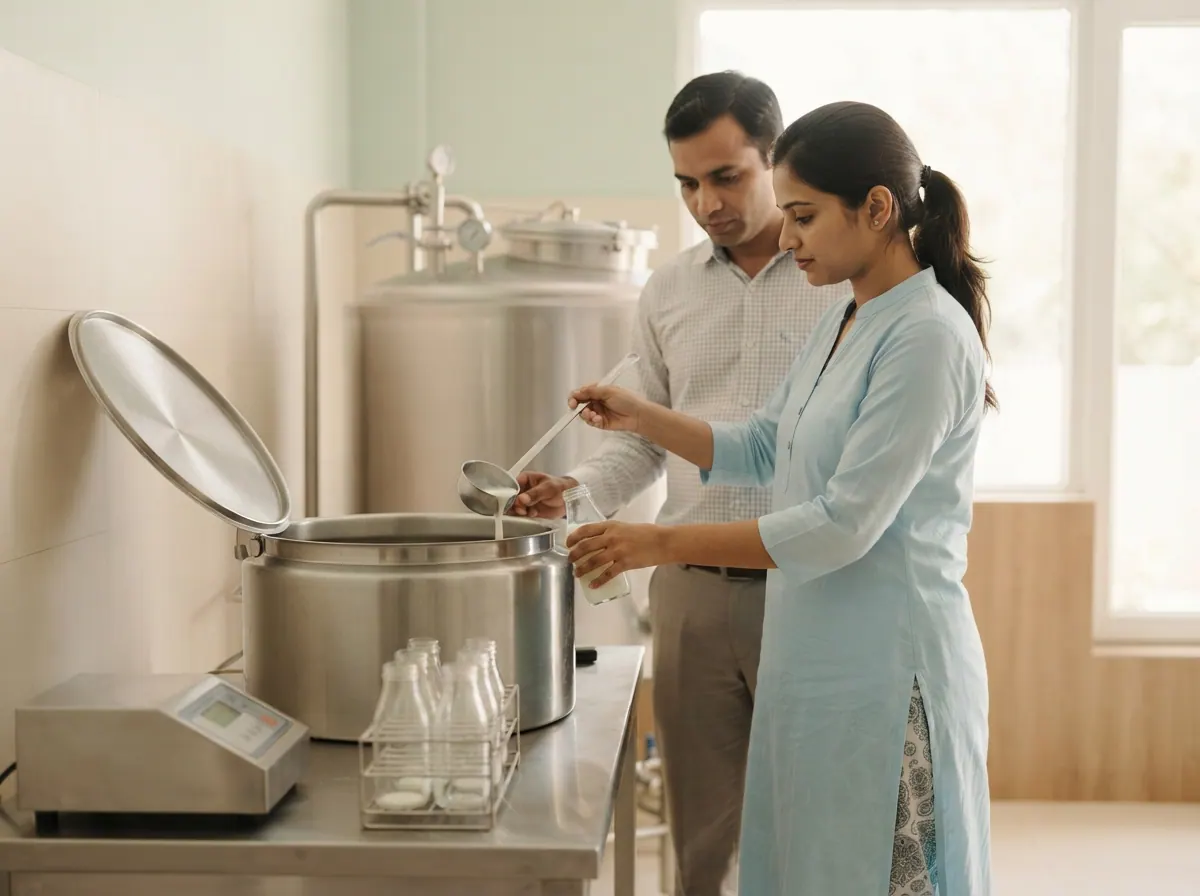
A basic milk collection centre in India can start at about ₹1–2.3 lakh, and one with a 1,000-litre bulk milk cooler costs about ₹5.5–11 lakh. You need a clean room near farmers, a milk analyser and weighing scale, cans, a tie-up with a dairy that will send a tanker or van, working money to pay farmers before the dairy pays you, and enough milk every day. Your earning is a small amount per litre, so the business depends on volume and on saving every litre from going bad.
All figures here are estimates. Check prices near you before you spend.
What does it cost?
| Item | Basic centre, no chiller | With 1,000-litre bulk cooler |
|---|---|---|
| Shed, floor and drain | ₹30,000–60,000 | ₹60,000–1.2 lakh |
| Bulk milk cooler (1,000 litres) | – | ₹3–5 lakh |
| Milk analyser, weighing scale, computer or billing unit | ₹30,000–80,000 | ₹50,000–1.2 lakh |
| Generator or inverter backup | – | ₹40,000–1 lakh |
| Cans, strainers, testing kit | ₹10,000–20,000 | ₹15,000–30,000 |
| Table, register, small furniture | ₹5,000–10,000 | ₹10,000–20,000 |
| Working money to pay farmers | ₹30,000–60,000 | ₹1–2 lakh |
| Total | about ₹1–2.3 lakh | about ₹5.5–11 lakh |
A bulk cooler is the big item, and many dairies have their own preferred makes or even supply the cooler under an agreement. Ask the dairy before you buy.
How does a collection centre work?
- Morning and evening collection. Farmers bring milk twice a day. You weigh it, test fat and SNF, and record it against each farmer.
- Rejection and cleaning. Sour or watered milk is rejected. Cans and equipment must be washed after every round.
- Chilling. In a bulk cooler centre the milk is cooled to a low temperature within hours, so it can wait for the tanker. A basic centre sends milk on the next van quickly instead.
- Dispatch. The dairy collects milk by van or tanker at fixed times.
- Farmer payment. Farmers are paid by fat and SNF on a fixed cycle, often every ten days or fortnight. Your records must match theirs.
How much can it earn?
Take a bulk cooler centre that collects about 1,000 litres a day, with a margin of about ₹1.8 per litre.
Monthly income
- 1,000 litres × 30 days = 30,000 litres
- 30,000 × ₹1.8 = ₹54,000
Monthly costs
- Operator and tester = ₹10,000
- Helper = ₹6,000
- Power for the cooler, plus diesel for cuts = ₹6,000
- Shed rent = ₹4,000
- Cleaning chemicals, test supplies = ₹3,000
- Interest on working money, about ₹3.5 lakh at 12% = ₹3,500
- Other costs = ₹2,000
- Total = ₹34,500
Left over: ₹54,000 − ₹34,500 = about ₹19,500 a month, before any loan instalment on the cooler.
If you also repay a ₹4 lakh loan over five years at about 12%, the instalment is around ₹9,000 a month, which leaves roughly ₹10,500. If milk falls to 600 litres a day in summer, income falls to ₹32,400 and the centre loses money. One spoiled tanker of 1,000 litres at ₹35 a litre costs ₹35,000, nearly two months of profit.
What do you need before you start?
- Enough farmers and animals close by, who are ready to bring you milk twice a day all year, including summer when milk is low.
- A dairy tie-up, with its price, testing method, payment cycle and pickup times in writing.
- Reliable power or a backup, because a bulk cooler without power is only an expensive tank.
- An honest tester. Farmers watch the fat reading closely, and one disputed reading can lose you a whole village.
- Working money. You pay farmers before the dairy pays you.
Step by step
- Count the milk. Walk the villages, list farmers and animals, and ask how much each sells and to whom.
- Talk to the dairy's procurement office. Ask what centres they accept, their rate, test method, margin and payment days.
- Choose the site near a road a tanker can use, with water, drainage and power.
- Set up the room with a washable floor, a platform for cans, and clean water.
- Buy the equipment from a supplier who will also train your tester and service the machine.
- Test with a few farmers first, and show the fat readings to them openly.
- Keep daily records of litres, fat, SNF, rejections and payments, and reconcile with the dairy's slips every cycle.
- Clean everything after each shift and check the cooler temperature.
Which licences apply?
Rules vary by state, so confirm with the dairy and local offices:
- FSSAI registration or licence for handling and chilling milk. Ask the food safety office which one fits your size.
- Dairy or cooperative approval if you work with a particular dairy.
- Panchayat or local permission for the shed.
- Electricity connection at the right tariff for a cooler.
- Weighing scale and measure checks. Ask the legal metrology office about checking and stamping your scale.
- Udyam and GST. Ask a CA how your commission is treated.
- Loans and schemes. Some dairy and animal husbandry schemes have supported chilling equipment. Confirm with your dairy and district office before you plan around any support.
What goes wrong?
- Milk turns sour before chilling. A delay of a few hours in summer can spoil a lot. Cool quickly and send on time.
- Farmer disputes about fat readings. A doubtful machine or a hurried tester damages trust. Calibrate and show readings.
- Farmers leave for a better price. A private buyer pays a rupee more for a week, and your volume falls.
- Tanker does not come. If pickup is late and milk waits, loss is yours or the dairy's, so settle that in writing.
- Late payment from the dairy. You pay farmers every ten days and the dairy pays later, so money runs short.
- Adulterated milk. Water, detergent or other additions must be rejected, and farmers must hear why.
Situations you will face
What would you do? Each choice costs something.
Getting started
A cooler costs several lakh but keeps milk safe for hours. A basic centre is cheap but depends on a quick van.
- Buy a 1,000-litre cooler: Costly, milk stays fresh
- Start with a basic centre: Cheap, spoilage risk in summer
The dairy's officer promises a good margin and a daily pickup, but nothing is written down.
- Ask for terms in writing: Takes time, clear margin
- Start on the officer's word: Faster, later disputes
A cheap analyser reads fat roughly. A better one costs more and farmers trust its readings.
- Buy the better analyser: Costlier, fewer disputes
- Buy the cheap one: Saves money, arguments likely
A site on the road suits the tanker. A site inside the village is easier for farmers on foot.
- Rent the roadside shed: Higher rent, easy pickup
- Use a village room: Cheaper, hard for the van
The local private buyer pays cash at once. You can only pay after the dairy's cycle.
- Pay farmers weekly from savings: Cash tied up, farmers join
- Stick to the dairy cycle: Safe cash, fewer farmers
Power goes for hours in your village. A cooler without backup warms up and spoils milk.
- Buy a generator: Costly, milk stays cold
- Rely on the grid: Saves money, big spoilage risk
The dairy officer asks if your centre is registered. The office says it takes two weeks.
- Register before opening: Fee and delay, clean papers
- Apply for temporary registration: Small fee, opens a little later
First month
A farmer shouts that the buffalo milk gave a low fat reading. Others are watching.
- Retest in front of everyone: Takes time, builds trust
- Stand by the reading: Quick, the farmer may leave
A regular farmer's can reads thin and low. The farmer swears nothing was added.
- Reject and explain: Lose the litres, keep standards
- Test it, accept only if clean: Costs a test, safe milk only
One farmer brought milk that has turned. If mixed with the rest it can spoil the whole batch.
- Reject that can: Lose a little, protect the batch
- Pay half, send it apart: Costs more, handled apart
Your helper says washing every can with hot water slows the morning round and adds fuel cost.
- Wash every can properly: Time and fuel, clean milk
- Wash with warm water, quickly: Less fuel, cans still clean
Running it
An inspector checks your weighing scale. It has not been verified and stamped this year.
- Get it verified now: Fee, clean record
- Book verification, use a verified scale: Fee, a day of delay
Your register shows 180 litres more than the dairy credited last cycle.
- Audit your records fully: Costs a day, finds the cause
- Accept the dairy's figure: Quick, you lose the money
The tester who runs the analyser says another centre has offered a better salary.
- Raise the tester's pay: Higher cost, trusted tester
- Train a new person: Cheaper, mistakes at first
The dairy suggests a quick test kit for adulteration. Farmers may feel you are accusing them.
- Test every day with the kit: Kit cost, safer milk
- Test only when in doubt: Cheaper, miss some cases
Sweet makers want much more milk for a week and will pay a higher rate to your farmers directly.
- Supply sweet makers too: Better price, dairy upset
- Keep to the dairy: Steady, lose the extra
When things go wrong
Temperatures climb and the van is two hours late. Milk is warming in the cans.
- Chill with ice and send early: Ice cost, milk saved
- Shade the milk, call another van: Small cost, milk protected
The dairy tanker breaks down and will not reach you until tomorrow. The cooler is full.
- Arrange a private tempo: Costly, milk reaches the dairy
- Hold on ice, test before sending: Ice cost, tested milk only
A private dairy agent pays two rupees more per litre for a month to take away your farmers.
- Match with a small bonus: Cuts margin, keeps farmers
- Hold your rate: Margin kept, some leave
The dairy's payment is late by two weeks. Farmers expect their money on the usual day.
- Pay farmers from savings: Cash drained, trust kept
- Ask farmers to wait: Keep cash, trust drops
The bulk cooler's temperature reading rises overnight. A technician is two hours away.
- Call the technician at once: Visit fee, milk protected
- Move milk to ice, call tomorrow: Ice cost, milk protected
Cows in a nearby village are sick. Their milk is not fit to collect and farmers are worried.
- Stop collecting that milk: Lose litres, protect others
- Collect only from healthy herds: Extra checks, fewer litres
Growing
Farmers ask you to stock cattle feed and mineral mix. It brings more visits but ties up money.
- Stock feed and minerals: Cash tied up, loyal farmers
- Stay with milk only: Simple, no extra income
A vet offers to hold a health camp at your centre. You would pay for tents and tea.
- Host the camp: Small cost, farmer goodwill
- Skip the camp: No cost, no goodwill
Farmers in the next village ask you to open a second collection point. It means a new room and tester.
- Open a second point: Costly, more litres
- Collect their milk by van: Cheaper, more spoilage risk
In winter milk flows more and your cooler overflows. A bigger cooler costs a lot.
- Buy a 2,000-litre cooler: Costly, room to grow
- Send milk to dairy twice daily: Higher van cost, no big spend
A company offers rooftop solar for your cooler. It costs a lot but could lower your bill.
- Install solar: Costly, lower bills later
- Keep paying the bill: No spend, bills stay
A supplier offers an electronic unit that prints slips and records every farmer's milk automatically.
- Buy the unit: Costly, fewer disputes
- Keep the manual register: Cheap, slow and error-prone
A bank offers a loan to upgrade your equipment, but your margins are thin in summer months.
- Take the loan: Upgrade now, instalments
- Upgrade slowly from profit: Safer, slower
Your accountant says your commission may need registration as turnover grows.
- Ask a CA, register if needed: CA fee, clean books
- Track turnover, register at limit: Free, a notice is unlikely
Is it right for you?
A milk collection centre suits you if you live in a milk-producing area, know many farmers, can be at the centre morning and evening, and keep honest records. It suits you less if your area has few animals or if you want an easy income without early starts.
A good test: before you buy a cooler, sit at a village collection point for two weeks with the dairy's tester and count the litres. If the daily milk is well below your break-even, start smaller or look at a nearby village.