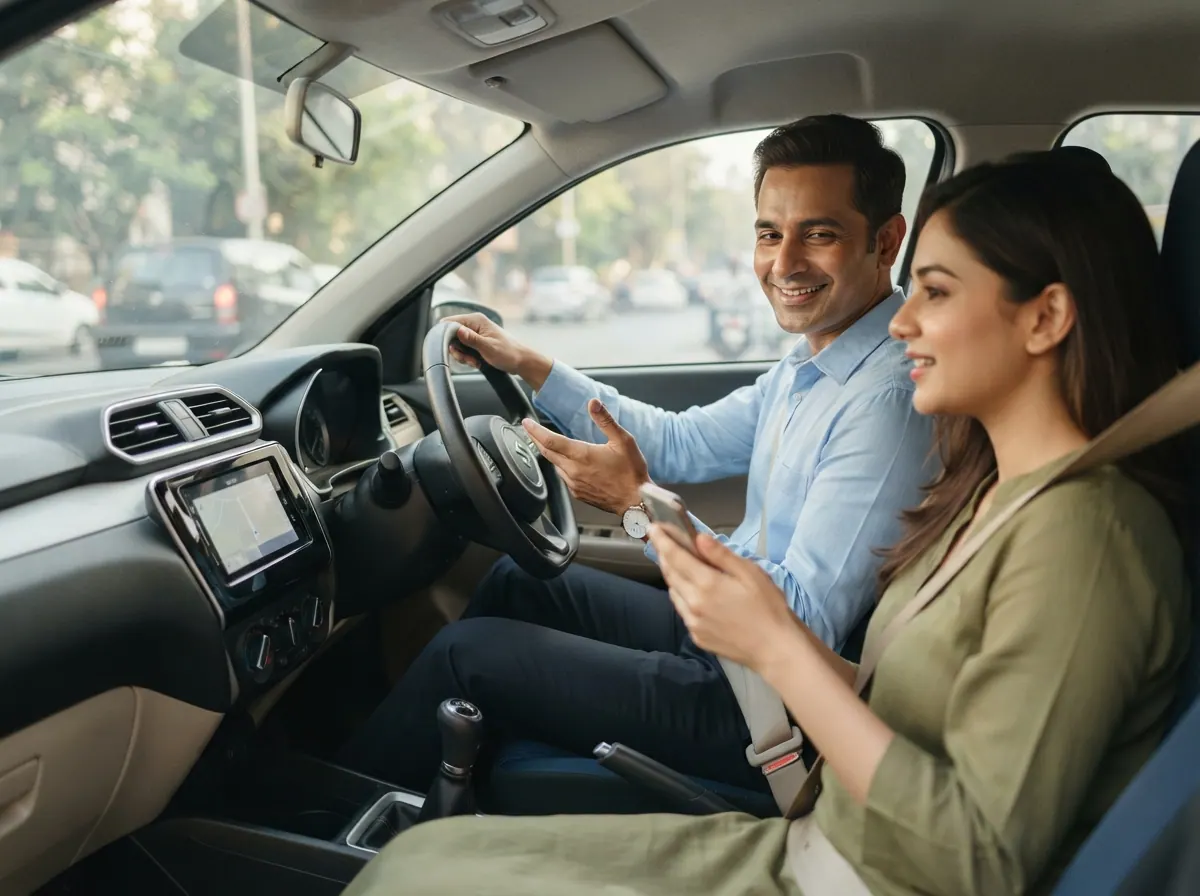
A taxi business means you own a car registered for hire, and earn per kilometre or per trip from ride apps, direct customers or both. One cab costs about ₹6–12 lakh, and an owner who drives it can take home about ₹18,000 to ₹39,000 a month depending on how you count the loan. It is a job with a car attached, not a passive investment, and the hours decide everything.
All figures here are estimates. Check prices near you before you spend.
What does it cost?
For one cab, a CNG sedan used in a city:
| Item | Estimate |
|---|---|
| Car (new CNG hatchback about ₹7 lakh, new sedan ₹8.2–8.9 lakh on road, or a used one) | ₹4.7–8.9 lakh |
| CNG kit, if the car does not have one | ₹40,000–60,000 |
| Commercial registration, permit, fitness | ₹15,000–30,000 |
| Commercial insurance, first year | ₹30,000–50,000 |
| Seat covers, phone holder, GPS, uniform | ₹10,000–20,000 |
| Driver badge, police verification papers | ₹5,000–10,000 |
| Working money for fuel and first month | ₹40,000–80,000 |
| Total | about ₹6.1–11.4 lakh |
Most owners pay ₹1.5–2 lakh down and borrow the rest. Dealers and banks have commercial vehicle loans, and some will ask for a permit or a platform onboarding letter. Choose a car with a service centre near you and a good boot for airport luggage.
How much can it earn?
Assume a CNG cab in a city, 26 working days, 200 km a day of which 160 km is paid, and ₹18 a paid kilometre on an app. Notified city rates are ₹22–24 a kilometre, but app fares run lower. The platform takes about 20%, which is an assumption (the 2025 aggregator rules say you keep at least 80%, and some apps charged 25%), so check the current rate. CNG costs about ₹4 a kilometre.
One owner-driven month
- Fares: 160 km × ₹18 = ₹2,880 a day
- Platform cut: 20% = ₹576
- CNG: 200 km × ₹4 = ₹800
- Cash a day: ₹2,880 − ₹576 − ₹800 = ₹1,504
- Cash a month: ₹1,504 × 26 = ₹39,104
Fixed costs each month, on a ₹6 lakh loan
- EMI = ₹13,000
- Commercial insurance and permit spread over a year = ₹4,000
- Service, tyres, wash = ₹3,000
- Parking, challans and small costs = ₹1,000
- Total: ₹21,000
What is left
- Owner who drives: ₹39,104 − ₹21,000 = ₹18,104 on top of the driving
- With a hired driver at ₹25,000: ₹18,104 − ₹25,000 = −₹6,896
Read the first number correctly: you are paid for your own driving through the ₹39,104, so ₹18,104 is just what the car adds after EMI. If the EMI ends in five years, ₹13,000 a month comes back. If you add airport pickups, office contracts and outstation trips that pay by the day, your per-kilometre earnings go up. The cab with a hired driver only works when you have steady, well-paid trips.
What do you need before you start?
- A driving licence for the vehicle class, and the badge or papers your state asks of a commercial driver.
- A clean record. Many apps ask for police verification and a vehicle check.
- A phone with enough data and a good mount. Navigation and ride requests run all day.
- A savings cushion. Repairs, a missed month and the first insurance bill arrive before the first profit.
- A plan for hours. Know which hours pay in your city: the morning office rush, airport runs, evenings.
Step by step
- Spend a week as a passenger, or ride with a working driver, and count how many paid kilometres they get against empty ones.
- Choose the car for running cost, not the badge. CNG or diesel usually costs less per kilometre than petrol for heavy use.
- Check the permit and registration rules with your RTO before you pay the dealer. Ask what plate, permit and fitness papers the car needs for hire.
- Compare two or three loan offers by total interest paid, not just the EMI.
- Fit a dashcam and keep a trip book, noting every trip, fuel fill and expense.
- Sign up for one app first, and look at your real earnings per hour. Then add direct customers.
- Build a list of direct callers: hotels, offices, wedding families, the nearest railway or airport. Give a card to each passenger who asks.
- Service on a schedule and keep the car clean. Ratings and repeat customers depend on it.
Which licences and papers apply?
- Commercial registration of the vehicle, usually with a permit and a fitness certificate, from your RTO. The all-India tourist permit costs ₹20,000 a year for a car under five seats.
- Driving licence of the correct class, and a driver badge or similar papers if your state asks.
- Commercial insurance. A private-car policy usually does not cover paid hire, and using a private car for hire is illegal: it can be impounded, fined ₹10,000 and the insurance claim denied.
- Platform onboarding checks, including police verification, if you join an app.
- GST and income tax. Ask a CA about your platform income and how the car loan is treated.
- Airport or railway station entry often needs its own pass or booking. Ask the local office.
What goes wrong?
- Platform cuts and changing fares. You do not set the price, and a rate change can wipe out a month's profit.
- Empty running. Long waits and dead trips return nothing, and the fuel is still paid for.
- A driver who drives for themselves. A hired driver may take cash trips off the book or abuse the car.
- Accident or breakdown. A week in the garage is a week of EMI with no income.
- Challans and parking. Fines on a commercial plate add up.
- A cheap-fare war. New apps and drivers pull rates down, and old drivers work longer for less.
- Night risk. Late trips can be unsafe, and some owners stop them.
Situations you will face
What would you do? Each choice costs something.
Getting started
CNG costs far less per kilometre, but takes boot space and queues at the pump. Petrol is easier and costs more every day.
- Buy a CNG car: Cheaper running, boot space lost
- Buy a petrol car: Easier, higher fuel bills
A new compact sedan carries a bigger EMI. A used one costs less, but nobody knows how hard it was driven.
- Buy new: Large EMI, warranty and looks
- Buy used: Smaller EMI, repair risk
The dealer says you can register it as private first and change later. The RTO says hire cars need commercial papers from the start.
- Register as commercial now: Higher cost, papers right
- Register as private first: Cheaper now, cannot take hire
A larger down payment lowers the EMI. A smaller one keeps savings in hand for repairs and slow weeks.
- Pay a big down payment: Lower EMI, thin savings
- Pay the minimum, borrow more: Higher EMI, cash in hand
An app gives rides on day one but takes a cut and fixes the fare. Direct customers pay better but take months to find.
- Join the app first: Rides now, lower fares
- Build direct customers: Slow start, better fares
Apps and some customers like a recording in the car. It costs money and passengers may feel watched.
- Fit dashcam and tracker: Costly, safer in disputes
- Skip it: Saves money, no proof
Airport runs pay well but mean long waits in the queue. City rides are shorter and steady, with more empty running.
- Work the airport queue: Big fares, long waits
- Stay with city rides: Steady, smaller fares
First month
A request comes at midnight from a lonely stretch. It pays double, but you are tired and the road is dark.
- Take the ride: Double fare, real risk
- Decline politely: Safe, no extra income
A few passengers marked you low because you took a wrong turn. The app may send you fewer rides.
- Offer water, mints, a clean car: Small spend, ratings climb
- Ignore it: No cost, fewer rides
A passenger argues the meter fare is too high after a detour caused by traffic. You have no way to prove it.
- Accept the lower fare: Lose money, keep the peace
- Insist on the full fare: Keep money, bad rating likely
You waited at a station for a fare and fuel was spent. Other drivers are moving to a busier spot across town.
- Move to the busier spot: Fuel used, better chance
- Keep waiting: Saves fuel, rides uncertain
A small hotel wants you on call for its guests at a fixed rate. The rate is a little below app fares.
- Accept the tie-up: Steady trips, lower rate
- Stay free to choose rides: Higher fares, uncertain
You stopped where a no-parking board was hidden by a tree. The fine is ₹1,000 on your commercial plate.
- Pay the fine at once: Costs money, record clean
- Ignore until later: Cash saved, fine grows
Running it
The app lowered its per-kilometre rate and raised its cut. Your daily cash is lower for the same hours.
- Drive longer hours: Make up money, tired and risky
- Shift to direct customers: Effort now, better rates
A wedding family wants the car for four days at a fixed daily rate. The days are long, and other rides would be missed.
- Take the wedding booking: Big money, no app rides
- Stay with regular rides: Smaller steady income
A family wants a two-day trip to a hill station. You earn more per day, but tolls, parking and wear come from your pocket.
- Quote a fair outstation rate: Good money, long drive
- Quote low to win it: Win the trip, thin profit
The car has run 90,000 km and the mechanic says tyres and brake pads are almost gone. A cheap local set is also on offer.
- Fit good branded tyres and pads: Big bill, safe for years
- Fit cheap local ones: Smaller bill, wears faster
A comprehensive policy for a commercial car costs more than third-party only. An agent offers the cheaper one.
- Take comprehensive cover: Higher premium, protected
- Third-party only: Cheaper, your car unprotected
A small company offers a monthly contract for staff pickups at a fixed price. It is steady money but lower per kilometre.
- Sign the contract: Steady money, limited hours
- Stay on open rides: Freedom, uncertain income
Several riders mentioned a smell and sticky seats. A proper interior wash costs more than the usual outside rinse.
- Deep clean every month: Small cost, better ratings
- Keep rinsing outside: Cheap, ratings slip
Your cousin offers to drive the night shift for a share of the fare. You would rest, but trust is the issue.
- Let cousin drive nights: More hours worked, trust risk
- Drive all shifts yourself: No wage paid, tired
When things go wrong
An auto-rickshaw touched your car's side in traffic. The driver wants cash on the spot, and the car needs paint.
- Claim through insurance: Slow, paperwork, clean record
- Settle in cash now: Quick, costs more
A hot afternoon trip ended with steam from the bonnet. The repair shop says a week and ₹18,000, and EMI is due.
- Repair properly: Costly, a week without income
- Cheap patch and drive on: Cheaper, may fail again
A passenger claims you took a longer route and went to the police station. You have no dashcam recording.
- Cooperate, show trip records: Time lost, record clean
- Refund the whole fare: Quick end, money lost
Rain and a rail strike cut your trips by half. The lender will charge a penalty if you are late.
- Borrow to pay on time: Interest cost, record clean
- Pay the EMI late: Keep cash, penalty and record
Your hired driver's trip book shows fewer trips than the fuel suggests. A customer mentioned a cash ride.
- Fit tracker, check trips: Cost, driver feels watched
- Warn and carry on: No cost, losses may continue
Growing
You turn down trips every week. A second cab needs a driver you trust, and a second EMI whether rides come or not.
- Buy a second cab: Big EMI, more trips at once
- Keep one and raise rates: Safer, limited growth
A travel agent offers weekly airport transfers at a lower fixed rate. You get steady bookings and lose some freedom.
- Accept the agent's work: Steady trips, lower rate
- Stay independent: Better rate, uncertain
An electric cab costs little per kilometre, but charging points are few and the price is high. Some apps favour them.
- Buy an electric cab: High price, low running cost
- Stay with CNG: Known costs, no new risk
Repeat customers keep asking for your number. A printed card and WhatsApp group would bring direct bookings, but they take time.
- Print cards, run a WhatsApp group: Small cost, direct bookings grow
- Rely on the app only: No effort, no loyal base
Is it right for you?
This suits you if you can drive 10 hours a day, know your city's roads and enjoy talking to strangers politely. It helps if you can build direct customers, not just wait for an app to ping.
It suits you less if you want income without driving, or hope to own five cabs on borrowed money in your first year. Before you buy, drive or ride for a month with a working cab driver, and write down the fares, waiting time and fuel. That log shows what your owner's profit really is.