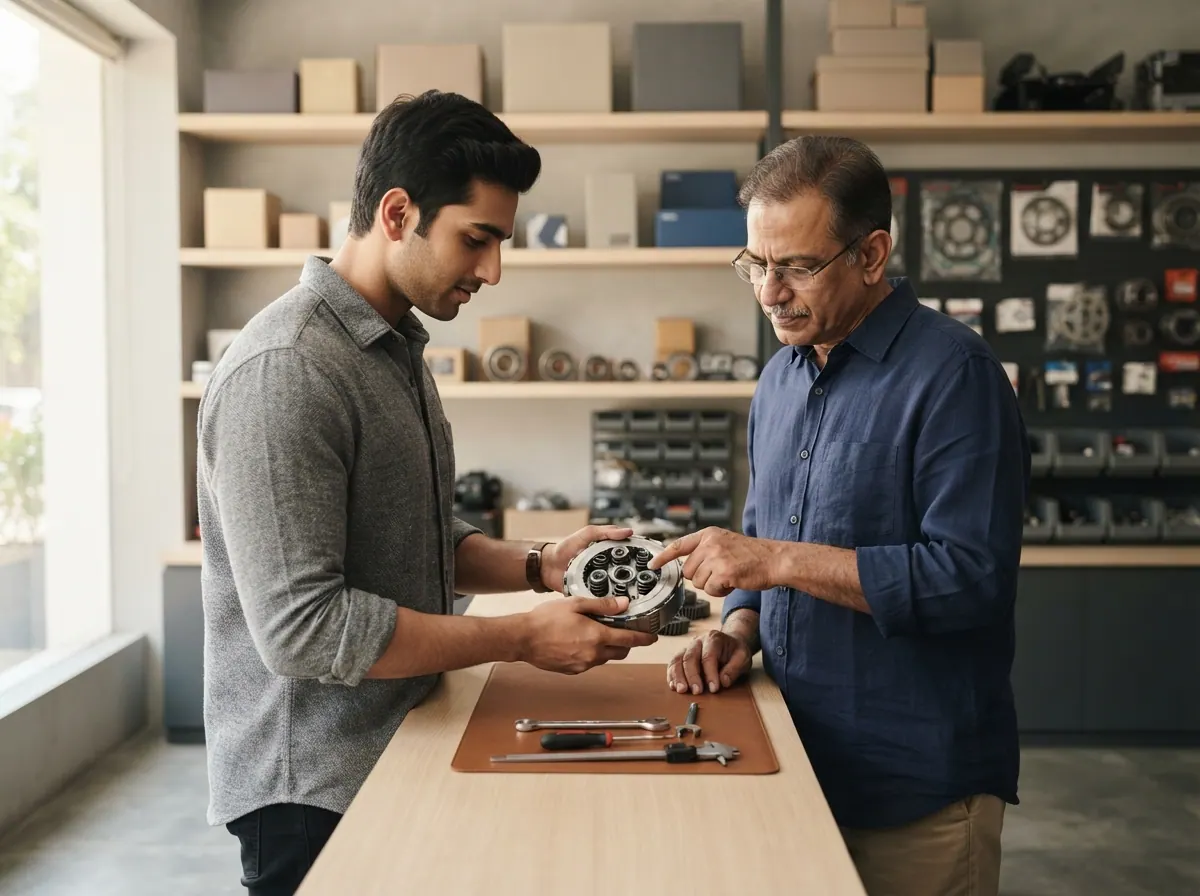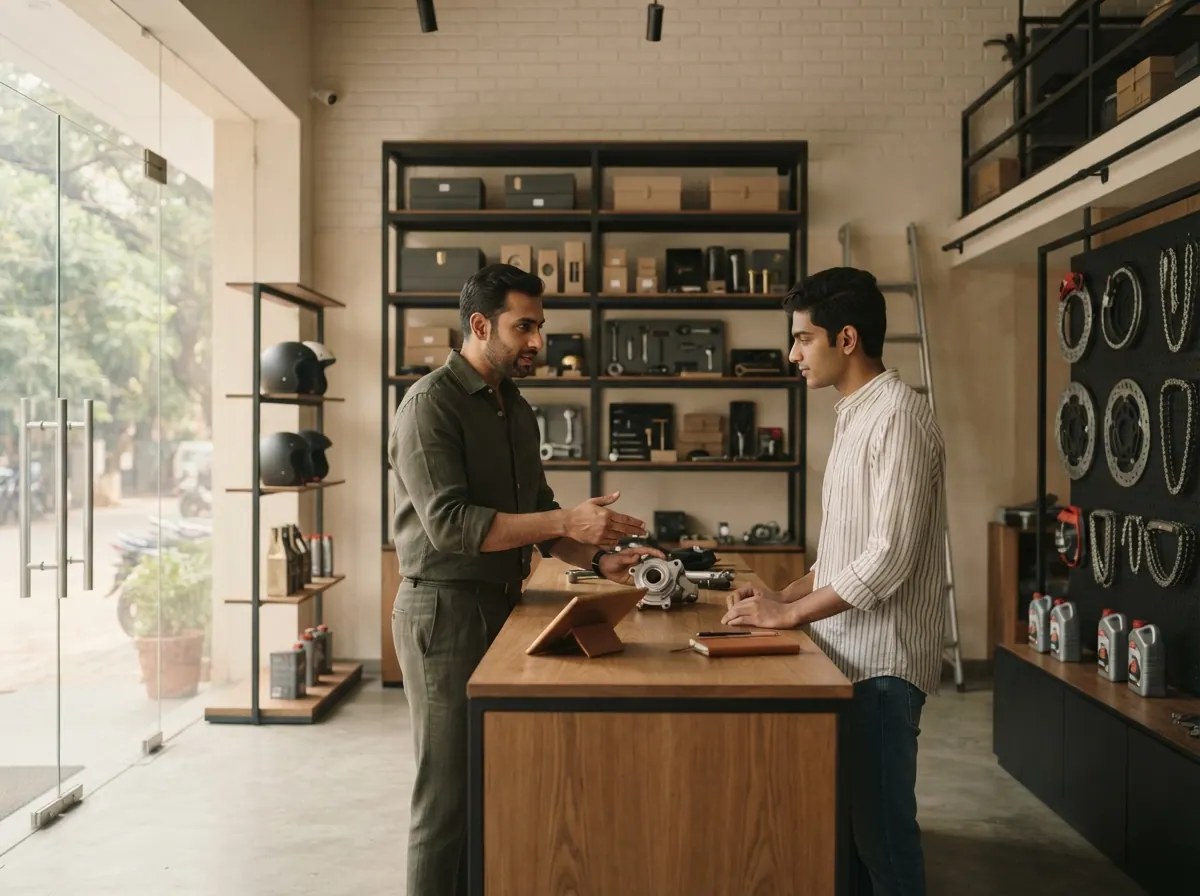
To start a spare parts shop in India you need a place near garages or a busy road, a part-number catalogue, a few distributors who give bills and credit, and about ₹3.5–4 lakh for a small two-wheeler parts shop or ₹14–15 lakh for a large one with cars, oils, batteries and tyres. Most of the money sits in stock, and your best customers are mechanics who buy daily and pay later.
All figures here are estimates. Check prices near you before you spend.
What does it cost?
| Item | Small shop (bikes) | Larger shop (bikes and cars) |
|---|---|---|
| Two-wheeler parts (filters, brake pads, chains, clutch plates, cables, bulbs) | ₹1.6 lakh | ₹5 lakh |
| Car parts (filters, pads, belts, bulbs, wipers) | ₹50,000 | ₹3 lakh |
| Engine oils and lubricants | ₹40,000 | ₹1.5 lakh |
| Tyres and batteries | — | ₹1.5 lakh |
| Racks, counter, part bins | ₹40,000 | ₹1 lakh |
| Signboard, catalogue software, billing | ₹15,000 | ₹40,000 |
| Rent advance (deposit) | ₹50,000 | ₹1.5 lakh |
| Cash kept for the first months | ₹25,000 | ₹60,000 |
| Total | about ₹3.8 lakh | about ₹14.5 lakh |
Two-wheeler parts rotate fast and need less money, so many owners begin there and add car parts later. Tyres and batteries tie up money, so add them only when your regular customers keep asking.
How much can it earn?
Here is a shop doing about ₹5 lakh of sales in a month. This is an illustration, not a promise.
Gross margin
- Sales: ₹5,00,000
- About 20% blended margin: ₹5,00,000 × 0.20 = ₹1,00,000
Costs each month
- Rent = ₹20,000
- One helper = ₹12,000
- Electricity and phone = ₹4,000
- Dead stock, returns and small bad debts = ₹10,000
- Transport and parcel charges = ₹4,000
- Total = ₹50,000
Left over: ₹1,00,000 − ₹50,000 = about ₹50,000 a month.
The usual trouble is not margin. It is credit and dead stock. If garages owe you ₹1.5 lakh and ₹40,000 of parts belongs to a bike model that has gone out of production, your cash is stuck even though sales look good.
What do you need before you start?
- A location near garages. Two-wheeler and car mechanics buy in the morning and at lunch. A shop near a garage cluster or a service road does better than a quiet lane.
- Part-number knowledge. Know the models people ride locally and learn the part numbers for common repairs.
- Distributors with bills. Ask who supplies each brand and what credit they offer.
- Credit money. Plan how much you can leave outstanding with garages.
- A way to look up parts quickly. A catalogue or software saves you from guessing, which means fewer wrong parts.
Step by step
- Spend a week near a successful parts shop and note which 80 parts move each day.
- Choose your focus: two-wheeler parts, car parts, or a local mix based on the vehicles on the road.
- Pick a shop near garages or on a busy road where people break down.
- Open accounts with 2–3 distributors, and keep the genuine and aftermarket lists separate.
- Stock fast movers first: oil filters, air filters, brake pads and shoes, clutch plates, chains and sprockets, cables, bulbs, spark plugs, batteries for popular models.
- Use a catalogue. Check the part number before you hand over the part.
- Meet local mechanics and offer fair rates on their first few orders.
How do you decide what to stock?
Begin with the vehicles on your road. Stand outside a garage for a morning and count which bikes and cars come in. In many towns that means a few popular commuter bike models and a handful of hatchback cars, so stock their filters, pads, chains, clutch plates and bulbs in depth before you stock a thin range of everything. Keep a notebook of every part you had to send a customer away for. When three customers ask for the same part, order it. Check old stock every quarter and move slow items at a discount before the model is dropped and nobody wants them.
Which licences apply?
Confirm each with your local office, as rules vary by state:
- Shop and establishment registration with the municipality or labour department.
- GST where your sales cross the limit, and for buying on tax invoices.
- Trade licence from the local body in some towns.
- Batteries and oils. If you sell old batteries or used oil, ask about rules for collection and disposal.
What goes wrong?
- Fake or low-quality brake and clutch parts. Cheap copies of branded safety parts can fail, and your name is on the bill.
- Wrong part sold. A part that does not fit leads to a return and a lost mechanic.
- Dead stock. When a company stops a model or updates it, old parts stay on your shelf.
- Credit that never returns. Garages sometimes owe for months.
- Online prices. Customers compare small parts with app prices.
- Monsoon damage. Water can rust brake discs, chains and bearings.
Situations you will face
What would you do? Each choice costs something.
Getting started
Bike parts turn over fast with small money. Car parts earn more per sale but need bigger stock and a wider catalogue.
- Start with bike parts: Lower stock, quick turns
- Add car parts from day one: Big stock, bigger bills
Genuine parts carry a company name and a thin margin. Good aftermarket brands cost less and mechanics often prefer them.
- Stock mostly genuine: Costly, trusted by owners
- Stock good aftermarket brands: Cheaper, more mechanic sales
A shop inside the garage lane has mechanics at the door but little else. A main road shop gets walk-ins and bike owners.
- Rent in the garage lane: Mechanic orders, narrow lane
- Rent on the main road: More walk-ins, high rent
A big-city parts market has more choice and lower prices, but a long trip and no easy returns.
- Make the trip, buy big: Cheaper stock, hard to return
- Use local distributors: Dearer, easier returns
Finding the right part number from thick paper books is slow. Parts software costs money and takes time to learn.
- Buy catalogue software: Cost, fewer wrong parts
- Use paper catalogues: Cheap, slower and riskier
Oil sells every service but ties up money in many grades and brands, and customers bargain hard.
- Stock three main brands: Cash locked, repeat sales
- Stock one brand only: Lower risk, limited choice
Batteries sell at good prices but warranty claims mean paperwork, delays and unhappy customers.
- Stock one trusted battery brand: Spend, claim handling needed
- Skip batteries for now: No risk, miss some sales
First month
A mechanic opened a clutch plate kit and found it does not fit the model. You looked it up in a hurry.
- Exchange and own the mistake: Small loss, trust kept
- Say they should have checked: No loss, mechanic leaves
Two mechanics say they will send customers to you if you pay them 10% on every part bill.
- Agree to 10%: More customers, margin cut
- Offer a trade discount: Cheaper, weaker pull
A customer needs a part for a less common model. Your distributor can bring it in four days.
- Order it for the customer: Wait, builds loyalty
- Send them to another shop: No cost, lose the sale
A busy garage wants ₹20,000 of parts now and will pay in 15 days, after the customers pay it.
- Give the credit: Big sale, money may be late
- Ask for half now: Safer, may go elsewhere
A customer returns a battery that has stopped holding charge. The warranty claim with the company takes weeks.
- Replace it now, claim later: Cash out now, goodwill
- Ask the customer to wait: No cost, a cross customer
A customer buying filters, plugs and oil together asks for 12% off the whole bill.
- Give 8% on the kit: Small loss, repeat buyer
- Hold the full price: Keep margin, lose them
Running it
Rain brings brake pad, wiper, bulb and chain repairs. Last year you ran out by the second week.
- Stock heavily before rains: Cash locked, ready for rush
- Stock a moderate lot: Safer, may run short
The maker stopped a popular bike model. You hold ₹40,000 of parts for it and no new buyers are coming.
- Clear stock at a discount: Loss, free your cash
- Hold for old bike owners: Cash stays locked
A large garage wants every part from you, at a trade price, and will pay on the last day of the month.
- Take the account: Big sales, slow payment
- Ask for payment every 10 days: Safer, they may refuse
Customers show you app prices for bulbs, filters and chain sets, some below your buying price.
- Match on a few popular parts: Lose margin, hold footfall
- Hold price, offer fitting advice: Keep margin, lose price hunters
A small fleet owner wants filters, pads and oil on a monthly contract. They pay after 30 days.
- Sign the contract: Steady orders, wait for money
- Supply only on payment: Safer, fewer orders
Before Diwali, riders buy mirrors, seat covers, lights and horns. Items are cheap but sell in bulk for a week.
- Stock an accessories rack: Spend, fast festival sales
- Skip accessories: No spend, quieter week
Several customers with electric scooters ask for tyres, brake pads and chargers you do not carry.
- Stock common EV parts: Spend, new customers
- Stay with petrol vehicles: No spend, miss a trend
Mechanics are too busy to come in. They ask if a boy can bring parts to their garage within minutes.
- Hire a delivery boy: Wages and fuel, more orders
- Ask them to send someone: No cost, slower service
When things go wrong
A trader offers famous-brand brake pads at half the dealer price. There is no bill, and the box printing looks slightly off.
- Refuse, stay with the distributor: Full cost, safe name
- Send a sample to the brand: Delay, a clear answer
A rider had a minor crash and says the brake pads you sold failed. Your bill and batch are on record.
- Inspect with the company, help: Time and cost, honest answer
- Deny and refuse to talk: No cost, trust damaged
A garage is two months late and says customers have not paid it. It still wants parts today.
- Stop supply until it pays: Lose the garage, protect cash
- Give a small lot on credit: More owed, garage stays
A year of slow parts for old models sits at the back. They have not moved and block space for new stock.
- Sell the lot to scrap: Loss, space for new stock
- Keep it and wait: Cash locked, shelf blocked
A flooded drain sent water over the bottom racks. Chains, discs and bearings are starting to rust.
- Oil, clean, discard the rusty ones: Costly, honest stock
- Sell the lightly rusted ones cheap: Less loss, a weak name
Small high-value parts disappear when the counter is crowded. A helper or a customer may be taking them.
- Add a camera, move small parts: Cost, fewer losses
- Warn the helper only: Free, losses may continue
Growing
Car owners ask for seat covers, mats, music systems and horns. They give better margins but need floor space.
- Add an accessories section: Spend, higher margin
- Stay with parts only: Focused, smaller bills
Small shops in nearby towns want to buy from you in bulk. They ask for a lower rate and a month to pay.
- Start wholesale with advance: Volume, wait or risk
- Stay with retail: Simple, slower growth
Mechanics send part names and photos on WhatsApp and want quick delivery. It needs a catalogue and a runner.
- Build the catalogue and delivery: Cost, wider customer base
- Keep it over the counter: No spend, no extra reach
Is it right for you?
A spare parts shop suits you if you enjoy learning model numbers, can deal firmly with mechanics, and are patient with slow money. It suits you less if you want fast cash, or if you are uncomfortable saying no to credit.
A good test: spend two weeks behind the counter of a parts shop. Watch how many customers are mechanics, how much is credit, and how often someone comes in for a part that is not in stock. If you can live with that, start with two-wheeler parts and expand into cars only when your regular customers ask.