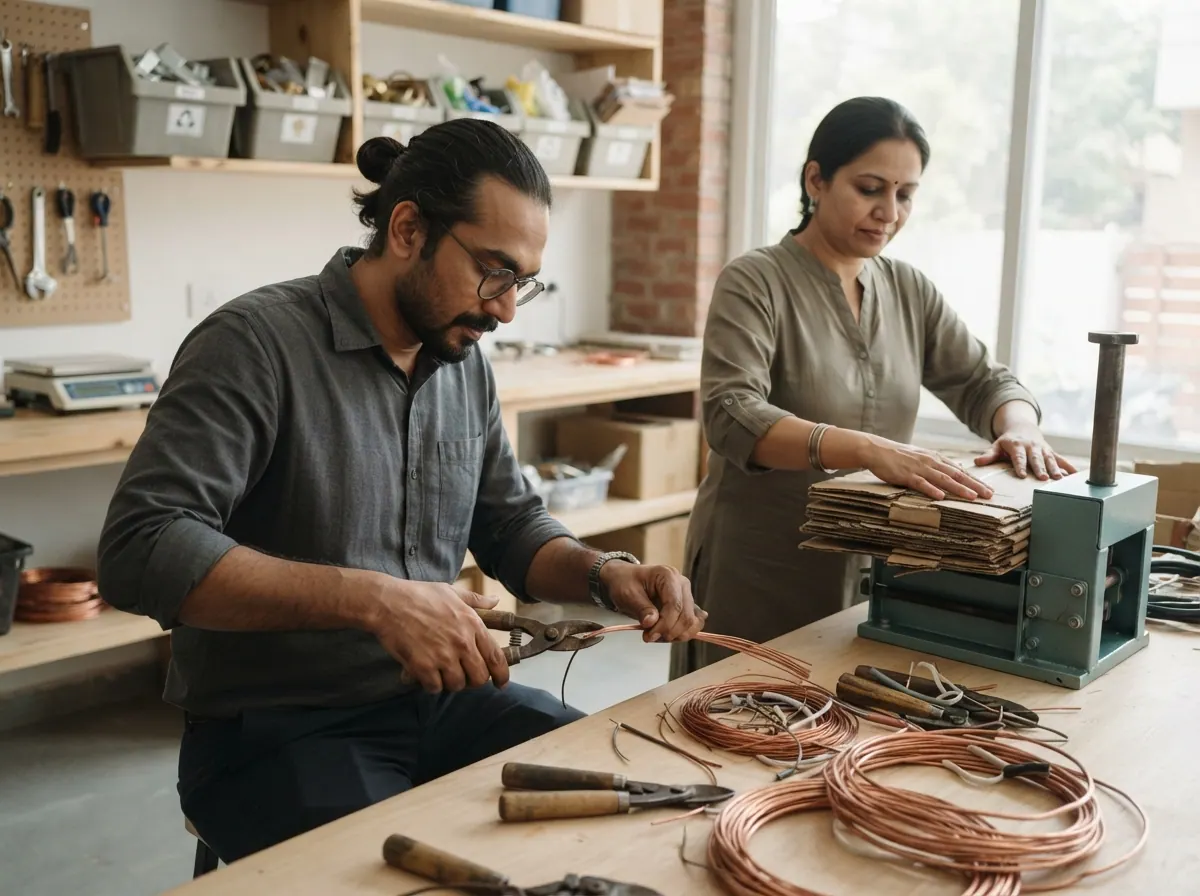
To start a scrap business in India you need a godown or yard, an accurate scale, daily buying money, and a buyer for each material. Expect to spend about ₹75,000 to ₹1.7 lakh for a small godown, or ₹3 to ₹4.8 lakh with a vehicle and a bigger yard. The profit is only a few rupees on each kilo, so the business is about volume, honest weighing and knowing the rate of every material.
All figures here are estimates. Check prices near you before you spend.
What does it cost?
| Item | Small godown | Bigger yard with vehicle |
|---|---|---|
| Platform scale and small counter scale | ₹12,000–20,000 | ₹25,000–40,000 |
| Godown deposit and rent advance | ₹25,000–60,000 | ₹60,000–1.2 lakh |
| Used small goods vehicle | Hire when needed | ₹1–1.5 lakh |
| Buying money for the first weeks | ₹30,000–80,000 | ₹1–1.5 lakh |
| Gloves, shoes, extinguisher, first-aid | ₹5,000–8,000 | ₹10,000–15,000 |
| Sacks, tarpaulin, phone, signboard | ₹3,000–5,000 | ₹5,000–10,000 |
| Total | about ₹75,000–1.7 lakh | about ₹3–4.8 lakh |
Your buying money is the part that runs out. Scrap is paid for in cash when you buy, but your big buyer may pay a week later.
What will you buy and sell?
- Paper and cardboard (raddi). Easy to find from shops and offices, but light, so you need volume. Keep it dry.
- Iron and steel. Heavy, so each kilo pays more per load. Sorted by thickness.
- Plastic. Sorted by type, because mixed plastic fetches little.
- Aluminium, copper and brass. Higher price per kilo, and often where mistakes in grading cost most.
- Old appliances and e-waste. Treat with caution, because of legal rules and hazardous parts.
Your best customers are shops, offices, factories, and housing societies who give you a regular pickup.
How much can it earn?
Take a small godown that handles about 500 kg a day, mixed material.
Margin
- 15,000 kg a month bought and sold
- Average buying rate about ₹18 a kg, average selling rate about ₹22 a kg
- Margin = ₹4 × 15,000 = ₹60,000
Costs each month
- One helper = ₹12,000
- Godown rent = ₹10,000
- Loader hire and fuel = ₹8,000
- Power and small repairs = ₹2,000
- Loss from moisture, sorting waste and weighing differences = ₹3,000
- Total = ₹35,000
Left over: ₹60,000 − ₹35,000 = about ₹25,000 a month.
At 7,000 kg a month the margin is only ₹28,000, and the same costs leave a loss. The numbers above also assume your buyer pays on time and your rates are right, which is not always so.
What do you need before you start?
- A godown with a gate wide enough for a vehicle, and a dry floor. Rent matters more than anything else you will pay.
- A buyer for every material. Visit two bigger dealers or recycling units and ask for their weekly rates and payment terms.
- A verified scale. Customers watch the needle, and a doubtful scale ends your regular pickups.
- Safety basics. Gloves, shoes, a tetanus shot from your doctor, and an extinguisher.
Step by step
- Spend a week with a working kabadi. Learn grading, rates and how they spot bad material.
- Find a godown away from crowded homes, because of fire and noise.
- Buy a scale and get it verified under legal metrology rules. Ask your local office how.
- Find your sellers: shops, offices, small factories and societies.
- Set daily buying rates and write them on a board.
- Sort as you buy so your bales are clean and fetch full rate.
- Sell in full loads to your dealer, and keep a record of every weight and payment.
Which licences apply?
- Shop or trade licence from your local body. Rules differ by city.
- GST if your turnover needs it. Ask a CA.
- Weighing scale verification under legal metrology rules.
- Pollution and fire. A godown with stacked paper or plastic may need local fire or pollution clearance. Ask the municipal office.
- E-waste and used batteries are covered by special rules and authorisations. Ask your state pollution control board before you buy these.
What goes wrong?
- Moisture in paper. Wet cardboard weighs more, but your buyer deducts it, and wet stock rots.
- Rates fall after you stock up. Holding too much of one metal can lock your money in.
- A fire in the godown. Paper and plastic burn fast, so keep the stock away from wiring.
- Mixed or hidden material. A bag of mixed metal with something else inside can cost you at the weighbridge.
- Hazardous items. Gas cylinders, batteries and old chemical drums can be dangerous. Do not buy what you cannot handle.
- A buyer who pays late. If one dealer holds your money for weeks, your daily buying stops.
Situations you will face
What would you do? Each choice costs something.
Getting started
An old dealer offers to let you watch their godown for a week. They want a small fee for their time.
- Pay and learn grading: Fee, fewer buying mistakes
- Start buying straight away: No fee, learn by mistakes
One godown is cheap but has a narrow lane. Another has a wide gate and costs more rent.
- Rent the wide-gate godown: Higher rent, easy loading
- Take the cheap narrow one: Lower rent, slow loading
A friend sells a used platform scale at half price. It has not been verified and the needle sometimes drifts.
- Buy a new verified scale: Costly, customers trust you
- Take the used scale and get it checked: Cheaper, repair cost possible
Sellers want cash the same day. More cash buys more scrap, but money sits in stock until your dealer pays.
- Keep a larger cash float: More buying, cash gets tied
- Keep a small float: Safer, miss some loads
Stacks of paper and plastic burn fast. A good extinguisher and a sand bucket cost money you have not yet earned.
- Buy extinguishers and fit them: Costs now, safer godown
- Ask the fire office first: Delay, learn real needs
One dealer pays a bit more but pays after 10 days. The other pays less but pays on the spot.
- Sell to the higher rate dealer: More money, cash delayed
- Sell to the cash dealer: Lower rate, steady cash
First month
Sellers keep comparing your price to the next kabadi. A clear board is honest but means you cannot haggle quietly.
- Put up a rate board: Builds trust, less haggling room
- Quote by person: Flexible, people suspect you
A leaking roof wet the bundles overnight. Your buyer will cut weight for moisture.
- Dry it in sun, lose a few days: Time lost, less cut
- Fix the roof properly: Costs money, future stock safe
You find a sealed paint drum with liquid in a mixed-metal bag. The seller says it is empty.
- Refuse the drum, return it: Lose the sale, stay safe
- Pay a handler to take it away: Costs money, safe disposal
A housing society wants you to collect old newspapers and bottles every Sunday. They want a fixed rate for a month.
- Agree and send a pickup: Regular supply, transport cost
- Ask them to bring it: No cost, they will say no
Sorting paper, plastic and metal takes hours. A helper's wage cuts into your thin margin.
- Hire a helper: Wage each month, cleaner sorting
- Sort it yourself: No wage, fewer pickups
A regular seller claims your scale reads 2 kg short. Others in the lane are listening.
- Weigh again in front of them: Takes time, proves honesty
- Dismiss the complaint: Saves time, rumours spread
Running it
You hold 3 tonnes of iron. The dealer's weekly rate drops, and could drop more.
- Sell now at the lower rate: Lose margin, free cash
- Hold for a better rate: May recover, cash stays locked
A factory offers regular bulk purchases, but only with a proper invoice. You have not registered.
- Register for GST with a CA: Fees and paperwork, bigger buyer
- Stay with cash buyers: Simple, smaller market
Loose cardboard takes space and loads badly. A second-hand baler would pack it tight but costs a lot.
- Buy a used baler: Costly, better rate per load
- Bundle by hand: Cheap, slow and bulky
Homes clear out old newspapers and boxes before Diwali. Sellers queue up, and paper rates may dip because everyone has stock.
- Buy all you can, store it: Cash tied up, rate may recover
- Buy only what you can sell: Safer, miss some volume
Hiring a loader every pickup is costly. A used goods vehicle needs a big payment and a driver.
- Buy a used goods vehicle: Big spend, saves each trip
- Keep hiring loaders: No big spend, costs each trip
A helper cut their hand on sharp sheet metal without gloves. It needs stitches.
- Pay treatment and buy gloves for all: Costs money, fewer accidents
- Pay only the treatment: Cheaper, risk remains
Shops near you would sell more if you collected from the door. Pickup costs fuel and time every day.
- Offer free door pickup: Costs fuel, more supply
- Buy only at the godown: No cost, less supply
When things go wrong
A big dealer owes you ₹60,000 and keeps promising next week. Your daily buying money is running short.
- Stop supplying until they pay: Pressure them, lose their loads
- Keep supplying, wait: Keeps the buyer, tight cash
A stranger offers a lot of fresh-cut copper cable at a cheap rate. They cannot say where it came from.
- Refuse and send them away: Lose the deal, stay clean
- Ask for ID and a bill first: Slower, protects you
An office wants to give you 40 old computers and monitors. You have no authorisation for e-waste.
- Decline and name an authorised recycler: No income, you stay legal
- Ask the pollution board first: Slow, learn real rules
A garage wants to sell 30 old vehicle batteries. You have no safe place to store them.
- Build a safe battery area: Costs money, new income
- Turn the batteries away: No cost, lose a seller
A worker used a cutter near the paper pile and a spark flew. No fire, but it was close.
- Move the cutting area away: Time and cost, safer godown
- Tell workers to be careful: No cost, same risk remains
Trucks and metal dropping in the lane start at 6 am. Neighbours go to the local office.
- Change timings and build a wall: Costs money, keeps your site
- Ignore the complaint: No cost, risk of notice
Growing
A magnet and a small bench help you separate copper, brass and steel. Better sorting sells at better rates.
- Set up a sorting bench: Costs money, better rates
- Sell mixed metal: Easy, lower rate
A recycling unit says it will pay more if you deliver 5 tonnes at a time, with a clear quality check.
- Aim for full loads: Better rate, need more stock
- Stay with local dealers: Easy, lower rate
A factory wants one party to buy all its metal waste each month. They want a deposit and a written agreement.
- Sign with a deposit: Big supply, locked money
- Buy lot by lot: Flexible, no assured supply
A busy market area wants a collection point. It needs rent, a scale, and someone you trust.
- Open the second point: Costly, more supply
- Keep one yard: Safer, less growth
You have been trusting memory. A register or app takes daily time but shows where money leaks.
- Keep a daily register: Time each day, clear picture
- Keep trusting memory: No time, leaks stay hidden
Is it right for you?
This business suits someone who is comfortable with dirt, heavy lifting and daily bargaining, and who keeps accurate records. It suits you less if you want a clean, quiet job, or if you cannot keep money aside for the days when your buyer pays late.
A good test: spend a week at an existing godown. If you can tell the grades and handle the haggling, start small, build regular pickups from shops and societies, and grow your volume before your yard.