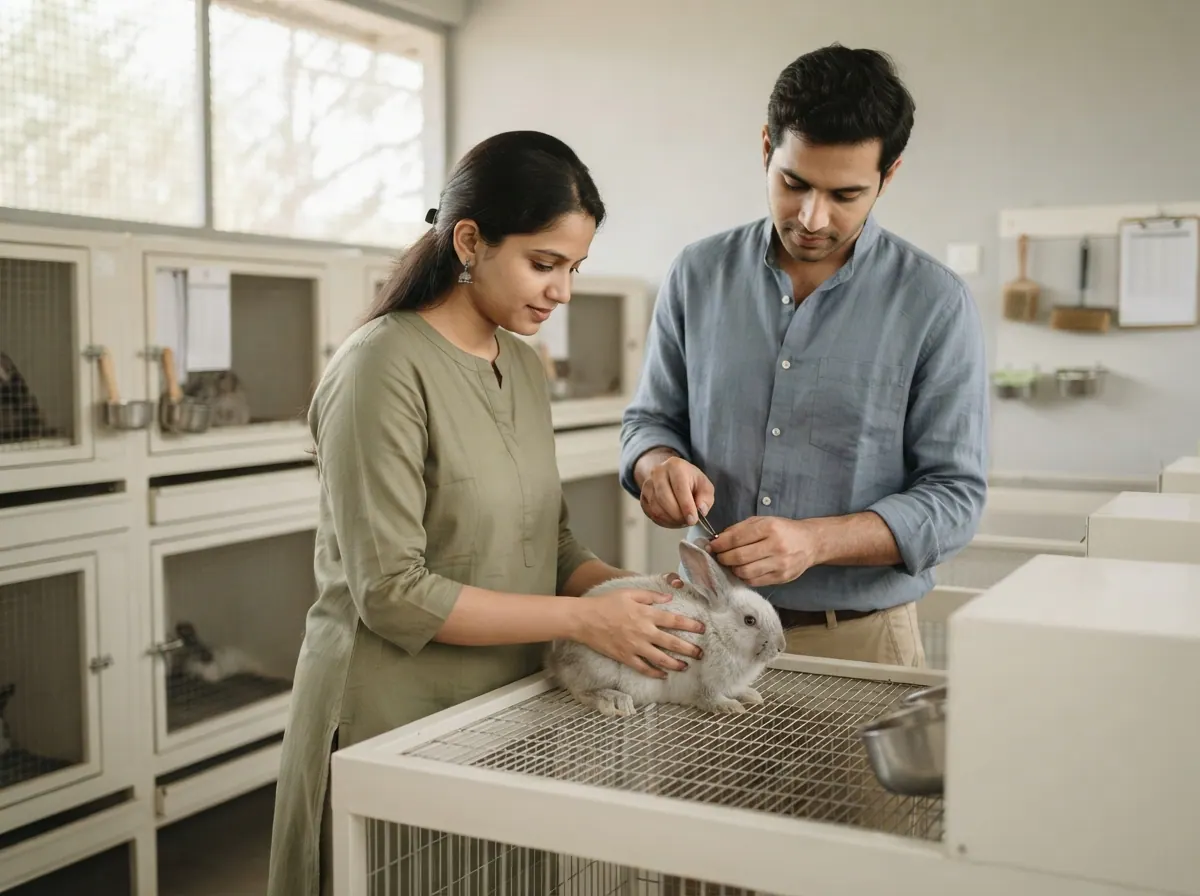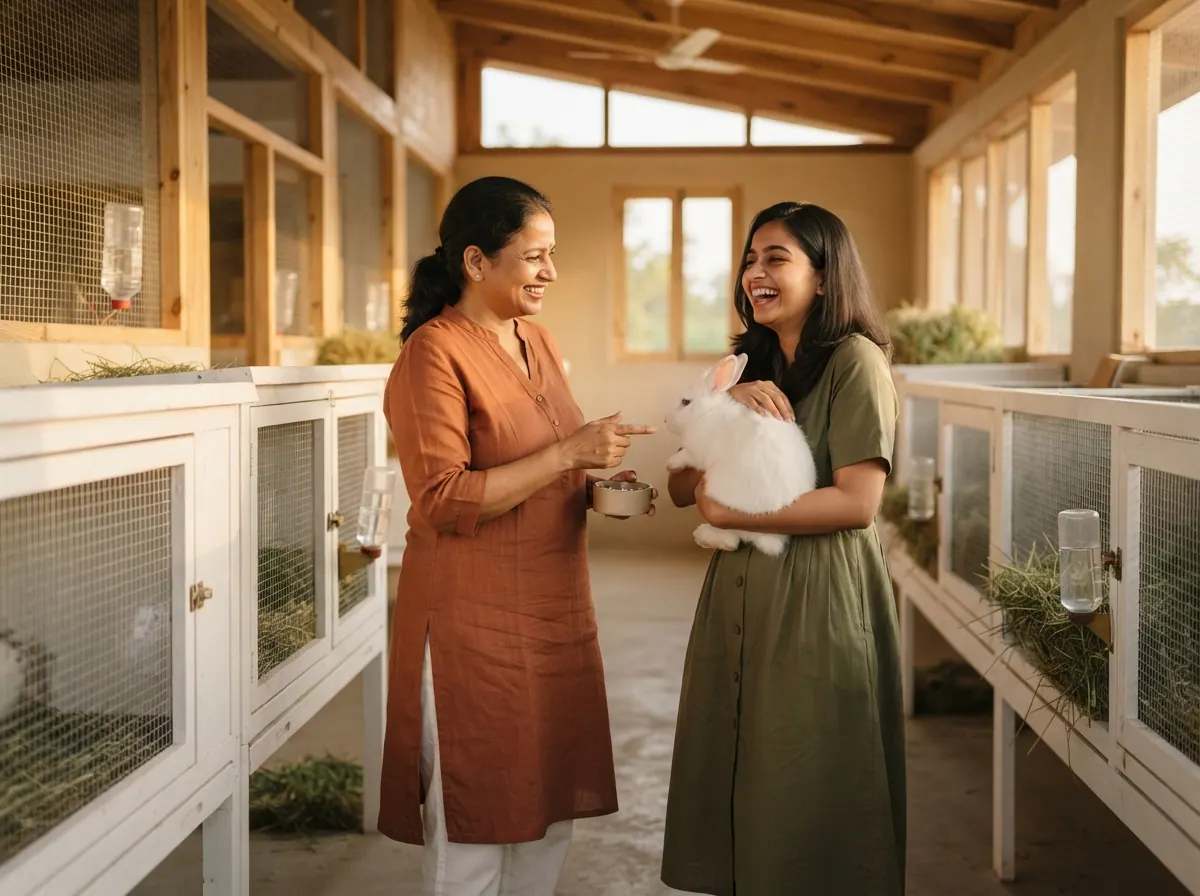
To start a rabbit farm in India you need raised wire cages in a shaded, airy shed, a feed plan that mixes pellets with green fodder, a buyer for meat or wool before you buy animals, and about ₹50,000–80,000 for 10 does and 2 bucks or ₹1.5–2 lakh for 40 does and 5 bucks. Rabbits breed fast and need little land, but the market is small, so selling is the hard part, not breeding.
All figures here are estimates. Check prices near you before you spend.
What does it cost?
| Item | 10 does, 2 bucks | 40 does, 5 bucks |
|---|---|---|
| Breeding rabbits | ₹18,000–30,000 | ₹70,000–1 lakh |
| Wire cages with trays | ₹15,000–25,000 | ₹50,000–70,000 |
| Shed, roof, shade net | ₹8,000–15,000 | ₹25,000–40,000 |
| Feeders, drinkers, nest boxes | ₹3,000–5,000 | ₹10,000–15,000 |
| Feed reserve for the first months | ₹5,000–8,000 | ₹20,000–30,000 |
| Vet visit, medicine | ₹2,000–3,000 | ₹6,000–10,000 |
| Total | about ₹50,000–80,000 | about ₹1.5–2 lakh |
Buy breeding stock from a reliable farm, not a market seller. Ask the age of the does and bucks and how they were fed.
Which breed should you keep?
- New Zealand White: a common meat breed that grows fast and is easy to handle.
- White Giant: a large, meat-type breed that needs good feed.
- Soviet Chinchilla: a hardy meat breed with good fur.
- Grey Giant: a large, hardy meat breed.
- Angora: kept for wool, not meat. It does better in cooler areas, and wool buyers are few, so find one before you buy.
How much can it earn?
Rabbits do not earn quickly. Here is a settled farm with 40 does. These are example numbers.
Rabbits sold in a year
- 40 does × about 4 litters a year = 160 litters
- 160 litters × about 6 young raised to market = 960 rabbits
- 960 rabbits × about ₹600 each (about 2.2 kg) = ₹5,76,000 a year
- ₹5,76,000 ÷ 12 = about ₹48,000 a month
Costs each month
- Feed for growing rabbits: 960 × about ₹210 = ₹2,01,600 a year, so about ₹16,800 a month
- Feed for does and bucks: about ₹74,000 a year, so about ₹6,200 a month
- One paid worker = ₹10,000
- Vet and medicine = ₹2,000
- Power, water and cage repairs = ₹3,000
- Total = about ₹38,000
Left over: ₹48,000 − ₹38,000 = about ₹10,000 a month.
It is thin, and it assumes you sell every rabbit at ₹600. If your family works the farm and you grow your own green fodder, it improves. If you cannot sell at that price, it falls quickly.
What do you need before you start?
- A buyer first. Hotels, restaurants, meat shops and some pet or lab buyers may take rabbits. Talk to them and get their price and weight needs in advance.
- Shade and cool air. Rabbits suffer when it is above about 30°C. Plan roof, shade net, and fans or wet curtains.
- Feed. Pellets plus green leaves and some dry hay. A sudden change upsets their gut.
- A vet who has treated rabbits.
Step by step
- Visit a working rabbit farm and ask how many young die before weaning.
- Build a raised cage row with wire floors, droppings trays, and shade.
- Buy a few healthy pairs of one breed, instead of mixing many.
- Keep new rabbits apart before adding them to the shed.
- Breed a doe only when it is the age and weight your seller advises, and give it a nest box before kindling.
- Wean young at the age your vet or breeder advises, and move them to growing cages.
- Record each doe: mating date, kindling date, litter size, deaths.
Which licences apply?
- Local permission: small units may only need panchayat or local approval, which varies by area.
- Loans and schemes: small livestock units may be supported by banks or state schemes. Rules change, so ask your district animal husbandry office.
- Selling meat: processing and selling meat needs food licences and local rules. Ask FSSAI and your local office.
- Tax: ask a CA how your sales are treated.
What goes wrong?
- Not being able to sell. This is the biggest reason new rabbit farms close.
- Heat stress. Rabbits die in hot, closed sheds. Shade and airflow matter more than cage quality.
- Ear mites and gut disease. Dirty cages and wet feed cause trouble. Clean daily.
- Feeding wet greens. Wet or sudden new greens cause diarrhoea, which kills young rabbits quickly.
- Does stepping on or killing their young. A first-time doe without a nest box may do this.
- Inbreeding. Mating close relatives gives weak young. Record every pair.
Situations you will face
What would you do? Each choice costs something.
Getting started
A hotel chef may take rabbits, but only 2 kg and above. A meat shop wants smaller ones.
- Plan for the hotel size: Longer feeding, better price
- Plan for the meat shop: Quicker sales, lower price
A farm sells pedigree stock with records. A market seller offers cheaper rabbits of unknown age.
- Buy from the farm: Higher price, known stock
- Buy from the market: Cheaper, age and health unknown
Wire cages stay clean but cost more. A carpenter offers wooden boxes that hold urine and germs.
- Order wire cages: Costly, easy to clean
- Take wooden boxes: Cheap, harder to keep clean
Summer heat under tin can pass 35 degrees. A thatched or net roof costs more and lasts less.
- Thatch roof with shade net: Cooler, more upkeep
- Plain tin roof: Cheap, heat stress risk
Angora wool sells at a higher price but buyers are few. Meat rabbits have more local buyers.
- Keep meat breeds: More buyers, lower price
- Keep Angora: Higher price, one wool buyer
Pellets cost more and keep growth steady. Greens are cheaper but vary through the year.
- Pellets plus some greens: Costly, steady growth
- Mostly greens and kitchen waste: Cheaper, slower growth
A friend gives you six rabbits. You have no isolation cage.
- Build a separate cage first: Small cost, safer shed
- Put them straight in: No cost, disease risk
First month
The doe is restless. A nest box and straw are ready but the cage is in a noisy spot.
- Move to a quiet cage: Needs handling, better odds
- Leave the doe there: No effort, may lose litter
Your first-time doe has killed the litter. There was no nest box and the shed was noisy.
- Add nest boxes, cover cages: Cost now, calmer does
- Mate again quickly: Cheap, same risk
Several rabbits shake their heads and have crusts in their ears.
- Call the vet for treatment: Fee and medicine
- Clean ears only at home: Cheap, mites may spread
Fresh cut fodder is soaked. Feeding it is easy but may upset their stomachs.
- Dry it in shade first: Time lost, safe feed
- Feed it straight: No wait, diarrhoea risk
Running it
Rabbits are lying flat and breathing fast during a heatwave.
- Add fans and wet curtains: Power and water cost
- Give cold water and shade only: Cheap, some losses likely
Young rabbits are eating pellets. Early weaning helps the doe to breed again but needs good feed.
- Wean on schedule, good feed: Feed cost, more litters
- Leave them longer: Less work, fewer litters
One doe has had four litters back to back and looks thin.
- Rest the doe two months: Fewer litters, healthier doe
- Rebreed immediately: More litters, doe weakens
Two siblings were mated by mistake and the litter is weak.
- Tag cages and keep records: Small cost, fewer mistakes
- Trust your memory: No cost, weak litters
The hotel wants 2.2 kg. Your batch is close but each week costs feed.
- Hold two more weeks: Feed cost, hotel price
- Sell now to the meat shop: Cash in, lower price
A wool buyer visits and wants clean, unmatted wool; shearing needs care and time.
- Shear carefully and sort: Time, better price
- Sell mixed, matted wool: Quick, low price
The hotel took two batches and asks to settle next month.
- Wait and keep supplying: Feed bills pile up
- Stop until paid: Lose a main buyer
A shop wants small rabbits for pets. They pay more per rabbit but need healthy, handled ones.
- Supply a few for pets: Handling time, higher price
- Keep to meat only: Simple, no extra
When things go wrong
Many rabbits sneeze and have wet noses. Others look fine.
- Isolate sick rabbits, call vet: Fee, stops spread
- Wait a few days: No cost, may spread
Eight young rabbits died in three days with watery droppings.
- Call a vet, change feed slowly: Fees, protects the rest
- Replace dead stock: Cost, same problem
Dogs scared the rabbits last night and two does aborted.
- Build a wall and gate: Costly, safer stock
- Put up a thorn fence: Cheaper, dogs may return
Two buyers say demand is low and offer 20 per cent less.
- Accept the lower price: Keep sales, thinner profit
- Search for new buyers: Time and fuel, uncertain
The helper who handles feeding leaves for a city job.
- Offer more pay to stay: Higher wage, steady care
- Train someone new: Mistakes meanwhile
Growing
Sales are steady. More does need more cages, feed and your time.
- Raise young does yourself: Slow, cheaper
- Buy twenty breeders: Costly, faster
A spare quarter acre could grow lucerne or napier for rabbit feed.
- Plant a fodder plot: Cost now, cheaper feed
- Keep buying greens: No effort, higher cost
A hotel wants dressed meat. It needs a clean room and a food licence.
- Get licence and prepare: Fees and work, higher price
- Sell live rabbits only: No licence, lower price
Gardeners ask for rabbit manure for plants. It needs bagging and storage.
- Bag and sell it: Small bags, small income
- Give it free to neighbours: Goodwill only
A local group asks you to run a short class on rabbit keeping.
- Run a paid class: Time away from farm, small income
- Decline: Keeps focus
The bank may lend for more cages, but wants a report and your last year's records.
- Prepare it with a CA: Fees, cleaner records, no promise
- Grow from own savings: No fees, slower growth
Is it right for you?
Rabbit farming suits you if you have already found buyers, have a cool, shaded spot, and enjoy daily careful work with small animals. It suits you less if you cannot sell meat in your area or cannot be on the farm every day.
A good test: spend a week at a working rabbit farm and take a price quote from at least two buyers. If both are positive, start with 10 does and 2 bucks, and grow only when the selling is steady.