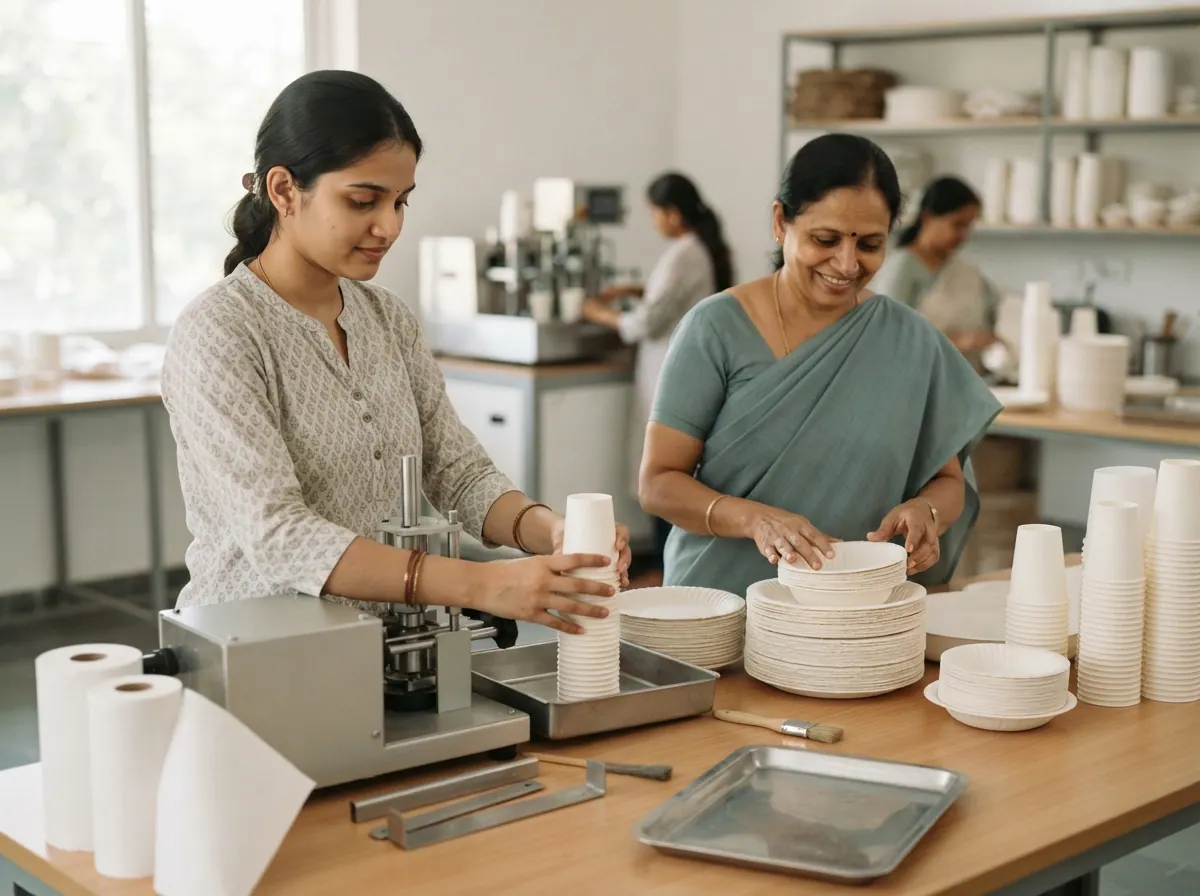
To start a paper plate business in India you need one or more plate-making machines with dies, a regular supply of paper, a dry workshop, a packing table, and about ₹1–8 lakh. The money is made on volume. Each plate earns a small amount, so your paper cost, your wastage and your buyers matter more than the machine.
All figures here are estimates. Check prices near you before you spend.
What does it cost?
| Item | One machine, small start | Several machines, plates and cups |
|---|---|---|
| Rented shed with power | ₹10,000–30,000 deposit | ₹40,000–80,000 deposit |
| Plate machine (semi-automatic, with dies) | ₹50,000–1.5 lakh | ₹2–4 lakh |
| Cup machine | not needed | ₹2–5 lakh |
| Extra dies for different sizes | ₹10,000–40,000 | ₹40,000–1 lakh |
| Paper stock to start | ₹20,000–70,000 | ₹1–2 lakh |
| Packing material and a weighing scale | ₹5,000–15,000 | ₹15,000–40,000 |
| Power connection and wiring | ₹10,000–30,000 | ₹30,000–70,000 |
| Registration and sample testing | ₹3,000–10,000 | ₹10,000–30,000 |
| Total | about ₹1–3 lakh | about ₹5–8 lakh |
Machine quality matters. A machine that does not press evenly makes plates with cracked edges, and a shop will not buy them. Ask for a demonstration with your own paper before you pay.
Which product should you make?
- Plain plates in common sizes. The easiest start, sold in packs to caterers and shops, but many small makers compete on price.
- Cups. Higher demand for tea and cold drinks, but the paper, machine and quality needs are higher.
- Plates for sweets and snacks. Smaller sizes for sweet shops, chaat stalls and tiffin sellers who order again and again.
- Printed or special plates. A shop's name or a design can earn more, but need more setup and bigger orders.
How much can it earn?
Take a small unit with two plate machines, making about 5,000 plates a day for 26 days, so 1,30,000 plates a month. These are rough numbers.
Each month
- Sales: 1,30,000 plates × about ₹1.10 = ₹1,43,000
- Paper: 1,30,000 × about ₹0.52 = ₹67,600
- Three workers: 3 × ₹11,000 = ₹33,000
- Power: about ₹6,000
- Rent: about ₹8,000
- Packing and delivery: about ₹6,000
- Left over: ₹1,43,000 − ₹67,600 − ₹33,000 − ₹6,000 − ₹8,000 − ₹6,000 = about ₹22,400
That is a thin number. If the paper price rises by just ₹0.05 a plate, you lose about ₹6,500 a month. If buyers pay in thirty days, you also need cash to buy paper until then. A machine that makes 10% rejects eats another large part of the margin.
What do you need before you start?
- Paper supply you can reorder. Know two sellers of paper so that a price rise or a delay does not stop you.
- A buyer list. Caterers, sweet shops and canteens in your area who will try your plates.
- A dry room. Paper takes moisture and curls, and then the plates press badly.
- A mechanic nearby. Machine problems should not stop you for a week.
- Cash for paper. You buy paper first and get paid later.
Step by step
- Visit two units and watch the machine run. Count good plates and rejects for an hour.
- Choose one size and a second later, based on what your buyers use most.
- Set up the machine, a bench for stacking, and a dry store for paper.
- Run test batches with your paper and check edge finish, shape and how well the plates stack.
- Count and pack in clean sleeves or bags of fifty or a hundred, with your name on the pack.
- Take samples to caterers, sweet shops and event planners.
- Take small first orders and deliver on the promised day.
Which licences apply?
Rules vary by state, so confirm with local offices:
- Udyam registration for loans and schemes.
- GST, if your sales need it. Ask a CA.
- Local permission for a workshop, and a commercial power connection.
- Rules for food-contact items. Ask the district industries centre and the food safety office what applies to the paper you use and the plates you sell.
- Rules on plastic. Some single-use plastic items are restricted in India, which is part of the demand for paper plates. If a coating is used, ask your supplier what it is and check with the pollution board.
- Loans and schemes. Small manufacturers can ask their district industries centre what is open now.
What goes wrong?
- Cracked or curled plates. Damp paper, wrong pressing temperature or a worn die gives rejects.
- Paper price swings. A rise cuts your margin immediately, and shops do not accept price rises easily.
- Slow payments. Caterers and shops often pay late, while your paper supplier wants cash.
- Dust and fire. Stacked paper and dry offcuts burn easily. Keep the room tidy and the wiring safe.
- Poor machines. A cheap machine with uneven pressing makes poor plates.
- Quiet months. Orders fall after the wedding season, but rent and wages continue.
Situations you will face
What would you do? Each choice costs something.
Getting started
Caterers use large plates, sweet shops use small ones. Each size needs its own die, and a die costs money.
- Start with caterer plates: Bigger orders, slow payers
- Start with sweet-shop plates: Small orders, repeat buyers
A dealer shows a machine making perfect plates with the dealer's own paper. The dealer does not want to test yours.
- Insist on a demo with your paper: Delay, avoids a bad buy
- Buy the cheaper machine anyway: Save money, risk of rejects
A used semi-automatic machine costs half the price. Its heater and press may be worn.
- Buy a new machine: Costly, even pressing
- Buy the used one: Cheaper, more rejects
A paper mill agent offers the best price but needs a large order. A local dealer sells small lots at a higher price.
- Order a large lot: Cheaper, cash tied up
- Buy small lots locally: Dearer, little cash tied
One shed is cheap but the walls seep in rain. A dry shop costs more rent.
- Rent the dry shed: More rent, dry paper
- Take the damp shed: Cheap, paper curls
The commercial connection needs a deposit and weeks of paperwork. The shed has only a home line.
- Pay and wait for the connection: Deposit, lose some weeks
- Rent a generator meanwhile: Fuel cost, start on time
A caterer wants a proper bill with GST and your registration. Registration takes a few days.
- Register first: Small fee and wait
- Delay the first order: Lose a week, keep papers clean
First month
Many plates split at the rim. The paper may be damp, or the press temperature may be wrong.
- Dry the paper, adjust heat: Lose a batch, find the fix
- Sell the plates as seconds: Little cash, weaker name
A caterer wants a big order for a wedding in two weeks. It is more than your machine makes in that time.
- Hire extra hands, run a shift: Wages, win the order
- Accept part of the order: Safe, smaller sale
Shops prefer packs of fifty. Caterers want hundreds, with a count that does not come short.
- Offer both pack sizes: More packing work
- Only packs of 100: Simple, lose small shops
A shopkeeper counts forty-six plates in a pack marked fifty. Your workers count by weight.
- Count every pack by hand: Slower, trusted packs
- Add a few extra plates each pack: Costs margin, no complaints
Paper trimmings fill a corner and a worker smokes close by. The landlord has noticed.
- Clear offcuts daily, ban smoking: Small cost, safer shed
- Sell offcuts to a scrap dealer weekly: Small income, a little tidier
A good buyer wants thirty days. You must pay the paper supplier right away.
- Give 15 days only: Safer cash, may lose the buyer
- Give the 30 days: Keep the buyer, cash tied up
Running it
Your paper supplier raises the price. Buyers will not accept a higher plate price easily.
- Raise the plate price slightly: Protect margin, lose some buyers
- Hold the price: Keep buyers, thin margin
Orders pour in for weeks. Your two machines run all day, and the dies are heating up.
- Run a night shift: Wages, more output
- Rest the machines, take fewer orders: Safer machines, lose sales
One die presses unevenly and makes weak rims. A new die costs money and a week's wait.
- Order a new die: Cost and wait, clean plates
- Get the die re-machined: Cheaper, lasts less
Many buyers want cups too. A cup machine and cup paper are a big spend and a new skill.
- Buy a cup machine: Big spend, new buyers
- Stay with plates: No spend, no new buyers
A bigger maker sells plates at a price that leaves you no margin. Some shops ask you to match it.
- Match the price for key buyers: Lower margin, keep buyers
- Hold price, stress quality: Some buyers leave
A chain of sweet shops wants printed plates. Printing and a plate die cost more but orders are steady.
- Do the printed plates: Setup cost, better price
- Decline the printing: No spend, lose the shop
The operator who knows your machine takes a job elsewhere during the busiest week.
- Hire and train quickly: Wages, slow week
- Run the machine yourself: Save wages, less selling time
A hospital canteen asks if your paper is safe for hot food and wants a letter from the paper supplier.
- Get a supplier letter and test: Fee and wait, trusted order
- Offer plates for dry food only: No cost, smaller sale
When things go wrong
A loose wire sparks near the paper stack. No fire starts, but the stack is dry and large.
- Rewire and buy an extinguisher: Cost now, much safer
- Move the stack, call an electrician: Mid cost, wiring checked
The roof leaks and wets two bundles of paper. The damp paper curls when it dries.
- Discard the wet bundles: Loss, clean output
- Dry and test a small lot: Time, may save some
The heating element burns out. The mechanic can fit a new one in two days, for a fee.
- Pay for the express fix: Costly, quick restart
- Wait for the normal visit: Cheaper, lose output
A wholesaler who takes a third of your plates keeps delaying payment and asks for more stock.
- Stop supply until paid: Lose volume, protect cash
- Supply smaller lots: Sales hold, risk stays
Orders drop sharply for six weeks. Rent and wages continue and the store is full of plates.
- Offer discounts to shops: Cash comes in, lower margin
- Run fewer shifts: Save power, idle workers
Growing
Orders have outgrown two machines and workers are on overtime. A third machine would clear the backlog.
- Buy the machine: Spend now, more output
- Keep overtime: Wages, tired workers
Event planners pay better than wholesalers but want delivery to venues and flexible quantities.
- Buy a delivery vehicle: Spend now, better price
- Keep selling to wholesalers: No spend, lower price
Customers ask for natural-looking plates. A separate machine and different material are needed.
- Add a premium line: Big spend, higher price
- Stay with paper: No spend, no new range
Supermarkets and kirana shops may stock printed retail packs. Printing and sealing cost more.
- Make branded retail packs: Printing cost, better rate
- Keep bulk sales only: No spend, low rate
Is it right for you?
A paper plate unit suits you if you can sell to caterers and shops, handle a machine and a few workers, and manage cash carefully. It suits you less if you want a high margin on every piece, or if you cannot wait for payments.
A good test: spend two days at a running unit, count good plates against rejects, and call three caterers to ask what they pay and how they buy. If the numbers still look right, start with one machine and one size.