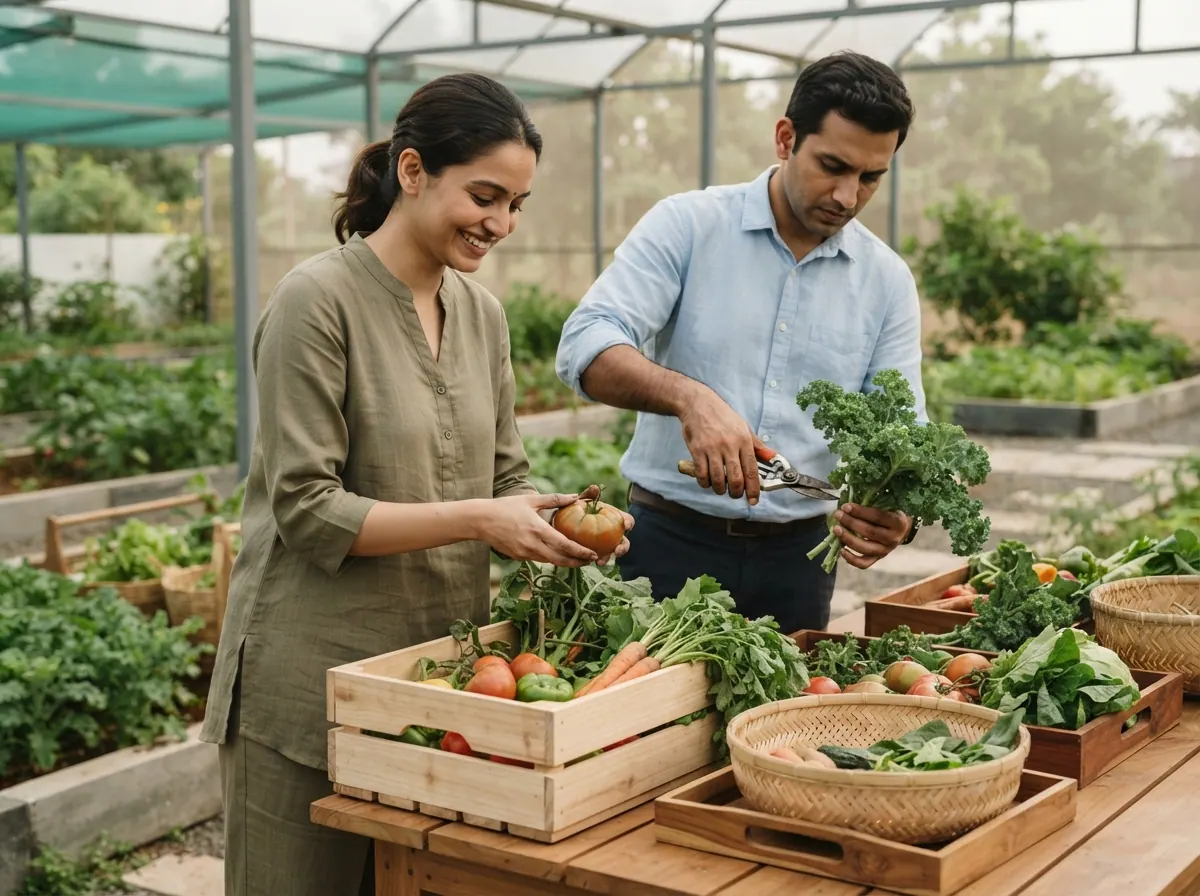
To start an organic vegetable farm in India you need land with a reliable water source, a compost and bio-input plan, a nursery area for seedlings, a certification route, buyers who pay extra for it, and about ₹1.7–3.4 lakh for one acre or ₹5.7–11 lakh for four acres. That assumes you own the land. Organic farming rarely pays more in the first year or two, because yields dip while the soil and pests settle, and you cannot always charge a premium before you have proof.
All figures here are estimates. Check prices near you before you spend.
What does it cost?
| Item | 1 acre | 4 acres |
|---|---|---|
| Land preparation, beds, farmyard manure | ₹15,000–30,000 | ₹60,000–1.2 lakh |
| Drip irrigation | ₹20,000–40,000 | ₹1.2–2 lakh |
| Vermicompost beds or compost pits | ₹20,000–40,000 | ₹60,000–1.2 lakh |
| Nursery area, shade net, trays | ₹20,000–40,000 | ₹50,000–1 lakh |
| Seeds and saplings | ₹10,000–20,000 | ₹35,000–70,000 |
| Organic inputs for the first year (neem cake, bio-fertilisers, bio-pesticides, traps) | ₹30,000–60,000 | ₹1.2–2.4 lakh |
| Tools, sprayers, crates | ₹15,000–25,000 | ₹30,000–50,000 |
| Certification or group fees | ₹5,000–20,000 | ₹10,000–30,000 |
| Packing, weighing, small cold space | ₹30,000–60,000 | ₹80,000–1.6 lakh |
| Total | about ₹1.7–3.4 lakh | about ₹5.7–11 lakh |
You can often spend less if you make your own compost, grow your own seedlings and have cattle for manure.
What do you grow?
Choose vegetables that families buy every week and that suit your season:
- Leafy greens: palak, methi and coriander grow fast, but spoil quickly and need delivery on the day.
- Fruiting vegetables: tomato, brinjal, okra and chilli give the main income. They attract pests, so watch them daily.
- Roots and gourds: radish, carrot, bottle gourd and ridge gourd keep longer.
- Desi and local varieties: some buyers pay extra for old, local types. Test before you plant a lot.
Plant many kinds on small beds, so one pest or one bad price does not hit your whole income.
How much can it earn?
Here is one acre of mixed organic vegetables in a settled year, sold mostly direct to families and shops.
Sales in a year
- About 9,000 kg of sellable vegetables from two or three crops a year
- 9,000 kg × about ₹45 a kg = ₹4,05,000
Costs in a year
- Organic inputs and compost = ₹60,000
- Seeds and saplings = ₹25,000
- One full-time worker at ₹12,000 a month = ₹1,44,000
- Water and power = ₹12,000
- Packing, transport and delivery = ₹40,000
- Certification or group fees = ₹10,000
- Other = ₹15,000
- Total = ₹3,06,000
Left over: ₹4,05,000 − ₹3,06,000 = about ₹99,000 a year, or about ₹8,250 a month.
If your family does the field work, you keep the ₹1,44,000 as well, about ₹20,000 a month. One acre is small, and the thin margin is the honest one. The premium price makes the difference, so each rupee you lose per kilo, by selling unlabelled to a mandi trader, costs about ₹9,000 a year.
What do you need before you start?
- A water source that lasts the year. Check it in May, not December.
- A clean field. If neighbours spray chemicals, drift and runoff can come into your plot. Keep a buffer strip.
- Compost and cattle. Bought manure adds cost, so one or two cows or a tie-up with a dairy nearby helps.
- A plan for buyers. Know who will pay a premium before you plant. Ten to twenty regular families is a good start.
- Patience. The first two seasons are for learning, not for profit.
Step by step
- Talk to two organic growers and ask for their yields, losses and buyers in the first and third years.
- Choose your certification route with your district agriculture office or a certifier, and start your records on day one.
- Build the soil. Add compost, rotate crops and keep the soil covered with mulch or a green manure crop.
- Set up drip and a nursery, and raise seedlings yourself if you can.
- Manage pests early. Use traps, neem-based sprays, crop mixing and healthy soil. Check the rules of your certifier before using any spray.
- Pick in the morning and pack carefully, with a label of your farm name and date.
- Sell in a fixed weekly pattern so customers know when to expect you, and keep a record of every sale.
- Keep records: inputs, sowing, harvest and sales. Certifiers ask for them.
Which licences apply?
- Organic certification. To call produce organic you generally need certification, such as NPOP (mainly for exports) or PGS-India (group-based, for local sales). Confirm which applies and its fees with an accredited certifier or the district agriculture office.
- Food safety. FSSAI registration may apply if you pack or process under your own name. Ask the food safety office.
- Loans and schemes. Governments have supported organic farming through various schemes and banks give agriculture loans. Names and amounts change, so ask your district agriculture and horticulture offices.
- Tax. Farm income and trading income are treated differently. Ask a CA if you start selling other people's produce too.
What goes wrong?
- Selling "organic" without certification. It breaks labelling rules and loses buyer trust. Describe what you really do, or get certified.
- A yield dip in the first years. Lower yields and no premium together can be a hard first season.
- Pests with no quick fix. A whitefly or fruit borer outbreak can wipe out a tomato crop in a week.
- Spray drift from neighbours. It can contaminate your plot and your certification.
- Only one buyer or one crop. A single large order that stops, or a glut of one vegetable, leaves you stuck.
- Delivery eats the margin. Small deliveries by bike take time and fuel, so group them.
- Quality varies. A family that gets a wilted bunch once may not buy again.
Situations you will face
What would you do? Each choice costs something.
Getting started
A group certification costs fees and record-keeping from day one. A friend says just start selling and call it organic.
- Join a certification group: Fees and records, honest label
- Sell without any organic claim: No fee, no premium
The next field is sprayed with chemicals on windy days. Your first beds are three metres from the boundary.
- Plant a buffer hedge: Cost and lost space, safer plot
- Plant beyond the three metres: Less area, safer plot
Packet seed from the shop is coated with chemicals. Untreated or desi seed costs a lot more.
- Buy untreated seed: Higher cost, fits certification
- Buy coated seed, sell as non-organic: Cheap, no organic premium
A dairy will deliver cow dung at a rate. Making vermicompost saves money but takes months to start.
- Buy manure for now: Cost now, soil ready soon
- Build vermicompost beds: Slower, cheaper later
Drip saves water and weeding but costs a lot upfront. Flooding the beds costs nothing but uses water and grows more weeds.
- Install drip: Costly, less water and weeds
- Flood the beds: Free, more weeds and labour
A housing society offers a weekly stall. A WhatsApp group could also take orders, but needs delivery.
- Take the society stall: Stall fee, direct sales
- Start a WhatsApp group: No fee, delivery time
Tomato sells for more but attracts pests. Greens grow fast, sell cheaper and spoil quickly.
- Plant tomato: Higher price, pest risk
- Plant leafy greens: Faster, lower rate
First month
Tiny white insects are under every leaf. Neem spray helps but needs repeating and chemical spray is not allowed.
- Use traps and neem spray: Labour and inputs, organic
- Spray, then sell as non-organic: Quick fix, organic status lost
After the first rain the weeds are growing faster than the vegetables. Hand weeding takes many workers.
- Hire extra weeders: Labour cost, clean beds
- Mulch over the weeds: Cheaper, slower to work
The group inspector wants a record of every input and sowing date. You have been writing on scraps.
- Set up a register now: Time and effort, compliant
- Mark gaps, keep records from now: Gaps shown, the inspector may query
The beds give less than half what a conventional farmer next door gets. Customers are waiting.
- Add compost tea and mulch: Cost, slow improvement
- Tell customers, fill orders late: Slower, honest, some leave
The borewell gives less each day. Plants wilt by afternoon and drip lines run dry.
- Build a rain-fed farm pond: Big cost, lasting water
- Water in short rounds: No cost, plants stressed
Customers complain the palak was limp by the time it reached them. You used plastic sacks.
- Buy crates and damp cloth: Cost now, fresher produce
- Deliver earlier in the day: No cost, tiring mornings
Running it
A mandi trader offers to take all your tomatoes at the market rate. Your direct families pay far more but take time.
- Sell the glut to the trader: Quick cash, no premium
- Keep it for direct buyers: Better price, risk of waste
A restaurant wants fixed quantities every Monday at a rate lower than your direct price, with weekly payment.
- Accept the order: Steady buyer, lower rate
- Decline and sell direct: Higher price, more selling time
Holes are showing in a third of the fruit. A neem spray helps only a little once the insect is inside.
- Pheromone traps, remove fruit: Cost and labour, saves rest
- Leave and sort at picking: Cheap, big losses
A cloudburst has left water standing in the lower beds for two days. Roots are rotting.
- Dig drains and raise beds: Cost and labour, long fix
- Wait for it to dry: Free, crop loss likely
A shop wants your name and a certification mark on the pack. Printing and labels cost money.
- Print proper labels: Cost now, higher price
- Sell unlabelled bundles: Free, lower price
Nearby farmers want to buy your nursery trays. It brings cash but uses up your own planting space and time.
- Sell some trays: Extra cash, less for your beds
- Keep all for your beds: Full planting, no extra cash
The worker who knows the beds says another farm pays more. Training a new one will take a season.
- Raise the wage: Higher monthly cost
- Let the worker go and retrain: No raise, slower work
When things go wrong
A patch of plants collapses overnight with brown stems. The disease may spread through the soil and water.
- Remove plants, rotate the crop: Lose the crop, clean soil
- Water more and hope: No cost, may spread
A worker used a leftover chemical bottle on one bed. The inspector notes it in the report.
- Report it and wait out the bed: Lose one bed, keep trust
- Tell customers, sell as non-organic: Lose the premium, honest
A short hailstorm tears the leaves of half the crop. The vegetables are marked and unfit for premium customers.
- Cover beds with net next time: Cost now, future safety
- Sell the marked produce cheaply: Some cash, lower price
A shop that bought a third of your produce shifts to a cheaper supplier. Stock begins to pile up.
- Start home delivery boxes: Time and cost, new buyers
- Cut the price for the shop: Keeps buyer, thinner margin
The dairy that gave you cow dung has shut. Compost stock lasts only two months.
- Buy manure from far away: Costly, long transport
- Boost green manure crops: Cheaper, slower soil
Compost tea and hard water have choked half the emitters. Rows at the far end are going dry.
- Flush lines and add a filter: Cost and a day's work
- Hand water the dry rows: No cost, heavy labour
Growing
A producer group offers shared transport and a combined stall at a bigger market. It takes a share of sales.
- Join the group: A share of sales, wider market
- Stay independent: Full price, slower reach
A neighbour offers a plot on lease. It needs a conversion period before you can call its crop organic.
- Lease and convert it: Cost, two years of waiting
- Improve your own acre: Smaller spend, steady gain
Extra tomatoes and chillies could become packed products. It needs a kitchen, packing and a food licence.
- Register and start small: Cost and paperwork, extra income
- Keep selling fresh only: Simple, waste in gluts
Customers ask for a weekend farm visit with a picnic. It builds trust but takes time and cleaning.
- Hold a paid farm day: Extra income, lost work
- Decline for now: Work continues, less trust
Is it right for you?
Organic farming suits you if you enjoy selling and talking to customers as much as growing, can wait two years for a premium, and have land and water already. It suits you less if you want quick money, or need to sell everything through a mandi trader.
A good test: start with a quarter acre, sell it direct to twenty families for a season, and check your real margin. If they stay and the numbers work, grow your area one bed at a time.