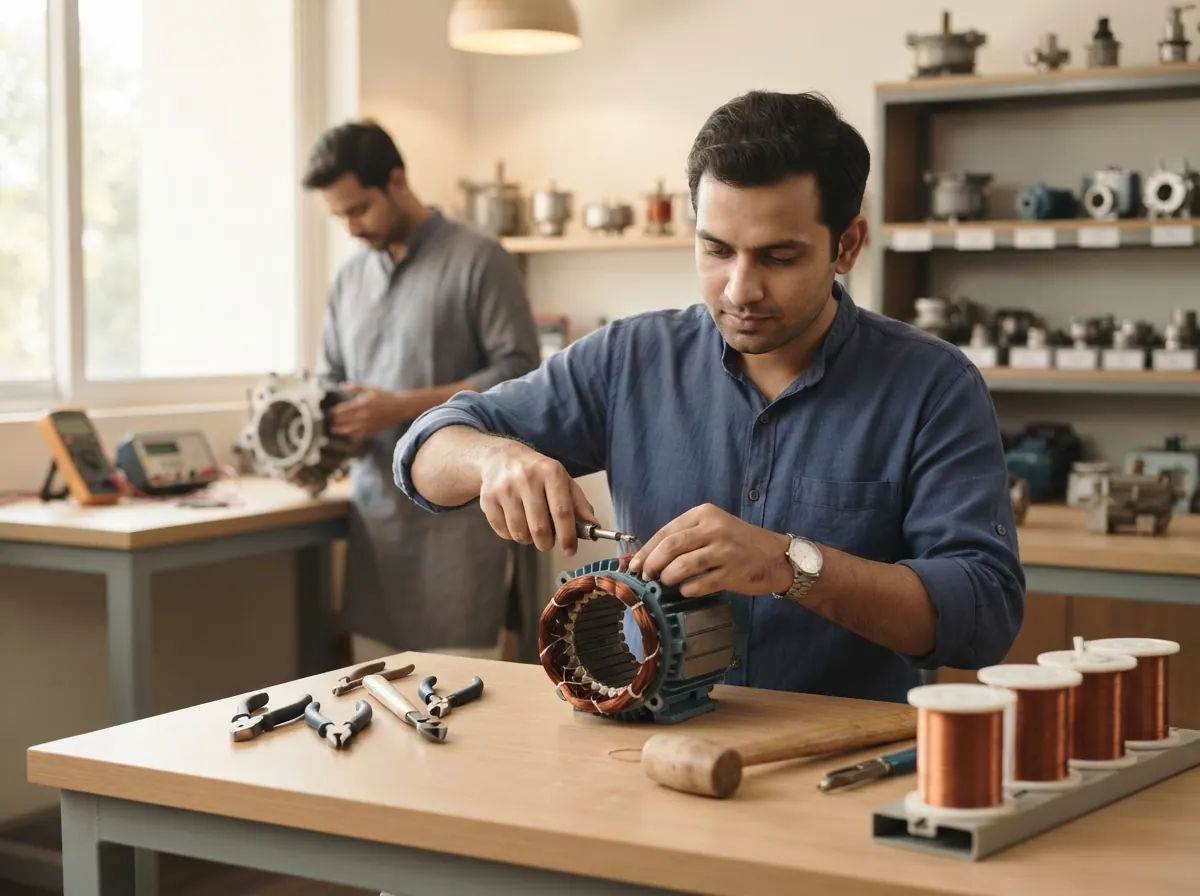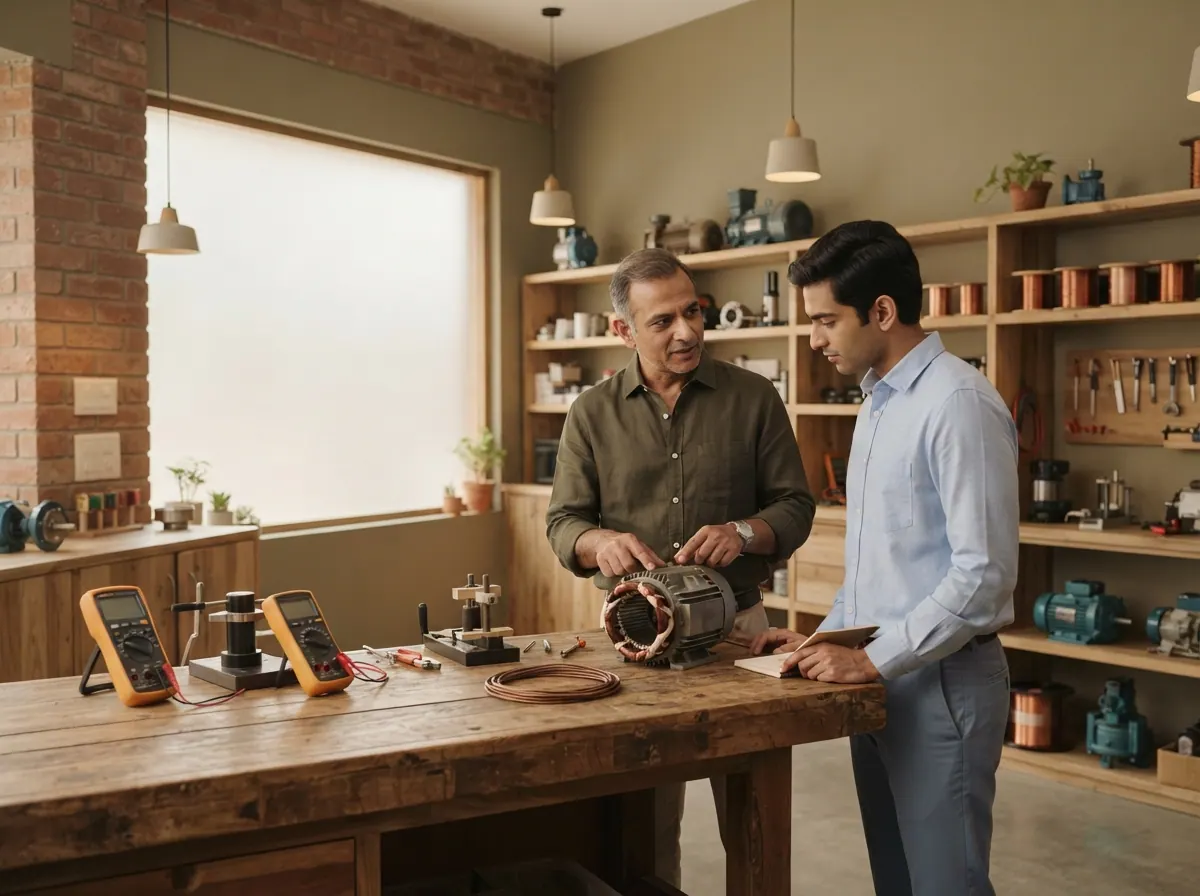
To start a motor rewinding and pump repair shop in India you need a winding machine, hand tools, a megger and multimeter, a varnish and baking setup, a stock of enamelled copper wire and insulation, one trained winder (yourself or a hired one), and about ₹1 lakh to ₹3 lakh. You earn by rewinding burnt pump and workshop motors, changing bearings, and repairing fans, mixers and small pumps. The biggest cost of each job is the copper, and the biggest risk is a motor that comes back burnt.
All figures here are estimates. Check prices near you before you spend.
What does it cost?
| Item | Basic shop | Fuller shop |
|---|---|---|
| Winding machine and coil formers | ₹15,000–35,000 | ₹35,000–70,000 |
| Hand tools, bearing puller, press | ₹10,000–20,000 | ₹20,000–40,000 |
| Megger, multimeter, clamp meter | ₹6,000–12,000 | ₹12,000–25,000 |
| Varnish dip tank and small baking oven | ₹10,000–25,000 | ₹25,000–50,000 |
| Copper wire, insulation, sleeves, bearings (starting stock) | ₹25,000–50,000 | ₹60,000–1.2 lakh |
| Shop deposit, bench, racks, shutter | ₹15,000–30,000 | ₹30,000–50,000 |
| Phone, board, visiting cards | ₹3,000–8,000 | ₹8,000–15,000 |
| Total | about ₹1–1.8 lakh | about ₹2.2–3 lakh |
Copper is costly and its price moves, so buy in small amounts at first, from a wire dealer who gives good-quality enamelled wire and proper bills.
What do you need before you start?
- A proper winder's skill. Motors need the same number of turns, wire gauge, coil span and connection as the original. A winder who guesses will return burnt motors.
- Motor basics. Learn single-phase and three-phase motors, capacitors, starters and why motors burn: low voltage, dry running, overload, a failed bearing or a single-phase supply on a three-phase motor.
- Testing before delivery. A megger test for insulation and a no-load current check for every motor you return.
- A place near your customers. Near a market, a mill belt, a farm area or a borewell mechanic, who can send you work.
- A copper dealer. Good wire at steady rates, and a way to verify wire quality.
How much can it earn?
Here is a settled shop in its second year, with one hired helper. These numbers are examples, not promises.
Monthly income
- 30 rewinds × about ₹2,000 average bill = ₹60,000
- 40 small jobs (bearings, fans, mixers, capacitors) × about ₹350 = ₹14,000
- Total bills = ₹74,000
Materials
- Copper, insulation and varnish for rewinds, about 50% = ₹30,000
- Parts for small jobs, about 30% = ₹4,200
- Total materials = ₹34,200
Monthly costs
- Shop rent = ₹6,000
- One helper = ₹9,000
- Power, varnish, misc = ₹5,000
- Total = ₹20,000
Left over: ₹74,000 − ₹34,200 − ₹20,000 = about ₹19,800 a month.
This is a modest number, and it is the honest one. If you do the winding yourself and tie up with borewell mechanics who send regular pump motors, you can keep more.
Step by step
- Work for a year under an experienced winder if you can. Learn to read data from the burnt winding and from the nameplate.
- Buy the winding machine and test equipment first, then a small stock of the most-used wire gauges.
- Meet borewell mechanics, electricians and farm pump dealers. They often get the first call when a motor burns, and many do not wind themselves.
- Record data from every motor before you strip it: turns, gauge, span, connection. Keep a card for each.
- Test each motor with a megger and no-load current before you return it.
- Give a short warranty in writing, and say what it does not cover, for example voltage problems or dry running.
- Add pump repair and sales once your winding work is steady.
Which licences apply?
For a small shop:
- Shop and establishment registration with your local body.
- GST once your sales pass the limit, or if business customers need tax invoices. Ask a CA.
- Local rules on noise, varnish fumes and disposal of old copper and varnish waste. Ask your local office.
- Fire safety around the baking oven and varnish. Ask your local fire office.
- Staff rules. If you employ several people, ask your local labour office about wages and records.
What goes wrong?
- Motors returning burnt. A wrong gauge or turns count, or a poor connection, burns the winding again.
- Customers who bring in the same motor again and again. The real fault is voltage, dry running or a weak starter, not the winding.
- Copper rate jumps. A fixed quote can turn into a loss in a week.
- Bearings and shafts ignored. A new winding on a worn bearing fails again, and the customer blames the winder.
- Unpaid farm or mill bills. Farmers and small mills pay late, often after harvest or a big order.
- Substituting poor wire. Thinner or poor-quality wire saves money for a month and costs customers for a year.
Situations you will face
What would you do? Each choice costs something.
Getting started
You can strip a motor but have never wound a full coil set. A winder offers to teach you for a year at a low wage.
- Learn from the winder first: Low pay now, motors come right
- Open and learn on jobs: Earn sooner, burnt motors likely
A semi-automatic winding machine counts turns for you. A manual one is cheaper but slower and counted by hand.
- Buy the counting machine: Costlier, fewer turn errors
- Buy the manual machine: Cheaper, slow and error-prone
One dealer sells good enamelled wire at a steady price. The other is cheaper but gives no bill and unclear quality.
- Buy from the proper dealer: Costs more, safe winding
- Buy a small trial from both: Mixed cost, test the cheap one
A small baking oven gives a good varnish cure. Air drying costs nothing but takes days and leaves a weaker finish.
- Buy a baking oven: Cost now, longer-lasting winding
- Air dry for now: Free, slow and weaker
A megger checks insulation before you hand back a motor. A multimeter alone cannot show weak insulation.
- Buy the megger: Spend now, fewer returns
- Use the multimeter only: Saves money, motors may fail
A shop beside the borewell mechanics costs more. A lane shop is cheap but few customers come by.
- Take the shop near mechanics: Higher rent, steady referrals
- Take the lane shop: Low rent, few referrals
A motor arrives with a burnt winding. Writing down turns, gauge and span takes time, and some owners are in a hurry.
- Record all the data first: Slower, correct winding
- Strip it quickly, wind by guess: Faster, burnt motor risk
First month
A farmer returns a pump motor you wound last week. It has burnt again and the farmer is angry.
- Test, find cause, rewind free: Cost to you, trust kept
- Charge half and rewind: Some money, angry farmer
A flour mill owner brings a motor for the third time. The area has low evening voltage and the starter is weak.
- Suggest a stabiliser and starter: Lose a rewind, gain trust
- Rewind and warn about voltage: Honest, income is smaller
A customer wants only a rewind to save money, but the bearings are worn and the shaft wobbles.
- Change the bearings too: Bigger bill, motor lasts
- Rewind and tell about bearings: Cheaper bill, warned it may fail
Wire costs rise by a good margin. You have quoted four customers last week at the older rate.
- Honour the quotes: Loss now, goodwill
- Raise the price, explain: Margin safe, some complaints
A farmer needs the pump motor today and says payment comes after harvest in three months.
- Wind now, take part payment: Some risk, loyal farmer
- Cash only: Safe money, lose the job
Before summer, many cooler and ceiling-fan motors arrive. They pay little, but they bring new faces to your shop.
- Take them, quick turnaround: Small bills, many new customers
- Keep the bench for pumps: Bigger bills, fewer walk-ins
Running it
Dozens of burnt pump motors arrive in one week. You can wind about ten a week alone.
- Hire a temporary winder: Wage cost, more rewinds
- Take only what you can do: Quality kept, lose jobs
Two mechanics send you steady pump motors and ask for a cut of each bill.
- Give a small fair cut: Less margin, steady work
- Refuse the cut: Full margin, fewer motors
A customer offers old wire from a burnt motor and asks you to reuse it to save cost.
- Refuse and use new wire: Higher bill, reliable motor
- Turn the job down: No risk, lose the job
Customers ask you to repair pump bodies, impellers and seals, not only the motor.
- Stock pump parts, learn: Stock cost, bigger bills
- Do only the motor part: Simple, miss some jobs
A customer returns a motor after two months, claiming it is under warranty. You said one month.
- Check it and repair at cost: Small cost, goodwill
- Hold to one month: Policy kept, upset customer
Varnish cans are stored close to the oven. A helper notices them getting hot and warns you.
- Move them, add an extinguisher: Small cost, safe shop
- Move cans to a cool shelf: Small cost, slower oven use
Small jobs pay little but come daily. They crowd out larger rewinds that pay more.
- Set a small-job day: More rewinds, some small jobs lost
- Take all jobs: Many customers, thin bills
A small workshop customer asks for a tax invoice for the rewinds. You are near the registration limit.
- Register and bill properly: CA fee, bigger customers
- Plain bills, register at the limit: Saves the fee, may lose the customer
When things go wrong
Your trained helper opens a bench two lanes away and some farmers follow.
- Raise pay for the next one: Higher wage, keeps standards
- Do all the winding yourself: No wage, slower work
Four motors you wound with one reel have shorted early. The enamel on that wire was poor.
- Rewind all four free: Costly, trust saved
- Tell all four, rewind at cost: Cheaper, honest
A new shop offers rewinds at half your price. Some of your regulars try them.
- Match on small motors: Thin margin, keep customers
- Stay on testing and warranty: Margin safe, lose some
Power cuts stop your machine and oven for days, while rent and wages continue. Customers wait.
- Rent a small generator: Rent cost, work continues
- Wait for power: No cost, delays and cancels
A flour mill owes ₹18,000 for three rewinds and keeps delaying. It is a regular customer.
- Ask part payment, pause work: Pressure, may lose the mill
- Keep working, wait: Keep the client, cash tied
Growing
A small factory wants 10 HP and bigger motors wound. You would need bigger formers and a stronger stand.
- Buy bigger equipment: Large spend, higher bills
- Stay with small motors: No spend, smaller bills
A dealer offers pumps to sell on a small margin. It needs stock, but your customers trust your advice.
- Stock a few pump sets: Cash tied, extra margin
- Keep only repairs: Simple, miss some sales
A small factory with thirty motors wants a yearly contract for checks and quick repair.
- Take the yearly contract: Steady work, low rate
- Charge per job: Higher rate, uncertain work
Work is piling up. A trained winder will cost a good wage and needs a second machine.
- Hire a winder, add a machine: Spend and wage, more rewinds
- Raise your own rates: No spend, fewer jobs
Is it right for you?
Motor rewinding suits you if you have patient hands, like working out why a machine failed, and are comfortable with steady, modest income. It suits you less if you want quick profits, or if you dislike dust, varnish smell and long hours on a bench.
A good test: spend a few months with a winder, strip and rewind at least thirty motors under supervision, then open with a small bench and a winding machine, tie up with two or three mechanics who send pump motors, and grow from there.