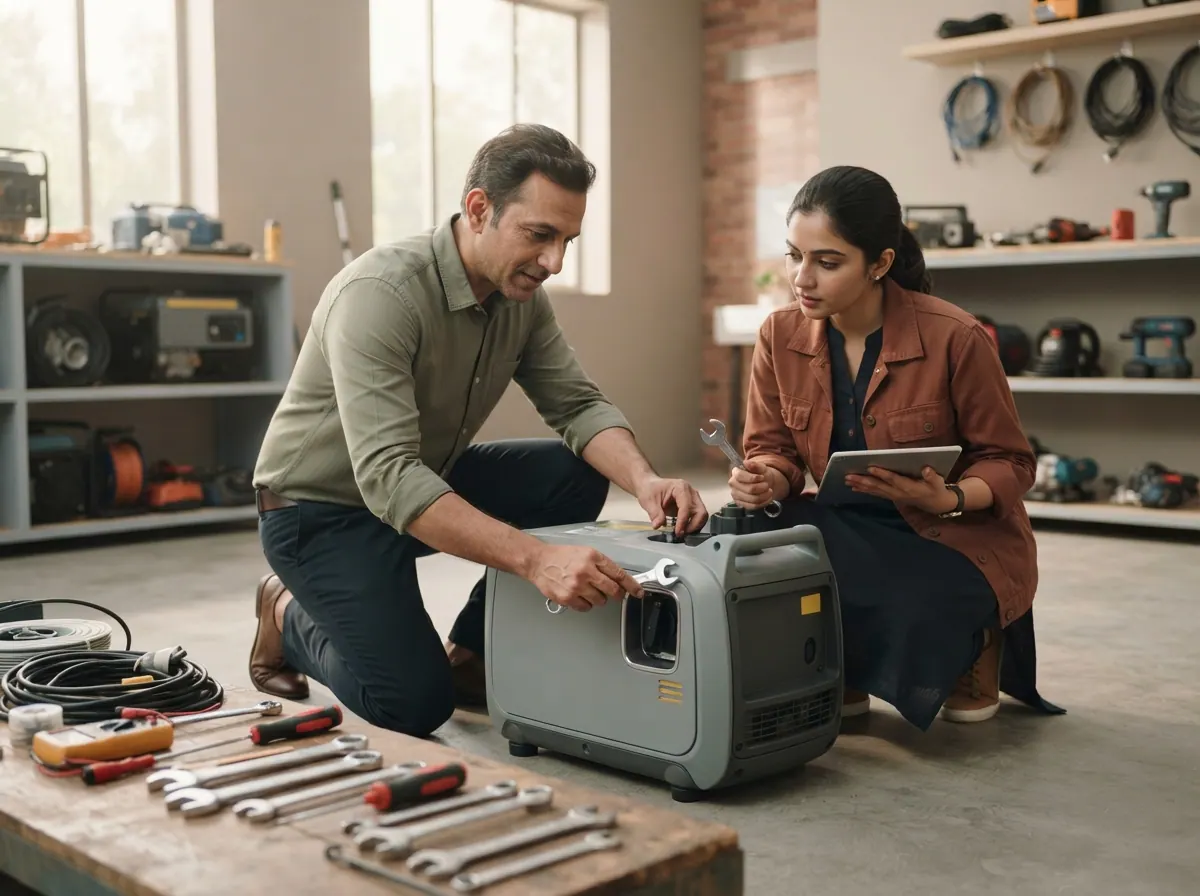
To start a generator rental business in India you need two or three well-maintained silent DG sets, a loader or tempo to move them, heavy cables with proper connectors, a person who can handle the wiring safely, and about ₹3 lakh to ₹15 lakh depending on how many sets and what size. You earn rent by the day or hour from weddings, events, shops, construction sites and small factories. The money is in keeping sets running, not in having them sit in a yard.
All figures here are estimates. Check prices near you before you spend.
What does it cost?
| Item | Small start (3 sets) | Fuller fleet (4 to 5 sets) |
|---|---|---|
| Silent DG sets (e.g. 10 kVA, 15 kVA, 25 kVA) | ₹2–4 lakh used or small new | ₹7–11 lakh |
| Heavy cables, couplers, distribution box | ₹25,000–50,000 | ₹60,000–1 lakh |
| Earthing kits, MCBs, safety gear | ₹10,000–20,000 | ₹20,000–35,000 |
| Loader or tempo | Hire | ₹1–2.5 lakh |
| Yard or shed, tarpaulin, security | ₹10,000–25,000 | ₹30,000–60,000 |
| Insurance, papers, advertising | ₹10,000–20,000 | ₹25,000–40,000 |
| Total | about ₹3–5.5 lakh | about ₹10–15 lakh |
Used sets can save a lot, but check the running hours and ask a mechanic to inspect the engine and alternator before you pay.
What do you need before you start?
- A clear idea of your customers. Tent houses, caterers, builders, shops and function halls all rent differently. Ask them what size they use and when.
- Engine knowledge. You need to know oil, coolant, filters, belts, batteries and how to spot a failing alternator.
- Safe electrical connection. Hooking a generator into a house or shop without a changeover switch can send power back into the line and hurt a linesman. Always use a proper changeover.
- A person who can run on-site. Many customers want an operator who starts the set and refuels it.
- Insurance and a rental agreement. The agreement says who pays fuel, what happens on damage, and when rent ends.
How much can it earn?
Here is a small fleet in its second year. These numbers are examples, not promises.
Monthly rental income
- 2 sets of 10 kVA × 8 days × about ₹3,000 a day = ₹48,000
- 1 set of 15 kVA × 7 days × about ₹4,500 = ₹31,500
- 1 set of 25 kVA × 5 days × about ₹7,000 = ₹35,000
- Total = ₹1,14,500
Monthly costs
- Two operators or drivers = ₹28,000
- Loader fuel and upkeep = ₹12,000
- Servicing and spares = ₹10,000
- Yard rent, insurance, misc = ₹8,000
- Total = ₹58,000
Left over: ₹1,14,500 − ₹58,000 = about ₹56,500 a month before any loan.
If you borrowed ₹8 lakh and your instalment is about ₹20,000 a month, you keep about ₹36,500. Each set here is rented only about a quarter of the month, so a slow month with few weddings can bring in a lot less while your costs stay.
Step by step
- Talk to ten customers such as tent houses, caterers, builders and shop owners. Ask what size, when, and what they pay now.
- Buy or lease your first set in a size they ask for. Test it under load for a few hours before buying a used one.
- Get proper cables and an earthing kit. Never hand over a set with twisted wires.
- Write a simple rental agreement that includes fuel reading, security deposit, damage terms, and late return charges.
- Take a security deposit for each set and keep a checklist with photos at handover and return.
- Service after each rental. Check oil, filters and coolant, and keep a log for each set.
- Add sets as your booking diary fills, and add a larger set only after repeat requests.
Which licences apply?
Paperwork depends on the state and the size of the set:
- Shop and establishment registration and GST, as with most trades. Ask a CA.
- Pollution and noise rules for generator sets exist, and silent canopy sets are common for rentals. Ask your pollution control board what applies.
- Fuel storage. Keeping diesel in large quantities has safety and fire rules. Ask your local fire office.
- Insurance for the sets, for transit and for damage to customers' property.
- Electrical rules for installation at sites. Use a licensed electrician where a connection to a building is needed.
What goes wrong?
- Idle sets. A set that is booked ten days a month still costs insurance, a yard and a loan every day.
- Customers who overload the set. A 10 kVA set trips or burns when a caterer plugs in too much. Teach them the load.
- Late return and fuel disputes. Without a clear fuel reading, one side feels cheated.
- Wedding-night breakdown. A set failing at a function is a disaster for your name. Test before every booking.
- Water in the diesel. It chokes the engine in the middle of a function.
- Theft of cable and fuel. Copper cable and diesel disappear from yards and sites.
Situations you will face
What would you do? Each choice costs something.
Getting started
A dealer offers a used 15 kVA set at nearly half the new price. Its running hours are not written anywhere.
- Buy a new set: High price, fewer breakdowns
- Buy used after a mechanic check: Lower price, a mechanic fee
Caterers ask for 10 kVA, builders want 25 kVA. You can afford only one set for now.
- Buy a 10 kVA silent set: More bookings, smaller rent
- Buy a 25 kVA set: Bigger rent, fewer customers
A shop sells cable that looks thick enough for rental use at a low price. It heats up under a heavy load.
- Buy proper rated cable: Costly, safe for heavy loads
- Rent only to small loads: Cheaper cable, fewer bookings
A yard with a guard costs more than an open plot near your home. Thieves target cable and diesel.
- Pay for a guarded yard: Higher rent, safer sets
- Use the open plot: Cheap, theft risk
Your first customers are friends who say there is no need for papers. You worry about fuel and damage disputes.
- Use a written agreement: Awkward, avoids fights
- Trust them on word: Friendly, a dispute risk
A shop owner asks you to connect the generator straight to the panel without a changeover switch.
- Insist on a changeover: Needs an electrician, safe
- Turn the booking down: Lose the job, no risk
Wedding customers ask for someone to start and watch the set. An operator costs wages every day.
- Offer a paid operator: Higher bill, fewer faults
- Hand over with a short demo: No wage, customers misuse it
First month
A customer says the set used little diesel. Your tank shows a much bigger drop, and there is no note.
- Settle on a fair middle: Lose some, keep customer
- Insist on full amount: Full money, angry customer
Halfway through the reception your set trips. The caterer has plugged in too many ovens.
- Send a standby set: Cost of transport, goodwill
- Reset it and explain the fault: Small cost, honest answer
A set coughs and stops at a shop opening. You find water in the bottom of the tank.
- Drain tank, change filters: Cost and delay, engine saved
- Just restart and hope: No cost, injector damage risk
A builder's team kept the set two extra days and says the work ran over. The next customer is waiting.
- Charge the extra days: Fair money, builder annoyed
- Waive the extra: Goodwill, lose rent
The sets are booked back to back. A proper check after each return costs time, oil and filters.
- Check after every return: Time and parts, fewer breakdowns
- Service monthly only: Saves time, failures likely
A caterer plans to run several ovens and coolers on one 10 kVA set. The set will trip or overheat.
- Insist on a bigger set: Higher rent, no breakdown
- Rent two small sets: More handling, split load
Running it
Every date is booked, and a tent house asks for three more sets. You own two.
- Sub-rent from another firm: Margin shared, more income
- Say no to the extra: No risk, lose a regular
Diesel gets costlier and customers grumble about fuel bills. Some say your sets use too much.
- Offer fuel-saving tune-ups: Service cost, happy customers
- Ignore the complaints: No cost, quiet losses
A builder wants a 25 kVA set for three months. Rent is lower per day and payment comes monthly.
- Take the long contract: Steady money, lower rate
- Keep for short bookings: Higher rate, uncertain days
A big event firm asks for a fifteen percent discount in exchange for regular bookings.
- Give the discount: Thin margin, steady bookings
- Offer a smaller discount: Better margin, may refuse
A function in a residential lane ran a set late at night. Neighbours phoned the police about the noise.
- Offer a silent canopy set: Costly set, fewer complaints
- Tell customers to handle it: No cost, bad name risk
A first-time customer wants the set now and promises to pay after the function.
- Take a deposit first: Safe money, a few refuse
- Give it on trust: Friendly, payment risk
An agent offers a policy covering theft and damage on the rental sets. The yearly premium is not small.
- Buy the policy: Yearly cost, covered losses
- Skip it for now: No premium, big risk
A fair committee wants power for stalls for ten days. They ask for a low rate and payment after the mela.
- Take it with half advance: Good income, tight handling
- Take it all on credit: Bigger bill, payment risk
When things go wrong
Someone cut the lock and took a roll of heavy copper cable. A booking is tomorrow.
- Buy new, add guard and light: Costly, deters thieves
- Rent proper cable for now: Rent cost, safe for loads
A set burned its alternator during a booking. Repair is costly and the customer asks for a refund.
- Repair, refund the day: Big cost, trust saved
- Check the log, share the cost: Costs repair, fair to customer
Your oldest set smokes and loses power. A full overhaul costs nearly a new small set.
- Overhaul the engine: Large bill, set back in work
- Sell it, buy a newer one: Cash in, bigger purchase
A new firm rents at a lower rate with old sets. Some regular customers try them.
- Match the rate on small sets: Thin margin, keep customers
- Stay on reliability: Margin safe, lose some
Heavy rain floods your yard and water enters two sets. You must dry and test them before use.
- Dry and fully test them: Cost and delay, safe sets
- Raise the sets, test one: Cheaper, another may fail
Growing
A factory and a hospital annex ask for a big set. It costs a lot, and bookings are rare but high value.
- Buy the big set: Huge spend, large rent
- Sub-rent one when needed: No spend, thin margin
Event firms ask for light towers, cables and distribution boards with the set as a package.
- Offer a full power package: Equipment cost, bigger bills
- Rent only the generators: Simple, lose package buyers
A town 30 km away has no good rental firm. You would need a loader trip and a local contact.
- Start service there: Transport cost, more bookings
- Stay in your own town: Easy, less growth
Shop and hall owners with their own generators ask who can service them yearly.
- Offer yearly service plans: Steady income, mechanic wage
- Stay with rentals only: Simple, miss a market
Is it right for you?
Generator rental suits you if you can handle machines, keep records, and take calls at odd hours during wedding season. It suits you less if you do not like talking about damage and deposits, or if you need steady money every month, because income swings with weddings, weather and power cuts.
A good test: spend a wedding season helping a tent house or a rental firm with their sets. If you can handle the late nights, start with two or three well-chosen sets and an operator, and add more only when your diary is full.