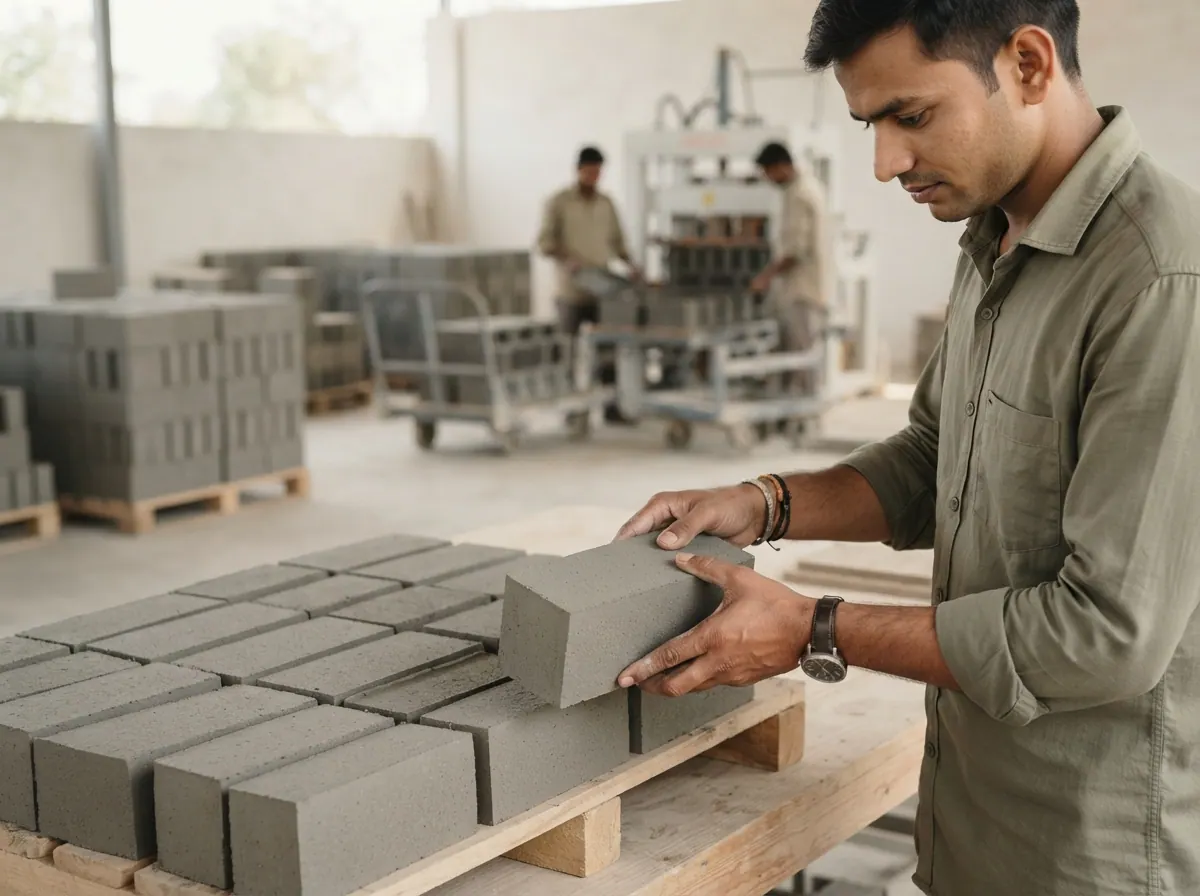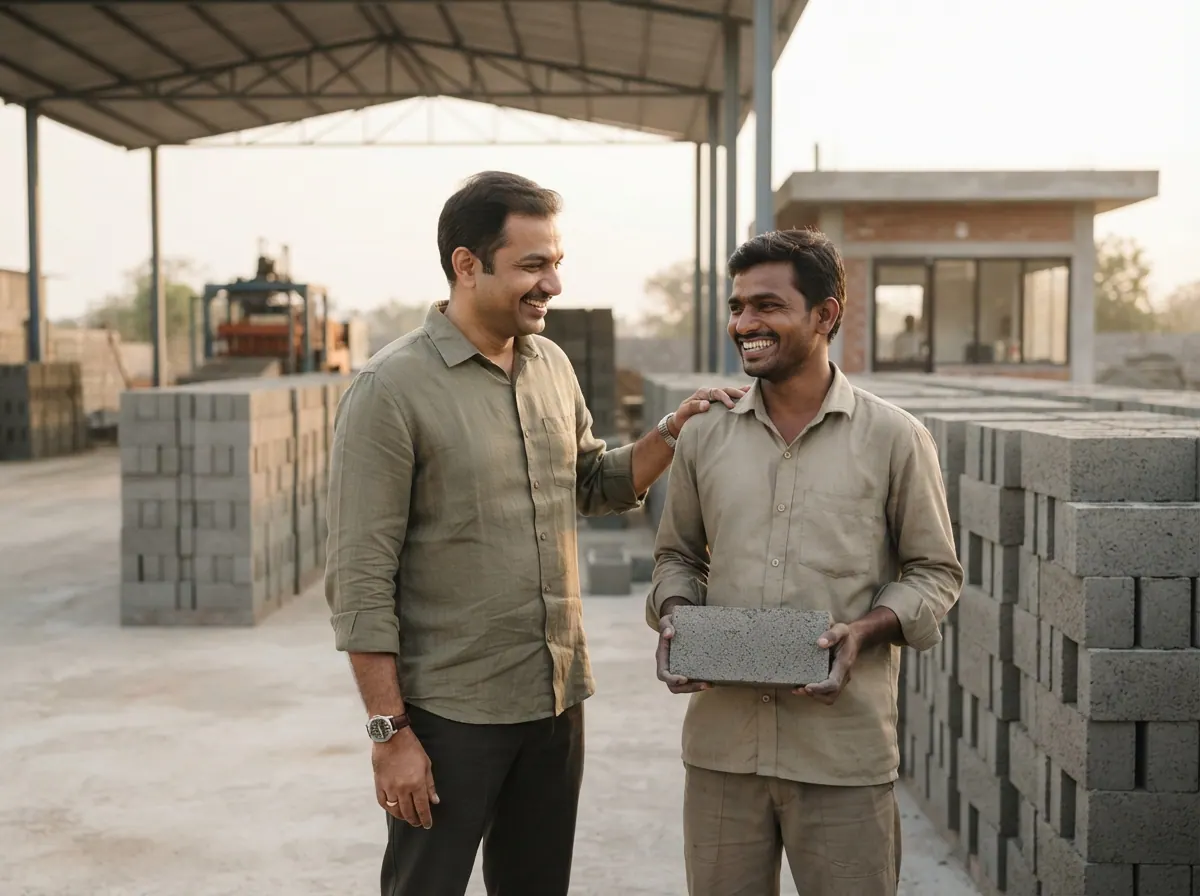
To start a fly ash bricks and cement blocks unit in India you need a press machine, a mixer, a level yard with a covered shed, a curing area with water, a source of fly ash close by, and about ₹5–30 lakh. The money is made on thousands of bricks every day, so your raw material cost, your breakage and the distance you deliver decide your profit.
All figures here are estimates. Check prices near you before you spend.
What does it cost?
| Item | Small semi-automatic unit | Larger automatic unit |
|---|---|---|
| Land or yard on rent (deposit) | ₹1–3 lakh | ₹3–8 lakh |
| Shed, level floor and water tank | ₹1.5–4 lakh | ₹4–8 lakh |
| Brick press (semi or fully automatic) | ₹3–8 lakh | ₹8–15 lakh |
| Pan or drum mixer | ₹40,000–1.2 lakh | ₹1.5–3 lakh |
| Pallets, trolleys and moulds | ₹50,000–1.5 lakh | ₹2–4 lakh |
| Loader or conveyor | not needed | ₹1–3 lakh |
| Power connection and wiring | ₹30,000–1 lakh | ₹1–2 lakh |
| Fly ash, cement and sand stock to start | ₹1–2.5 lakh | ₹3–6 lakh |
| Registration and lab tests | ₹20,000–50,000 | ₹40,000–1 lakh |
| Total | about ₹5–15 lakh | about ₹15–30 lakh |
Pallets are a cost people forget. A unit that makes thousands of bricks a day needs several thousand pallets, or the bricks have nowhere to cure.
What can you make?
- Fly ash bricks. The common product, sold to builders and contractors for walls.
- Solid and hollow cement blocks. Used in boundary walls and frame buildings.
- Paver blocks. Need different moulds and a different customer base, such as colonies and compounds.
- Kerb stones and tiles. Add these only once the first product sells steadily.
How much can it earn?
Take a small semi-automatic unit making about 4,000 bricks a day, over 26 days, so 1,04,000 bricks a month. These are rough numbers.
Each month
- Sales: 1,04,000 bricks × about ₹6.50 = ₹6,76,000
- Raw material (fly ash, cement, sand): 1,04,000 × about ₹3.80 = ₹3,95,200
- Eight workers: 8 × ₹12,000 = ₹96,000
- Power and diesel: about ₹20,000
- Rent and loan interest: about ₹40,000
- Left over: ₹6,76,000 − ₹3,95,200 − ₹96,000 − ₹20,000 − ₹40,000 = about ₹1,24,800
That assumes you sell every brick at that rate and the builders pay. Breakage of even 5% takes about ₹33,800 from sales. Rain stops production for days, and a rise in the price of cement or fly ash hurts at once. Delivery by truck is usually extra, and long distances can make your bricks dearer than a rival's.
What do you need before you start?
- Fly ash nearby. Transport can cost as much as the fly ash itself. Know where the ash comes from and what it costs delivered.
- A mix that passes tests. Take samples to a lab, and keep records of the ratio you use.
- Level, well-drained land. A flat yard with a hard surface, away from flooding, with water for curing.
- Builders who will buy. Contractors, builders and masons near you, and their payment habits.
- Working capital. Cement and ash are paid for quickly, while builders may pay in weeks.
Step by step
- Visit two units and ask about the mix, breakage and how many days they lose to rain.
- Find your fly ash and cement source and get delivered rates.
- Prepare the yard with a level floor, a shed over the press, curing area and a water supply.
- Install the machine and mixer, and run a trial with a lab-approved mix.
- Make test bricks and send samples for strength tests after curing.
- Cure for the full period, keeping bricks wet as advised.
- Show samples to builders and take small first orders, delivering on the day you promise.
Which licences apply?
Rules vary by state and site, so confirm each with local offices:
- Udyam registration for loans and schemes.
- GST, if your sales need it. Ask a CA.
- Land use permission for an industrial or small-scale unit on your plot.
- Pollution consent. Fly ash dust and wastewater may need consent from the state pollution board.
- Rules on using fly ash. India has rules that encourage fly ash bricks near power plants. Ask the district industries centre what applies to you.
- Quality standard. Bricks have a Bureau of Indian Standards specification, and some buyers ask for tests. Ask the BIS office.
- Loans and schemes. Banks and some state schemes support small building material units. Ask the district industries centre what is open now.
What goes wrong?
- Weak bricks. Too little cement, bad curing or wrong mix gives bricks that crumble, and builders return them.
- Breakage in handling. Rough stacking and loading can break a large share of the bricks.
- Rain. Production stops and uncured bricks can wash out.
- Fly ash dust. It affects workers' lungs and neighbours' homes. Use masks, water spray and a covered store.
- Delivery costs. Long distances eat your margin.
- Late payment from builders. A large order paid after three months can block your next purchase of cement.
Situations you will face
What would you do? Each choice costs something.
Getting started
An automatic press makes far more bricks per day but costs several times as much. You have no steady orders yet.
- Buy the semi-automatic press: Lower cost, slower output
- Buy the automatic press: Big spend, faster output
A power plant supplies ash at a low rate but it is far away. A nearby dealer sells it at a higher rate.
- Buy direct from the plant: Cheaper ash, freight cost
- Buy from the nearby dealer: Dearer ash, easy supply
The yard is uneven and turns to mud in rain. A hard level floor costs a good sum.
- Lay a hard level floor: Costly, fewer broken bricks
- Level the soil only: Cheap, muddy and uneven
A lab test of your mix costs money and takes days. Your machine maker says the standard ratio is fine.
- Get the mix lab-tested: Fee and wait, trusted bricks
- Go ahead with the ratio given: Faster, unknown strength
Bricks need pallets while they cure. Buying enough costs a lot, and fewer pallets limit your output.
- Buy a full set of pallets: Big spend, steady output
- Buy half and add later: Less spend, limits output
The industrial connection will take a month. A generator can run the press until then.
- Rent a generator: Fuel cost, start on time
- Wait for the connection: Save money, lose weeks
The ash dust may need consent from the pollution board. The paperwork needs a fee and a site visit.
- Apply before starting: Fee and wait, safe start
- Start with a trial run only: Small output while applying
First month
Test bricks break easily after a week. The cement may be too little or the curing too short.
- Adjust the mix, cure longer: Lose a batch, fix the mix
- Sell them for filler use: Some cash, weaker name
Bricks need to stay wet for days. The borewell gives little water in summer.
- Dig a tank and fit a pump: Cost now, steady curing
- Buy water by tanker: Daily cost, flexible
A mason wants to try a thousand bricks before giving an order. The mason wants a lower price for the trial.
- Give the trial at a discount: Lower price, order may follow
- Sell at full price: Fair price, slower trust
The mixing area is dusty and workers cough. Masks and a water spray cost money.
- Fit a spray and give masks: Cost now, safer workers
- Give masks only: Cheap, dust still spreads
Builders expect delivery. A small truck costs a lot, and hiring trucks adds to every order.
- Buy a small truck: Big spend, control delivery
- Hire trucks per order: Per-trip cost, no capital
A third of a day's output is chipped after loading. Workers stack in a hurry.
- Train a loading crew: Wages, fewer breakages
- Accept the breakage: No cost, lower sales
Running it
Rain floods part of the yard. Uncured bricks are wet and some slump.
- Cover stacks and clear drains: Cost now, saves bricks
- Wait for it to pass: No cost, some bricks lost
Cement costs more per bag. Builders do not accept a higher brick price easily.
- Raise the brick price a little: Protect margin, lose a few buyers
- Hold the price: Keep buyers, thin margin
A builder wants a big supply over two months, with payment in 60 days.
- Take the order: Big volume, cash tied up
- Ask for 30% advance: Safer cash, may be refused
A nearby unit sells below your cost of delivery. Some builders ask you to match.
- Match for key builders: Lower margin, keep builders
- Hold the price, show test reports: Some buyers leave
A housing society wants paver blocks for its roads. It needs new moulds and colour.
- Buy moulds and make pavers: Spend now, higher price
- Stay with bricks: No spend, no new buyers
The ash trucks are delayed for a week. The press stands idle and workers wait.
- Buy ash from a dealer: Dearer, keep running
- Pause and wait: Cheaper, lose output
A worker gets a hand caught while clearing the mould. It is a painful crush injury.
- Pay treatment and wages, add guards: Cost now, safer press
- Pay the clinic bill only: Cheaper, workers lose trust
A builder with a deadline asks for bricks only a few days old. They are not fully cured and may be weak.
- Refuse until cured: Lose the rush, keep quality
- Offer older stock at a discount: Lower price, a safe sale
When things go wrong
A builder says a load is crumbling at the corners. It may be a bad batch or poor curing.
- Take back and replace: Heavy cost, trust kept
- Test and then decide: Test fee, a delay
A builder who took a large order keeps delaying payment. Cement suppliers want their money.
- Stop supply until paid: Lose the builder, protect cash
- Keep supplying small loads: Sales hold, risk grows
The press loses pressure in a rush week. The mechanic needs a part from another city.
- Pay for express delivery: Costly, quick restart
- Wait for the normal delivery: Cheaper, a week lost
Residents near the yard say dust coats their homes. A complaint may reach the pollution board.
- Cover stockpiles, spray water: Cost and effort, calmer area
- Wait and see: No cost, notice likely
Rain has cut sales for weeks. The bank instalment is due, and cash is low.
- Ask the bank for time: Extra interest, breathing room
- Sell stock at a discount: Cash now, lower margin
Growing
Orders exceed one shift. A second shift needs wages and more pallets for curing.
- Run a second shift: Wages and pallets, more output
- Stay on one shift: No spend, lose orders
Builders ask for hollow cement blocks too. You need new moulds and a bigger curing area.
- Add a hollow block line: Spend now, wider range
- Keep fly ash bricks only: No spend, no new range
Loading by hand is slow and breaks bricks. A loader costs a lot but speeds up dispatch.
- Buy the loader: Big spend, faster loading
- Hire extra loaders: Wages, slower
A contractor on a large project wants lab strength certificates for every lot you supply.
- Test every lot and share reports: Test costs, bigger orders
- Skip large project orders: No test cost, no big orders
Is it right for you?
A fly ash brick unit suits you if you have land or a yard, a fly ash source close by, and can manage workers and a daily production target. It suits you less if you want easy cash quickly, or if you have no way to deliver and collect payments from builders.
A good test: spend a few days at a running unit, count good bricks and breakage, and ask three builders what they pay and how soon. If the numbers still work, start with a small semi-automatic machine before you invest in a bigger one.