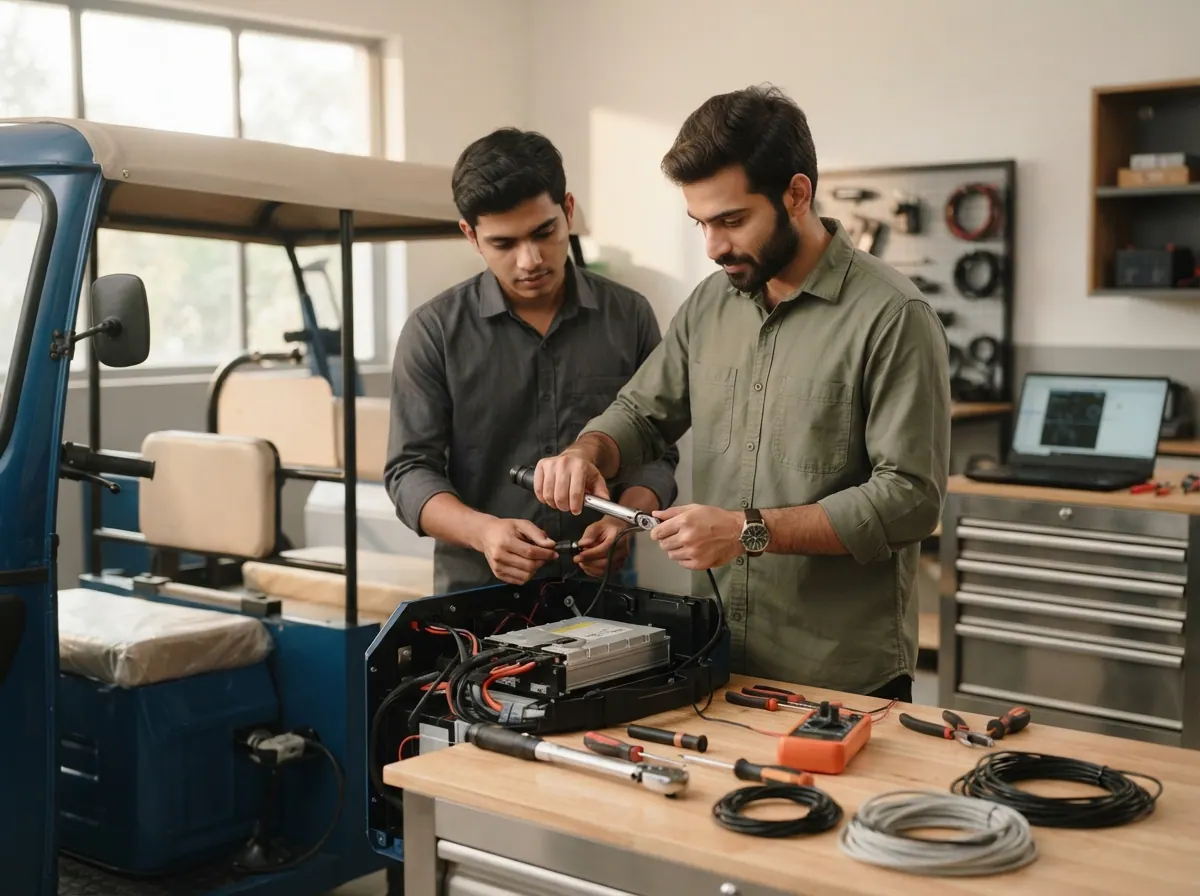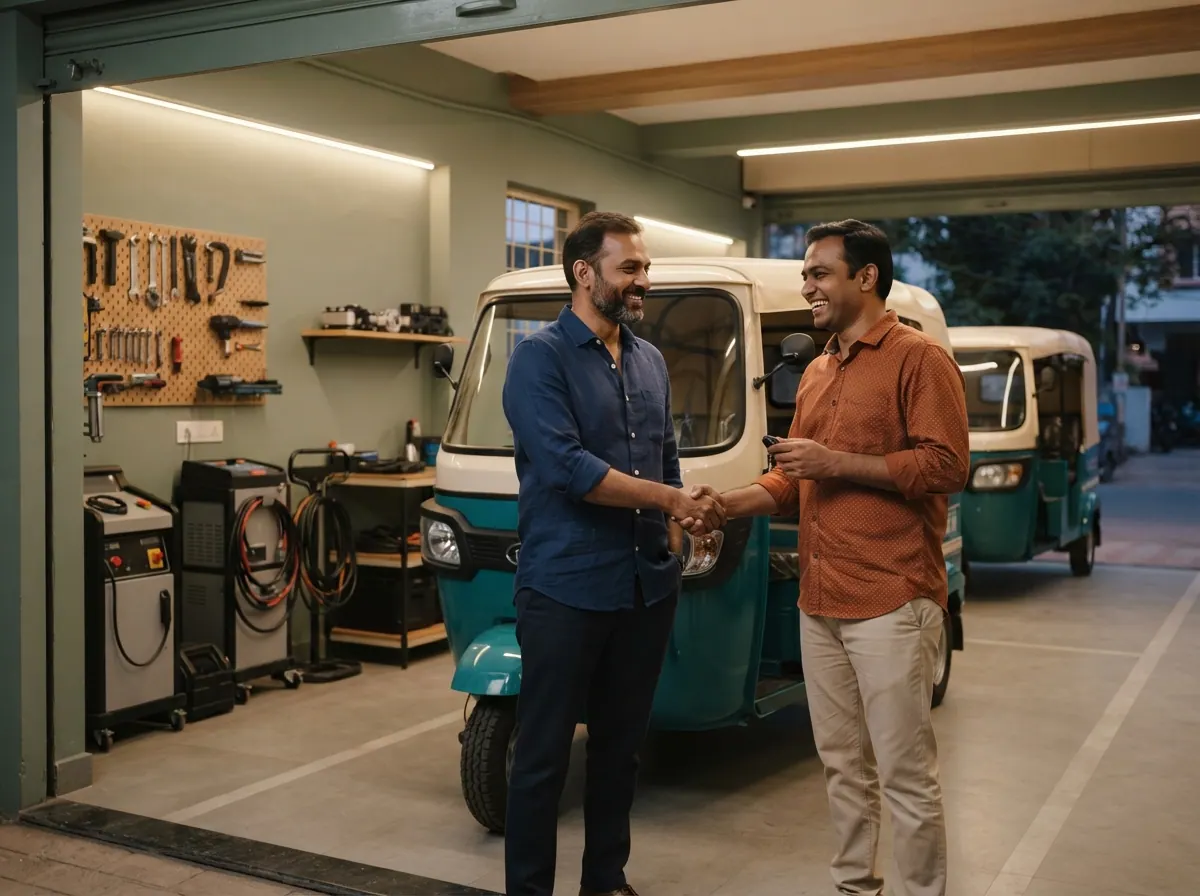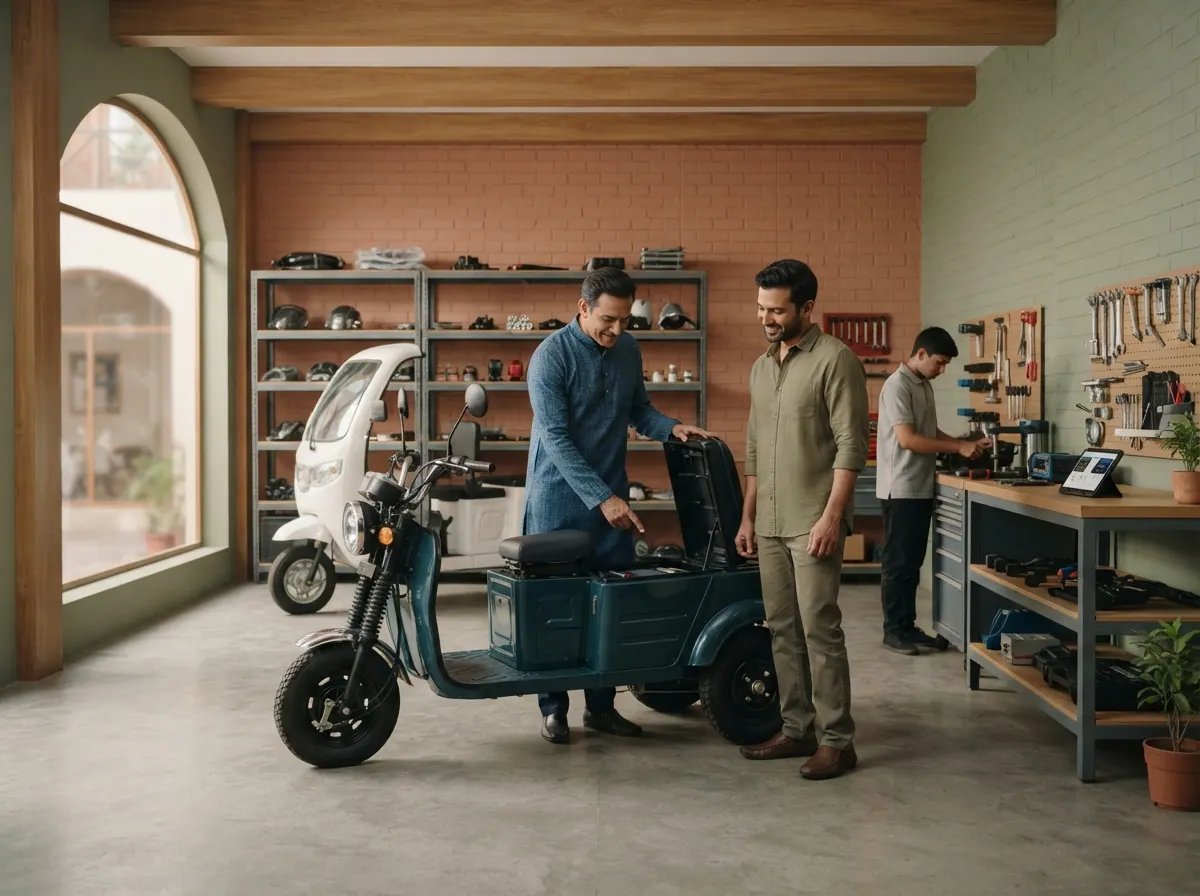
To start an e-rickshaw, auto and EV repair garage in India you need a covered bay near a road where e-rickshaws and autos stop, a multimeter and controller tester, a battery tester and charger, a hydraulic jack and hand tools, a spare parts stock, one trained helper, and about ₹1 lakh to ₹5 lakh. Your customers are mostly drivers who live on their daily earnings, so they pay quickly, but they expect you to fix the vehicle the same day.
All figures here are estimates. Check prices near you before you spend.
What does it cost?
| Item | Basic garage | Fuller garage |
|---|---|---|
| Multimeter, clamp meter, controller tester | ₹6,000–12,000 | ₹12,000–25,000 |
| Battery load tester, charger, hydrometer | ₹10,000–20,000 | ₹20,000–40,000 |
| Hand tools, jack, stands, welding set | ₹15,000–30,000 | ₹30,000–60,000 |
| Spare parts (controllers, contactors, brake shoes, tyres, tubes, bulbs) | ₹30,000–60,000 | ₹70,000–1.5 lakh |
| Battery stock (a few sets) | – | ₹80,000–1.5 lakh |
| Shop deposit, shed, shutter, board | ₹15,000–30,000 | ₹40,000–80,000 |
| Phone, billing, ads | ₹3,000–8,000 | ₹8,000–15,000 |
| Total | about ₹1–1.8 lakh | about ₹3–5 lakh |
Start with the repair work and a small parts stock. Batteries tie up a lot of cash, so add them after drivers have started trusting you.
What do you need before you start?
- Electrical and mechanical basics. E-rickshaws combine a motor, controller, contactor and batteries with a simple chassis. You need to read wiring, use a multimeter and know brakes, differential and tyres.
- Knowing local fleet types. Look at which makes and which batteries drivers use near you. Parts are not interchangeable across all models.
- Safe battery handling. Battery packs carry a lot of current. A dropped spanner across the terminals can cause burns or a fire. For lithium packs, learn proper handling from the maker.
- A spot where drivers pass. Near a stand, a market, a metro or a bus station, with space to park a few vehicles.
- Parts supplier. One good wholesaler in the nearest big market, and a way to get a missing part the same day.
How much can it earn?
Here is a settled garage in its second year. These numbers are examples, not promises.
Monthly income
- 70 repair jobs × about ₹800 average bill = ₹56,000
- Parts cost about 40% = ₹22,400
- Margin on jobs: ₹56,000 − ₹22,400 = ₹33,600
- Battery and tyre sales margin = about ₹12,000
- Total margin = about ₹45,600
Monthly costs
- Shop rent = ₹8,000
- One helper = ₹10,000
- Power, water, misc = ₹3,000
- Total = ₹21,000
Left over: ₹45,600 − ₹21,000 = about ₹24,600 a month.
Drivers often pay in cash on the spot. They also often ask for credit when the vehicle has been idle, so decide your credit rule before the first request.
Step by step
- Work in an existing garage for a few months on e-rickshaws and autos, if you can.
- Choose a location near a stand, a market or a metro station where drivers are always going by.
- Buy the test tools first, then a small parts stock for the faults you see most often.
- Be fast. A driver who loses a day loses income. Promise a time and meet it.
- Write each job down with the vehicle number, fault, parts, bill and date. Call back after a week to ask how it is running.
- Test batteries openly and show the driver the readings before suggesting a replacement.
- Add battery sales and a charging service once you have regular drivers.
Which licences apply?
For a small garage:
- Shop and establishment registration or a local trade licence. Ask your local body.
- GST if your sales cross the limit or a supplier needs it. Ask a CA.
- Waste oil and old batteries. Rules apply to disposing of used oil and lead-acid batteries. Ask your pollution control board or distributor.
- Fire safety for a garage with many batteries and chargers. Ask your local fire office.
- Brand authorisation if you want to advertise as an authorised service point. Ask the maker for their terms.
What goes wrong?
- Replacing a good battery. A driver pays for a new battery when the real fault was a loose terminal or a weak charger. They tell the stand.
- Cheap spare parts. A cheap controller that fails in two weeks sends the driver to the next garage.
- Same-day promises you cannot keep. Waiting for a part overnight loses the driver a day's earnings.
- Credit that does not come back. A driver who is short for a week is hard to chase.
- Fire from charging. An overloaded charger or poor wiring near cartons can start a fire.
- Newer models you cannot service. Lithium packs and newer controllers need training, tools and sometimes the maker's approval.
Situations you will face
What would you do? Each choice costs something.
Getting started
You know auto repair but not controllers and contactors. A garage owner offers you a month of work for a small fee.
- Pay and learn for a month: Fee and delay, fewer mistakes
- Open now, learn on drivers: Earn sooner, wrong fixes likely
A shop near the e-rickshaw stand costs double the rent. A lane shop is cheap but drivers rarely pass.
- Rent near the stand: Higher rent, drivers walk in
- Take the lane shop: Low rent, few walk-ins
A controller tester lets you find faults without swapping parts. It costs more than a multimeter.
- Buy the tester: Cost now, quicker diagnosis
- Swap parts to find faults: Saves money, slow and costly
Controllers fail often and cost a lot each. The market is a two-hour trip, so a missing part means a lost day.
- Stock the common ones: Cash tied, same-day repairs
- Order per breakdown: Little cash tied, slower jobs
You plan to charge four batteries at once near your cartons. An electrician offers proper wiring for a fee.
- Pay for proper wiring: Costly, safer from fire
- Charge only two at a time: Cheap, fewer jobs a day
A boy offers to work for very little, claiming to have watched repairs. A trained mechanic asks for much more.
- Hire the trained mechanic: Higher wage, faster repairs
- Hire and train the boy: Low wage, slow work
A driver with a dead motor cannot pay until earning again. The driver works at the stand every day.
- Repair now, part payment: Some risk, a loyal driver
- Cash first: Safe, driver goes elsewhere
First month
A driver says the batteries are dead and wants new ones. You find a corroded terminal and weak connections.
- Clean and tighten, charge: Small bill, honest, trusted
- Sell batteries after showing the fault: Small sale, the driver may decline
A trader sells controllers at a low price with no brand name. Drivers like cheap fixes.
- Stay with branded ones: Lower margin, fewer returns
- Stock the cheap ones: Better margin, early failures
A driver wants the vehicle back tonight. The motor part will reach you only in the morning.
- Fetch it by bike tonight: Fuel and effort, the driver is grateful
- Ask the driver to wait: No cost, driver loses earnings
Your helper dropped a spanner across a battery pack. There was a spark and a small burn on the helper's hand.
- Stop, teach safe handling: Lost hour, insulated tools
- Rest the helper, work alone: Slower jobs, helper recovers
A driver wants only a small adjustment, but you see the brake shoes are worn out and the driver carries school kids.
- Insist on new brake shoes: Bigger bill, safer ride
- Refuse the job as asked: Lose the job, the driver may go elsewhere
Running it
Summer heat kills many batteries at once. Drivers ask you for replacements, but a bulk order needs cash.
- Order batteries in bulk: Big outlay, strong sales
- Order per customer: Little cash tied, slower
Drivers leave old batteries when they buy new ones. A scrap dealer wants them but a recycler pays less and is far.
- Give to authorised recycler: Less cash, follows the rules
- Hold for a better rate: Space used, uncertain
A driver brings a new lithium-pack vehicle. You have not been trained on the pack or its software.
- Refer the driver to the maker: Lose the job, no risk
- Take training from the maker: Fee and time, new customers
A man with twelve e-rickshaws wants all repairs done by you at a lower rate, paid monthly.
- Take the contract: Steady work, delayed pay
- Ask for weekly payment: Safer money, the owner may refuse
Tyre jobs are many and you send them out. A machine costs money but keeps the margin.
- Buy the machine: Spend now, more margin
- Keep sending it out: No spend, lose margin
A motor you rewound has failed. The driver says it was under your warranty, but the warranty you gave was one week.
- Repair free this time: Cost to you, goodwill
- Stand by the one-week limit: Policy kept, angry driver
Flood water blocks the road and many vehicles stall in water. Drivers bring wet motors and controllers.
- Work late, dry and test each: Long hours, loyal drivers
- Take fewer wet vehicles: Rest, lose repair jobs
Many controllers burn in the heat. You suspect poor airflow and overloaded vehicles.
- Add fans, advise drivers: Extra work, fewer repeats
- Just replace controllers: More sales, drivers complain
When things go wrong
You smell burning in the morning. A charger is melted and the wire insulation near it has blackened.
- Replace wiring and charger: Costly, safer garage
- Shut charging for a week: Cheaper, lost battery work
Overnight, two customer batteries were stolen from your shop. Drivers look to you to cover them.
- Pay the drivers, add a guard: Costly, trust kept
- Report it and share the loss: Cheaper, drivers upset
A new garage nearby charges half for common repairs and uses cheap parts. Some drivers move.
- Match on labour only: Thin margin, keep drivers
- Stay on quality and speed: Margin safe, lose some
Traders say repaired vehicles parked on the road block their shops. A local officer has noticed.
- Rent a small parking space: Extra rent, no more complaints
- Park fewer vehicles: No cost, fewer jobs
Your senior mechanic quits to open a garage on the next road. Some drivers follow.
- Raise pay for the next one: Higher wage, steadier team
- Do the repairs yourself: No wage, slower service
Growing
A battery distributor offers you a dealer rate if you take a stock order. It brings more drivers but locks cash.
- Take the dealer rate: Big stock, better margin
- Buy battery by order: Little cash tied, thin margin
The shop is full of waiting vehicles. A second bay and a mechanic would double the jobs you can do.
- Build the second bay: Spend and wage, more jobs
- Book repairs by time: Cheap, still limited
A small e-rickshaw maker offers you service work for their buyers, but wants tools and a trained staff member.
- Accept and train a staff member: Cost and wage, steady jobs
- Stay independent: Freedom, fewer leads
Drivers stranded on the road call you at night. A tow cart or small pickup would let you fetch them.
- Buy a small pickup: Big spend, loyal drivers
- Send a mechanic on a bike: Cheap, only small faults
The leader of an e-rickshaw stand wants a lower rate for all twenty drivers, paid weekly.
- Give a small group rate: Many jobs, thinner margin
- Keep normal rates: Margin safe, fewer jobs
Is it right for you?
An e-rickshaw garage suits you if you are a hands-on mechanic, work fast, and can stay calm with tired drivers who want the vehicle back immediately. It suits you less if you dislike dirty, loud work, or if you want customers who pay well for a single job, because margins per job are small and volume matters.
A good test: spend a month in a garage near an e-rickshaw stand. If you enjoy the speed and the problem-solving, start with the basic setup near a stand, build a regular group of drivers, and then add battery sales.