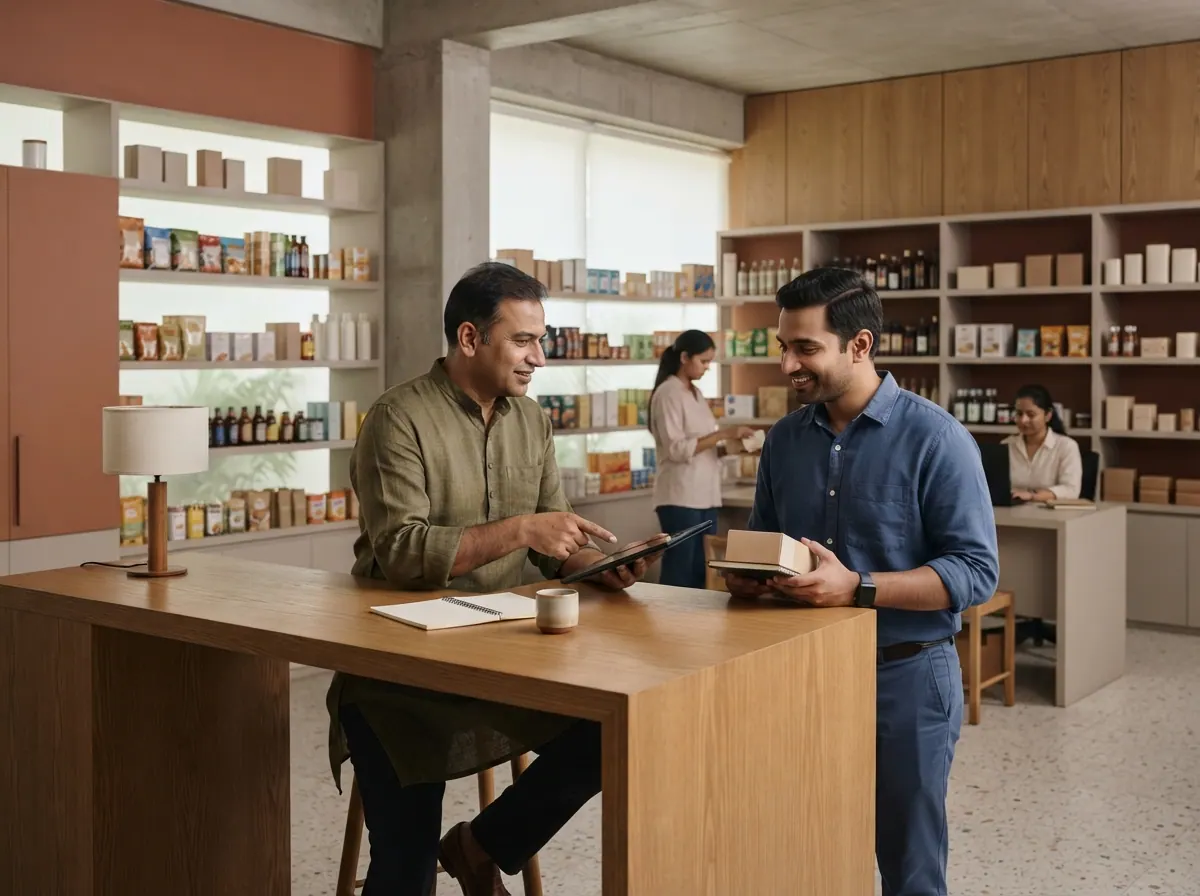
To start a distributorship in India you need a company that will appoint you for an area, a godown, a delivery vehicle, a few salesmen who know the shops, and about ₹5–30 lakh. The money goes mostly into stock, credit given to shops, and any deposit the company asks for. A distributor buys from the company and sells to kirana, general stores and small wholesalers, earning a small percentage on each sale. Profit comes from volume, quick collection and low expiry losses.
All figures here are estimates. Check the company's terms and local prices before you spend.
How do you get a distributorship?
Companies that sell food, soap, biscuits, oil, tea and similar goods appoint distributors area by area. Some advertise, some take enquiries through their area sales office, and some pick an existing wholesaler. Ask the company's sales office:
- Is there a vacancy in your town or nearby areas?
- What godown size, vehicles and staff do they expect?
- What deposit, credit terms and margin do they offer?
- Which shops and territory will be yours?
Do not pay anyone who promises to get you a distributorship. Only the company appoints you. You can also start by becoming a sub-distributor or wholesaler for an existing distributor and learn from there.
What does it cost?
For a small distributor covering one town and nearby villages:
| Item | Estimate |
|---|---|
| Godown rent deposit | ₹50,000–2 lakh |
| Racks, pallets, weighing scale, office setup | ₹50,000–1.5 lakh |
| Delivery vehicle (small pickup, used or new) | ₹1.5–6 lakh |
| Billing software, phone, printer | ₹30,000–80,000 |
| Company deposit, where asked | ₹1–5 lakh |
| First stock | ₹2–10 lakh |
| Credit given to shops in the first month | ₹1–4 lakh |
| Registration, GST and paperwork | ₹10,000–30,000 |
| Total | about ₹5–30 lakh |
Money tied up in stock and shop credit is your biggest cost. Count it before you count profit.
How much can it earn?
A distributor earns a percentage margin on what it sells, which the company sets. The numbers below use an assumed margin only to show the arithmetic.
Income
- Monthly sales to shops: ₹30,00,000
- Assumed blended margin of 5% = ₹1,50,000
Costs
- Godown and office rent = ₹20,000
- Two salesmen = ₹36,000
- Driver = ₹14,000
- Van fuel and repairs = ₹14,000
- Accountant = ₹15,000
- Power and phone = ₹4,000
- Credit losses and interest on money stuck with shops = ₹15,000
- Small things = ₹4,000
- Total = ₹1,22,000
Left over: ₹1,50,000 − ₹1,22,000 = ₹28,000 a month, and this has to pay you as well.
The answer swings a lot with the real margin and with unpaid credit. A single large shop that does not pay ₹1 lakh can wipe out several months.
What do you need before you start?
- A company appointment. No appointment, no stock at company rates.
- Working capital. You pay the company early and shops pay you late. The gap has to be funded.
- A godown. Dry, safe from rain, rats and theft, with room to stack by product and expiry date.
- A delivery vehicle and driver. Shops want delivery on a fixed day each week.
- Salesmen who know the shops. They visit, take orders, and collect payments. Local people who know the kirana shops are worth more than a polished CV.
- A billing system. Invoices, stock, expiry dates and credit per shop must be tracked.
Step by step
- Walk the market. Count the shops in your area and see which brands they stock and which are missing.
- Contact the company's area sales office and ask how they appoint distributors.
- Arrange a godown that meets their needs and set up racks and a scale.
- Hire a driver and two salesmen and give each a clear route and a weekly day for each shop.
- Start with a limited first order, especially for slow brands.
- Set a credit limit for each shop in writing, and a day for payment.
- Use first-in, first-out. Dispatch the oldest stock first, and check expiry dates every week.
- Collect on delivery day wherever possible. Weekly collection is easier than month-end.
- Track every shop's sales monthly and push the brands they are not buying.
Which licences apply?
- GST registration is needed to invoice shops and buy from companies.
- Shops and Establishments registration and a local trade licence where your municipality asks for one.
- FSSAI licence if you handle food products, as the rules cover those who store and distribute food. Ask the local food safety office which one applies.
- Udyam registration is free and helps with a bank loan.
- Company agreement. Read it with a CA or lawyer before signing, especially clauses on targets, returns and termination.
Confirm all of this with your local office or a CA, since rules vary by state.
What goes wrong?
- Shop credit that never comes back. A shop takes goods for months and then closes or changes owner.
- Expiry losses. A pallet of biscuits or oil that expires in the godown becomes your cost unless the company takes it back.
- Company targets. The company may push you to buy more than shops want, to meet monthly targets.
- Salesmen leaving with shop contacts. A salesman moves to a rival distributor and takes the orders with them.
- Stock theft and counting errors. Without a daily count, small leaks become big.
- Rate cutting by neighbours. Another wholesaler sells the same brand at lower prices and pulls away your shops.
- Late company supply. The company delays dispatch and shops buy elsewhere.
Situations you will face
What would you do? Each choice costs something.
Getting started
Someone says they know the area sales manager and can get you a distributorship for ₹2 lakh. You have not written to the company.
- Write to the company office: Takes time, the real route
- Ask other distributors the process: Small cost, the real route
A cheaper godown has a leaking corner and rats. A dry one on the main road costs ₹8,000 more each month.
- Take the dry godown: Higher rent, safe stock
- Take the cheap godown: Saves rent, damage risk
Shops expect weekly delivery. A used pickup costs a lot upfront, while hiring a van per day costs more over time.
- Buy a used pickup: Big cost, full control
- Hire a van by the day: Low cost, sometimes unavailable
The sales officer says a big first order brings a better scheme. Your godown is not yet full of customers.
- Place a big order: Better scheme, cash stuck
- Place a smaller order: Safe cash, thinner scheme
One man has worked for a rival and asks ₹22,000 a month. A fresh hire asks ₹14,000 but does not know the shopkeepers.
- Hire the experienced man: Higher pay, faster start
- Hire the fresher: Lower pay, slow start
Paper bills are cheap but miss expiry dates and shop-wise dues. Software costs money and a few weeks of learning.
- Buy billing software: Cost and training, clear books
- Use paper bills: Cheap, errors build up
You will stock biscuits, oil and tea. Neighbours say nobody checks a small godown.
- Get the food licence first: Fee now, papers clean
- Start with non-food lines only: Smaller range, stay legal
First month
The largest kirana in your area will take ₹60,000 of goods a month if you give 45 days credit.
- Give 15 days credit: Safer, may lose the shop
- Give 45 days credit: Big shop kept, cash stuck
You cover 300 shops. Weekly visits to all shops cost more fuel and salesman time than visiting the small ones fortnightly.
- Weekly for big shops, fortnightly for small: Saves fuel, small shops miss
- Visit every shop weekly: More cost, steady orders
A company truck brought 98 cartons for a bill of 100. The driver wants you to sign and leave.
- Count and note the shortage: Takes time, claim possible
- Sign and settle later: Quick, a ₹4,000 loss
Forty cartons of biscuits have four weeks of shelf life left. Shops hesitate to take them.
- Offer a discount to shops: Cash back, less margin
- Ask the company to take back: May get credit, takes time
A shopkeeper says three cartons were missing from yesterday's delivery. Your driver says the count was right.
- Credit the shop, check records: Costs money, trust kept
- Refuse until proven: No cost, the shop may leave
A new scheme gives one free pack for every ten, but shops expect a price cut. Your salesmen explain it differently.
- Print a simple scheme sheet: Small cost, clear to all
- Let salesmen explain verbally: Free, fights likely
Running it
Shops will order more oil, sweets, packs and gift items before Diwali. The company pushes a large lot.
- Stock heavily: Strong sales, expiry risk
- Stock moderately: Safer, may run out
A wholesaler in the next market sells the same brand 2% cheaper and your small shops are leaving.
- Match with a small discount: Lower margin, keep shops
- Offer better service instead: Costs effort, loyal shops
The salesman knows 120 shops by name and has an offer from a bigger distributor.
- Raise pay and give incentive: Higher cost, stays
- Let go, hire a new one: Saves pay, shops may follow
A mid-size shop has not paid for 80 days and the shutter is half down most days.
- Stop supply, press for payment: Tense, some cash may return
- Keep supplying, hope for payment: Keeps the shop, debt grows
The area manager wants you to take ₹5 lakh more stock this month to qualify for an incentive. Shops do not need that much.
- Take the extra stock: Incentive earned, cash stuck
- Decline politely: Safe cash, manager unhappy
A bridge is washed out and the van cannot reach 40 shops for a week.
- Hire a tractor for deliveries: Costs money, shops served
- Wait for the road: Free, shops buy elsewhere
A small snack brand wants you to distribute in your town. The margin is higher but nobody knows the name.
- Take the brand: Higher margin, slow sales
- Stay with known brands: Safe, margin stays
A salesman's cash collection is ₹9,000 less than the shop receipts show. The salesman says shops paid less.
- Check with every shop: Takes days, clears the gap
- Ask for repayment: Quick, may lose the salesman
Many shops return soaked cartons from one batch. The company has a strict damage claim period.
- Claim with photos in time: Time spent, money back
- Absorb the loss: No effort, loss stays
Rent goes up 12%. A cheaper godown outside town would add distance and fuel to each trip.
- Pay the higher rent: Higher cost, same place
- Move outside town: Saves rent, longer trips
When things go wrong
A night count shows fifteen cartons short. Only two staff hold the keys.
- Install a camera and daily count: Costs money, deters theft
- Warn the staff only: Free, the gap may continue
Rats have torn open bags of flour and pulses at the back of the godown. About ₹18,000 of stock is hit.
- Clean fully, add pest control: Costs money, safe stock
- Bin it and claim what you can: Smaller loss, more paperwork
Your best-selling brand is out of stock at the company depot. Shops are asking daily.
- Buy from a nearby distributor: Thin margin, shops served
- Wait for the company: Free, shops go elsewhere
A notice says your returns do not match purchases from the company. Some entries were missed.
- Hire a CA to reconcile: Fee and tax, papers clear
- Reply yourself with your bills: Small cost, answer on time
The company wants payment in three days, but shops owe you more than you can collect this week.
- Offer shops a small cash discount: Cash in, lower margin
- Borrow from a private lender: Quick, costly interest
Growing
The company offers you a neighbouring town too. It needs another godown, salesmen and a lot more credit.
- Take the second territory: Big spend, more volume
- Deepen your own town: Safer, slower growth
A non-competing company wants you for its range, which goes on the same van and to the same shops.
- Take the second range: More income, more stock risk
- Stay with one company: Simple, income limited
Is it right for you?
A distributorship suits you if you are comfortable with credit and collection, like managing a small team, and know the local shopkeepers. It also helps if you can keep careful stock and expiry records, because losses hide there.
It suits you less if you want fast returns on small money. Margins are thin, money is tied up for weeks, and the work is daily. Try this first: spend a month with a local distributor or wholesaler, ride on the delivery van, and see how often shops pay late and which stock gets stuck.