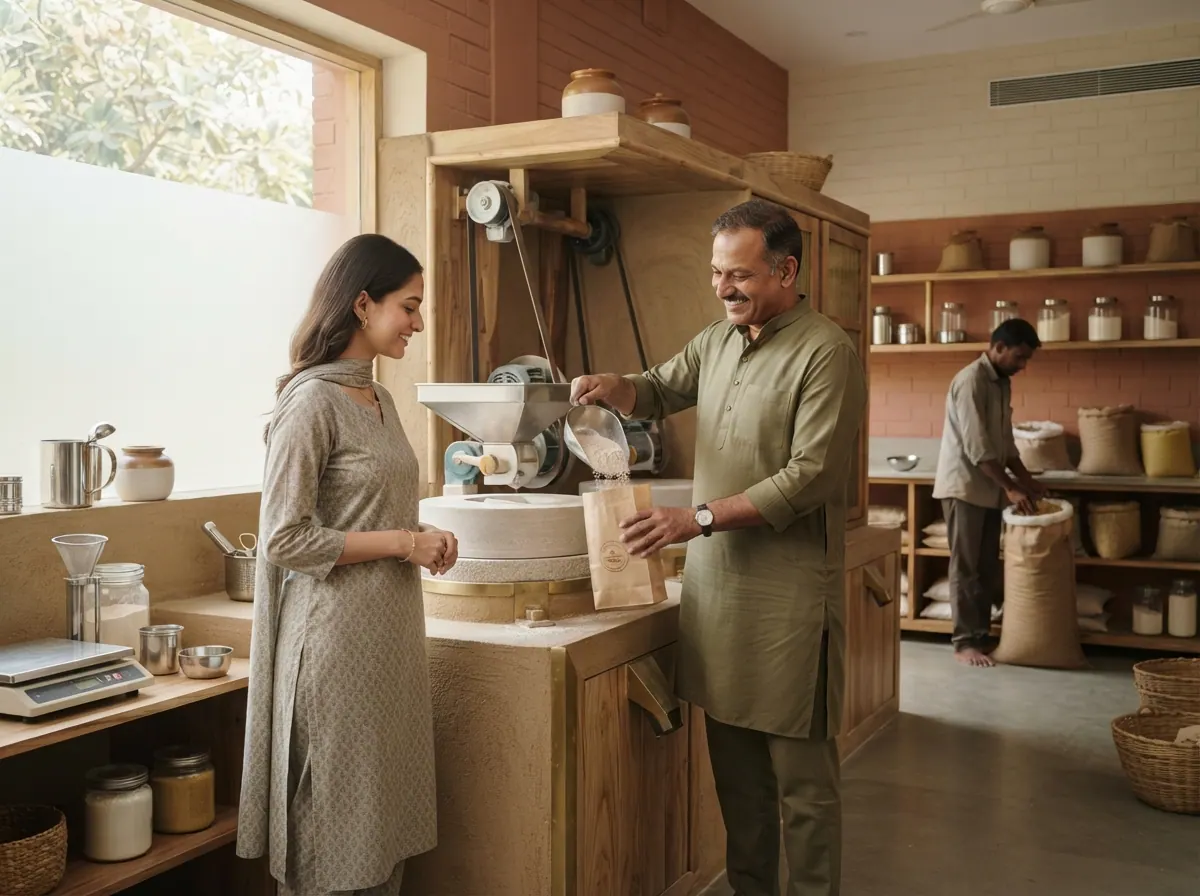
To start an atta chakki in India you need a shop with a firm floor and three-phase power, a chakki and motor, a way to clean grain and pack atta, an FSSAI registration for packed flour, and about ₹50,000–1.5 lakh for a single small machine or up to about ₹3 lakh for a fuller setup. The trade earns from small charges on large quantities, so location, timing and honest weight decide the profit.
All figures here are estimates. Check prices near you before you spend.
What does it cost?
| Item | Single chakki | Fuller shop |
|---|---|---|
| Chakki (stone or steel) with motor | ₹40,000–80,000 | ₹70,000–1.2 lakh |
| Starter and wiring, three-phase set-up | ₹8,000–20,000 | ₹15,000–30,000 |
| Grain cleaner or sieve | ₹5,000–12,000 | ₹20,000–45,000 |
| Pulveriser for spices (optional) | ₹0 | ₹25,000–50,000 |
| Weighing scale and counter | ₹5,000–10,000 | ₹10,000–20,000 |
| Packing: bags, sealer, labels | ₹3,000–8,000 | ₹10,000–25,000 |
| First lot of wheat | ₹15,000–30,000 | ₹40,000–80,000 |
| Deposit, shutter, FSSAI | ₹10,000–25,000 | ₹25,000–50,000 |
| Total | about ₹50,000–1.5 lakh | about ₹2–3 lakh |
Ask the dealer about power use, spare stones or plates and how the machine handles a long day. A cheap machine that overheats costs you in lost flour quality.
Where do the earnings come from?
- Custom grinding: customers bring wheat, millet or maize and pay per kilo. Cash comes in daily with no stock risk.
- Selling packed atta: you buy wheat, grind it and sell by the 5 or 10 kg bag. More profit per kilo but you carry stock and need a licence for packed flour.
- Other grains: bajra, jowar, ragi and besan are popular in winter and in the regions that eat them.
- Spices and dal splitting: extra income if you add the right machine.
Location matters more than machine: a chakki near homes, a market or a hostel gets steady walk-in trade.
How much can it earn?
Here is a shop that sells 4,000 kg of packed atta a month and also grinds 4,000 kg of customers' grain.
Sales
- Wheat bought: 4,000 kg. About 95% becomes atta, so 3,800 kg atta × ₹38 = ₹1,44,400
- Bran: 200 kg × ₹20 = ₹4,000
- Custom grinding: 4,000 kg × ₹3 = ₹12,000
- Total = ₹1,60,400
Costs each month
- Wheat: 4,000 kg × ₹30 = ₹1,20,000
- Power: ₹10,000
- Bags, 400 × ₹5: ₹2,000
- Rent: ₹5,000
- One helper: ₹8,000
- Delivery and small items: ₹4,000
- Total = ₹1,49,000
Left over: ₹1,60,400 − ₹1,49,000 = about ₹11,400 a month.
This is thin because wheat cost is most of the bill. A shop that runs only custom grinding has no stock risk and keeps almost all the charge, but earns less in total. Wheat prices move through the year and by region, so check the local mandi.
What do you need before you start?
- A shop with a strong floor for the vibration, near homes or a market.
- Three-phase power and a plan for voltage drops.
- A dust plan: fine flour dust irritates lungs and can be a fire risk, so you need cleanliness and good airflow.
- A source of clean wheat from a mandi trader you trust.
Step by step
- Count the walk-in trade: stand near the planned shop for two days and note how many people carry grain.
- Visit a working chakki and ask how long a set of stones or plates lasts.
- Get the power connection sized for your motor.
- Install on a firm base with the motor, belt and guards properly fitted.
- Clean and dry the grain before grinding. Stones, soil and moisture damage the machine and the flour.
- Fix your grinding charge and display it. Weigh grain in front of the customer, and weigh the flour back.
- Start packed atta only after you have a licence and a few families or shops who will buy it.
Which licences apply?
- FSSAI registration or licence for packed atta, depending on your size.
- Udyam registration can help with loans and schemes. Confirm with the office.
- Weights and measures: scales usually need to be checked or stamped. Ask the local office what applies.
- Power and local permission for a machine shop, including noise and dust limits.
- GST as your sales grow. Ask a CA.
What goes wrong?
- Customers who suspect short weight. One accusation can empty your shop, so weigh openly.
- Mixed grains in the same chakki. The flour carries the old smell, and buyers complain.
- Wheat with stones or insects, which damage the machine or spoil stock.
- Stones or plates wearing out faster than expected.
- Dust and noise complaints from neighbours.
- Wheat price rises after you have fixed your atta rate.
Situations you will face
What would you do? Each choice costs something.
Getting started
Buyers praise stone-ground atta for its taste. A steel chakki is cheaper and grinds faster.
- Buy the stone chakki: Costlier, slower, loved taste
- Buy the steel chakki: Cheaper, faster, hotter flour
A corner shop near the market costs more rent but has many walk-ins. A quiet lane shop is cheap.
- Take the market corner: Higher rent, steady trade
- Take the lane shop: Low rent, slow start
The power office says three-phase will take weeks. A neighbour offers a shared line, but voltage drops.
- Wait for your own connection: No risk, lose weeks
- Pay for a dedicated line: Fee now, steady power
A shop closing down offers its chakki at half the price. The stones look worn and the motor is old.
- Buy it, replace stones: Cheaper, repair cost
- Buy a new machine: Costly, fewer worries
A cheap digital scale costs little. Customers trust stamped scales more and officers check them.
- Buy a stamped scale: Costs more, trusted weight
- Buy the cheap scale: Saves money, buyers doubt
A mandi trader offers a big lot at a good rate. Your shop and cash are limited.
- Buy a big lot: Good price, cash tied up
- Buy a small lot weekly: Higher rate, cash free
First month
A customer's grain has many small stones that damage the plates. They are in a hurry.
- Clean it first, charge extra: Time, customer may grumble
- Grind it as it is: Quick, plates wear faster
A regular claims the atta weighs less than the wheat they brought. A small loss in grinding is normal but they are upset.
- Weigh again in front of them: Time, builds trust
- Give a few kilos free: Costs flour, ends the dispute
After grinding bajra, a wheat customer says the atta smells off. The chakki was not cleaned.
- Clean the chakki between grains: Time lost, clean flour
- Grind wheat first each day: Free, limits orders
Fine flour dust blows into the next shop. They threaten to complain to the municipality.
- Fit a dust hood, cloth bag: Cost, cleaner shop
- Shut the shutter while grinding: Cheap, hot and dark
Running it
A few weeks after harvest, wheat gets dearer. Your packed atta rate is fixed with shops.
- Raise your atta price: Margin holds, some buyers drop
- Hold price, thin margin: Buyers stay, less profit
Families bring bajra and jowar for rotis. The chakki cannot take wheat and bajra at once.
- Set separate hours for each: Planning, clean flour
- Add a small second chakki: Cost, no mixing
Several families want packed atta delivered. A delivery boy and a bike cost money.
- Start delivery with a boy: Wages, more sales
- Ask them to come by: No cost, some leave
The chakki is slow and hot, and the flour feels coarse. The plates are worn from dusty grain.
- Replace the plates: Cost, better flour
- Adjust the gap and carry on: Cheap, coarse flour stays
A hostel mess wants atta every week at a low rate, paid at month end.
- Accept the order: Steady volume, thin margin
- Ask for weekly payment: Safer money, may lose it
Two kirana shops want 10 kg bags of your atta. Packed flour needs FSSAI registration and proper labels.
- Register, then supply: Fee and wait, safe sales
- Keep to custom grinding: No fee, smaller trade
Families want ragi and jowar ground fresh. Each one means cleaning the stones between grains.
- Grind them on set days: Cleaning time, new buyers
- Stay with wheat only: Simple, lose the work
Before a big festival every family brings grain at the same time. Queues reach the road.
- Run extra hours: More power, more income
- Take tokens, serve in turn: Calm, some customers leave
When things go wrong
A motor spark lit a small heap of dust. A worker beat it out and nobody is hurt. Dust has built up in corners.
- Clean daily, add extinguisher: Time and cost, safer
- Clean it once and carry on: Cheap, risk remains
Voltage dips keep stopping the chakki. Customers wait or leave to the shop down the road.
- Buy a stabilizer: Cost, steady running
- Grind at night, steady power: Free, loses day trade
A weights-and-measures inspector checks your scale and finds a small error. You face a fee and a fix.
- Get it fixed and stamped: Fee, a clean record
- Argue the error is tiny: No fee, weaker standing
A new chakki opposite your shop charges less per kilo and offers free grinding on Sundays.
- Match the grinding charge: Keeps customers, thin margin
- Stay with your quality: Margin kept, may lose some
Regulars say they will pay next week for grinding. Some owe you money from last month.
- Cash only from now: Safe money, some leave
- Allow credit for regulars: Keeps them, cash waits
Growing
Households ask for ground turmeric and chilli. A separate machine avoids mixing smells with atta.
- Buy a spice pulveriser: Cost, extra income
- Stay with grain only: No cost, narrower trade
Health-minded families ask for a wheat, jowar and ragi mix. It needs blending and extra bags.
- Launch a multigrain blend: Test cost, higher price
- Keep plain wheat atta: No risk, no new buyers
Dirty wheat slows grinding and damages plates. A cleaner costs money but protects the machine.
- Buy a cleaner: Costly, longer plate life
- Hand sieve each lot: Cheap, slower and less clean
A landlord offers a shop in a growing colony. You would need another machine and trusted staff.
- Open the second shop: Heavy cost, more trade
- Improve your first shop: Small spend, steady
A farmer group offers wheat at harvest price if you take a full truck and pay on delivery.
- Buy a full truck: Cheaper wheat, cash locked
- Keep buying weekly: Higher rate, cash flexible
A printer offers branded 5 and 10 kg bags with a minimum order. Branded bags raise trust with families.
- Order branded bags: Print cost, trusted look
- Use plain bags with stickers: Cheap, plainer look
A bank officer says a small business loan may fund more machines if you show accounts and a plan.
- Prepare accounts with a CA: Fees now, funds for growth
- Grow from own savings: No fee, slower growth
Is it right for you?
An atta chakki suits you if you are happy with a steady, repeat trade, can be in the shop most days and can keep your machine and floor clean. It suits you less if you want fast profit, since thin margins reward patient, honest work.
A good test: stand beside a busy chakki for two days, count customers and kilos, and ask the owner what they earn from grinding alone. Then begin with custom grinding and add packed atta once your name is trusted.