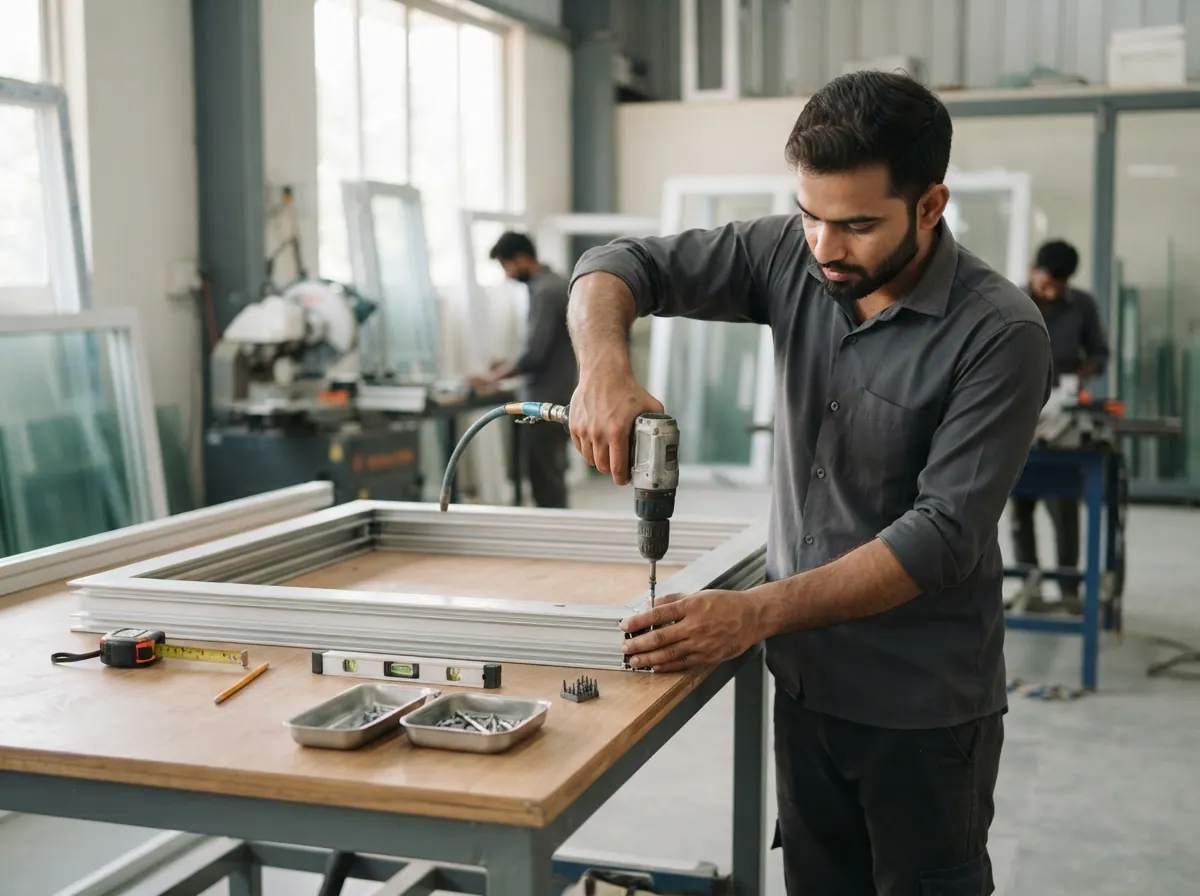
To start an aluminium and glass fabrication business in India you need a small workshop with room for long sections, a mitre cutting machine, drill and hand tools, a stock of sections, glass and hardware, one or two skilled fitters, a vehicle to carry long sections, and about ₹2 lakh to ₹8 lakh. You make windows, doors, partitions, shower cabins and shopfronts, and your income comes from per-square-foot jobs for builders, interior designers and home owners.
All figures here are estimates. Check prices near you before you spend.
What does it cost?
| Item | Small workshop | Fuller workshop |
|---|---|---|
| Mitre cutting machine | ₹30,000–70,000 | ₹70,000–1.5 lakh |
| Drill, grinder, crimping and hand tools | ₹15,000–30,000 | ₹30,000–60,000 |
| Glass cutting tools, suction lifters, trolley | ₹8,000–15,000 | ₹15,000–30,000 |
| Stock of sections, glass and hardware | ₹60,000–1.5 lakh | ₹1.5–3 lakh |
| uPVC welding and cleaning machine | – | ₹1–2 lakh |
| Workshop rent deposit, racks, shutter | ₹30,000–60,000 | ₹60,000–1 lakh |
| Vehicle for long sections | Hire per trip | ₹0–1.5 lakh |
| Phone, samples, visiting cards | ₹10,000–20,000 | ₹20,000–40,000 |
| Total | about ₹2–3.5 lakh | about ₹5–8 lakh |
You do not need a large stock at first. Buy section and glass per job from a trusted dealer, and keep only fast-moving items like rollers, locks and sealant.
What do you need before you start?
- A trained fitter. Straight cuts, tight joints and a window that slides smoothly are what builders look for. Learn from a working fabricator.
- Knowing materials. Different sections suit different jobs, and glass thickness depends on the size and where it is used. A window by a road and a bathroom partition need different glass.
- Measuring right. Most mistakes begin at the site. A window cut 10 mm short is a loss you cannot fix.
- Dealer relationships. A dealer for sections, one for glass and one for hardware. Ask about delivery time and credit.
- Safety. Glass cuts badly, and work on upper floors needs a safe method. Do not let helpers stand on a window edge.
How much can it earn?
Here is a small workshop in its second year. These numbers are examples, not promises.
Monthly income
- 12 jobs × about ₹18,000 average bill = ₹2,16,000
- Material cost about 65% = ₹1,40,400
- Margin: ₹2,16,000 − ₹1,40,400 = ₹75,600
Monthly costs
- Two fitters = ₹28,000
- Workshop rent = ₹10,000
- Transport and fuel = ₹6,000
- Power, blades, consumables = ₹4,000
- Total = ₹48,000
Left over: ₹75,600 − ₹48,000 = about ₹27,600 a month.
Work comes in lumps, usually when builders are finishing flats. Payments can be slow, so it is common to ask for an advance on materials, then collect the rest in stages.
Step by step
- Work with a fabricator for six months to a year, so you can measure, cut and fit by yourself.
- Set up a small workshop with room for sections and a place to cut, assemble and store glass.
- Make a sample window and a partition to show customers, so they can see and touch the finish and the sliding.
- Visit builders, interior designers and architects. Leave samples and your rate sheet. A few steady builders give more work than many random home owners.
- Measure carefully at the site, write the size on the drawing, and have the customer confirm in writing.
- Ask for an advance to cover the material before cutting, and the balance on fitting.
- Add uPVC, shower cabins and railing once your aluminium work is steady.
Which licences apply?
Paperwork is usually light:
- Shop and establishment registration with your local body, if you work from a shop or workshop.
- GST once your sales pass the limit, or if builders and companies ask for tax invoices. Ask a CA.
- Staff rules. If you employ several fitters, ask your local labour office about records and wages.
- Site rules. Builders may have their own safety and entry rules for fitters working at height.
- Warranties. Check what your section and hardware suppliers offer and write your own terms clearly.
What goes wrong?
- A wrong measurement. A window short by a few millimetres cannot be fixed, and the glass may be wasted.
- Thin glass for a big window. It cracks in the first hot day or strong wind, and the customer blames the fitter.
- Leaks in monsoon. Weak sealing around the frame makes the first rain a problem.
- Late builders. A builder who pays after months can sink a small workshop.
- Broken glass during fitting. One glass pane costs a day's profit, and a bad cut can hurt a helper.
- Colour and finish mismatch. Customers choose a shade from a card and complain when the fitted section looks different.
Situations you will face
What would you do? Each choice costs something.
Getting started
You can cut sections but have never fitted a full window. A fabricator offers you work for three months at a low wage.
- Work under a fabricator first: Low pay now, clean fitting later
- Open and learn on jobs: Earn sooner, costly mistakes
A good double-head mitre machine costs a lot. A basic single-cut one is cheaper but slower and less exact.
- Buy the better machine: Costly, clean fast cuts
- Buy the basic machine: Cheaper, slower and rougher
A dealer sells sections that are thinner and cheaper. Other fabricators warn that windows made of them bend and rattle.
- Buy proper thickness: Higher cost, solid windows
- Buy the thin sections: Cheaper, complaints later
Builders want to see and touch a window before they order. A sample set takes a day and good material.
- Make a sample set: Cost and time, wins builders
- Show photos only: No cost, fewer orders
A shed with room for six-metre sections costs double. A small room is cheap but long cuts are awkward.
- Rent the big shed: Higher rent, easy work
- Use the small room: Low rent, slow handling
A skilled fitter asks for a high daily wage. A helper with no experience costs much less.
- Hire the skilled fitter: Higher wage, neat fitting
- Hire the helper: Low wage, rework likely
A glass cutter and suction lifters cost money, but dropped glass costs much more.
- Buy proper tools and lifters: Costly, fewer breakages
- Rent lifters for each job: Rent each time, safer lifting
First month
You cut a sliding window based on the owner's measurement. At fitting, it is short and leaves a gap.
- Remake it at your cost: Costly, owner satisfied
- Offer a discount and refit trim: Honest, a discount and extra work
A buyer asks for thin glass on a big window to cut the bill. You know it may crack in the heat.
- Recommend thicker glass: Higher bill, safer window
- Offer two smaller panes: Lower bill, a frame bar added
While carrying a large pane up the stairs, your helper trips and the glass shatters. The helper has a small cut.
- Treat the cut, order again: Cost and delay, helper looked after
- Cut a smaller piece instead: Cheaper, a smaller window
A home owner asks you to start work and pay everything after fitting. Material costs are high.
- Ask for a material advance: Safe cash flow, may lose job
- Start on trust: Friendly, cash tied
The customer chose a shade from a small card, but the fitted section looks darker. The customer is upset.
- Replace the frames: Costly, customer satisfied
- Show the card again: No cost, unhappy customer
A cheap sealant costs half the branded tube. Fitters say it cracks and peels after a few months of sun.
- Use the branded sealant: Costs more, lasts longer
- Use cheap for interior jobs only: Saves on indoor work
Running it
A builder wants forty windows for a finishing deadline at a low per-square-foot price. Payment will be slow.
- Take it with stage payments: Large work, thin margin
- Ask for a higher rate: Better margin, may refuse
Three homeowners call about water coming in at the frame edges. Your sealing was rushed.
- Re-seal all three at your cost: Cost and time, trust kept
- Charge a service fee: Earn something, angry owners
A designer brings steady work but wants a share of your bill for each referral.
- Give a small agreed share: Less margin, regular jobs
- Decline the arrangement: Full margin, fewer jobs
Section prices go up while you have fixed quotes for several customers.
- Raise your new quotes: Keeps margin, fewer orders
- Hold prices to keep clients: Margin falls, loyal clients
Some homeowners prefer uPVC. It needs a welding machine and training, and you work only in aluminium.
- Buy the machine, train: Large spend, new customers
- Refer them elsewhere: No cost, lose some jobs
A new flat owner wants a toughened-glass shower cabin in a week. Glass takes time from the toughening plant.
- Rush the glass order: Rush fee, a happy owner
- Quote the normal time: No extra cost, may lose job
A balcony glass job is on the fifth floor with no scaffolding. A helper offers to lean out to save time.
- Hire safe scaffolding: Cost and delay, safe crew
- Turn the job down: No risk, lose the job
When things go wrong
A builder owes you ₹80,000 and says it will come after sales close in two months. You owe the glass dealer.
- Stop work till part payment: Pressure, may lose builder
- Keep working, wait: Keep the client, cash tied
A bundle of aluminium sections left at a site overnight is missing. It was for a job tomorrow.
- Reorder and absorb the loss: Costly, job on time
- Ask the builder to share: Cheaper, a strained talk
Your fitter takes a job with a rival and some builders follow along. Two jobs are half done.
- Hire a replacement quickly: Higher wage, jobs finish
- Finish them yourself: No wage, late jobs
A new workshop quotes a far lower per-square-foot rate using thin sections.
- Match on basic windows: Thin margin, keep builders
- Show them the difference: Margin safe, lose some
A customer demands free repair on a roller you supplied. Your terms said six months.
- Repair at cost price: Small cost, goodwill
- Stick to six months: Policy kept, angry owner
Growing
Orders are rising and one cutting machine is the bottleneck. A double-head one cuts twice as fast.
- Buy the machine: Big spend, faster output
- Add a second shift: Wage cost, tired crew
A shop on the main road would let walk-in customers see finished windows and partitions.
- Open the display shop: Rent and stock, walk-ins
- Keep working from workshop: Low cost, fewer walk-ins
A small mall asks for glass shopfronts for twelve units. It is big work with a strict finishing date.
- Take it with a bigger crew: Hiring cost, big bills
- Take only half the units: Manageable, less income
Architects ask for glass balustrades. It needs toughened glass handling, steel fittings and careful installation.
- Add railings with training: Cost and time, high-value jobs
- Stay with windows: Simple, miss premium work
Customers ask who will fix rollers and seals later. A yearly visit would bring steady small jobs.
- Offer a yearly service plan: Time and parts, repeat work
- Charge only per call: Simple, fewer repeat clients
Is it right for you?
Aluminium fabrication suits you if you like precise, hands-on work, can measure carefully, and can wait for payments from builders. It suits you less if you want money every day, or if you dislike working at height and on site in the sun.
A good test: spend a few months with a fabricator, measure and fit at least twenty windows, and then start with a small workshop and a few trusted builders, adding uPVC and shower cabins only after you have repeat clients.