How to start a solar installation business in India (2026): investment, profit and licences

A solar installation business in India needs about ₹1.2 lakh–₹10 lakh to set up, depending on the format. A well-run one typically makes ₹15,000–₹2.4 lakh a month in profit. You usually need: PM Surya Ghar vendor registration for your state and DISCOM (no fee in the national manuals), bank guarantee of ₹2.5 lakh per state for multi-state vendors, state electrical licence where your state asks for it, GST registration: 5% on goods and 18% on service, split 70:30, net-metering application with the DISCOM for each customer.
How much investment do you need?
- Cheapest start
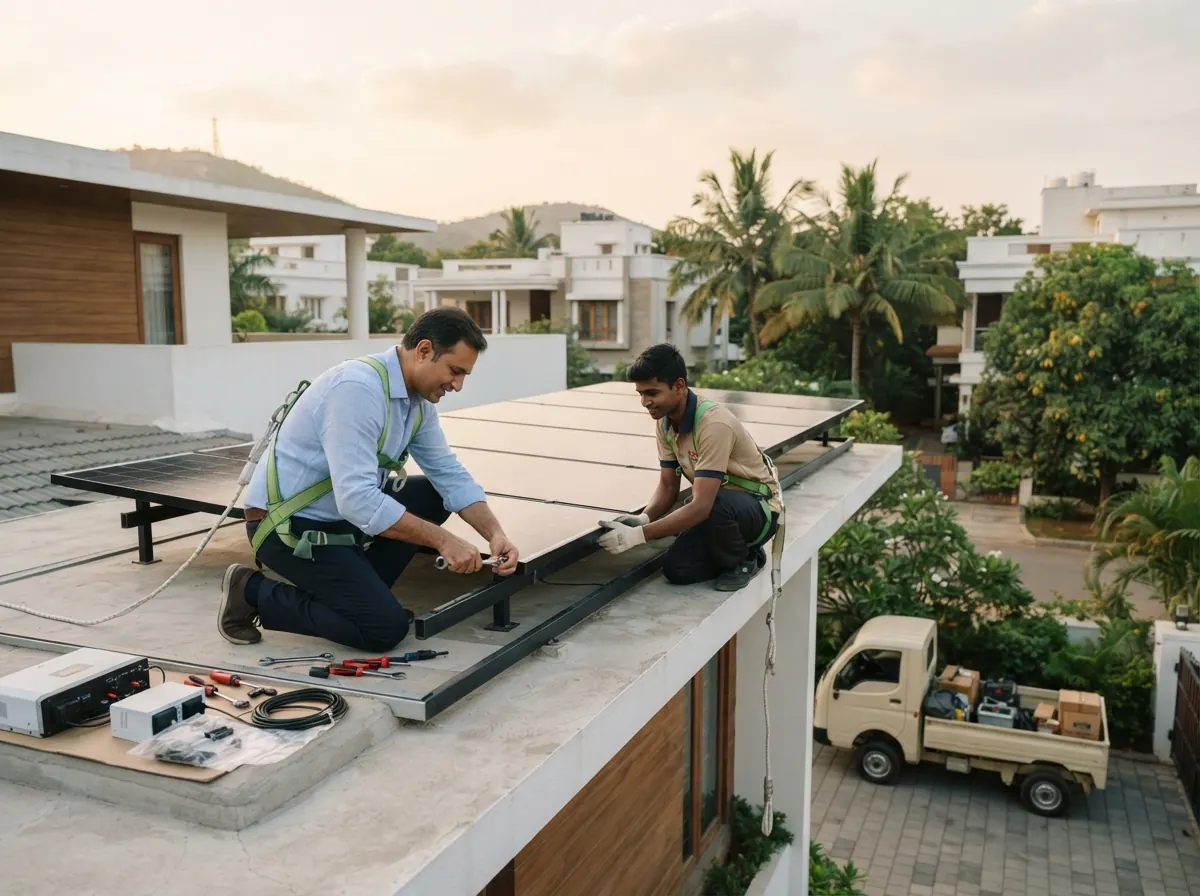
Home-based installer
Owner and a technician, full tools and safety kit, a tempo hired per job. Small home systems.
Setup cost₹1.2 lakhSuggested budget (with working capital): ₹2.4 lakh Local installer with office and crew
Small office and store, used pickup, up to three technicians, and a ₹2.5 lakh state guarantee.
Setup cost₹5 lakhSuggested budget (with working capital): ₹8 lakh
Local EPC with two crews
Bigger office, two crews, a sales and paperwork person. Homes plus 10–50 kW shop and factory jobs.
Setup cost₹10 lakhSuggested budget (with working capital): ₹15.7 lakh
How to start a solar installation business, step by step
- Choose your format and budget: Start with Home-based installer: about ₹1.2 lakh to set up, or ₹2.4 lakh with working capital.
- Pick the location: Compare the rent with the number of customers who pass by, at the hours you will be open.
- Get your licences: Commonly needed: PM Surya Ghar vendor registration for your state and DISCOM (no fee in the national manuals), bank guarantee of ₹2.5 lakh per state for multi-state vendors, state electrical licence where your state asks for it, GST registration: 5% on goods and 18% on service, split 70:30, net-metering application with the DISCOM for each customer. Rules vary by state and city, so confirm with your municipal office.
- Arrange stock, staff and prices: Check local prices first, and keep money aside for the first months of rent, wages and stock.
- Plan for the risks: Watch for: falls from roofs, balance held until the net meter or subsidy comes, thin net margin of about 5–14%, five years of free repairs on what you fit, scheme rule changes and the 31 March 2027 end date.
- Practise before you invest: Run it day by day in the free simulator to see where the money goes.
How much profit can you make?
A well-run solar installation business typically nets ₹15,000–₹2.4 lakh a month: about ₹1.1 lakh–₹2.4 lakh in a metro and ₹15,000–₹43,500 in a small town. A casually run one can make far less or lose money.
| City | Net profit per week | Net profit per month |
|---|---|---|
| Metro city | ₹25,000–₹55,000 | ₹1.1 lakh–₹2.4 lakh |
| Tier 2 city | ₹10,000–₹26,000 | ₹43,500–₹1.1 lakh |
| Small town | ₹3,500–₹10,000 | ₹15,000–₹43,500 |
Ranges are for a well-run business of the typical format in each city size, from public sources and estimates. Your results depend on location and how you run it.
Profit calculator
Put in your own numbers for a quick monthly estimate. For a realistic run with festivals, rain, staff and stock, use the simulator.
Run it day by day before you invest
Run a solar installation business day by day. Choose your city, budget and location, then make the decisions a real owner faces as they come up. Your advisor can test each choice on your next 3 months.
Play the simulator free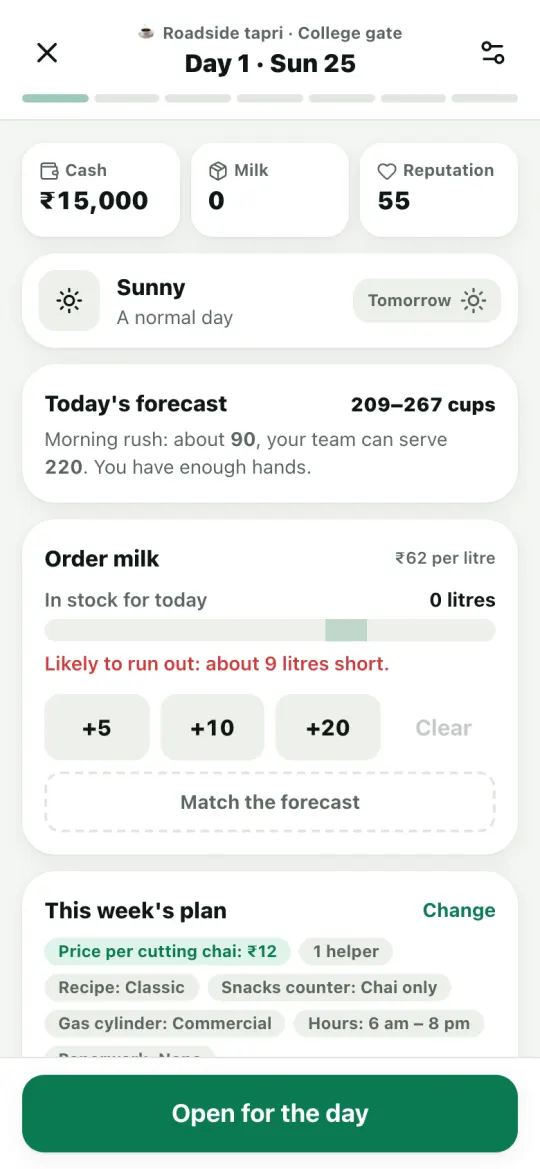
Key numbers (181 researched factors)
JSON · Source · Estimate
| Factor | Typical value in India | Source |
|---|---|---|
| State vendor guarantee | ₹2.5 lakh per state | quickestimate.co |
| National vendor guarantee | ₹25 lakh | quickestimate.co |
| Working capital interest | 12–18% a year | qbitsenergy.com |
| Scheme paperwork per project | ₹3,000–8,000 | quickestimate.co |
| 3 kW home price before subsidy | ₹1.65–2.10 lakh | greentechlead.com |
| Per-kW price, guide A | ₹45,000–65,000 | voltflow.net |
| DCR TOPCon module, 30 Jan 2026 | $0.289/W | metal.com |
| Non-DCR module, 30 Jan 2026 | $0.155/W | metal.com |
| Monsoon share of installs | 20–25%, secondhand | energetica-india.net |
| Oct–Nov festive lift | +20–40% | energetica-india.net |
| Suryamitra technician pay | ₹15,000 a month (older) | context.news |
| Technician job listing | ₹18,000–20,000 a month | apna.co |
| Commercial payment terms | 50% upfront, 40% on fitting, 10% retention | quickestimate.co |
| Commercial collections | often 60–90 days | quickestimate.co |
| Tier-2 cities vs metro markets | 2–5× installs | energetica-india.net |
| Aurangabad installs, 2025 | 14,500+ | energetica-india.net |
| Registered vendors | 34,219, of which 29,469 active (Aug 2026) | pv-magazine-india.com |
| Registered vendors, Oct 2026 | 37,000+ | angelone.in |
| Central subsidy, first 2 kW | ₹30,000/kW | reslink.org |
| Central subsidy, third kW | ₹18,000 | reslink.org |
| Roof fall cases | Lucknow Aug 2026; Mapusa May 2026; Thane Jan 2025 | thegoan.net |
| After-sales cost | ₹5,000–12,000 per 5 kW over 3 years | qbitsenergy.com |
| Word of mouth per install | ₹3,000–8,000 | qbitsenergy.com |
| Gross margin 1–3 kW | 18–22% | quickestimate.co |
Licences and rules
Rules vary by state and city: confirm with your municipal office.
- PM Surya Ghar vendor registration for your state and DISCOM (no fee in the national manuals)
- Bank guarantee of ₹2.5 lakh per state for multi-state vendors
- State electrical licence where your state asks for it
- GST registration: 5% on goods and 18% on service, split 70:30
- Net-metering application with the DISCOM for each customer
| Factor | Typical value in India | Source |
|---|---|---|
| Central subsidy, first 2 kW | ₹30,000/kW | reslink.org |
| Central subsidy, third kW | ₹18,000 | reslink.org |
| Subsidy cap | ₹78,000; special category ₹85,800 | reslink.org |
| Vendor registration fee | none in national manuals | quickestimate.co |
| Empanelment time | no national standard; West Bengal within one month | quickestimate.co |
| Free repair owed | 5 years from commissioning | reslink.org |
| Performance ratio | 75% at commissioning, kept for 5 years | reslink.org |
| Shadow report | required per site | reslink.org |
Risks to plan for
- Falls from roofs
- Balance held until the net meter or subsidy comes
- Thin net margin of about 5–14%
- Five years of free repairs on what you fit
- Scheme rule changes and the 31 March 2027 end date
| Factor | Typical value in India | Source |
|---|---|---|
| After-sales cost | ₹5,000–12,000 per 5 kW over 3 years | qbitsenergy.com |
| After-sales provision | 5–7% of revenue | qbitsenergy.com |
| Warranty provision (other source) | about 2% | quickestimate.co |
| Vendor complaints case | 55 in J&K, referred to Crime Branch | reslink.org |
| Do not promise subsidy dates | advice | reslink.org |
| Vendor rating framework | exists on portal | quickestimate.co |
| Monsoon expectation | 2.5–3.5 vs summer 3.5–5.5 kWh/kWp a day | heavengreenenergy.com |
| Cleaning visits | 4 a year dusty, 2 coastal | heavengreenenergy.com |
Frequently asked questions
How much investment is needed to start a solar installation business?
It depends on the format: Home-based installer ₹1.2 lakh; Local installer with office and crew ₹5 lakh; Local EPC with two crews ₹10 lakh. Keep extra working capital for stock, wages and rent for the first months.
How much profit does a solar installation business make per month?
A well-run solar installation business typically nets ₹15,000–₹2.4 lakh a month: about ₹1.1 lakh–₹2.4 lakh in a metro and ₹15,000–₹43,500 in a small town. A casually run one can make far less or lose money.
Which licences do I need for a solar installation business?
Commonly: PM Surya Ghar vendor registration for your state and DISCOM (no fee in the national manuals), bank guarantee of ₹2.5 lakh per state for multi-state vendors, state electrical licence where your state asks for it, GST registration: 5% on goods and 18% on service, split 70:30, net-metering application with the DISCOM for each customer. Rules vary by state and city, so check with your municipal office.
Is a solar installation business profitable in a small town?
Yes, at a smaller scale. A well-run solar installation business in a small town nets about ₹15,000–₹43,500 a month, with lower rent and wages but fewer customers.
What are the biggest risks of a solar installation business?
The main ones are: falls from roofs, balance held until the net meter or subsidy comes, thin net margin of about 5–14%, five years of free repairs on what you fit, scheme rule changes and the 31 March 2027 end date.
How can I practise running a solar installation business before investing?
Play the free BizGame solar installation business simulator. It runs day by day with Indian prices, festivals, weather and inspections, and shows how your money is doing after every decision.
solar business in india · how to start solar business in india · how to start solar business in india without investment · solar installation business · rooftop solar business
More business ideas to simulate
 Salon or beauty parlourSetup from ₹1.8 lakh192 researched factors
 Car washSetup from ₹1 lakh183 researched factors
 AC repair businessSetup from ₹75,000165 researched factors
 Home appliance repair businessSetup from ₹60,000177 researched factors
 Bike repair garageSetup from ₹1 lakh200 researched factors
 Electrician businessSetup from ₹30,000192 researched factors
 GymSetup from ₹8 lakh176 researched factors
 Laundry businessSetup from ₹2 lakh158 researched factors
 House painting businessSetup from ₹30,000194 researched factors
 Photography businessSetup from ₹2.4 lakh178 researched factors
 Plumbing businessSetup from ₹30,000192 researched factors
 Tailoring shop or boutiqueSetup from ₹40,000150 researched factors