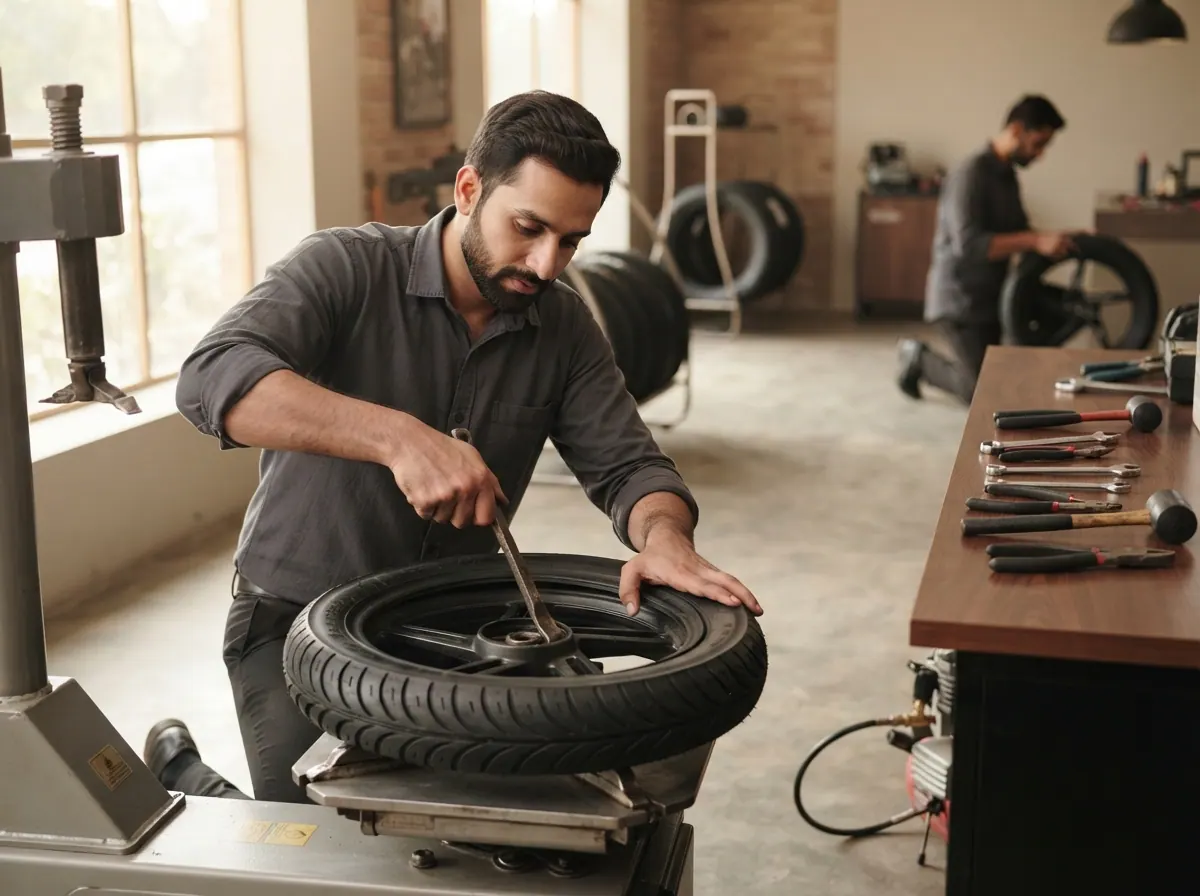
A puncture shop is a roadside workshop that mends tubes and tubeless tyres, fills air and nitrogen, fits new tyres and sometimes balances wheels. It can start from about ₹50,000 to ₹1 lakh with a compressor and basic tools, and reaches about ₹3 lakh once you add a tyre changer, balancer and tyre stock. Income depends on one thing more than any other: how many vehicles pass your door, and whether they stop.
All figures here are estimates. Check prices near you before you spend.
What does it cost?
| Item | Estimate |
|---|---|
| Air compressor (1 to 2 HP) with tank and hose | ₹12,000–25,000 |
| Tubeless repair kit, plugs, patches, vulcanising tools | ₹5,000–10,000 |
| Bead breaker and hand tools, rim tools | ₹5,000–15,000 |
| Water tub, jack, stands, wheel stand | ₹5,000–10,000 |
| Stock of tubes, valves, sealant, weights | ₹10,000–25,000 |
| Signboard, shed, shelves, light | ₹10,000–25,000 |
| Rent deposit | ₹20,000–60,000 |
| Optional: tyre changer machine | ₹30,000–1,00,000 |
| Optional: wheel balancer | ₹40,000–1,00,000 |
| Optional: small stock of new tyres | ₹50,000–1,50,000 |
| Total (basic to full) | about ₹50,000–3 lakh |
You can begin with the first six items and add machines when you see that customers ask for them. Compressors vary a lot in quality, so buy one from a supplier who will come back for service.
How much can it earn?
Take a basic shop on a road with steady two-wheeler and auto traffic. Assume about 25 jobs a day, average ₹70 a job (a mix of tube patches, tubeless plugs and air), a shop open 26 days a month, and a few tyre or tube sales.
A busy month
- Repair income: 25 × ₹70 × 26 = ₹45,500
- Margin on tyres and tubes sold: about ₹4,500
- Total income: ₹50,000
- Rent ₹8,000 + helper ₹9,000 + electricity ₹2,500 + patches, plugs and valves ₹6,000 + small costs ₹2,000 = ₹27,500
- Left over: ₹50,000 − ₹27,500 = ₹22,500
A slow month (15 jobs a day)
- Repair income: 15 × ₹70 × 26 = ₹27,300
- Margin on sales: about ₹2,000
- Total income: ₹29,300
- Costs stay close to ₹27,500
- Left over: about ₹1,800
If you work the shop yourself and skip the helper, you keep another ₹9,000 a month. The shop earns more from the second half of the day, when people are coming back from work, and after rain, when roads are full of nails and broken edges. Selling extra items such as valve caps, tyre shine, air filling for cycles and nitrogen is small, but it fills the gaps.
What do you need before you start?
- A spot where vehicles slow down or stop, such as near a petrol pump, a truck stop, a market, a school road or a highway turn. Count vehicles for one full day, then another on a Sunday.
- Basic skill. Spend two or three months working under an experienced mechanic. Mending a tubeless tyre properly is different from sticking a patch on a tube.
- A trusted helper who can handle the shop while you buy stock or take lunch.
- A cash cushion for slow weeks and for a dead compressor.
Step by step
- Decide the vehicles you serve: bikes and scooters, autos and cars, or trucks and tractors. A truck tyre job needs heavier tools, bigger bead breakers and more strength.
- Rent a place with a water supply and room to park two or three vehicles and stack old tyres.
- Buy a good compressor first. It is the heart of the shop, and slow filling turns customers away.
- Learn tubeless repair properly: remove the tyre or repair from outside as the tyre allows, inspect the inside, and use the correct plug or patch. A quick outside plug on a damaged sidewall is not a repair.
- Put your rates on a board: tube patch, tubeless plug, air, nitrogen, valve change, tyre fitting. Fixed rates avoid arguments.
- Open an account with a local tyre and tube distributor, and stock the three or four sizes that sell fastest near you.
- Add a tyre changer and balancer only after you are turning down tyre fitting work.
- Keep a small register of tyre sales, credit and warranty claims.
Which licences apply?
- Shop and establishment registration or the local trade licence, depending on your town. Ask the municipal office.
- GST if your yearly sales cross the limit or if you sell tyres. A CA can say what applies to you.
- Fire and electricity safety: compressors and rubber stock need a safe layout, proper wiring and an extinguisher.
- Disposal of old tyres and tubes. Pollution rules cover used tyres, and burning them is harmful and often not allowed. Ask your local office who collects them.
- Dealer terms if you take a brand dealership. Confirm them directly with the company.
What goes wrong?
- Rubber and nails at your door. A nail in your own shop floor injures your own customers' tyres. Keep the floor clean.
- The customer who says "it was repaired yesterday". A tube patched properly goes on, but a damaged valve or a rim burr can cause the same puncture again. Check before you blame the tyre.
- Dealer credit on tyres. Tyres sitting unsold for six months are cash locked up, and an old date code is hard to sell.
- Weak compressor, long queues. Customers wait once, and then go to the next shop.
- Cheap patching on a worn tyre. A tyre with a bulge or cut sidewall is not safe to patch, and a failure on a highway is on you.
- Rain and slack seasons. Punctures rise after rain. They fall when roads are new.
- A helper who keeps the cash. A small drawer count at night saves a big argument later.
Situations you will face
What would you do? Each choice costs something.
Getting started
A cheap 1 HP unit fills slowly. A 2 HP unit with a big tank costs much more but handles trucks and queues.
- Buy the 2 HP unit: Costs more, faster filling
- Buy the cheap 1 HP: Saves money, slow queues
One shop sits by the petrol pump with high rent. The other is on a quiet lane at half the rent.
- Take the petrol pump spot: High rent, steady stops
- Take the quiet lane: Low rent, few customers
Most new bikes and cars here run tubeless tyres. An experienced mechanic offers a few weeks of training for a fee.
- Pay for the training: Costs money, more kinds of work
- Learn by watching videos: Free, early mistakes likely
Fitting tyres by hand takes long and tires you out. A machine costs about a lakh before you have many customers.
- Buy the machine: Big cost, quick clean fitting
- Fit by hand for now: Saves money, slow and risky
Customers keep asking the price and then bargain hard. A board makes prices fixed, but some will walk away at the number.
- Put up a fixed rate board: Clear prices, fewer bargainers
- Quote by face: Flexible, more arguments
The municipal office wants your shop registered. An agent offers to do it quickly for a high fee.
- Do it yourself at the office: Cheap, takes days
- Pay the agent: Faster, costs more
The tube and tyre distributor offers a better rate for a bigger first stock. Your cash is tight.
- Order the bigger stock: Better rate, cash locked up
- Order only fast sizes: Lean stock, more refusals
First month
A scooter rider says the same tyre is flat again. You think a damaged valve is the problem, but they blame your patch.
- Redo it free: Costs time, keeps the customer
- Charge them again: Fair on paper, they tell others
Scrap and broken glass collects at your shop entrance. More punctures near you means more work, but the complaints are growing.
- Sweep daily, fix the entrance: Some lost work, goodwill
- Leave it as it is: More punctures, angry people
A truck driver wants a patch on a tyre with a bulge on the sidewall. They cannot afford a new one and say they are driving far.
- Refuse and explain: Lose the job, they are safe
- Sell a used tyre cheaper: Small margin, safe tyre
You noticed your helper plugs tubeless tyres from outside without looking inside. It is faster, but some come back.
- Retrain them, slower jobs: Fewer comebacks, fewer jobs
- Add a checklist sticker: Small cost, checks shown
For the third time this week the drawer is a few hundred rupees short. Only you and the helper handle it.
- Count nightly, keep a book: Takes effort, stops the leak
- Let it go, trust them: No quarrel, losses go on
Car owners ask for nitrogen. The setup costs a fair amount and many will only pay a little for it.
- Buy a nitrogen unit: Costly, a new service
- Stick to plain air: Saves money, misses some cars
Running it
Roads are full of nails after the storm and the queue is long. Your helper wants to leave early today.
- Pay overtime, serve all: Extra pay, big day
- Close on time: No overtime, angry waiting riders
Discarded tyres and tubes fill the back of the shop. A scrap dealer offers a small price. Some neighbours say they burn theirs.
- Sell to the scrap dealer: Small money, clean lane
- Pay for a municipal pickup: Small fee, clean lane
A trader offers unbranded tyres at a very good margin. Customers keep asking for cheap tyres, but quality is doubtful.
- Stock mainly branded tyres: Thin margin, trusted
- Stock a mid-range branded tyre: Fair margin, known quality
A transport owner with eight vehicles wants a monthly rate for tyre jobs. Payment comes at the month end.
- Give a monthly rate: Steady jobs, lower margin
- Stay with walk-in prices: Better price, uneven work
A taxi driver you know wants a new tyre now and says they will pay by month end. It is a decent sale for you.
- Give it on credit: Sale made, payment uncertain
- Ask for part payment: Safer, they may go elsewhere
The motor has burnt out and there is a queue. A mechanic can come tomorrow, or you can hire air from the next shop.
- Pay for an urgent repair: Costly, back in hours
- Send customers away today: Cheaper, lose the day's work
Car owners ask for balancing when you fit tyres. A balancer is costly and needs training and floor space.
- Buy the balancer: Big cost, higher bills per car
- Send them elsewhere: No cost, lose these customers
When things go wrong
A customer's new tyre burst in two months. The company asks for inspection. The customer wants a free replacement from you now.
- Replace it, claim later: Your cash out, claim may fail
- Make them wait for the claim: Safe for you, they are upset
A short circuit near the stacked tubes started a small fire. You put it out, but the wiring is clearly unsafe.
- Rewire and buy an extinguisher: Costly, safer shop
- Hire an electrician for that wire: Cheaper, fixes only this wire
The road in front was re-laid and smooth. Punctures dropped in a few weeks, and your rent stays the same.
- Add tyre sales and fitting: Needs stock, new income
- Wait for it to pass: No spend, thin weeks
They charge ₹10 less and offer free air. Some of your regulars have already gone.
- Match the price: Thinner margin, keep regulars
- Hold price, stress quality: Keep margin, lose some
A local officer asks for your registration and notes the pile of old tyres and the loose wiring.
- Fix issues, show papers: Costs money, record clean
- Promise to fix later: Saves now, warning on file
A car you plugged last week had a blowout. Nobody was hurt, but the owner is angry and says your repair was bad.
- Pay for a new tyre: Costly, honest and fair
- Inspect the tyre with them: Time spent, find the cause
Growing
A friend offers a shed on the highway where trucks stop. It would need a helper, a compressor and big tools.
- Open the second outlet: Large spend, more income
- Strengthen this shop: Smaller spend, steady growth
Customers with a breakdown call you to come to them. A bike with a kit could serve them, but it takes you off the shop.
- Start a call-out service: Kit and fuel cost, new income
- Stay at the shop: No cost, miss breakdowns
A company's distributor offers you a dealer tag, with a deposit and monthly stock to take. It brings walk-ins and a sign.
- Take the dealership: Deposit and stock, brand pull
- Stay multi-brand: Freedom, no brand pull
Truck drivers ask if you can do their heavy tyres. It pays several times a car job, but needs a big bead breaker and strong helpers.
- Buy heavy tools, take trucks: Big spend, bigger bills
- Stay with bikes and cars: No spend, lower ceiling
Is it right for you?
This suits someone who can work with their hands, is comfortable with grease, dirt and long standing hours, and likes steady small cash over big margins. It helps if you already know a mechanic who will teach you.
It suits you less if you want big profits quickly or cannot find a location with enough passing traffic. Before you buy anything, stand near your planned spot for a day with a notebook and count punctured tyres you see being walked or pushed along the road. That count says more than any business plan.