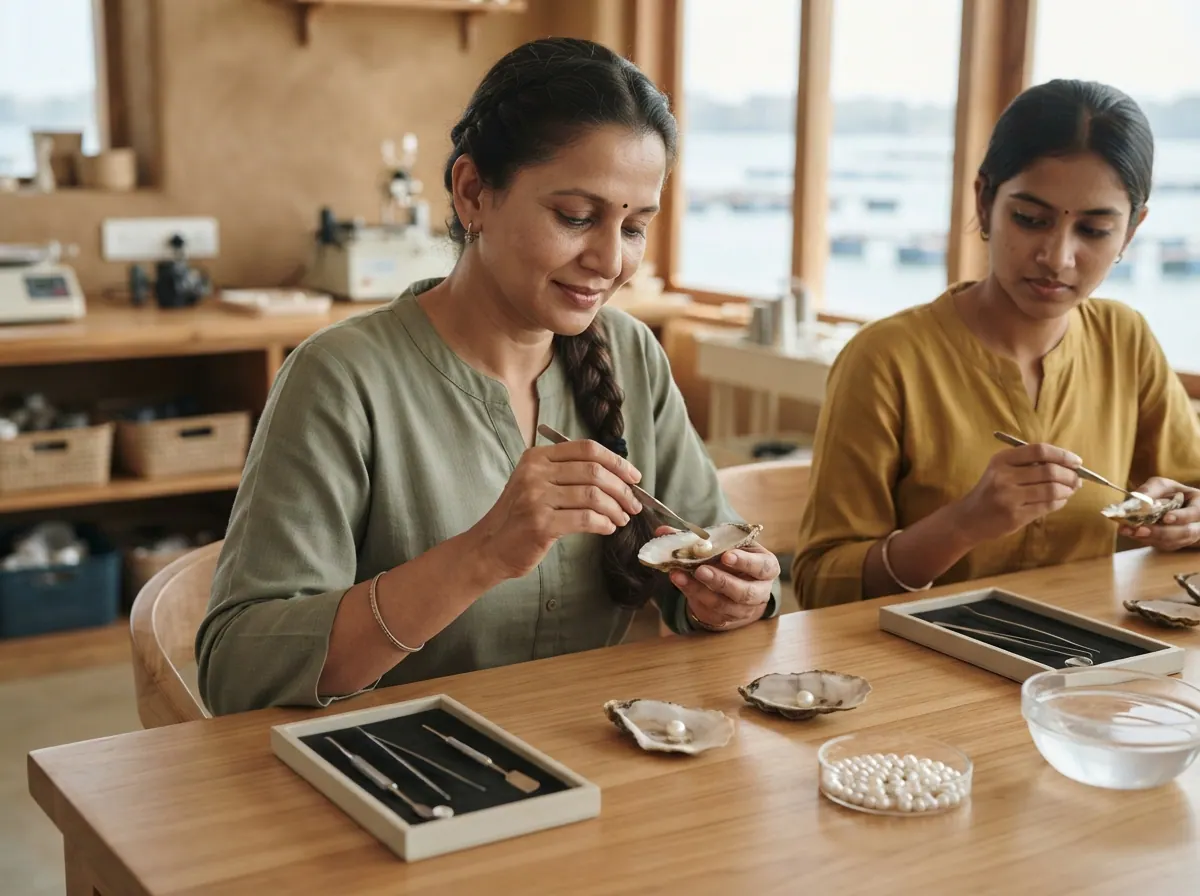
Pearl farming in India usually means raising freshwater mussels in a pond or tank, which costs about ₹70,000–1.4 lakh for a small start of around 500 mussels, and about ₹1.8–3.3 lakh for around 1,500. You need training in mussel surgery, clean water that grows plankton, healthy mussels, a year or more of patience, and a buyer for your pearls. The honest picture is a slow, risky small business, not the quick income that many videos promise.
All figures here are estimates. Check prices near you before you spend.
What does it cost?
| Item | About 500 mussels | About 1,500 mussels |
|---|---|---|
| Mussels (live, from a reliable source) | ₹5,000–10,000 | ₹15,000–30,000 |
| Nuclei (beads) for implanting | ₹4,000–6,000 | ₹12,000–20,000 |
| Tank or pond preparation | ₹20,000–50,000 | ₹60,000–1.2 lakh |
| Training and surgery kit | ₹10,000–20,000 | ₹10,000–20,000 |
| Nets, nylon bags or cages | ₹8,000–12,000 | ₹20,000–35,000 |
| Manure, lime, water and care for the first months | ₹8,000–12,000 | ₹20,000–30,000 |
| Working money | ₹15,000–30,000 | ₹40,000–70,000 |
| Total | about ₹70,000–1.4 lakh | about ₹1.8–3.3 lakh |
The training is the cheapest part and the most important. Do the course before you buy mussels.
How does pearl culture work?
- Mussel. Freshwater mussels are collected from ponds or rivers, or bought, and kept in clean water for a few days to settle.
- Surgery. A trained person opens the shell slightly and places a nucleus (a bead) or a tissue graft inside. Some farmers make shaped pearls using moulds, such as small figures, which need more skill.
- Recovery. Implanted mussels are watched in a tank for the first weeks. Weak ones die and are removed quickly.
- Growing. Mussels are hung in nets in the pond. They filter food from the water, and the pearl layers form slowly over many months.
- Harvest. After about a year or more, the mussels are opened and the pearls are taken out, graded and sold.
How much can it earn?
Take 1,500 mussels, each implanted with two beads, over one cycle of about 15 months. These numbers are a cautious guess.
Pearls
- 1,500 mussels × 2 beads = 3,000 beads
- About 60% of mussels survive: 1,500 × 60% = 900 mussels
- 900 mussels × 2 = 1,800 pearls
- About half are good enough to sell: 900 pearls
- 900 × about ₹250 = ₹2,25,000
Costs for the cycle
- Mussels: 1,500 × ₹15 = ₹22,500
- Nuclei: 3,000 × about ₹5 = ₹15,000
- Share of pond and cages = ₹40,000
- Training = ₹15,000
- Manure, lime, water = ₹20,000
- Part-time helper = ₹60,000
- Total = ₹1,72,500
Left over: ₹2,25,000 − ₹1,72,500 = ₹52,500 over 15 months, or about ₹3,500 a month.
That is small, and it falls to zero if survival is 40% or if your pearls sell at ₹150. It can rise if you make shaped or high-quality pearls and have a good buyer. Pond and cages are reused for later batches, so later cycles can do better if you learn from the first.
What do you need before you start?
- Training and practice on a real mussel with an experienced person before you spend on beads.
- Clean water that is neither too hot nor polluted. Fertilise lightly to grow green plankton, and avoid chemicals or runoff from fields.
- Healthy mussels from clean water. Wild mussels from polluted ponds die after surgery.
- A buyer. Talk to jewellers, craft sellers and pearl dealers about size, shape, colour and price before you start. Small freshwater pearls usually sell for far less than a natural sea pearl.
- Patience. You will wait over a year to learn what you have.
Step by step
- Do a training course with a recognised institute or fisheries office. Ask to see a harvest.
- Visit a working pearl farm and ask for their survival numbers, not just their best photos.
- Prepare the pond or tanks. Clear weeds, add lime and manure as advised, and check water quality.
- Collect or buy mussels and keep them in clean water for a few days before surgery.
- Implant the beads with the trained person, in small batches, under clean conditions.
- Watch recovery in a tank for the first weeks and remove dead mussels the same day.
- Hang mussels in the pond in bags or nets, and check water, food and any deaths weekly.
- Take a few samples after nine to ten months to check how the pearls look before you open the whole batch.
- Harvest, grade and sell, and write down your actual numbers for the next cycle.
Which licences apply?
Rules vary by state, so confirm with the local fisheries office:
- Collecting mussels from rivers or ponds may have rules, and some water bodies are controlled by the panchayat or fisheries department. Ask before you collect.
- Pond use or lease. If the pond is not your own, get a written lease.
- Loans and schemes. Fisheries departments run schemes for freshwater aquaculture, and some include pearl culture. Terms change, so confirm with your district fisheries office before you plan around any support.
- Selling pearls. Ask a CA how sales are treated, and ask the local office about any rules on selling gems or jewellery.
What goes wrong?
- Mussels die after surgery. Poor handling, dirty water, or heat can kill a large share.
- Pearls come out small, misshapen or dull. Many pearls will not be sellable, so plan on that.
- Expensive training kits and big promises. Some sellers charge a lot for a kit and promise easy income. Check them with an institute first.
- Polluted or hot water. Pesticide runoff or a drying pond can wipe out a batch.
- Poaching and theft. Mussels and pearls attract thieves, so you may need a watchman.
- Nowhere to sell. A pile of small pearls with no jeweller or craft buyer is unsold stock.
Situations you will face
What would you do? Each choice costs something.
Getting started
A seller offers a cheap kit and says you can learn from videos. A fisheries course costs more and takes a week.
- Do the fisheries course: Fee and a week, real skill
- Learn from the videos: Cheap, high mussel loss
A seller offers a complete kit with a guarantee of monthly income. It costs far more than the course.
- Skip the kit: Keep your money
- Buy the kit: Costly, income promise is shaky
A cement tank is easier to control but costs more. Your farm pond is cheaper but gets muddy in rain.
- Build the cement tanks: Costly, easy to manage
- Use the farm pond: Cheaper, harder to control
A fisherman offers wild mussels from a river very cheaply. A farm sells conditioned mussels at a higher price.
- Buy conditioned mussels: Costlier, better survival
- Buy wild mussels: Cheap, more deaths
The pond water is very clear. Mussels need green plankton to feed, and that needs manure.
- Add manure and watch it: Small cost, takes weeks
- Add half now, rest later: Slower green, safer water
A supplier sells nuclei at two prices. The cheaper beads are uneven and may give odd-shaped pearls.
- Buy the good beads: Costlier, rounder pearls
- Buy the cheap beads: Saves money, uneven pearls
People in the village know mussels are valuable. A fence and a watchman cost money.
- Fence and keep a watchman: Costly, mussels are safe
- Rely on neighbours: Cheap, theft risk
First month
The trained helper says to implant only 200 mussels today to keep the work clean. You have 600 waiting.
- Do 200 a day, carefully: Slow, higher survival
- Do all 600 at once: Quick, tired hands and deaths
Eleven mussels have died after surgery. The tank smells and others may be affected.
- Remove them and change water: Labour, saves the rest
- Remove them by evening: Small effort, protects the rest
Temperatures rise and the water in your pond is very warm. Mussels stop feeding.
- Shade the pond and add water: Cost and effort, protects mussels
- Wait for rain: Free, high losses likely
Running it
You are unsure how your pearls are growing. Opening a few mussels loses those mussels.
- Open three and look: Lose a few, learn quality
- Wait for the full harvest: No loss, no early warning
A family expense comes up. You could open half the mussels now, but the pearls would be thin.
- Wait for the full time: Better pearls, tight months
- Harvest half now: Quick cash, thin pearls
A lab offers a water test. You could learn if the pond has problems before mussels die.
- Get the water tested: Small fee, early warning
- Judge by eye: Free, hidden problems
You lose track of which mussels got which beads and when. Records need daily effort.
- Tag and record each batch: Effort, learn what works
- Rely on memory: Free, learn nothing clearly
Rain brings mud into the pond. Mussels are getting covered and feed poorly.
- Desilt and clean nets: Labour, healthier mussels
- Leave it till harvest: Free, weaker growth
When things go wrong
A neighbour's pesticide may wash into your pond after rain. Mussels are sensitive.
- Build a bund, talk to them: Cost and effort, safe water
- Do nothing: Free, mussels could die
Too much manure has made the pond very green. Oxygen drops at night and mussels gape.
- Stop manure and add fresh water: Cost, water clears slowly
- Add an aerator: Costly, quick relief
The pond is dropping and your pump fails. A mechanic wants a high fee, and a new pump costs more.
- Repair the pump: Cheaper, may fail again
- Buy a new pump: Costly, reliable
You open the mussels and most pearls are dull and misshapen. Survival was also low.
- Sell what you can, learn why: Small income, honest lesson
- Blame the supplier and quit: No more spending, no learning
You lease the pond. The owner asks for a much higher rent at renewal, right as your batch is growing.
- Pay the higher rent: Costly, batch is safe
- Negotiate a written lease: Takes time, fairer rent
Early morning, many mussels have their shells open. Oxygen in the water is low after a cloudy spell.
- Add an aerator: Costly, quick relief
- Stir by hand and wait: Cheap, some may die
Growing
A craft shop wants small figure-shaped pearls. They need moulds and more skill, and more mussels fail.
- Try a small shaped batch: Extra cost, higher price if it works
- Keep to round beads: Safe, normal price
A local jeweller offers a fixed price for all pearls, but it is below what you hoped for.
- Sell all to them: Quick cash, lower price
- Hold back the best pearls: Wait for a better buyer
A buyer in a big city wants photos and will pay for the clear pearls. Shipping and trust need care.
- Sell through photos and courier: Better price, risk of disputes
- Sell only locally: Simple, lower price
The first batch is still growing. Starting a second batch now means more money out before any income.
- Start a small second batch: Cash out, steady cycle
- Wait for the first harvest: Safer, gap in income
Villagers ask you to teach them for a fee. Teaching takes your time but earns steady money.
- Teach small groups: Time spent, steady fee
- Focus on your own pond: More time for the mussels
After harvest you have many empty shells. A craft maker will buy them for decoration.
- Sell to the craft maker: Small extra income
- Dump them: No effort, no income
The district fisheries office holds a meeting about support for freshwater culture. You must prepare papers.
- Attend and apply: Time and paper costs
- Skip the meeting: Save time, miss options
A few pearl farmers plan to sell in a group for a better price. You would share costs and grading.
- Join the group: Better price, shared decisions
- Sell alone: Full control, weaker price
Buyers pay more for pearls sorted by shine, size and shape. Sorting takes time.
- Grade carefully: Time spent, better price
- Sell as one mixed lot: Quick, lower price
Is it right for you?
Pearl farming suits you if you have a clean pond or tank, can wait over a year for results, and enjoy careful hand work. It suits you less if you need income soon, or if you are tempted by a course that sells you a dream.
A good test: do the training, then start with 300 to 500 mussels. If at least half survive and some pearls are good, add a second batch next year. If not, you have lost little and learned why.