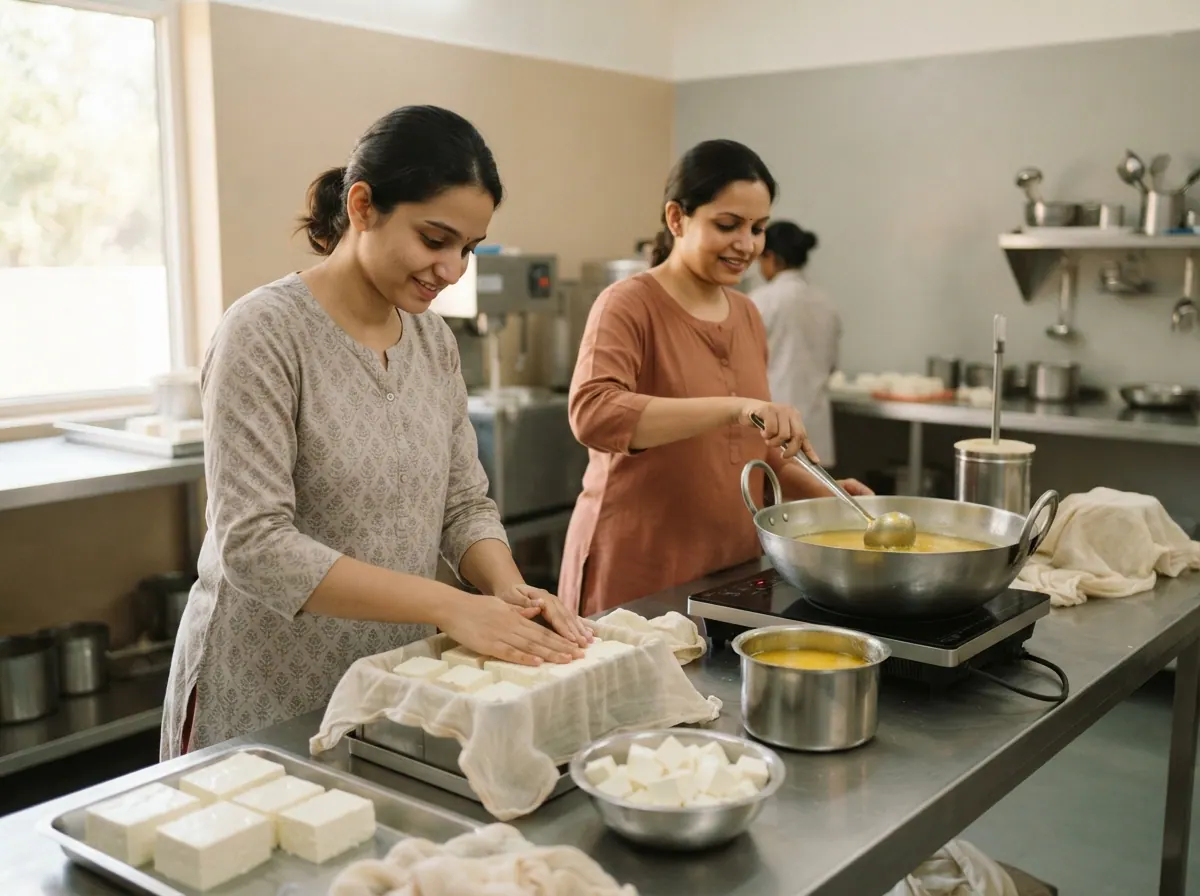
To start a paneer and ghee making business in India you need a reliable milk supply, a steel kettle, a paneer press, a cream separator or churn for ghee, a deep freezer or chiller, clean packing, an FSSAI registration, and about ₹1–10 lakh. A small paneer unit can begin near ₹1.5–3 lakh. Milk is nearly all of your cost, and a litre of milk that sours before you use it is a litre you pay for twice, so the business is won by milk buying, hygiene and fast selling.
All figures here are estimates. Check prices near you before you spend.
What does it cost?
| Item | Estimate |
|---|---|
| Steel jacketed kettle or heating vessels, 100–300 litres | ₹40,000–1.5 lakh |
| Paneer press, moulds, cloths and tables | ₹15,000–60,000 |
| Cream separator or ghee-making set (boiler, churn) | ₹30,000–1.5 lakh |
| Milk cans, chiller or deep freezer | ₹40,000–2 lakh |
| Packing: vacuum or sealing machine, weighing scale | ₹20,000–80,000 |
| Shed, tiles, drains, hot water and electrical changes | ₹30,000–1.5 lakh |
| Registrations, water test and first labels | ₹10,000–40,000 |
| Milk, fuel and packing for the first month | ₹60,000–1.5 lakh |
| Total | about ₹2.5–10 lakh |
Starting with only paneer and a small chiller can come in around ₹1.5–3 lakh. Ghee needs more equipment, but fits well, because it uses cream and keeps for months.
How much can it earn?
Here is a month for a small unit that makes about 50 kg of paneer a day for 26 days, taking about 5 litres of milk for each kilo:
Sales
- 50 kg × 26 days = 1,300 kg
- 1,300 kg × about ₹380 a kg wholesale to shops and hotels = ₹4,94,000
Costs
- Milk: 1,300 kg × 5 litres = 6,500 litres × about ₹50 = ₹3,25,000
- Packing = ₹13,000
- Three workers = ₹45,000
- Fuel and power = ₹30,000
- Rent = ₹15,000
- Delivery = ₹20,000
- Tests, cleaning and small things = ₹7,000
- Total = ₹4,55,000
Left over: ₹4,94,000 − ₹4,55,000 = ₹39,000.
Now see how thin it is. If milk rises by ₹3 a litre, your costs rise by 6,500 × ₹3 = ₹19,500, which is half of your profit. If poor curdling means you need 6 litres for each kilo instead of 5, you buy 1,300 extra litres, about ₹65,000, and the month turns into a loss. That is why a unit that sells only paneer needs a tight milk price, good yield checks and, often, ghee or other products to use cream and spread risk.
What do you need before you start?
- A milk source you trust. Local farmers, a dairy society or a milk agent each have a different quality and price. Check fat and adulteration, such as water and starch, before you accept a can.
- A clean shed. Hard floors, a drain, hot water, a covered store, and a separate place for packing.
- A yield check. Make the same batch three times with weighed milk, note the paneer and whey, and do the maths before you buy equipment.
- A cold chain. Paneer spoils quickly. A chiller or deep freezer, and fast delivery to shops and hotels, protect your money.
- Buyers lined up. Hotels, dhabas, sweet shops, caterers and kirana shops all want different pack sizes and payment terms.
- A reason to pick you. Fresh daily delivery, soft texture, or pure desi ghee with a flavour known in your town.
Step by step
- Test your milk sources for fat and quality, and decide who supplies you in summer and winter.
- Do trial batches of paneer, with weights, so you know your yield per litre.
- Visit hotels and shops with samples. Ask how much they buy a day, their pack size and when they pay.
- Register for FSSAI under the right category and set up the shed with a clear flow: milk, boiling, curdling, pressing, cutting, packing, chilling.
- Start with one route and deliver fresh each morning.
- Make ghee from the cream you take out, or from white butter, and learn the temperature and smell that tell you when it is ready.
- Test your products and water at a lab now and then, and keep a batch log with milk quantity, yield and date.
- Review every week: milk bought, paneer and ghee made, sales, returns and unpaid bills.
Which licences apply?
- FSSAI registration or licence. Dairy manufacturing is covered under food safety rules. The category depends on your size, so check on FoSCoS or with the local food authority.
- GST as you grow, or when hotels and larger buyers ask for GST bills. Ask a CA about the rate on dairy products.
- Udyam registration is free and helps with bank loans.
- Packaging and labelling rules. Packed paneer and ghee must carry the details that food rules ask for, such as the name, net weight, dates and FSSAI number. Confirm the current rules with the food authority.
- Pollution and waste. Whey and washing water can cause smell and drain trouble. Ask locally about the rules for your size.
- Local trade or factory permissions may apply depending on your power load and number of workers.
What goes wrong?
- Souring milk. A power cut or a late can makes the whole batch go to waste.
- Adulterated milk. Added water or starch lowers yield and you pay for it.
- Low yield. Wrong temperature, poor curdling or cutting too soon leaves more of your milk in the whey.
- Hard or rubbery paneer. Overheating and over-pressing make the product a poor buy for hotels.
- Spoilage in the shop. A warm delivery bag or a shop fridge that is turned off ends in complaints.
- Cheap blended ghee. Some competitors add cheap fats. Selling honest ghee costs more, and you must explain why.
- Unpaid bills from hotels. Large buyers pay late while the milk supplier wants money weekly.
Situations you will face
What would you do? Each choice costs something.
Getting started
A dairy society sells steady milk at ₹52 a litre. Local farmers sell richer buffalo milk at ₹56 but are less regular.
- Buy from the society: Steady supply, lower fat
- Buy from farmers: Richer milk, uneven supply
A 100-litre jacketed kettle costs ₹60,000. A 200-litre one is ₹1.1 lakh. Your first orders are small.
- Buy the 100-litre kettle: Cheaper, limited volume
- Buy the 200-litre kettle: Room to grow, big spend
A small chiller costs ₹80,000 and uses power. Ice and thermocol boxes cost much less but warm up in summer.
- Buy a chiller: Safe cold chain, big spend
- Use ice boxes: Cheap, spoilage risk
Your first 20 litres gave only 3 kg of paneer. A sweet-maker says your curdling temperature is off.
- Pay them to teach you: Fee now, better yield
- Experiment on your own: Free, wastes milk
Neighbours complain about steam and whey smell. A tiled shed costs ₹12,000 a month plus ₹60,000 for fit-out.
- Rent the shed: Rent and fit-out, cleaner
- Keep it at home: No rent, complaints
A hotel wants samples tomorrow. You have no FSSAI registration yet, and the food authority is strict about unregistered sales.
- Register first, delay the sale: Fee and a week lost
- Apply online, no samples yet: Slow lead, legal
Hotels take loose 5 kg slabs in a tub. Shops want 200 g vacuum packs, which need a ₹45,000 machine.
- Buy the vacuum machine: Shop market, big spend
- Sell loose to hotels only: Cheap, thinner price
First month
A hotel offers ₹330 a kg for 20 kg a day but pays after 30 days. Your cost is about ₹330.
- Accept at ₹330: Volume, no margin, late pay
- Ask for ₹360: Fair margin, may lose it
A six-hour power cut turned 150 litres of milk sour before you could process it.
- Throw it away: Lose ₹7,500, safe
- Use it for ghee only: Some recovery, lower quality
Your lactometer shows watery milk from a regular farmer. That can is half the day's supply.
- Reject the can: Lose supply, protect yield
- Pay for a lab test first: Test cost, fair talk
A sweet shop returns a batch as hard and rubbery. You pressed it for an extra hour.
- Replace the batch free: Costs ₹6,000, trust kept
- Offer half price instead: Cheaper, shop annoyed
You throw away 40 litres of whey a day into a drain. A bakery and a farmer both ask for it.
- Sell it to the farmer: Small income, tidy
- Keep draining it: No effort, smell complaints
A printer offers 5,000 labels for ₹9,000. You are not sure what details the food authority wants.
- Check the rules first: A week of delay, correct labels
- Print now and fix later: Fast, may be wasted
Running it
Before Diwali and Holi, sweet shops and caterers ask for double paneer and khoa. Milk gets costly and scarce.
- Buy extra milk at high price: Big sales, low margin
- Serve regular buyers only: Safe, miss a peak
Farmers raise milk by ₹4 a litre in summer. Your buyers have not agreed to any increase.
- Raise your price by ₹20: Protects margin, some leave
- Hold the price: Keep buyers, lose profit
Making ghee from cream is cheaper. Making it from fresh white butter gives a better aroma but costs more.
- Make from white butter: Better aroma, higher cost
- Make from cream: Cheaper, plainer taste
Your pure ghee costs ₹620 a kg to make. A rival's cheap ghee is selling fast, and you suspect it is blended.
- Tell customers about yours: Tastings cost, loyal buyers
- Lower the price a little: Thin margin, loses trust
A hotel owes you ₹60,000 and says the owner is out of town. The milk supplier wants payment this week.
- Stop supply to the hotel: Pressure, may lose the buyer
- Keep supplying and wait: Keep the buyer, cash stuck
Your 4 p.m. delivery in summer arrived warm. A shop says half the pack has a sour smell.
- Refund and change the van box: Costs money, fixes the cause
- Refund half, add ice packs: Smaller cost, partly fixed
A big hotel group asks for a lab report on your paneer and ghee before it will buy.
- Pay for the lab report: ₹6,000, opens big buyers
- Offer samples only: Free, may not satisfy them
You see a worker pack paneer without gloves after handling cash. The worker says gloves slow the work down.
- Train and enforce gloves: Costs gloves, safer food
- Give gloves, train next week: Cheap, short delay
A supermarket chain asks for branded 200 g packs at a low rate and 60 days of credit.
- Accept with your brand label: Big volume, cash waits
- Say no for now: Safe, smaller sales
When things go wrong
An inspector visits unannounced and finds the floor wet and the shed untidy, and takes paneer and ghee samples.
- Clean up and fix the drain: Cost now, safer
- Own the mess, promise a date: Warning likely, honest
A farmer who gave you 100 litres a day sells to a rival who pays on the same day.
- Pay them daily: Costs cash flow, steady milk
- Find new farmers: Uncertain quality for weeks
Two families say they felt unwell after eating your paneer. The batch was made on a hot, humid day.
- Recall the batch and test: Costly, protects people
- Offer medical costs, test batch: Costly, honest
Your boiler failed the night before a 150 kg wedding order. A repair takes two days.
- Rent boiler time at a dairy: Costly, order met
- Ask the caterer to wait: Free, may lose the order
Your electricity bill doubled after the chiller and boiler ran longer in summer. Margins are almost gone this month.
- Shift work to early mornings: Cuts power, tires the team
- Raise your paneer price slightly: Protects margin, some leave
Growing
A designer offers a tin label and a brand name for ₹30,000. Branded 500 ml ghee sells at a better price in shops.
- Launch the brand: Spend now, better price
- Sell loose ghee: No spend, lower price
Demand is higher than your 300-litre unit can handle. A bigger kettle, a second chiller and more cans cost ₹3 lakh.
- Expand the unit: Big spend, more sales
- Stay at 300 litres: Safe, miss orders
A refrigerated van costs ₹4 lakh. Your hotel customers in the next town want daily supply.
- Buy the cold van: Heavy spend, wider route
- Use insulated boxes: Cheaper, limited distance
Is it right for you?
A paneer and ghee unit suits you if you like working with milk in the early morning, are strict about cleanliness, and enjoy building regular supply for shops and hotels. A good nose for milk quality is a skill you learn quickly, and it pays.
It suits you less if you want a flexible schedule, or cannot manage a cold chain every day. Try this first: make 10 kg of paneer a day for two weeks from milk you buy yourself, sell it to three shops, and write down the yield, spoilage and money you collected.