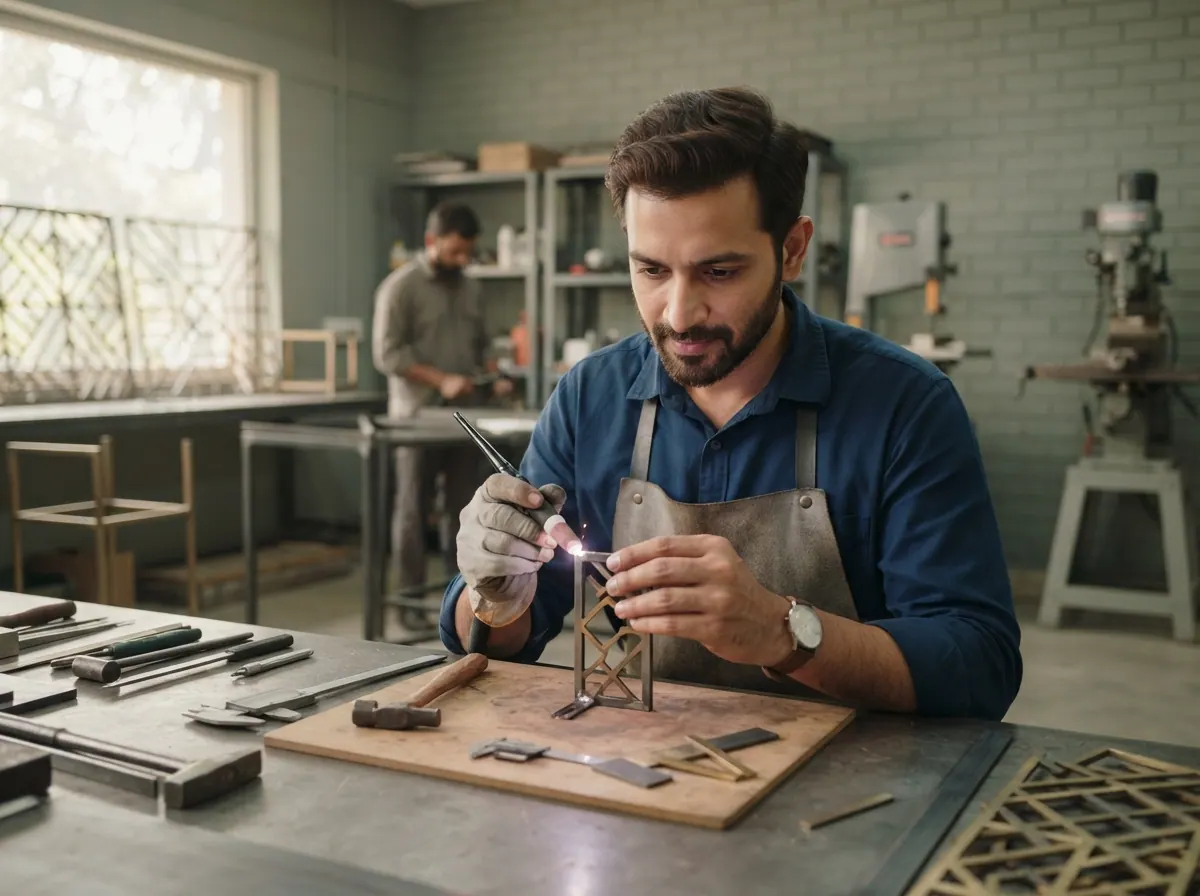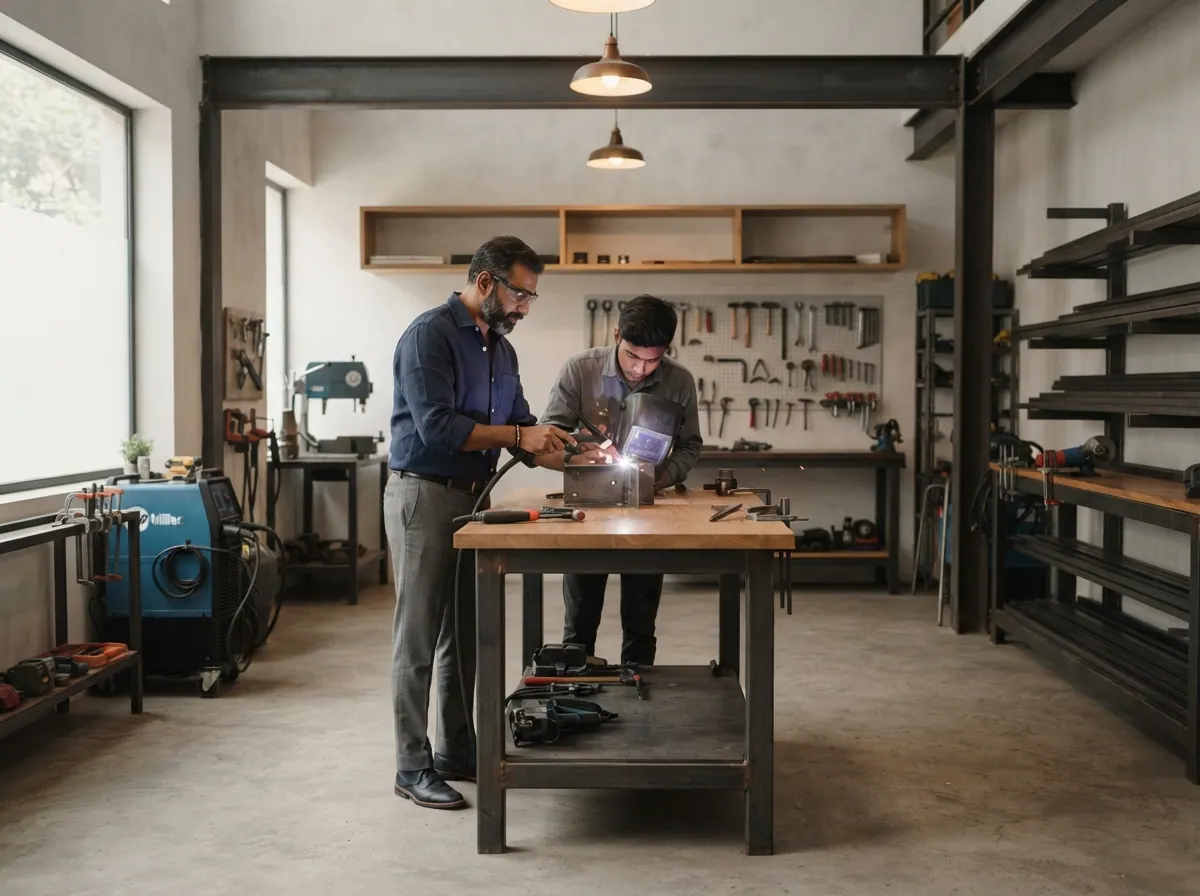
To start a welding and fabrication workshop in India you need a proper shed with a good power connection, an inverter arc welder, a few grinders and cutters, steel stock, and about ₹1.5–4 lakh. The money comes from gates, grills, sheds, railings and repair jobs, and the skill of the welder matters more than the machine.
All figures here are estimates. Check prices near you before you spend.
What does it cost?
| Item | Small workshop |
|---|---|
| Inverter arc welder (about 300–400 amp) | ₹25,000–45,000 |
| Angle grinders, cutting machine, drill | ₹15,000–30,000 |
| Work tables, clamps, hammers, measuring tools | ₹15,000–30,000 |
| Safety gear: helmets, gloves, aprons, extinguisher | ₹8,000–15,000 |
| Shed, shutter or rent advance | ₹30,000–80,000 |
| Power connection and wiring | ₹10,000–25,000 |
| First steel stock: angles, pipes, flats, sheets | ₹30,000–70,000 |
| Electrodes, discs, paint, gas | ₹8,000–15,000 |
| Total | about ₹1.5–4 lakh |
A MIG welder costs far more than an arc welder and is useful for sheet work and cleaner finish. Most new workshops start with arc and add MIG when customers ask. A pipe bender or a shearing tool is another later buy.
How much can it earn?
Most income is job work: you sell steel plus your labour. Here is a month for a workshop with the owner and two helpers.
Sales
- About 20 jobs a month (gates, grills, small sheds, repairs)
- 20 jobs × about ₹9,000 average bill = ₹1,80,000
Costs
- Steel and paint bought for those jobs, about 60% of sales = ₹1,08,000
- Electrodes, discs and gas = ₹9,000
- Two helpers × ₹10,000 = ₹20,000
- Electricity = ₹6,000
- Shop rent = ₹8,000
- Total = ₹1,51,000
Left over: ₹1,80,000 − ₹1,51,000 = about ₹29,000 a month, before your own work is counted as a wage.
Steel rates move, so quote with a short validity and ask for a part advance. A job quoted on last month's rate can wipe out the profit.
What do you need before you start?
- Skill. Spend at least a year with a good fabricator or at an ITI-type course. A clean joint, correct measurement and a straight gate are what customers remember.
- Power. Welders draw heavy current. Ask an electrician about load, wiring and earthing before you plug anything in.
- A place near customers. Near a colony, a market or an industrial area, with space to cut and stock long steel and to park a vehicle.
- A way to carry steel and finished work. A hired tempo for each job is fine at first.
- Working capital. Customers pay in parts and late, while steel is paid for up front.
Step by step
- Work for someone until you can estimate a gate or a shed by yourself.
- Choose your lane: home work (gates, grills, railings), shed and roof work, or factory repair and fittings.
- Set up the shed with safe wiring, an earthed welder, a fire extinguisher and a place to keep gas cylinders upright and chained.
- Buy a basic set of machines. Buy used or new from a reputed dealer and get a warranty.
- Make a rate card by kilogram of steel and by running foot, so customers can compare and you can quote quickly.
- Take a part advance. Collect enough to buy the steel before you start cutting.
- Keep photos of finished work on your phone. These sell the next job.
- Build contacts with contractors, builders, interior workers and local shops who keep sending work.
Which licences apply?
Rules vary by city, so ask locally:
- Local trade or shop permission from the municipality or panchayat, particularly for noise and fire.
- Commercial electricity connection instead of a household one.
- Udyam registration is free to apply and helps with loans. Confirm the current process on the official site.
- GST depends on your turnover and what you sell. Ask a CA.
- Fire and gas safety. If you use gas cylinders, store them as your supplier and the local fire office advise.
- Loans. Banks give small business loans, and Mudra loans are meant for businesses of this size. Ask your bank which are open.
What goes wrong?
- Underpriced quotes. Steel rises after you quote, and you finish the gate at a loss.
- Weak welds. A gate or railing that cracks harms your name, and a failed shed frame can injure someone. Slow down on load-bearing work.
- Fire and eye injury. Sparks near paint, wood or cloth start fires, and a missing helmet means burnt eyes. Safety gear is not optional.
- Late payment. A contractor says the money will come after the site is finished. Chase early and never hand over finished work for free.
- Rust and bad paint. A gate painted over wet steel peels in one rainy season, and customers blame you.
- Helpers who leave. A trained helper goes to start a competing shop with your customers. Pay fairly and teach carefully.
- Overloading one machine. Running a small welder all day on thick work burns it out.
Situations you will face
What would you do? Each choice costs something.
Getting started
A dealer shows you a MIG set that gives clean sheet work. An arc inverter costs far less and handles gates and frames.
- Buy the MIG set: Costly, cleaner finish
- Buy an arc inverter: Cheaper, rougher on thin sheet
A closing workshop sells a welder with no bill and no warranty. It runs fine today.
- Buy it as it is: Cheap, repair risk
- Buy new with warranty: Costs more, service backing
The electrician says your shed wire is too thin for the welder and the earthing is poor. Rewiring costs money.
- Rewire and earth properly: Costly, safe and steady power
- Use the old wire for now: Saves money, fire and shock risk
A shop in a colony gets walk-in gate and grill work but neighbours dislike noise. A plot in the industrial area is cheaper and quieter.
- Take the colony shop: Higher rent, more home jobs
- Take the industrial plot: Cheaper, fewer walk-ins
A steel dealer offers a good rate on a big lot of angles and pipes. It would use up most of your working cash.
- Buy the big lot: Good rate, cash locked up
- Buy for each job: Cash safe, slower starts
Your helper says old cloth is fine instead of a proper helmet and gloves. A set for each worker costs real money.
- Buy proper safety gear: Pay now, fewer injuries
- Use what you have: Saves money, burns and eye risk
Your cutting set has an oxygen and a gas cylinder. The corner near the welding table is the easiest place for them.
- Build a chained cylinder corner: Costs a bit, much safer
- Keep them near the table: Free, a fire risk
First month
A homeowner wants a main gate and asks for a price today. Steel rates were rising last week.
- Quote high, take advance: Safer margin, may lose the job
- Quote low to win it: Small advance, thin margin
A shop owner wants a shutter frame made and says they will pay everything on delivery. You would have to buy all the steel.
- Ask for half in advance: Safer, they may go elsewhere
- Buy the steel yourself: Cash locked up, keeps the job
The gate is done and the customer is waiting. The steel is damp from morning rain and primer will not stick well.
- Dry it and delay a day: Customer waits, paint lasts
- Paint over the damp steel: On time, peels in rains
Your only helper has learnt to cut and grind well. A rival workshop has offered them more.
- Raise their pay: Costs monthly, they stay
- Hire a new learner: Cheaper, slower work
A family next door says the grinding at 7 am wakes their children. They threaten to complain to the municipality.
- Add sound panels, start at 8: Costs money, slower mornings
- Carry on as before: Full hours, a complaint risk
Running it
A customer wants a curved staircase railing from a photo on their phone. It needs a pipe bender you do not own.
- Buy a bender and do it: Costly, new type of work
- Offer a simpler design: No spend, may lose the job
A builder wants twenty grills at a low rate per piece, to be paid after the flat is sold.
- Take it with 40% advance: Steady work, slow balance
- Refuse the delayed payment: Safe, you lose the order
The dealer raises MS angle and pipe rates. You have four jobs already quoted at the old rate.
- Ask customers for a small top-up: Fair, some will grumble
- Finish at the old rate: Trust kept, profit eaten
A trader offers loose electrodes at a low price. Your welder says the joints come out rough and need more grinding.
- Stay with branded rods: Costs more, clean welds
- Buy the cheap lot: Saves money, more rework
After a long day on thick angles, the machine shuts off and smells hot. A big shed order is due this week.
- Rest it and service it: Lose a day, machine lasts
- Keep pushing it: On time, burnout risk
A farmer brings a broken tractor plough on a tight schedule and asks for a rate close to cost.
- Do it at a fair rate: Thin margin, farmers refer you
- Charge full price: Good money, may not return
Cut ends and scrap steel fill one corner. A scrap dealer offers a price per kilo, but you could make small brackets from them.
- Sell to the scrap dealer: Quick cash, uses no labour
- Make brackets and hinges: Takes time, higher value later
When things go wrong
A spark lands near open paint tins and a rag burns. You put it out, but it was close.
- Buy extinguishers, move the paint: Costly, a real fix
- Just move the tins: Cheap, still exposed
A customer calls and says a joint on the gate you built last month has split. A child plays near it.
- Go today and re-weld it free: Costs time and steel, name kept
- Charge for the repair: Some money back, customer upset
Your helper looked at the arc without a mask and cannot see clearly. They say it will pass.
- Take them to a doctor: Costs fees, proper care
- Send them home to rest: Cheap, a risk to their eyes
A contractor has taken delivery of three shed frames and keeps saying payment will come next week.
- Stop work until they pay: Risk losing them, protects cash
- Keep working and wait: Keeps the relationship, money stuck
Ten long pipes stored outside are gone overnight. The shutter lock was not strong.
- Report it and fit a strong lock: Some cost, record made
- Just rebuy the pipes: Cheap fix, still exposed
A window frame was measured wrongly and does not fit the opening. The customer is upset.
- Remake it at your cost: Loss, trust kept
- Add a filler strip, charge less: Cheaper, looks patched
A trained helper rents a shed nearby and calls your regular customers with lower rates.
- Match with a loyalty rate: Margin drops, customers stay
- Hold your rate, stress quality: Margin kept, some leave
Growing
Jobs are piling up and customers wait two weeks. A skilled welder asks for a high monthly salary.
- Hire the skilled welder: Costly, faster delivery
- Train your helper further: Cheap, slower to ready
A local unit wants machine stands and guards made every month. Payment comes after 45 days and quality is checked strictly.
- Take the contract: Steady jobs, slow payment
- Stay with home customers: Faster cash, smaller jobs
A pipe bender and a shearing tool would cut your labour time on railings and sheet work. It would take most of your savings.
- Buy both machines: Heavy spend, faster work
- Buy only the pipe bender: Smaller spend, partial gain
The bank manager says a small business loan is possible if you show your bills and a few months of records.
- Apply with proper records: Fees and effort, cheaper capital
- Borrow from a local lender: Quick, high interest
Is it right for you?
A welding workshop suits you if you like hands-on work, can read a drawing and estimate steel, and can handle heat, noise and dust. It suits you less if you want a clean desk job or cannot chase customers for money.
A good test: spend two weeks at a busy workshop. See how jobs are quoted and how payments are collected. Then open with one welder, one helper and a small steel stock, and add machines only when jobs prove you need them.