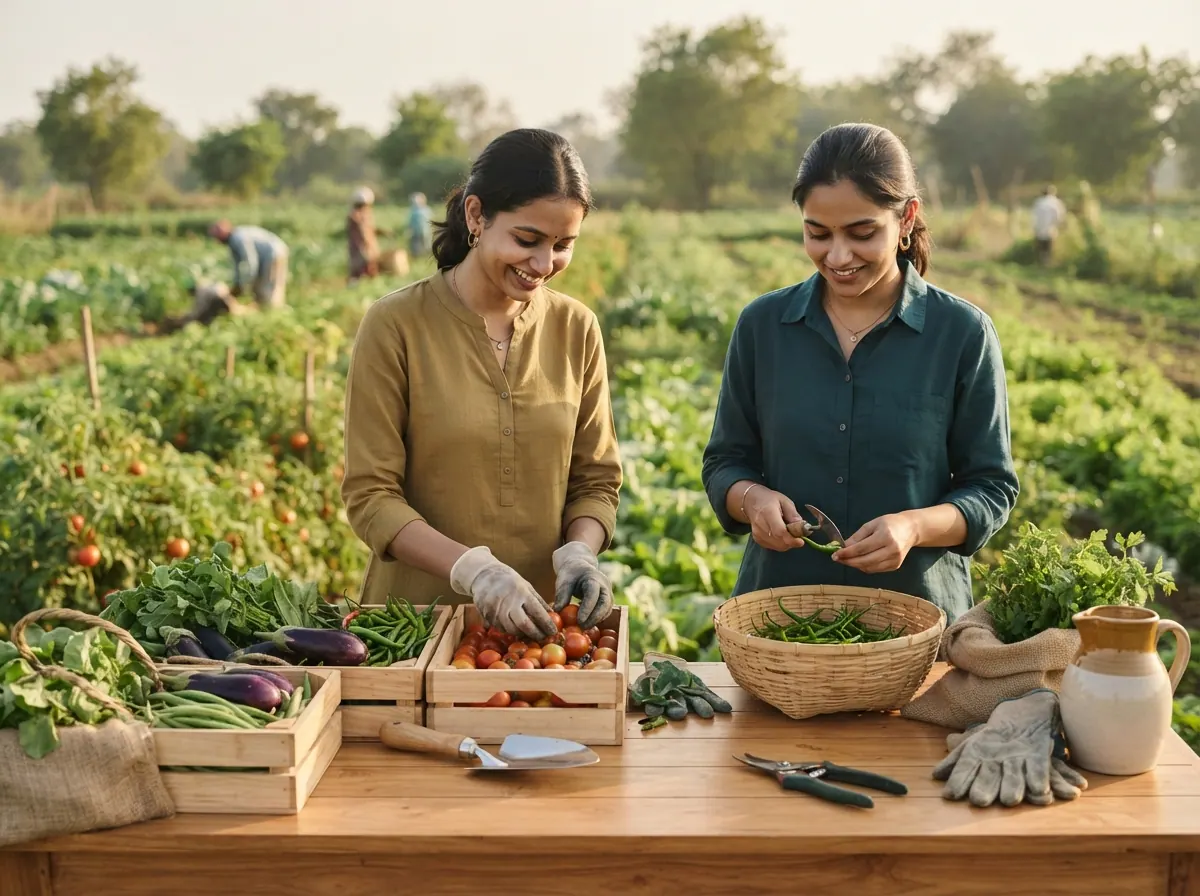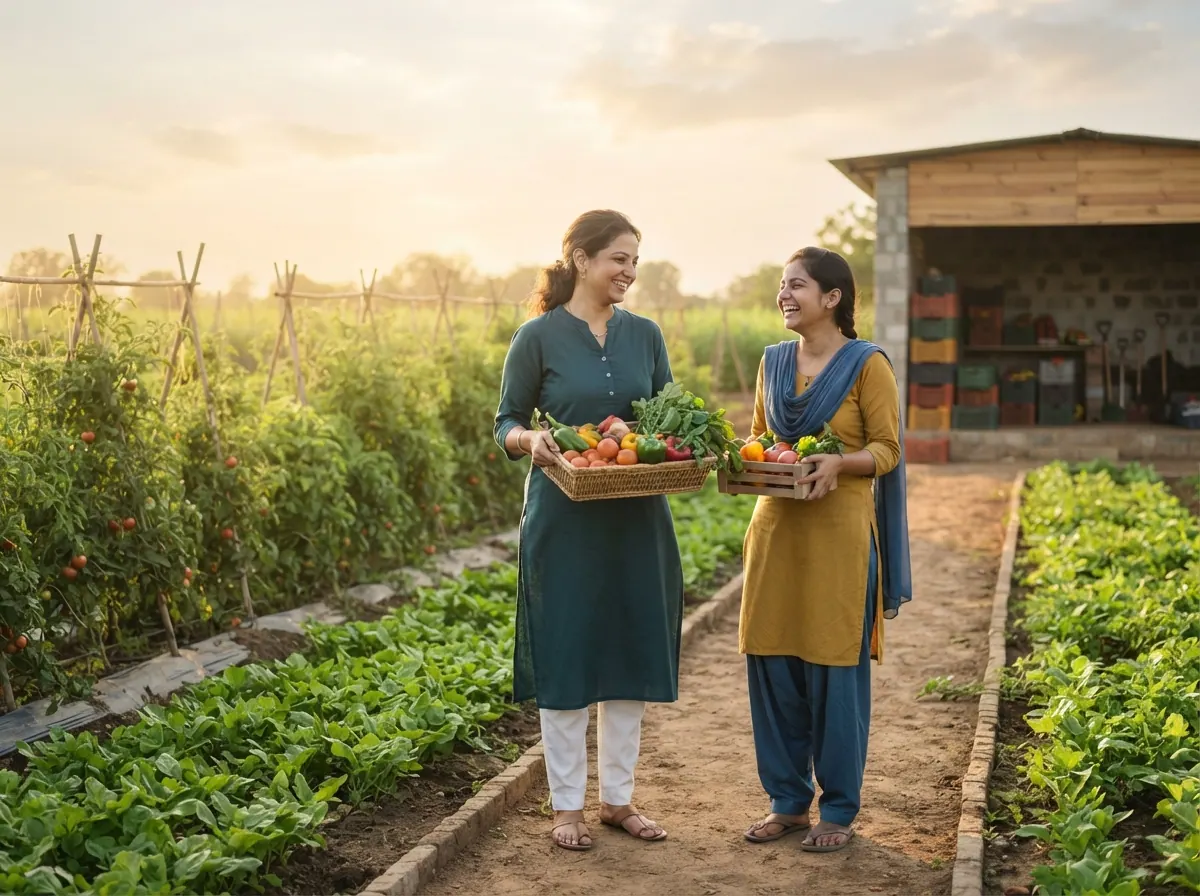
To start vegetable farming in India you need land with reliable water, a few well-chosen crops that your mandi buys, and about ₹1–2 lakh for one acre or ₹2–3.9 lakh for two acres. That is on land you own. Vegetables pay quickly, often within two or three months, but prices can swing so hard from week to week that one crop can double your money and the next can lose it.
All figures here are estimates. Check prices near you before you spend.
What does it cost?
| Item | 1 acre | 2 acres |
|---|---|---|
| Ploughing, bed making, farmyard manure | ₹8,000–15,000 | ₹16,000–30,000 |
| Seeds or seedlings for the first crop | ₹10,000–25,000 | ₹20,000–50,000 |
| Drip irrigation and fittings | ₹30,000–50,000 | ₹60,000–1 lakh |
| Sprayer | ₹3,000–6,000 | ₹5,000–12,000 |
| Fertiliser and plant protection for one crop | ₹15,000–30,000 | ₹30,000–60,000 |
| Hired labour for one crop | ₹20,000–40,000 | ₹40,000–80,000 |
| Crates, tarpaulins and weighing scale | ₹5,000–10,000 | ₹10,000–20,000 |
| Stakes, string and mulch | ₹10,000–20,000 | ₹20,000–40,000 |
| Total | about ₹1–2 lakh | about ₹2–3.9 lakh |
Leasing land adds a yearly rent. A borewell and pump, if you do not have them, can cost more than everything else in the table together.
What should you grow?
- Tomato: the highest swings in price. It needs staking and daily watching, and can pay very well or lose money.
- Brinjal, chilli and okra: longer picking seasons, so they give steady cash.
- Bottle gourd and other gourds: easy to grow, but prices can drop in the main season.
- Cabbage and cauliflower: better in the cooler months, and the whole crop comes at the same time.
- Leafy greens such as palak, methi and coriander: quick cash, short life after picking.
Do not put the whole farm into one crop. Split the area, and stagger sowing by a few weeks, so everything is not ready on the same day.
How much can it earn?
Here is one acre, owned, with two crops in a year, such as tomato followed by okra.
Sales in a year
- About 14,000 kg of sellable vegetables from both crops
- 14,000 kg × an average of about ₹20 a kg = ₹2,80,000
Costs in a year
- Seeds and seedlings = ₹30,000
- Fertiliser and sprays = ₹45,000
- Hired labour for picking and weeding = ₹70,000
- Water and power = ₹15,000
- Stakes, mulch and crate replacement = ₹15,000
- Transport and mandi commission = ₹20,000
- Total = ₹1,95,000
Left over: ₹2,80,000 − ₹1,95,000 = about ₹85,000 a year, or about ₹7,100 a month.
If your family does most of the picking and weeding, you keep much of the ₹70,000 labour too. A good price year can double this number, and a price crash, such as tomato selling at a few rupees a kilo, can wipe it out, because your cost has already been spent. Costs are fixed once you plant. Price is not.
What do you need before you start?
- Water you can count on. Check the borewell or canal in May.
- A mandi or buyer within reach. Vegetables spoil. A mandi two hours away is a very different business from one half an hour away.
- Soil you understand. Ask your agriculture office or a nearby growers' group about a soil test.
- Labour at picking time. Picking cannot wait, and pickers get scarce at festival and harvest time.
- Cash for the first crop. Plan for seed, labour and sprays before any sales.
Step by step
- Visit two growers near you and ask what they planted, what they sold it for last year and what they lost.
- Test the soil if you can, and add farmyard manure before ploughing.
- Raise seedlings on a small nursery bed for tomato, brinjal, chilli and cabbage. Seedlings from a trusted nursery are another option.
- Plant in rows with drip if you can afford it. It saves water and cuts weeding.
- Watch the crop every day. Check for wilting, leaf curl and insects early.
- Stake tall crops such as tomato before they fall.
- Pick at the right stage, in the morning, and sort by size and quality before you send.
- Compare mandis and buyers weekly, and note prices, so you know when to send and when to hold.
Which licences apply?
Open-field vegetable farming has little paperwork, but ask locally:
- Land papers. If you farm on leased land, get the lease in writing.
- Agricultural loans and schemes. Banks give crop loans, and state horticulture departments have run schemes for drip, mulch and crates. Rules and amounts change, so ask the district horticulture office.
- Crop insurance may be available for some crops. Ask the bank or agriculture office what is covered and when to enrol.
- Selling in a regulated mandi may need a trader or a commission agent. Ask local farmers how they sell.
- Pesticide use. Buy from licensed shops, keep the bills, and follow the label and your agriculture officer's advice.
What goes wrong?
- A price crash. Everyone plants the same crop after a high-price year, and the next season the price falls below your cost.
- Pests and diseases. Whitefly, fruit borer, leaf curl and wilt can take a crop in a week, and the wrong spray costs money without helping.
- Rain at picking time. Rain pushes prices down and rots tomatoes in the field.
- No labour at the peak. Fruit that is not picked in time falls in grade.
- Too much fertiliser and spray. It raises your cost, and buyers may reject produce with too much residue.
- Selling only to one trader. A trader who sets the price and pays late keeps your profit.
- Water running short. A dry May can kill a standing crop.
Situations you will face
What would you do? Each choice costs something.
Getting started
Loose seed from a local shop is half the price of branded hybrid seed. It has no germination guarantee.
- Buy branded hybrid seed: Costs more, better stand
- Buy the loose seed: Cheaper, patchy germination
Tomato paid well last year, so everyone is planting it. Okra gives steady picking at a lower price.
- Plant tomato: Big gain or loss, staking cost
- Plant okra: Steadier, lower price
Drip saves water and weeding, but costs a lot before the first crop. Flooding the rows costs nothing.
- Install drip: Costly, less water and weeds
- Flood the rows: Free, more weeds and water
A nursery sells ready seedlings. Raising your own is cheaper but needs a shaded bed and daily watering.
- Buy from the nursery: Higher cost, ready quickly
- Raise your own: Cheaper, a few weeks later
The soil lab charges a small fee and takes a week. Your neighbour just uses the usual fertiliser dose.
- Test the soil first: Small fee, a week lost
- Use the usual dose: No delay, may over-spend
A landowner offers an acre for a year's rent upfront. There is no written agreement yet.
- Lease with a written deed: Rent and a small fee, secure
- Skip it, farm your own land: No rent, less output
The big mandi pays better but is two hours away. A village trader picks up from the farm at a lower rate.
- Send to the big mandi: Better rate, transport cost
- Sell to the village trader: Easy pickup, lower rate
First month
After two cloudy days, a third of your nursery seedlings fall over. The base looks wet and thin.
- Drench and thin the bed: Cost and loss, saves the rest
- Water less and wait: Free, more seedlings may fail
The crop is a month old and weeds are as tall as the plants. Weeders charge more at this time of year.
- Hire a weeding gang: Labour cost, clean field
- Weed with family only: Slow, crop suffers
The leaves are curling and sticky. The shopkeeper pushes an expensive spray, while your neighbour says neem is enough.
- Ask the agriculture officer: Time and cost, right advice
- Spray what the shop sells: Costly, may not work
The plants are heavy with fruit and starting to lean. Stakes and string cost money and labour.
- Stake every row: Cost now, clean fruit
- Stake only the worst rows: Cheaper, fruit touches the soil
The motor stops in the middle of a hot week. The repair shop wants three days or a new motor.
- Buy a new motor: Big bill, back on tonight
- Wait for the repair: Cheaper, plants stressed
Okra needs picking every other day and the pickers have gone to another farm for a higher wage.
- Pay a higher picking rate: Higher cost, fruit picked
- Pick with family only: Cheaper, fruit gets old
Running it
Everyone's tomatoes arrived at once and the mandi price has collapsed. A cold store offers to hold your crop for a fee.
- Hold in cold storage: Fee, wait for recovery
- Sell at today's price: Quick, low price
Buyers pay more for clean, even-sized produce. Sorting takes workers and time before you pack.
- Grade before packing: Labour cost, better price
- Send everything mixed: Quick, lower rate
A commission agent offers cash upfront for the whole season. In return the agent will set the price on delivery.
- Take the advance: Cash now, agent sets rate
- Stay free to choose: No advance, better chances
The shop has raised the fertiliser rate before the next crop. Compost from a dairy is cheaper but takes time.
- Buy fertiliser now: Higher cost, quick results
- Add compost and halve fertiliser: Cheaper, slower growth
A local fruit and vegetable shop wants a fixed amount every day at a steady price, with weekly payment.
- Supply the shop: Steady buyer, daily delivery
- Keep selling at the mandi: Free to choose, price swings
Tomatoes packed in sacks reach the mandi bruised, and the buyer cuts the rate. Crates cost money.
- Buy plastic crates: Cost now, better grade
- Keep using sacks: Free, lower price
A week of rain has begun at harvest. Fruits are splitting and prices are falling.
- Pick early and sell fast: Extra labour, saves most
- Wait for it to clear: Free, fruit may rot
When things go wrong
Plants in one corner are collapsing, and the patch is growing every day. It may be a soil disease.
- Remove plants, change crop there: Lose that patch, protect rest
- Keep watering: No cost, may spread
A short hailstorm has torn leaves and bruised fruit across half the field. Crop insurance papers are not in order.
- File a claim with proof: Effort and fees, a payout chance
- Clear and replant: Cost, a late crop
A trader says your chilli was picked too soon after spraying. The lot is returned.
- Follow the waiting period: Loss now, trust later
- Test it, sell only if safe: Test fee, safe produce only
A trader has not paid for three loads and now asks for a fourth. Other buyers have started calling.
- Stop and demand payment: Safer, may lose a buyer
- Send one more load: Keeps buyer, more risk
The borewell gives less each day and the standing crop is wilting by noon.
- Rent a water tanker: Costly, saves the crop
- Water in short rounds: Cheap, yield falls
Cattle broke the fence at night and ate a fifth of the crop. Wire fencing costs a lot.
- Build wire fencing: Big cost, lasting fix
- Mend the old fence: Cheap, may happen again
Growing
Selling seedlings to neighbours could add income. A shade-net house costs money and needs daily care.
- Build the nursery: Cost now, extra income
- Skip it for now: No cost, no extra income
A mulch film saves water and weeding but must be bought and laid every season.
- Lay mulch film: Cost each season, cleaner rows
- Keep bare beds: Free, more weeding
The farm has paid for itself. Two more acres would double the work and the price risk.
- Lease and plant: Heavy cost, more output
- Improve your own acre: Smaller spend, steady gain
A group of growers sells together to a retail chain at steady rates. It asks for a membership fee and fixed quality.
- Join the group: Fee and quality rules, steady buyer
- Stay independent: Free choice, price swings
Is it right for you?
Vegetable farming suits you if you have land and water, can live with changing prices, and can be in the field every day. It suits you less if you need a fixed income every month, or if your mandi is far away.
A good test: plant one crop on a small plot next to your main field, keep every bill and every sale slip, and calculate your own cost per kilo. If it works at an ordinary price, not only a good one, expand to a second plot.