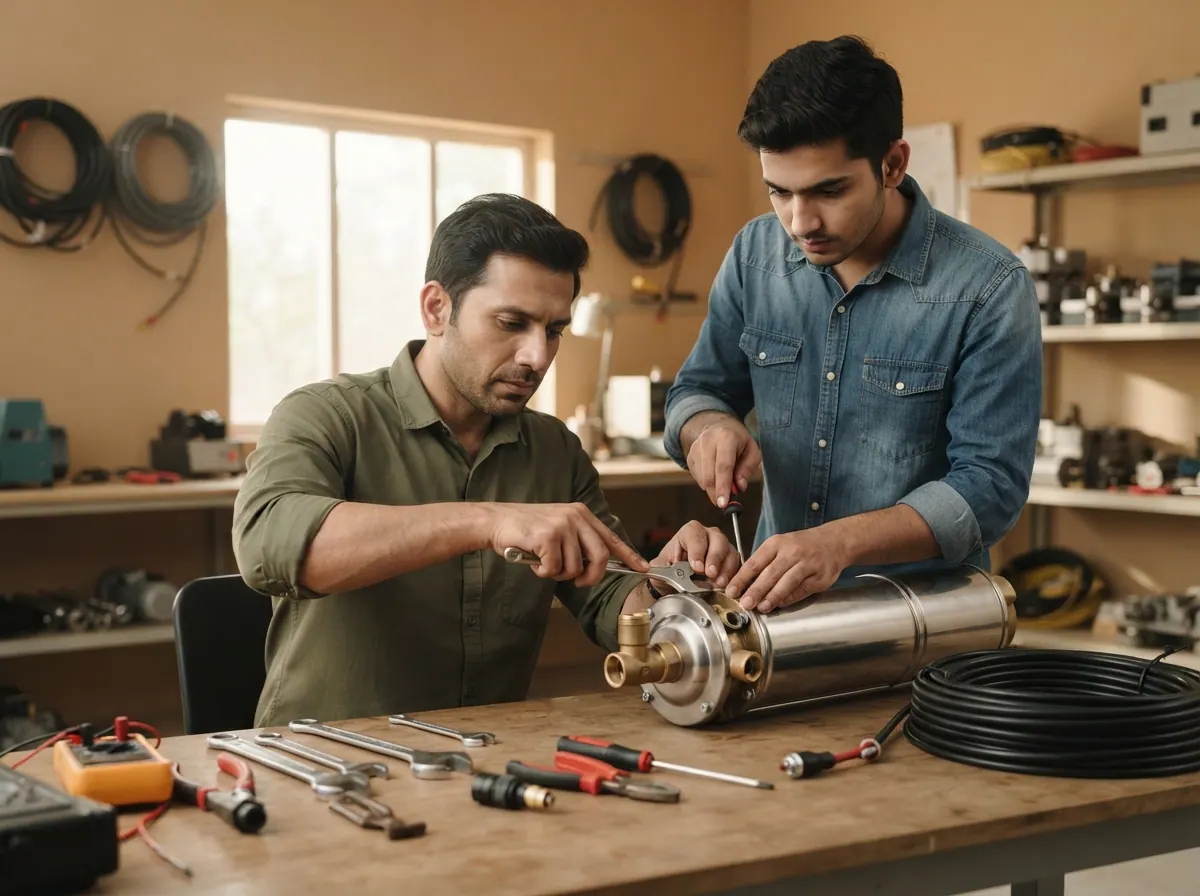
To start a submersible pump and borewell motor service business in India you need a tripod with chain pulley to pull motors out, pipe wrenches, a megger and multimeter, spare cable and a parts stock, a vehicle to carry pipes, two strong helpers, and about ₹1 lakh to ₹5 lakh. The work is pulling a motor out of a borewell, finding the fault, repairing or replacing the pump, and lowering it again. This is not drilling, which needs a rig costing far more.
All figures here are estimates. Check prices near you before you spend.
What does it cost?
| Item | Basic start | Fuller start |
|---|---|---|
| Tripod, chain pulley, ropes, clamps | ₹15,000–30,000 | ₹30,000–50,000 |
| Pipe wrenches, cutters, tools | ₹8,000–15,000 | ₹15,000–25,000 |
| Megger, multimeter, clamp meter | ₹6,000–12,000 | ₹12,000–20,000 |
| Spare cable, pipes, check valves, starters | ₹25,000–50,000 | ₹60,000–1.2 lakh |
| Motors and pump sets for sale | – | ₹50,000–1.5 lakh |
| Vehicle (second-hand loader or tempo) | Hire per trip | ₹60,000–1.5 lakh |
| Small yard or shed, phone, ads | ₹5,000–15,000 | ₹20,000–40,000 |
| Total | about ₹1–2 lakh | about ₹3–5 lakh |
Start with the basic set and hire a vehicle for long pipes. Add stock once you know which pump brands and horsepower your area uses.
What do you need before you start?
- Electrical sense. You will work with panels, capacitors and wires near water. Learn earthing, switching off and proving a line is dead before touching it.
- Knowing pump types. Submersible, openwell and monoblock pumps fail differently. Learn the common ones in your area, usually 1 HP to 5 HP.
- A rewinding partner. Find a motor rewinding shop that does good work at a fair price and returns the motor on time.
- Strong, steady helpers. Pulling a loaded rising main from a deep borewell takes two or three people. Safety and teamwork matter.
- Your area's water story. Farms with falling water levels, flats with sand in the water, or a colony with frequent power cuts each give different jobs.
How much can it earn?
Here is a small business with two helpers in its second year. These numbers are examples, not promises.
Monthly margin
- 35 jobs × about ₹3,000 average bill = ₹1,05,000
- Parts and materials about 50% = ₹52,500
- Margin on jobs: ₹1,05,000 − ₹52,500 = ₹52,500
- 2 pump sets sold × about ₹3,000 margin = ₹6,000
- Total margin = about ₹58,500
Monthly costs
- Two helpers = ₹20,000
- Vehicle fuel and repair = ₹8,000
- Yard rent = ₹6,000
- Phone and other = ₹3,000
- Total = ₹37,000
Left over: ₹58,500 − ₹37,000 = about ₹21,500 a month.
Summer can be much busier and winter slower, so keep a cushion. A yearly checking plan for farms and housing societies gives steadier work.
Step by step
- Work with an experienced pump mechanic for a few months. Learn to read a failed motor and a worn pump.
- Buy the basic pulling and testing tools, and a small stock of common parts.
- Visit farms, flat committees and electricians. Electricians often get the first call when a pump stops and can send you work.
- Do a proper diagnosis first. Check supply, cable, capacitor and insulation before you pull the motor. A pull costs the customer time and money.
- Give a written estimate for pulling, repair and lowering, and keep old parts to show.
- Record every job: borewell depth, pump HP, pipe length, fault, parts and date. This helps you quote and trace repeat faults.
- Add pump sales and yearly checks once the repair work is steady.
Which licences apply?
For servicing, paperwork is usually light but varies by state:
- Shop and establishment registration if you keep a shop.
- GST if your sales pass the limit, or if a supplier or business customer needs it. Ask a CA.
- Drilling and groundwater rules are separate, and some states control drilling. You do not need these only to service pumps, but ask your local office.
- Brand service agreements with pump companies have their own terms.
- Electrical safety. Work with proper earthing and ask the electricity department or a licensed electrician about wiring rules for panels.
What goes wrong?
- Pulling the motor too early. Without checking supply and capacitor first, you pull a good motor and the customer pays for nothing.
- Dropped pipe in the borewell. A snapped pipe or lost motor can block a borewell and cost far more than the job.
- Voltage and dry run. Many burnt motors come from low voltage or a pump running with no water. Customers blame you anyway, unless you explain it.
- Wrong HP or head. A pump too weak for the depth or too strong for the supply fails soon.
- Unpaid farm bills. Farmers may pay only after harvest. Agree terms before the work.
- Electric shock. Wet hands, bare wires and no earthing are the real danger in this trade.
Situations you will face
What would you do? Each choice costs something.
Getting started
An experienced pump mechanic will take you on their jobs for two months, but the fee is not small.
- Pay and learn properly: Fee and delay, safer jobs
- Start with your own jobs: Earn sooner, mistakes likely
A welder offers a light tripod at a low price. A heavier one with a good chain pulley costs far more.
- Buy the heavy tripod: Costly, safe for deep pulls
- Buy the light one: Cheaper, only shallow borewells
A megger checks insulation before you pull a motor. Without it you have to open the motor to find out.
- Buy a megger: Cost now, fewer wasted pulls
- Pull and check by hand: Saves money, many extra pulls
Long pipes and a tripod need a vehicle. A second-hand loader costs a lot, hiring costs every trip.
- Buy a second-hand loader: Big spend, work anywhere
- Hire per trip: Small cost, depends on others
A local electrician gets calls from farms when pumps stop. They want a share if they send them to you.
- Agree to a fair share: Less margin, regular jobs
- Refuse the deal: Full margin, fewer calls
Deep pulls need strong hands. A third helper makes work safer, but they must be paid even on slow days.
- Hire a third helper: Higher wages, safer pulls
- Stay with two: Lower wages, strain and risk
A dealer offers a bulk price on cable, pipes and check valves. It ties up cash.
- Buy the bulk lot: Cheaper, always ready for jobs
- Buy per job: Less cash tied, slower jobs
First month
A farmer says the pump burned. You find the water has dropped below the pump and it ran dry.
- Explain, lower the pump: Longer job, honest, trust built
- Sell motor with dry-run switch: Costs more, honest sale
The real fault was a failed capacitor in the panel. The customer paid for a pull they did not need.
- Refund the pulling charge: Cost to you, respect earned
- Refund half, explain the fault: Smaller loss, some doubt
Halfway through a deep pull you notice the rope is worn. The motor is heavy and the borewell is deep.
- Stop, buy new rope: Lost hours, safe lift
- Stop, hire a stronger rope: Pay a hire fee, lose the day
A village's voltage drops every evening and your third motor there has burnt. The owner blames your work.
- Fit an automatic starter: Extra cost, protects the motor
- Repeat the same fix: Cheap, it will burn again
A farmer asks for a price on the phone. Costs may change once the motor is out of the well.
- Give a written range: Takes effort, avoids disputes
- Give a quick verbal price: Quick, fights over the final bill
A flat complex complains of sand. The pump impeller is worn and the borewell may be silting.
- Flush well, change impeller: Costly, fixes the cause
- Only change the impeller: Cheaper, sand returns
Running it
Water tables fall and twenty farms want pumps lowered this week. You can finish half of them.
- Hire a temporary crew: Wage cost, finish most jobs
- Work longer hours yourself: No cost, tired crew and errors
The shop that rewinds your motors returns them late. Farmers are waiting without water.
- Switch to a better winder: Higher rate, on-time motors
- Stay with the old winder: Cheap, delays continue
A housing society wants one price for a yearly check of its borewell pumps. It means regular but low-margin work.
- Offer the yearly plan: Steady work, fewer big bills
- Charge per call: Better rate, uncertain work
A regular farmer wants a new pump set now and will pay after the crop is sold in four months.
- Give half on credit: Some risk, a loyal customer
- Cash only: Safe money, may lose a buyer
A pump maker offers a good margin if you push only its brand. Your customers like variety.
- Sell their brand: Better margin, less choice
- Stay brand-neutral: Trusted advice, thinner margin
A dairy's pump stopped and cattle have no water. They call late and offer extra pay.
- Go with a full crew: Extra wage, big goodwill
- Go in the morning: Rest, a lost customer
Customers keep promising to pay on UPI later. Several dues are adding up.
- Collect before leaving: Firm, some grumbling
- Let them pay later: Friendly, money delayed
When things go wrong
During a pull a pipe joint breaks and the motor falls deep into the borewell. The owner is shocked.
- Hire a fishing crew: Heavy cost, well recovered
- Tell the owner and share cost: Cheaper, a tense talk
A helper got a shock from a wet panel with no earthing. They are fine, but shaken.
- Stop work, fix earthing: Lost day, safer team
- Pause jobs, call electrician: Costly, a week of lost jobs
A new crew pulls pumps for half your rate. Several customers ask you to match it.
- Match on simple pulls: Thin margin, keep farmers
- Stay on quality and safety: Margin safe, lose some jobs
A motor you sold failed in a month. You find the dealer gave you a duplicate-looking unit.
- Replace and change dealer: Costly, trust saved
- Admit dealer fault, share cost: Costs money, truth told
The engine fails during the busiest week. Repair takes five days and farms are waiting.
- Hire a vehicle meanwhile: Hire charges, jobs continue
- Wait for the repair: No hire, jobs delayed
A farmer owes you ₹15,000 for a pump set. They stop answering calls after harvest.
- Visit and settle in parts: Time spent, part recovery
- Write it off: Lose the money, move on
Growing
Rewinding in-house keeps more of each job. You would need a winding machine and a trained winder.
- Set up rewinding: Machine and wage, more margin
- Keep outsourcing: No spend, thinner margin
A shop on the highway would let farmers buy pumps, cable and pipe from you, but needs rent and stock.
- Open the shop: Rent and stock, steady sales
- Keep working from a yard: Low cost, fewer walk-ins
More farms call than one crew can handle. A second crew needs a tripod, tools and a leader you trust.
- Start a second crew: Equipment and wages, more jobs
- Raise your prices instead: No spend, fewer jobs
Some farmers want solar pump sets. It needs new knowledge and a supplier, and schemes may or may not apply.
- Learn and stock a few: Training and stock cost
- Stay with grid pumps: Familiar, lose some farmers
Is it right for you?
This work suits you if you are strong, comfortable with electrical fault-finding, and happy to go to farms and plots at odd hours. It suits you less if you want a regular office-style day or dislike mud, ropes and heavy lifting.
A good test: join a pump mechanic for a summer month. If you still enjoy it after a few borewell pulls in the heat, start with the basic kit, build trust with local electricians, and grow from repeat farm and flat customers.