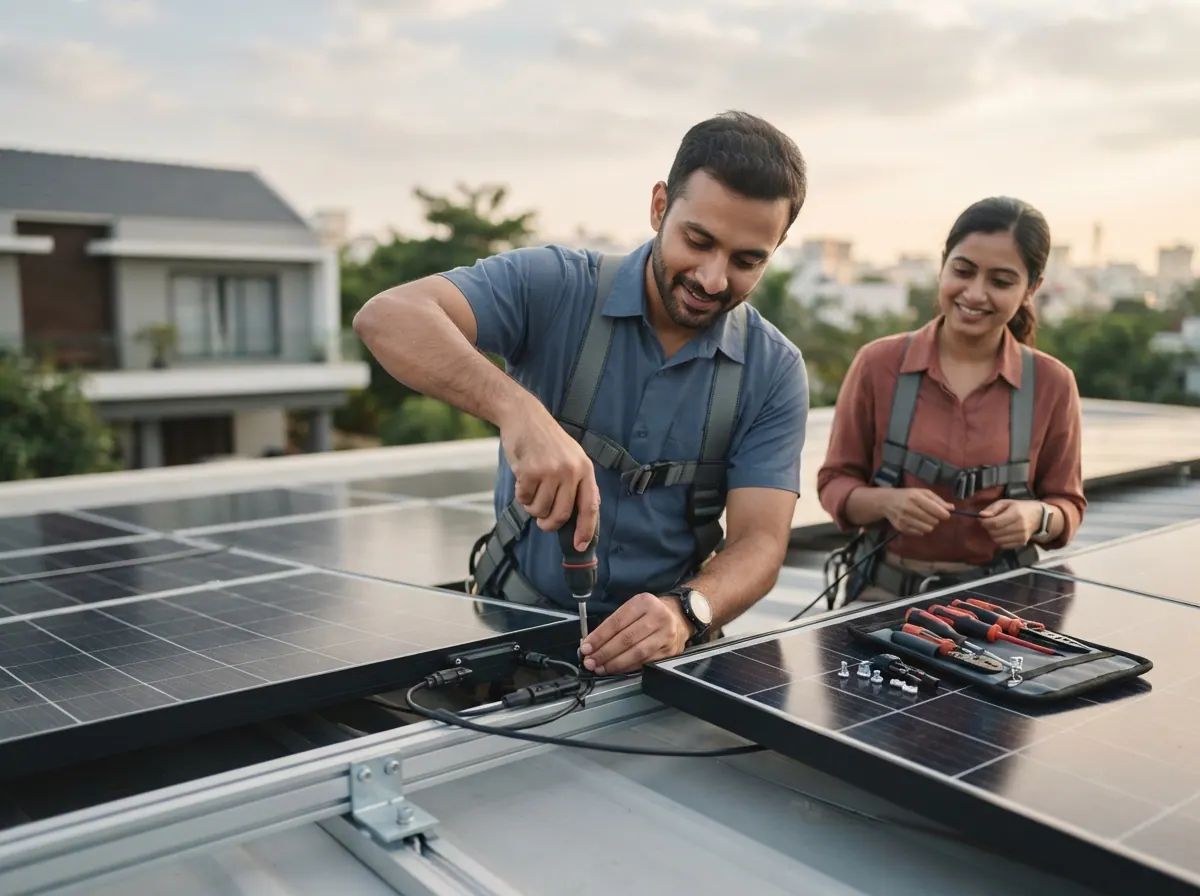
A solar installation business sells, designs and fits rooftop solar systems for homes, shops and small factories, and handles the paperwork with the power company. It can start from about ₹2 lakh with a small team that buys material job by job, and reaches about ₹15 lakh with a shop, a vehicle, tools, some stock and cash to fund projects. The money is made on each install. The pressure comes from buying panels and inverters before your customer pays in full.
All figures here are estimates. Check prices near you before you spend.
What does it cost?
| Item | Estimate |
|---|---|
| Hand tools, drill, crimper, earthing and testing tools | ₹30,000–80,000 |
| Safety kit: harnesses, helmets, gloves, ladders | ₹20,000–60,000 |
| Multimeter, clamp meter, insulation tester | ₹10,000–40,000 |
| Small shop or godown deposit and signboard | ₹30,000–1,00,000 |
| Vehicle (used pickup or loading auto) | ₹0–4,00,000 |
| Visiting cards, brochures, simple website, demo board | ₹10,000–40,000 |
| Registration and DISCOM empanelment costs | ₹10,000–50,000 |
| Cash for materials before customers pay (2 to 3 jobs) | ₹1,50,000–6,00,000 |
| Total | about ₹2.7–14 lakh |
Panels and inverters are bought from distributors and brands. A small installer rarely makes the equipment. You make money by designing it right, fitting it well and handling the paperwork.
How much can it earn?
Take a home rooftop job of 3 kW at about ₹2 lakh to the customer. After buying panels, inverter, structure, wire, earthing and labour, assume your gross margin is about ₹25,000 per job. These figures are assumptions to show the arithmetic.
A good month (4 jobs)
- Margin: 4 × ₹25,000 = ₹1,00,000
- Rent and shop costs ₹10,000 + two technicians ₹30,000 + vehicle and fuel ₹8,000 + phone, marketing and travel ₹7,000 + small costs ₹3,000 = ₹58,000
- Left over: ₹1,00,000 − ₹58,000 = ₹42,000
A slow month (2 jobs)
- Margin: 2 × ₹25,000 = ₹50,000
- Costs stay near ₹58,000
- Left over: −₹8,000
Over a year (7 good months, 5 slow)
- 7 × ₹42,000 = ₹2,94,000
- 5 × −₹8,000 = −₹40,000
- Total: about ₹2.5 lakh
That is thin for the effort. It improves when you add AMC (yearly service contracts), shop and small-factory installs, which bring higher jobs, and referrals. Many jobs also wait for approvals and net-metering, which delays your payment. If you work on the roof yourself and keep fewer technicians, you keep more, but you also install fewer jobs.
What do you need before you start?
- Technical skill, or a partner who has it. Roof layout, shadow, string wiring, earthing and safe working at height are not things to learn on a customer's roof.
- A reliable distributor who gives you branded panels and inverters with real warranty, and extends credit when you are known.
- Knowledge of how the power company works: net metering, sanctioned load, inspection, meter change and how long each takes in your area.
- A list of leads, such as people with high electricity bills, shop owners, schools, small units and housing societies.
- Cash to cover materials, because customers usually pay in stages.
Step by step
- Spend a few months working with an installer. Fit at least ten systems before you sell your own.
- Register your business, and ask the power company about empanelment for subsidy schemes and net-metering work.
- Choose two or three brands of panels and inverters and learn their warranties, service network and failure patterns.
- Prepare a standard quote for 1 kW, 3 kW, 5 kW and 10 kW systems, with bill of material, price, warranty and payment stages.
- Visit each roof before you quote. Check the shadow, roof strength, wiring distance, earthing and the existing meter.
- Take an advance on booking and a payment on delivery of material, with the balance after commissioning. Write it in the quote.
- Handle the paperwork for the customer: application, inspection, net-metering and any scheme claim, and tell them how long it takes.
- Give a service visit after three months and a yearly cleaning offer. Panels covered in dust lose output.
Which licences and schemes apply?
- Business registration, and GST on supply and installation. A 70:30 split of goods at 5% and service at 18% works out to about 8.9% overall. A CA can explain how it applies to you.
- Power company empanelment or registration, which many rooftop schemes require. Some states also ask for a guarantee or deposit, such as ₹2.5 lakh in West Bengal in 2026, valid five years, with three trained technical staff. Ask your DISCOM.
- Electrical licence or contractor rules for the electrical work. Your state electricity board can tell you what is needed.
- Rooftop solar schemes. Under PM Surya Ghar the subsidy is ₹30,000 a kW for the first 2 kW and ₹18,000 for the third, capped at ₹78,000, and goes to the home owner. The installer must be registered, give five years of free repair, and not hold an application over 60 days. The scheme ends on 31 March 2027, with no successor announced. Rules, amounts and eligible vendors change, so confirm on the official portal and with your DISCOM before you promise any customer a subsidy.
- Product standards and warranty. Use panels and inverters that meet the rules for the scheme, and give the customer the warranty papers.
- Safety. Working at height and with DC voltage needs proper gear and training.
What goes wrong?
- Promising a subsidy you cannot control. If it is delayed or does not apply, the customer blames you.
- Cheap panels and weak inverters. They fail in two years, and you do the repair visits.
- Shadow nobody checked. A tank or a neighbour's building shades the array and output falls well below what you quoted.
- Waiting for net-metering. The system is ready, and the power company's file sits for weeks. The customer holds back payment.
- Roof leaks after drilling. Fixing a leak costs money and goodwill, so seal the base well.
- Customers who pay late. You bought material on credit, and the balance sits with them.
- A falling worker. Heights without harnesses end badly. Never allow it.
- Competitors who quote very low. They cut quality, earthing or warranty, and you lose a sale to a worse system.
Situations you will face
What would you do? Each choice costs something.
Getting started
You know electrical work, but not rooftop solar. An installer offers a few months on their crew at low pay.
- Join their crew first: Low pay, real know-how
- Start on your own now: Faster, mistakes on customers
A big brand has a long warranty and a higher price. A lesser brand gives you a bigger margin but weaker service.
- Sell the known brand: Thin margin, easy trust
- Sell the cheaper brand: Fat margin, service risk
The power company says only empanelled installers can handle scheme files. It takes weeks and some fees.
- Apply and wait: Slower start, scheme jobs open
- Take only private jobs for now: Start now, fewer customers
A 3 kW job needs about ₹1.7 lakh in material, and the customer offers only a small advance.
- Fund it from your savings: Cash tied up, job won
- Insist on a bigger advance: Safer, some customers leave
A proper safety kit for two workers costs a fair amount. Many installers skip it on low sloping roofs.
- Buy the full kit: Costs now, safe crew
- Buy harnesses first, ropes later: Mid cost, partly safe
Panels and rails are heavy. A used pickup is a big spend. Hiring a tempo each time adds up.
- Buy a used pickup: Big spend, own transport
- Hire a tempo per job: Pay per trip, less spend
A long quote shows the brand, warranty and payment stages. A one-line price wins faster but leads to arguments later.
- Write a full quote: Slower, fewer disputes
- Give a one-line price: Quick sale, disputes later
First month
The customer wants the full 3 kW anyway. Output will be lower than your quoted numbers during the afternoon.
- Tell them and cut system size: Smaller sale, honest
- Install as asked: Full sale, complaints later
They heard a scheme gives big money back. You are not sure they qualify or when it arrives.
- Explain it may not apply: Honest, they may hesitate
- Quote without subsidy: Fewer sales, no false hope
The customer's roof leaks along the rail bolts after the first rain. They want it fixed and blame your crew.
- Fix and seal it at once: Costs money, keeps trust
- Inspect together, split the cost: Some cost, fair
One of your two workers left in the middle of a 5 kW install. The customer expects it done this week.
- Hire a day-wage helper: Extra cost, job done on time
- Finish slowly with one worker: Cheaper, late and rushed
Your first customer's neighbours are asking about the system. A small demo day could bring several quotes.
- Hold a small demo day: Snacks and time, more leads
- Hand out cards only: Free, fewer leads
The system is ready but the power company file has sat for weeks. The customer holds the last payment.
- Follow up at the office daily: Time and travel, faster
- Wait quietly: No effort, money stays stuck
A customer's output has dropped in a month. Droppings and dust sit on the panels, and they think the system is faulty.
- Visit, clean, teach them: Time and fuel, trust built
- Tell them to call a cleaner: No cost, they feel abandoned
Running it
Roof work is risky in rain, and you still have to pay your two technicians.
- Pay them and do AMC visits: Wage cost, service income
- Send them home unpaid: Save money, lose workers
A shop owner with a high bill asks for 10 kW. It is a larger job with big material cost and slow payment.
- Take it with a staged payment: Big margin, big cash needed
- Offer a smaller phase one: Lower risk, smaller margin
A rival quotes ₹30,000 less. Your customer has the quote in hand and asks you to match it.
- Match with plainer brand, say so: Lower price, they choose
- Hold price, show the warranty: Lose some, keep trust
A system you installed seven months ago has stopped. The brand's service centre is two weeks away.
- Swap in a spare inverter: Costly, customer happy
- Ask them to await the brand: Free, they are upset
A distributor offers material on 30 days credit if you take bigger monthly volume. You could grow faster, but the debt is real.
- Take the credit deal: Cash freed, debt pressure
- Keep paying upfront: No debt, slower growth
A home owner owes ₹45,000 after commissioning and says they are waiting for the subsidy.
- Wait, keep a good name: Money stuck, goodwill
- Send a firm notice: Money may come, strained tie
Dust cuts panel output within months. A yearly cleaning and check plan gives steady small money.
- Launch an AMC plan: Time and visits, steady income
- Skip it: No extra work, no repeat income
A home owner with power cuts wants batteries added. They cost a lot and need replacing in a few years.
- Sell a battery system: Bigger job, more cash needed
- Advise grid-tied only: Smaller sale, honest advice
When things go wrong
One of your workers fell from a low roof and broke an arm. They had no harness on.
- Pay their treatment: Costly, right thing
- Pay only part of it: Cheaper, they and others lose faith
A DC connector overheated and scorched the wall. No one was hurt, but the customer is shaken.
- Redo the wiring free and apologise: Costs money, trust kept
- Replace connector, inspect later: Mid cost, hazard checked
A customer's meter shows far fewer units than you estimated. They are angry and show your quote to others.
- Inspect and fix the cause: Visits and cost, honest
- Share meter data, explain: Small cost, honest
A scheme your customers were counting on changed its rules. Three open jobs now have uncertain support.
- Tell customers and offer a plan: Lose some sales, stay honest
- Tell them in writing, finish: Some anger, honest
You bought stock at higher prices. Rivals now quote less, and your shelf stock loses value.
- Sell the stock at a small loss: Cash back, margin lost
- Hold the stock: No loss now, locked cash
Growing
A society wants 50 kW for its common area. The job is large, with committee meetings and slow decisions.
- Bid for the society job: Big margin, big cash and time
- Skip big projects for now: Safe, small jobs only
A person with local contacts offers to bring leads for a commission on each installed job.
- Hire them on commission: Pay per job, more leads
- Keep selling yourself: No commission, slower growth
Customers ask about solar water heating and pumps for farms. It uses some of the same skills but needs new stock.
- Add a second product line: Stock cost, wider customers
- Stay with rooftop systems: Focus, fewer buyers
Is it right for you?
This suits someone who is comfortable with electrical work, patient with paperwork, and good at explaining numbers to a family that has never bought a solar system. It helps if you already know people who pay large electricity bills.
It suits you less if you want a no-effort business, dislike dealing with government offices, or cannot fund material while customers pay in stages. Before you start, install three systems under an experienced installer, and keep every quote, bill and approval date. That notebook shows you what a real job costs and how long it really takes.