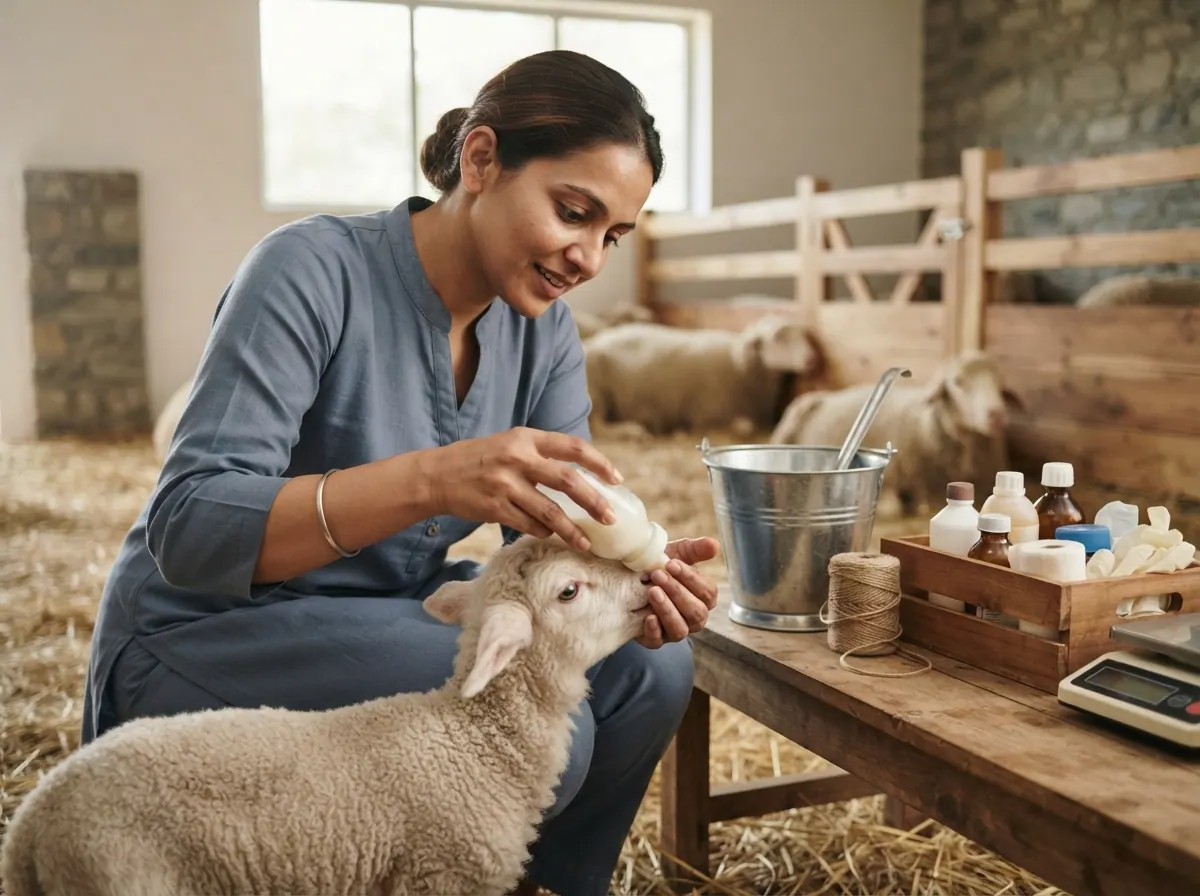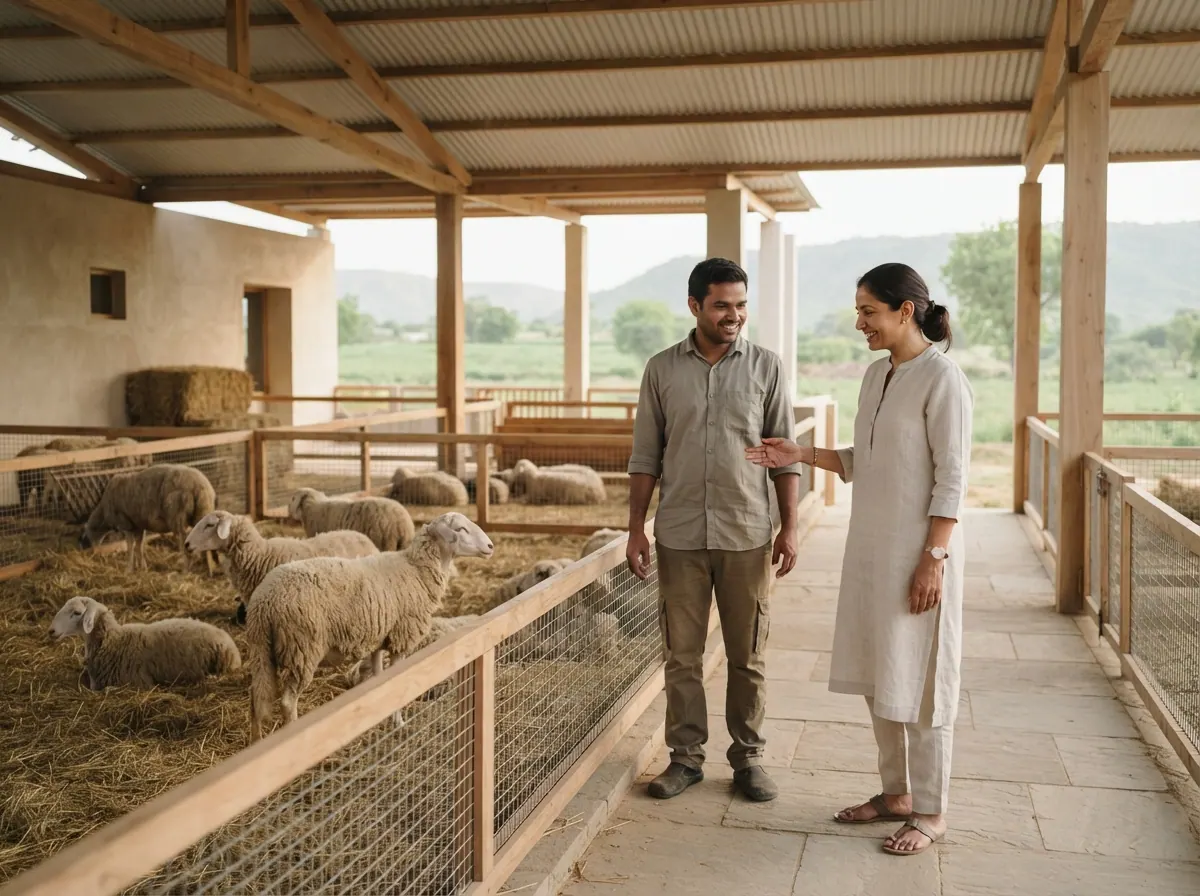
To start a sheep farm in India you need a dry, roofed night shed, grazing or a fodder plan that lasts the whole year, a vet for vaccines and worms, and about ₹2–4 lakh for 30 ewes and 2 rams, or ₹9–15 lakh for 100 ewes and 4 rams. That is on land you already have. Money comes from selling grown lambs, usually before a festival, and the first sale is often more than a year after you buy your first ewes.
All figures here are estimates. Check prices near you before you spend.
What does it cost?
| Item | 30 ewes, 2 rams | 100 ewes, 4 rams |
|---|---|---|
| Ewes | ₹1.2–2.4 lakh | ₹4–8 lakh |
| Rams | ₹30,000–60,000 | ₹70,000–1.4 lakh |
| Shed with raised or dry floor | ₹30,000–60,000 | ₹1–1.8 lakh |
| Fencing, water trough, lamb pen | ₹10,000–20,000 | ₹30,000–50,000 |
| Fodder seed or cuttings, chaff cutter | ₹10,000–25,000 | ₹40,000–70,000 |
| Feed reserve for the first months | ₹15,000–30,000 | ₹60,000–1.2 lakh |
| Vaccines, deworming, ear tags | ₹5,000–10,000 | ₹20,000–40,000 |
| Total | about ₹2–4 lakh | about ₹9–15 lakh |
Breed and age cause the biggest swings in cost. A pure Nellore or Bannur breeding ewe costs much more than a local sheep of no clear breed.
Which breed should you keep?
- Nellore: a tall meat breed from Andhra Pradesh, kept mostly for meat.
- Deccani: hardy and common across Maharashtra and Karnataka, suited to dry areas.
- Mecheri: a Tamil Nadu meat breed that copes well with confinement.
- Madras Red: a hardy red-coated breed from Tamil Nadu.
- Marwari and Magra: wool breeds from Rajasthan that do well in dry areas.
- Bannur: a Karnataka breed known for twin lambs.
How much can it earn?
Here is a settled farm of 100 ewes in its second or third year. These are example numbers.
Lambs sold in a year
- 100 ewes × 1.5 lambings a year = 150 lambings
- 150 lambings × 1.2 lambs = 180 lambs born
- Lose about 10% to illness and cold: 180 − 18 = 162
- Keep 15 females as future ewes: 162 − 15 = 147 to sell
- 147 × about ₹6,500 = ₹9,55,500 a year
- ₹9,55,500 ÷ 12 = about ₹79,600 a month
Costs each month
- Extra feed for about 250 animals × ₹4 a day × 30 days = ₹30,000
- One paid shepherd = ₹12,000
- Vet and vaccines = ₹5,000
- Water, repairs and transport = ₹3,000
- Total = about ₹50,000
Left over: ₹79,600 − ₹50,000 = about ₹29,600 a month.
This only works if grazing keeps your feed bill low. If you must buy most of the feed, the profit falls fast. A lamb that dies after months of feeding takes the money its mother ate with it.
What do you need before you start?
- Grazing and fodder. Check your pasture through the dry months and plan fodder for those weeks.
- A dry shed. Wet floors and cold winds cause pneumonia in lambs.
- A vet relationship. Ask your vet for a plan covering PPR, sheep pox, enterotoxaemia and deworming.
- A buyer. Local traders, butchers, and families buying before festivals are your market. Know them before you stock.
Step by step
- Visit two working farms of the breed you like, and ask how many lambs they lose in the first month.
- Build the night shed with a dry floor, shade and a separate lamb pen.
- Buy ewes from breeders in small lots, checking age, teeth and udder.
- Keep new sheep apart for the time your vet advises, then vaccinate them.
- Tag and record every animal: mother, date of birth, weight and sale price.
- Plan lambing so lambs are the right size for the festival you want to sell for.
- Shear wool breeds on time and find a wool buyer.
Which licences apply?
- Local permission: a panchayat may need to approve a large shed. Ask your panchayat.
- Loans and schemes: banks give livestock loans, and the National Livestock Mission has supported sheep and goat units. Rules change, so confirm with your district animal husbandry office.
- Insurance: livestock insurance usually needs ear tags and a vet's report if an animal dies.
- Selling meat: this is a different business with food licences and slaughter rules. Ask the local office.
- Moving animals: trucks and cross-border movement have rules. Check before you transport.
- Tax: ask a CA how your sales are treated.
What goes wrong?
- Buying at the weekly market. Sick animals often end up there, and one can infect your flock.
- PPR and other diseases. PPR spreads fast, and prevention beats treatment.
- Worms. Heavy worms thin animals even when they eat well, especially in monsoon grazing.
- Lamb deaths in cold or wet weather. A dry pen and a warm corner matter more than any feed.
- Grazing conflicts. Fields and common land can be disputed. Settle rights before you graze.
- Selling at the wrong time. Prices rise before festivals, but supply does too.
Situations you will face
What would you do? Each choice costs something.
Getting started
Nellore ewes grow big lambs but cost more. Local sheep are cheaper and hardy but sell lighter.
- Buy Nellore ewes: More upfront, heavier lambs
- Stay with local sheep: Cheaper, lighter lambs
A trader sells ewes far below a breeder's price. Nobody can tell you their age or health.
- Pay the known breeder: Higher price, healthier stock
- Buy from the trader: Cheaper, health unknown
A raised slatted floor stays dry for lambs. A plain ground floor costs far less but gets wet.
- Build the raised floor: Costly, fewer lamb illnesses
- Keep ground floor: Cheaper, wet in monsoon
The vet said to keep new animals apart for a while. Your isolation pen is not ready.
- Build the pen first: Pay now, protect flock
- Mix them in: No cost, infection risk
The common land you plan to graze is also used by a neighbour's cattle. The neighbour wants you to pay.
- Agree a fair monthly fee: Costs money, peace
- Graze elsewhere, walk farther: Time and fatigue, less feed
You have one spare acre. Planting costs now and gives nothing for weeks.
- Plant fodder now: Pay now, cheaper dry-season feed
- Skip, buy fodder later: Keep cash, higher feed cost
A neighbour offers a ram for free. You do not know that flock's disease history.
- Buy your own ram: Costly, control your line
- Borrow the neighbour's ram: Free, disease risk
First month
The vet comes for PPR and other vaccines. It costs money and the sheep are stressed.
- Vaccinate the whole flock: Fee, protects flock
- Vaccinate half now, half later: Spread cost, partial cover
An ewe has trouble. The lamb is half out and the ewe is weak.
- Call the vet: Visit fee, safe birth
- Help with clean hands: Free, risk of harm
- Wait until morning: Rest, risk losing both
A cold wave hits and lambs shiver. The pen has gaps in the wall.
- Seal gaps, add straw: Costs cash, fewer deaths
- Cover with old sacks: Cheap, less reliable
The flock eats well but looks weak, with pale eyelids and loose droppings.
- Deworm as vet advises: Medicine cost, better growth
- Deworm only the thin ones: Cheaper, others stay poor
The only pond is drying and the flock walks far for water.
- Dig a storage tank: Costly, steady water
- Bring water by tractor: Cost each trip
Running it
Several sheep limp in wet grazing and their hooves smell.
- Trim and treat hooves: Time and medicine
- Move to drier ground only: Free, slower recovery
Grazing is poor and ewes lose weight. Dry fodder costs more.
- Buy dry fodder and concentrate: Costly, keeps weight
- Walk the flock farther: Free, tiring, thin ewes
Buyers want lambs of 30 kg for a festival. Yours are a little light.
- Feed extra for three weeks: Feed cost, heavier lambs
- Sell as they are: Cash now, lower price
A trader will take twenty lambs and pay after the festival.
- Sell on credit: Higher price, late money
- Ask for advance payment: Safer, trader may refuse
Your wool sheep need shearing. A shearing team asks for a fee, and the wool buyer pays little.
- Hire the shearing team: Fee, clean wool
- Shear it yourself: Slow, uneven shearing
A buyer offers a low price. A craft group offers more but needs sorted wool.
- Sort and sell to the group: More work, better price
- Sell all to the buyer: Quick, low price
Lambs look weaker this year. A neighbour suggests swapping rams.
- Swap rams with a farm: Cost and transport, healthier lambs
- Keep the same ram: Free, weaker lambs
An agent offers cover for ewes and rams. It needs ear tags and annual premium.
- Insure the flock: Premium, claim protection
- Skip insurance: Saves premium, risk of loss
Sheep waste a lot of long dry fodder. A chaff cutter saves feed but costs money and needs power.
- Buy a chaff cutter: Costly, less waste
- Keep feeding it long: No outlay, more waste
When things go wrong
Sheep are dying in a nearby flock. Officials ask farms to stay careful.
- Keep the flock inside, vaccinate: Costs feed and work, protects flock
- Graze as usual: No cost, serious risk
After rain, hungry sheep ate fresh lush grass and their bellies swell.
- Call the vet right away: Fee, saves animals
- Walk them around and wait: Free, losses likely
Two lambs were stolen from the open pen last night.
- Build a locked pen, hire a night watch: Costly, safer stock
- Sleep near the flock: Free, tiring
Stray dogs killed three lambs. The shepherd is out at dusk.
- Fence and keep a guard dog: Cost, steady protection
- Return earlier each evening: Free, less grazing time
Your only shepherd leaves for another job during lambing.
- Offer a bonus to stay: Higher pay, steady care
- Do it yourself: Free, exhausting
Growing
Lambs sell well. More ewes need more shed, feed and land.
- Raise your ewe lambs: Slow, lower cost
- Buy more breeding ewes: Costly, faster
The district office mentions a livestock scheme. It needs a report, and nothing is promised.
- Apply with a CA: Fees, cleaner records, no guarantee
- Skip it: No fees, no outside help
Local families want to book lambs directly before the festival.
- Take bookings with advance: Time and delivery, better price
- Keep selling to traders: Easy, lower price
You cannot tell which ewe gave the best lambs. A tag and record system takes time each week.
- Tag and record every lamb: Small cost, better selection
- Go by memory: No cost, weak ewes stay
Is it right for you?
Sheep farming suits you if you already have grazing or fodder land, can be out with the flock most days, and can wait over a year for income. It suits you less if you have no grazing, need monthly income at once, or dislike early, outdoor work.
A good test: spend two weeks at a sheep farm during lambing. If you still want to start, begin with 30 ewes, get lamb deaths down, and grow from your own ewe lambs instead of buying more.