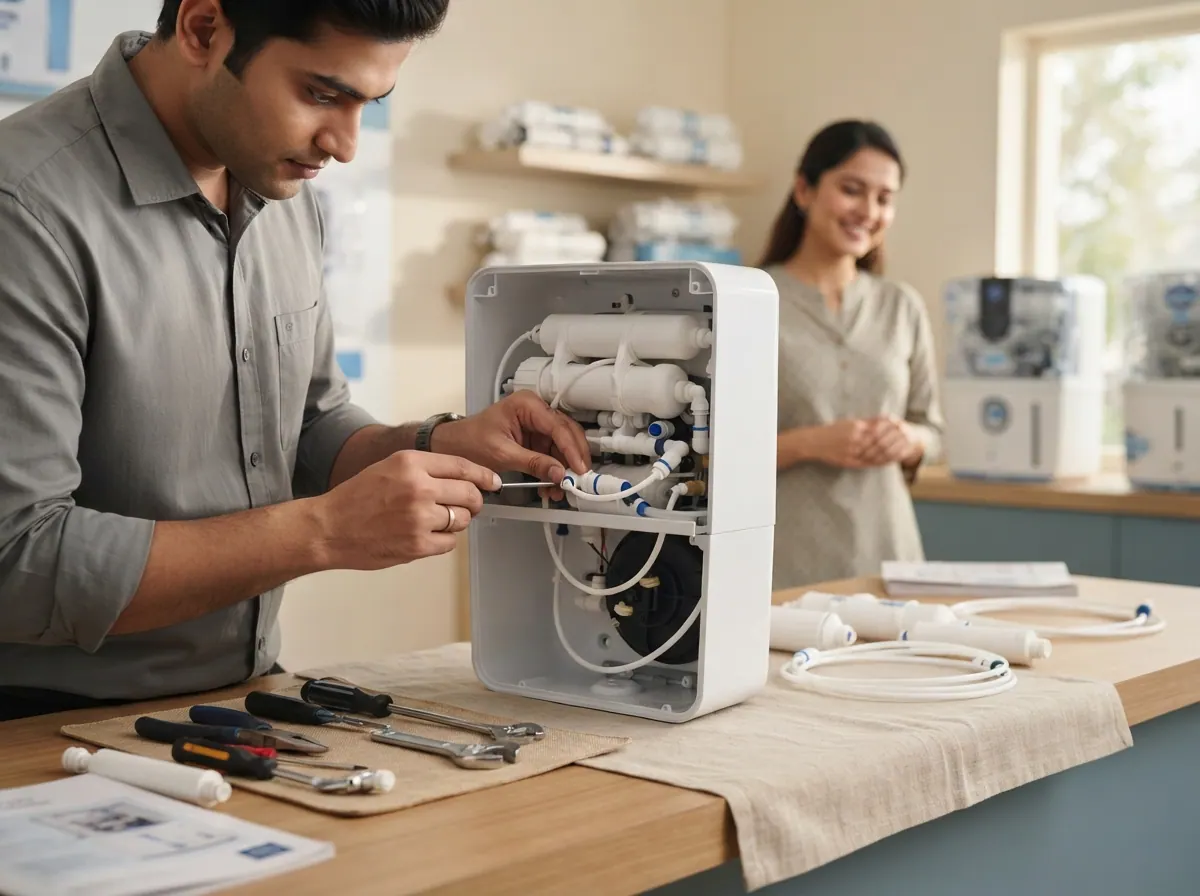
To start an RO service center in India you need a trained technician (yourself or a hired one), a tool kit and TDS meter, a spare parts stock, a bike for home visits, and about ₹50,000 to ₹3 lakh depending on whether you also keep a shop and purifiers to sell. The money is in service: filters, membranes and pumps get replaced every few months, so one happy customer pays you again and again.
All figures here are estimates. Check prices near you before you spend.
What does it cost?
| Item | Service-only start | Shop with sales |
|---|---|---|
| Tool kit, TDS meter, pressure gauge | ₹8,000–15,000 | ₹10,000–20,000 |
| Spare parts stock (filters, membranes, pumps, adaptors, valves) | ₹25,000–50,000 | ₹60,000–1,00,000 |
| Display and stock purifiers (3 to 6 units) | – | ₹30,000–90,000 |
| Bike for home visits | Use your own | ₹0–50,000 |
| Shop deposit, board, shelves | – | ₹30,000–60,000 |
| Phone, billing app, visiting cards, a few ads | ₹5,000–10,000 | ₹10,000–20,000 |
| Total | about ₹50,000–1 lakh | about ₹1.5–3 lakh |
Parts are your biggest stock cost. Buy a few of each common part first and add what your customers actually use.
What do you need before you start?
- Technical skill. Learn how a purifier works: sediment and carbon pre-filters, the RO membrane, the booster pump, the SMPS adaptor, the solenoid valve and the storage tank. Spend a few weeks with an experienced technician.
- Knowing your area's water. Hard water with high TDS ruins membranes faster than soft water. Borewell water in one colony can be very different from the municipal supply in the next. Test before you advise.
- A reliable parts supplier. Find one wholesaler in your city who gives good filters and membranes at steady prices. Ask what happens if a part is faulty.
- A way to be found. Most customers call because a neighbour recommended you, or find you on Google Maps. Put your number on a sticker on every purifier you service.
How much can it earn?
Here is a small shop in its second year. These numbers are examples, not promises.
Monthly income
- 100 service jobs × about ₹900 average bill (visit, filters, small parts) = ₹90,000
- Parts cost about 55% of that = ₹49,500
- Margin on service: ₹90,000 − ₹49,500 = ₹40,500
- 3 purifier sales × about ₹2,000 margin each = ₹6,000
- Total margin = about ₹46,500
Monthly costs
- Shop rent = ₹8,000
- One helper = ₹10,000
- Fuel and phone = ₹4,000
- Small repairs, ads, other = ₹2,000
- Total = ₹24,000
Left over: ₹46,500 − ₹24,000 = about ₹22,500 a month.
If you work alone from home with no helper and no shop, costs fall and you keep more, but you can do fewer jobs. A yearly service plan that covers a set number of filter changes gives you steadier money than random calls.
Step by step
- Learn the trade with a working technician. Practise opening and rebuilding a purifier.
- Choose your area with many flats or houses on borewell or hard water, where purifiers are everywhere.
- Buy tools and a small parts stock from a wholesaler. Do not buy everything for every brand.
- Start with service for all brands. Visit apartments, offer a free TDS check, and leave a sticker.
- Keep a customer register with name, address, purifier model and the date you changed each part. Call them when the next change is due.
- Offer a yearly service plan that includes a set number of visits and filter changes at a clear price.
- Add sales once you know which brands your customers ask for.
Which licences apply?
A small RO shop usually has little paperwork, but this varies:
- Shop and establishment registration with your state or local body, if you keep a shop.
- GST once your turnover passes the limit, or if a supplier or brand requires it. Ask a CA.
- Brand dealership agreements have their own terms on stock, targets and warranty claims. Read them and ask the company for details.
- Warranty claims. If you do service for a brand, ask them how they pay for warranty visits.
What goes wrong?
- Cheap membranes that fail early. A customer pays twice, and tells the whole colony.
- Not testing the water first. A purifier with the wrong setup for very hard water burns through membranes.
- Customers who only call once. Without a register and reminder calls, they go to someone else when the next change is due.
- Free service promises. Free visits for old customers add up fast when parts are not free.
- Waste water complaints. Many customers object to the reject water. Offering a way to reuse it for cleaning keeps people happy.
- Dead stock. Parts for old or rare models sit on the shelf for a year.
Situations you will face
What would you do? Each choice costs something.
Getting started
You can open your shop this month. A senior technician offers to train you for three weeks, but they want a small fee.
- Train with the technician: Fee and delay, better skills
- Watch jobs for a week first: Free, opens a week later
The wholesaler offers a big discount if you buy filters and membranes for every brand in bulk.
- Buy the bulk lot: Cheaper parts, cash locked up
- Buy only common parts: Less cash tied, some jobs wait
A cheap TDS meter costs a fraction of a good one. Customers sometimes argue about readings.
- Buy the better meter: Costs more, readings trusted
- Buy the cheap meter: Low cost, readings doubted
A residents' welfare group lets you set up a free water-testing table on Sunday. It takes your day and test kits.
- Run the free camp: Cost and a day, many new calls
- Just put up a poster: Cheap, fewer people reached
A purifier company wants you to stock their units and meet a monthly target. It brings customers but locks up money.
- Take the dealership: Stock cost, steady sales leads
- Stay independent for now: Free to choose, fewer leads
A small shop near the main road costs rent and a deposit. Working from home costs nothing, but customers cannot walk in.
- Rent the shop: Deposit and rent, more walk-ins
- Work from home: No rent, phone calls only
A family's borewell water tastes salty. Their small purifier is not made for it, and they want it fixed cheaply.
- Suggest a stronger model: They pay more, you earn trust
- Just change the membrane: Quick job, membrane fails soon
First month
A supplier offers membranes at half the price. They look the same, but you cannot check how long they last.
- Stay with trusted brand: Lower margin, fewer returns
- Stock a budget branded range: Lower margin, genuine parts
A customer's purifier is leaking all over the kitchen. They ask you to come right now.
- Go tonight: Your rest lost, they remember
- Go tomorrow morning: Rest well, an angry customer
You have 40 customers. Keeping a register and calling before each filter change takes time every week.
- Keep the register, call: Time spent, repeat jobs come
- Wait for them to call: No effort, many drift away
You fitted an adaptor of the wrong rating and the purifier's board burned out. The customer is upset.
- Replace the board free: Costly, customer stays
- Replace at half cost, own up: Own up, share the loss
An office asks for a GST bill for servicing three purifiers. You have not registered yet.
- Register and bill properly: CA fee, a bigger customer
- Give a plain slip: Saves fee, office may leave
Running it
In May everybody wants their purifier fixed at once. You can do ten calls a day, but 20 are waiting.
- Hire a day helper: Wage cost, all calls done
- Do what you can alone: No cost, some customers leave
A customer asks for one price for the whole year, including filter changes. It is cheaper for them but ties your parts.
- Offer a plan at fair price: Steady income, parts risk
- Keep charging per visit: Higher per job, random income
A 60-flat apartment wants yearly service at a low price per flat. It brings volume, but margin is thin.
- Take the contract: Many jobs, thin margin
- Bid higher, accept losing it: Fair margin, may lose it
Your supplier raises booster pump prices by a lot. You have a few weeks of stock left.
- Raise your service rates: Keeps margin, some complaints
- Keep rates, take less profit: Customers happy, margin shrinks
Diwali is near. You can stock extra units and run a sale, but unsold units tie up money.
- Stock extra units: Cash locked, bigger sales
- Sell only to order: Little risk, fewer sales
Your trained helper says a rival will pay more. Losing them means training someone new.
- Raise their salary: Costs monthly, they stay
- Let them go, train new: Save pay, slower service
A customer shows a payment screenshot but the money never reached your account.
- Check app before leaving: Awkward, safer money
- Trust it and leave: Smooth visit, risk of loss
A customer says the water tastes flat after your service. Their TDS reading is fine, but they are worried.
- Visit and explain the taste: Free visit, calmer customer
- Retest and share the reading: Free retest, honest result
When things go wrong
A customer says a part you changed four months ago has failed. The part's warranty is only three months.
- Replace it free this time: Cost to you, goodwill earned
- Charge as per warranty: Policy kept, angry customer
A customer posted a one-star review after waiting a week for a part. People nearby are reading it.
- Call, fix and reply politely: Free part, review improves
- Argue in the reply: Feels good, looks bad
Three customers call about new membranes failing early. They all came from one batch.
- Replace all, drop supplier: Heavy cost, trust saved
- Replace in batches by area: Slower, every customer told
A new shop nearby charges half your visit fee. Some old customers are asking why you cost more.
- Match price on visits only: Lose margin, keep customers
- Stay at your price: Margin safe, lose some jobs
A brand stops making a purifier model and you still hold unsold parts and two units.
- Sell at a loss to clear: Recover some cash
- Keep for old customers: Cash stays locked
Heavy rain floods the shop floor and wets the bottom shelves of filter cartons and adaptors.
- Raise shelves, replace damaged: Big bill, safer from now
- Bin adaptors, dry the rest: Lose adaptors, shelves stay low
Growing
Offices ask if you can service water coolers and dispensers too. It needs new tools and some learning.
- Learn and add coolers: Cost and time, new jobs
- Stay with purifiers only: Focused, fewer customers
Calls are rising and you cannot reach every house. A trained technician costs more than a helper.
- Hire a technician: Higher wage, more jobs
- Stay solo and pick jobs: No wage, jobs lost
A small factory asks for yearly service of 40 purifiers. They pay late, often after 60 days.
- Accept with part payment first: Fair terms, they may refuse
- Accept on their terms: Big volume, delayed money
A friend offers a space in another locality for a fee. You would need stock and a staff member there.
- Open the second counter: Big spend, wider area
- Improve the first shop: Small spend, steady growth
Is it right for you?
RO service suits you if you like fixing things, can talk patiently to customers in their homes, and are happy to build income slowly through repeat visits. It suits you less if you want quick sales profit, or if you dislike climbing stairs to flats in the summer with a bag of parts.
A good test: spend two weeks going on service calls with a technician. If you can handle the customers and the work, start service-only from home, build your register, and then think about a shop.