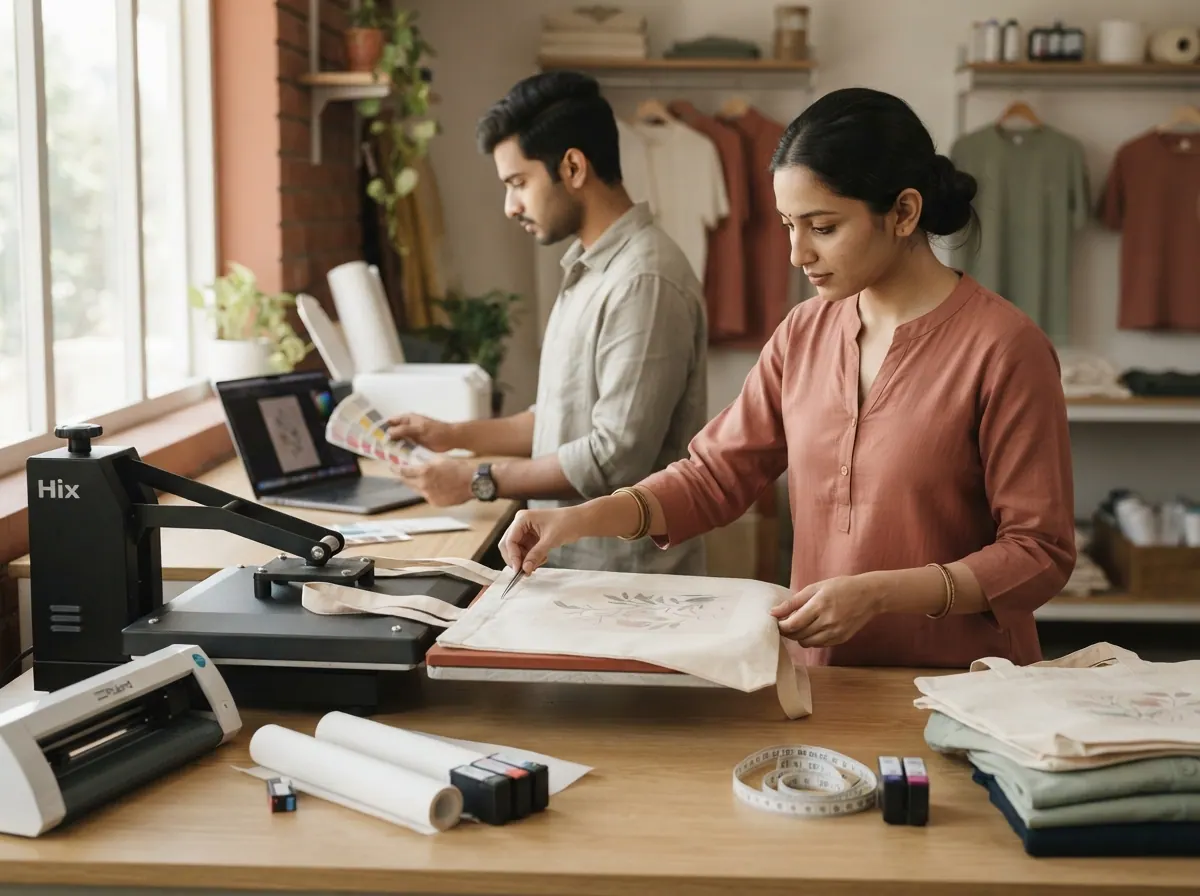
To start a print on demand business in India you need a store (your own site, Instagram shop or marketplace), a print partner that handles printing and shipping, designs you have the right to use, and about ₹5,000–50,000 for samples, tools and first ads. You carry no stock. The hard part is not printing, it is getting people to buy, and for the first months ads often cost almost as much as the profit.
All figures here are estimates. Check prices near you before you spend.
What does it cost?
| Item | Small start | Fuller start |
|---|---|---|
| Store plan or marketplace setup | ₹0–2,500 a month | ₹2,500–5,000 a month |
| Domain name (own site) | ₹500–1,200 a year | ₹500–1,200 a year |
| Sample orders (5–10 products) | ₹1,500–3,500 | ₹4,000–8,000 |
| Design tools and fonts | ₹0–2,000 | ₹2,000–6,000 |
| Product photos and mockups | ₹0–2,000 | ₹3,000–8,000 |
| First ad budget | ₹3,000–10,000 | ₹10,000–25,000 |
| GST help from a CA | ₹2,000–5,000 | ₹3,000–8,000 |
| Total | about ₹5,000–20,000 | about ₹25,000–50,000 |
There is no stock, so cost is spread over months. Samples are the part people skip, and that is a mistake: ordering the product yourself shows print quality, fabric feel and delivery time.
How does print on demand work?
You pick a product, such as a t-shirt, hoodie, mug, phone case or poster, and place your design on a mockup. A customer orders on your store. Your print partner, for example firms like Printrove or Qikink, which you should compare before choosing, prints the item and ships it in your brand's name. You pay the partner a base cost and keep the rest.
Check each partner's base prices, printing method (DTG on cotton, sublimation on mugs), delivery time, returns policy and whether they ship with your branding.
How much can it earn?
Be careful, because ads decide everything. Take a small shop with a steady trickle of orders.
Income in a month
- 120 orders × about ₹599 average price = ₹71,880
Costs in a month
- Product and printing cost: 120 × ₹280 = ₹33,600
- Shipping paid to courier: 120 × ₹55 = ₹6,600
- Payment gateway fees at about 2% = ₹1,440
- Ads on Instagram and Google = ₹15,000
- Returns and failed deliveries (about 8 orders × ₹150) = ₹1,200
- Store apps and tools = ₹2,000
- Total = ₹59,840
Left over: ₹71,880 − ₹59,840 = about ₹12,000 a month.
That is thin on purpose. If ads bring 70 orders instead of 120 for the same spend, you can lose money. Shops that last tend to find a small group of buyers, like a college, a sport or a profession, and sell to them again and again.
What do you need before you start?
- A niche. A shop for "everyone" competes with everyone. A shop for, say, trekkers, nurses or a regional-language humour group gets sharper ads.
- Designs you own. Make your own or buy a licence. Do not copy trending quotes or characters.
- A partner you have tested. Order samples before you promote anything.
- GST and a bank account. Many marketplaces ask for GST details before you sell.
Step by step
- Choose a niche and 10 designs. Test small, not 200 designs.
- Pick a partner by comparing base cost, quality and delivery speed. Order samples of every product you plan to sell.
- Create the store. Add clear photos, size charts, and a delivery and return policy.
- Check price maths for each product: selling price minus base cost, shipping, fee and an ad allowance. Do not guess.
- Run small ads with a daily budget you can afford to lose, and test two or three designs at a time.
- Watch returns. Cash on delivery orders in India can bring more failed deliveries, so consider a small advance or prepaid discount.
- Do repeat sales. Ask buyers for photos, add similar designs, and email or WhatsApp them when new ones come.
Which licences apply?
Rules depend on how you sell, so confirm with a CA:
- GST registration is usually needed to sell on marketplaces, and your own site has a turnover limit for goods.
- Business registration such as a proprietorship or Udyam registration may help with bank accounts and loans. Ask a CA.
- Intellectual property. You are responsible for what you print. Brand logos, film characters and song lyrics need permission.
- Consumer rules. Show prices, returns and a contact number on your store.
What goes wrong?
- Copyright takedowns. A shop selling a famous character can lose its marketplace account overnight.
- Poor print quality. If the design fades or the shirt is thin, returns pile up and your ads lose money.
- Ads that cost more than the profit. You can spend ₹15,000 and sell too little to pay it back.
- Slow delivery. Customers expect a week or less. Longer waits bring angry messages.
- Too many designs. Hundreds of unsold designs cost time and teach you nothing.
- Cash on delivery refusals. The partner prints, the courier tries, the buyer refuses, and you lose the cost.
Situations you will face
What would you do? Each choice costs something.
Getting started
One partner has the lowest base price. Another costs more per shirt but ships faster and prints sharper.
- Take the cheaper partner: Better margin, slower shipping
- Take the faster partner: Higher cost, happier buyers
Ordering your own shirts, mugs and cases costs real money. You are tempted to trust the partner's photos.
- Order all samples: Pay now, know the quality
- Order only one shirt: Cheap, other items untested
You can sell funny shirts for everyone, or focus on one group like trekkers. The wide shop gets more clicks, but weaker loyalty.
- Pick a clear niche: Fewer clicks, loyal buyers
- Sell to everyone: Wide reach, price wars
A freelancer will make ten designs for a fee. You can try making simple ones yourself in a free tool.
- Hire the freelancer: Cost now, sharper designs
- Make your own: Free, plainer look
A famous dialogue from a new film is trending. Shirts with it would sell by the hundred this week.
- Make your own twist: Slower, no takedown risk
- Skip the trend: No sales, safe account
Your own site keeps your margin but needs ads. A marketplace brings buyers but charges commission.
- Build your own site: Monthly fee, you own buyers
- List on a marketplace: Commission, instant traffic
A marketplace wants GST details before you list. A CA charges a fee and the filing will repeat every month.
- Register GST now: Fee and filings, can list
- Sell on Instagram first: Cheaper, limited reach
First month
You can spend a big sum to test fast, or a little and wait longer to learn what works.
- Spend ₹6,000 this week: Fast learning, may waste it
- Spend ₹1,500 and watch: Safer, slower
Three reviews say the fabric is thinner than the photos. The partner has a thicker GSM option at a higher cost.
- Switch to thicker shirts: Costs more, fewer complaints
- Keep the same shirt: Better margin, more returns
Buyers return shirts because sizes run smaller than expected. Returns cost you the shipping both ways.
- Add a proper size chart: Small effort, fewer returns
- Offer free exchanges: Costly, happier buyers
A trekking club wants forty shirts and asks for a big discount. Your margin is already thin.
- Give a small discount: Smaller margin, big order
- Hold your price: Full margin, they may leave
Four COD parcels came back this week. Buyers refused them and you paid for printing and shipping.
- Push prepaid with a discount: Fewer orders, fewer returns
- Keep COD open: More orders, more losses
A college group ordered fifty shirts for an event. The partner warns of a delay of several days.
- Pay for express printing: Costly, event saved
- Tell them honestly: No cost, they may cancel
Your store uses flat mockups. Real photos of people wearing the shirts convert better but cost money.
- Get real photos taken: Costs money, more orders
- Keep the mockups: Free, buyers hesitate
Running it
A single trekking design is bringing most of your orders. You can double down or try more new ones.
- Make variants of the winner: Small cost, safer growth
- Test ten new designs: Cost and time, big risk
The same ad now brings half the orders per rupee. Your profit per order barely covers the cost.
- Cut ads, email past buyers: Less reach, cheaper sales
- Raise your price a bit: Better margin, fewer clicks
Corporate buyers ask for mugs with logos in bulk. Orders pay well but need quick proofs and tight timelines.
- Take the bulk orders: Big income, tight schedule
- Stay with single orders: Easy, miss festival money
A buyer wrote that the shirt came late and faded. The review is public and affects new buyers.
- Refund and reply politely: Lose the sale, save the name
- Ignore the review: Free, buyers may doubt you
Winter buyers ask for hoodies. They sell at a higher price but cost more and are returned often.
- Add a small hoodie line: Sample cost, higher bills
- Stay with t-shirts: No cost, simple catalogue
You have about 300 past buyers' numbers. Messaging them can bring orders but may annoy some.
- Send a monthly new-design note: Free orders, some blocks
- Do not message them: Safe, miss repeat sales
When things go wrong
A brand says one design looks too close to its logo. The marketplace may suspend you if you do not act.
- Remove the design, apologise: Lose sales, keep account
- Argue it is different: Free, risk of suspension
Your print partner announces higher base costs from next month. Your margin shrinks on every shirt.
- Raise your prices: Margin saved, fewer orders
- Find another partner: Samples cost, takes time
Twenty orders arrive with the design off-centre. The partner offers a reprint, but it will take a week.
- Reprint and apologise: Delay, happy buyers
- Send a discount code: Cheap, buyers still unhappy
Your ads stop overnight and orders dry up. Appeals take days and sales are slow in the meantime.
- Appeal and use organic posts: Slow, steady recovery
- Open a new ad account: Fast, may be blocked again
Six parcels are lost and buyers demand refunds. The courier will pay only a little after weeks.
- Refund all buyers now: Costly, trust kept
- Reship at your cost: Costs more, buyers get items
Growing
A partner can add your own labels and packaging. It costs more per order but feels like a real brand.
- Add branded packaging: Costs more, repeat buyers
- Keep plain packaging: Cheaper, forgettable
Your top three designs sell daily. Printing a stock of them yourself saves cost but locks cash.
- Print 200 pieces of each: Locked cash, faster delivery
- Stay fully on demand: Cash safe, slower delivery
A college fest team asks for 300 custom shirts. The order needs a quote, a deposit and a firm date.
- Take it with a deposit: Big order, tight timeline
- Decline politely: No stress, no gain
A new niche could double your reach. It also means a second set of designs, ads and customer messages.
- Launch the second shop: Effort and ad budget
- Deepen the first niche: Cheaper, steady growth
Fresh designs bring repeat buyers, but you struggle to keep up. A part-time designer would cost monthly.
- Hire a part-timer: Monthly cost, steady designs
- Keep designing yourself: Free, slower releases
Is it right for you?
Print on demand suits you if you like design and marketing, can test small and accept that most designs will not sell. It suits you less if you want quick steady income, or do not want to learn ads and customer messages.
A good test: sell five designs for four weeks to a niche you know, with a small ad budget. If you can make a profit after ads on even one design, repeat it and slowly add more, instead of building a big catalogue first.