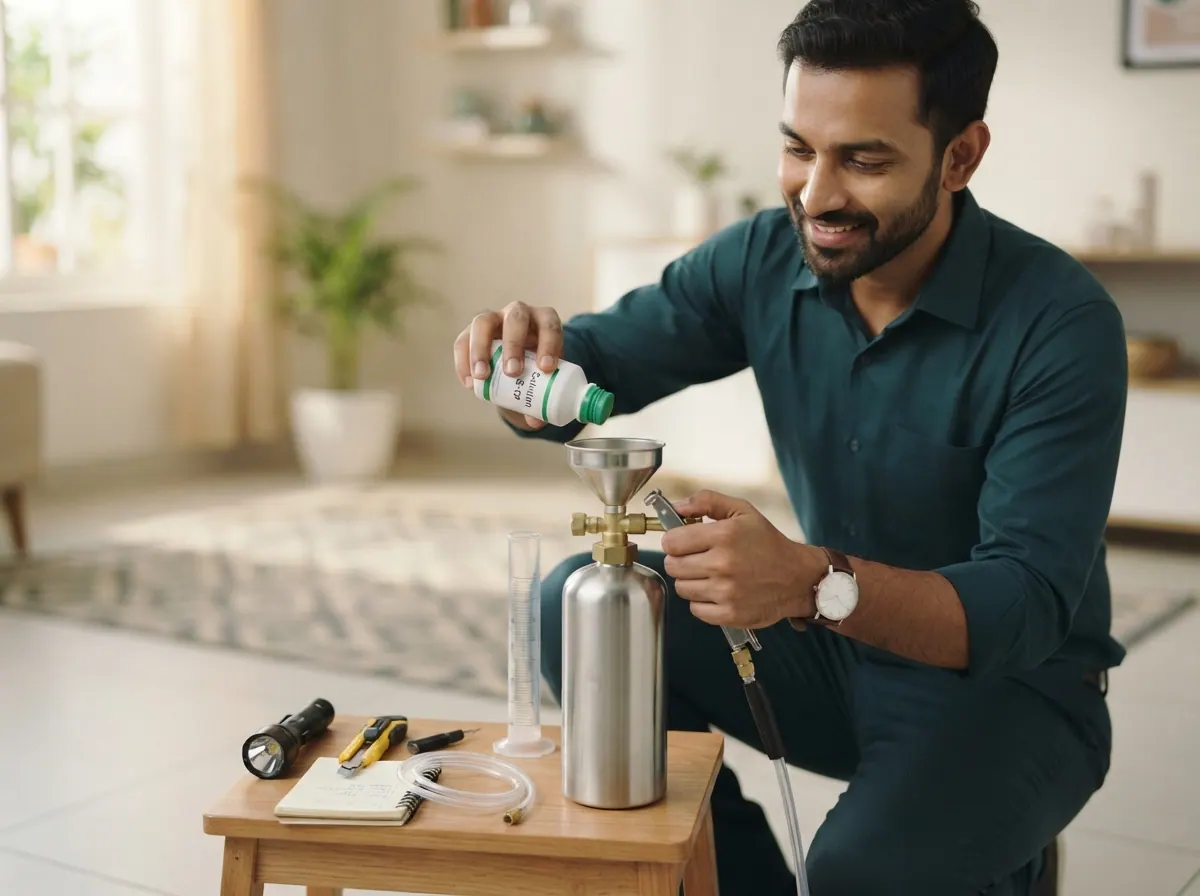
To start a pest control business in India you need an operator licence from your state, trained technicians, a sprayer, a fogger, a drilling kit for termite work, approved chemicals, protective gear, and about ₹1.2–2.5 lakh for a small start with one technician, or ₹2–3.7 lakh for a two-technician team. Customers pay you for a home without cockroaches and a kitchen that passes a food inspection. They pay again only if it works, and if you treated it safely.
All figures here are estimates. Check prices near you before you spend.
What does it cost?
| Item | 1 technician | 2 technicians |
|---|---|---|
| Power sprayer and knapsack sprayers | ₹12,000–25,000 | ₹20,000–40,000 |
| Thermal or ULV fogger | ₹15,000–35,000 | ₹15,000–35,000 |
| Drill machine, injector, termite kit | ₹15,000–30,000 | ₹15,000–30,000 |
| Gel guns, traps, baits, small tools | ₹8,000–15,000 | ₹12,000–25,000 |
| Approved chemicals, opening stock | ₹20,000–40,000 | ₹40,000–70,000 |
| Protective gear: respirators, suits, gloves, goggles | ₹6,000–10,000 | ₹12,000–20,000 |
| Training and licence fees | ₹10,000–25,000 | ₹10,000–25,000 |
| Uniform, cards, ads | ₹8,000–15,000 | ₹12,000–25,000 |
| Cash buffer | ₹30,000–50,000 | ₹60,000–1 lakh |
| Total | about ₹1.2–2.5 lakh | about ₹2–3.7 lakh |
You will also need a two-wheeler for jobs. Chemicals are a recurring cost, so buy from a good dealer who sells approved products and can show proper batch and expiry details.
Which services should you offer?
- General pest control. Cockroach, ant, silverfish and spider treatment in homes and flats. This is your regular work.
- Cockroach gel treatment. A common method in kitchens, because gel is placed in cracks and not sprayed everywhere.
- Termite treatment. Pre-construction treatment on new plots and post-construction drilling and injection in existing buildings. Termites cause serious damage, so customers want a guarantee.
- Bed bug treatment. Needs care and a second visit. Many customers are stressed, so honest expectations matter.
- Mosquito and fly control. Fogging and larvicide, busy in and after monsoon.
- Rodent control. Traps, baits and sealing entry points. Place baits where children and pets cannot reach them.
- Annual contracts. Regular visits to restaurants, cloud kitchens, hostels and offices at a fixed price.
How much can it earn?
Take a small team with you and two technicians. Suppose you do 45 home jobs a month at an average of ₹1,800, plus three restaurant or office contracts at ₹4,000 a month each.
Sales
- 45 home jobs × ₹1,800 = ₹81,000
- 3 contracts × ₹4,000 = ₹12,000
- Total = ₹93,000 a month
Costs each month
- Two technicians at ₹15,000 each = ₹30,000
- Chemicals and baits = ₹17,000
- Fuel = ₹7,000
- Leads and ads = ₹8,000
- Machine repair and protective gear = ₹3,000
- Phone and booking tools = ₹1,500
- Insurance and small items = ₹2,000
- Total = ₹68,500
Left over: ₹93,000 − ₹68,500 = about ₹24,500 a month, with you also working on jobs.
Home jobs fill the calendar, but contracts give you income when jobs are slow. Termite work in a bungalow can bring in a single job worth several thousand rupees, but you must give a guarantee and return if termites come back.
What do you need before you start?
- A licence and training. You usually need to pass or complete a training and hold an operator licence under the Insecticides rules of your state. Confirm with the state agriculture department before you start.
- Protective gear for everyone. A proper respirator, gloves, goggles and an overall. Not a cloth over the nose.
- A safe chemical store. Locked, labelled, away from food and children, with a plan for empty containers.
- A written job sheet. Pest, area treated, product used, date and next visit. It protects you in a dispute.
- A guarantee you can keep. Promise only what you are able to fix at your own cost.
Step by step
- Work for an established firm for a few months. Watch how they inspect, treat and speak to customers.
- Get trained and licensed as your state requires, and keep copies of every certificate.
- Buy the core kit and approved products from a reliable dealer. Keep bills and labels.
- Visit a few societies and restaurants and offer a free inspection. A clear written report builds trust faster than a discount.
- Fix your rate by flat size, pest and number of visits. Keep a separate rate for termite, per square foot or per drilled point.
- Give customers instructions: which rooms to empty, which food to cover, how long to stay away, and when to ventilate.
- Return for follow-up visits as promised. Many customers judge you by the second visit.
Which licences apply?
- Pest control operator licence. Generally needed under the Insecticides Act and rules, issued by the state. Ask your state agriculture department about training and licence steps.
- Approved products only. Insecticides must be registered under the law. Buy from licensed dealers, keep the bills and read labels.
- Shop and establishment registration and GST. Ask a CA about both once you have regular sales.
- Restaurants and food units. Their food safety rules require pest control, so they may ask you for a service record and a licence copy.
- Safe disposal. Ask your municipality or state pollution board how to discard empty chemical containers.
What goes wrong?
- Over-spraying. A customer who sees a wet floor and smells chemicals thinks you did a good job, but it can harm children and pets.
- Termites return. A treatment that missed a hidden mud tube comes back six months later, and you pay to fix it.
- Price war. A new operator takes your job at half the price using weak products and no licence.
- Allergy complaints. A customer says a family member had a reaction. Keep records of the product used.
- Bed bugs return. One visit rarely clears them, and the customer feels cheated if you did not say so.
- A technician quits and takes the customer list. Keep contacts in your own phone and book jobs yourself.
Situations you will face
What would you do? Each choice costs something.
Getting started
A training course and operator licence cost about ₹18,000 and take weeks. A friend says you can begin small jobs now.
- Get trained and licensed first: Costs, waits, legal work
- Work for a firm first: Earn a little, learn safely
A power sprayer covers a flat quickly but costs ₹18,000. A knapsack sprayer costs ₹3,000 and takes longer.
- Buy the power sprayer: Costs, faster jobs
- Buy a knapsack sprayer: Cheaper, slower work
A trusted dealer sells approved products with bills. A trader nearby sells repacked chemicals at half the price.
- Buy a full opening stock: Costs, ready for jobs
- Buy small lots as needed: Cash kept, more trips
A proper respirator costs ₹1,800 each. Your helper says a cloth over the nose is enough.
- Buy proper gear for all: Costs, safe team
- Buy only for chemical days: Cheaper, more risk spots
Your home has a spare room, but your kids play nearby. A rented locked room costs ₹2,500 a month.
- Rent a locked store room: Costs, safer
- Store at the dealer's godown: Cheaper, extra trips
A small restaurant wants monthly visits and a record they can show a food inspector. They want the lowest price.
- Quote ₹3,500 with records: Fair price, steady income
- Quote ₹2,500 to win it: Cheaper, thin margin
A bungalow owner asks for a termite treatment price. Measuring and drilling takes a full day.
- Quote by drilled points: Fair, needs explaining
- Quote a low lump sum: Easy sale, risk of loss
First month
A flat owner wants a one-day fix. Cockroaches usually need gel treatment and a second visit.
- Offer two visits with gel: Fair, takes longer
- Do a single spray visit: Quick, roaches may return
A family with a baby wants treatment. Spraying a nursery needs extra care.
- Use gel and seal cracks: Safer, slower
- Treat kitchen and bath only: Safer, less coverage
A student hostel has bed bugs in twelve rooms. The owner wants it done in a day.
- Treat in two rounds: Fair, right method
- Do one round and move on: Quick, bugs come back
A new technician sprayed a bedroom that was not on the job sheet. The owner sees it.
- Apologise and ventilate the room: Costs time, keeps trust
- Say it is harmless: No cost, owner upset
A flat owner says another operator quoted half your price. They have no licence.
- Show your licence and records: Lose the price fight, win trust
- Match the lower price: Lose margin
Running it
Societies want fogging after heavy rain. Your fogger fuel and chemicals run low by the third day.
- Restock and take all orders: Costs, big income
- Take only regular customers: Smaller income, safe stock
A bungalow you treated has fresh mud tubes. Your guarantee covers one return visit.
- Honour the guarantee fully: Costs, trust kept
- Charge for the second visit: Breaks your promise, customer upset
A builder wants an anti-termite treatment on forty plots. The rate is low but work is steady.
- Take it with extra helpers: Steady, thin margin
- Quote a higher rate: May lose it, better margin
A helper made the solution too strong for a flat because they thought stronger was better.
- Retrain the team on dilution: Costs time, safer work
- Fit a measuring cup and chart: Cheap, still needs checking
The restaurant owner wants a price cut to renew. Your records show five clean inspections.
- Renew at the same price: Hold margin, risk losing it
- Cut price for two years: Less margin, secure income
A canteen near a school wants rat control. Baits could be eaten by children or stray dogs.
- Use covered bait boxes and traps: Costs more, safer
- Skip the job: Lose income, no risk
Your dealer raises prices by 12%. A smaller approved distributor offers a better rate but delivers late.
- Switch to the distributor: Saves money, delays
- Stay with your dealer: Higher cost, steady supply
Your calls come from far apart. Each long trip costs fuel and a technician's hour.
- Group jobs by area and day: Slight delays, saves fuel
- Take every call on time: Higher fuel, happy customers
When things go wrong
One of your restaurant clients has an inspection tomorrow. The inspector wants your last three service reports.
- Give neat dated records: Costs nothing, client safe
- Ask the client to seek time: Inspector may penalise client
A customer's mother coughs and wheezes after your visit. They ask for a doctor bill refund.
- Pay the bill, share records: Costs, trust kept
- Refuse to take responsibility: No cost, possible complaint
Your most trained technician joins a rival and takes your regular customers' phone numbers.
- Raise your pay and bonuses: Costs, keeps team
- Hire and train a new person: Slow, fewer jobs for weeks
The fogger engine seizes during peak mosquito season. Spare parts take a week.
- Rent a fogger for the week: Costs, jobs continue
- Skip fogging jobs: No cost, lose peak income
A bottle leaked inside your vehicle storage box and the smell is strong.
- Clean up carefully and replace it: Costs, safe handling
- Air the box and repack later: Cheaper, a day lost
Growing
You have more calls than one person can serve. A second technician needs gear and two weeks of training.
- Hire and train one: Costs, double capacity
- Raise your rates: Fewer jobs, better margin
A hostel group with six buildings wants a single pest control vendor and monthly visits.
- Bid with a clear service plan: Costly start, steady income
- Skip the big bid: Safe, miss growth
A specialist offers a termite course that lets you offer longer guarantees and pre-construction work.
- Take the course: Costs, higher-value jobs
- Stay with general work: Save money, lower jobs
An app can send clients a report after each visit. It costs ₹6,000 a year.
- Subscribe to the app: Costs, clients like records
- Keep paper reports: Cheap, slower
Technicians carry heavy gear on motorbikes. A small goods vehicle would speed jobs but needs a ₹50,000 down payment.
- Pay the down payment: Costly, bigger jobs
- Keep the motorbikes: No cost, limits the load
Is it right for you?
Pest control suits you if you can follow safety steps every time, even when you are rushed, and if you can calmly inspect a messy kitchen or a crowded home. It suits you less if you want quick money with little training, because licensing and safe handling are not optional.
A good test: ride along with an established operator for two weeks and see a termite drilling job and a restaurant visit. If you can keep your attention on the label and the gear for a full day, get trained, get licensed and start with one technician.