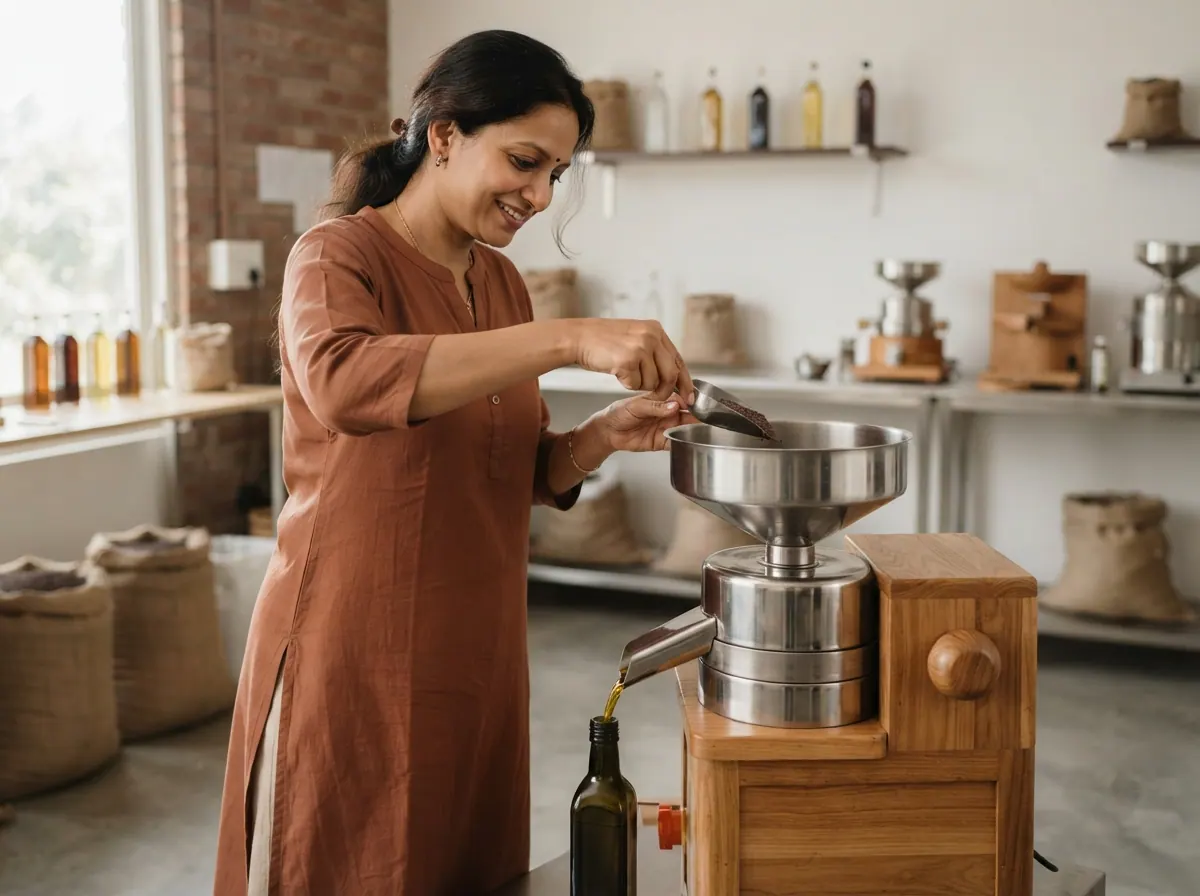
To start a cold-press oil mill in India you need one or two ghanis (wooden or steel rotary presses), a clean room, a reliable seed supplier, a way to filter and settle the oil, an FSSAI registration, and about ₹2–4 lakh for one ghani or up to about ₹10 lakh for a larger small unit. Money comes from two products, oil and cake, and the main risk is that seed prices move more than the price you can charge.
All figures here are estimates. Check prices near you before you spend.
What does it cost?
| Item | One ghani | Small unit |
|---|---|---|
| Ghani (rotary press, 1–3 HP) | ₹1.2–2.5 lakh | ₹3–5 lakh |
| Motor, wiring and three-phase connection | ₹20,000–50,000 | ₹50,000–1 lakh |
| Seed cleaner or sieve, drying trays | ₹10,000–30,000 | ₹40,000–80,000 |
| Filter press and settling tanks | ₹20,000–60,000 | ₹70,000–1.5 lakh |
| Weighing scale, drums, cans | ₹15,000–30,000 | ₹40,000–70,000 |
| First lot of seed | ₹40,000–80,000 | ₹1–2 lakh |
| Bottles, labels, cartons | ₹10,000–25,000 | ₹30,000–60,000 |
| FSSAI, rent deposit, set-up | ₹20,000–50,000 | ₹50,000–1 lakh |
| Total | about ₹2–4 lakh | about ₹6–10 lakh |
Ask a maker for a demo with your own seed. Yields depend on the seed and the machine, so ask what other buyers actually get before you trust a brochure.
Which oil should you start with?
- Groundnut: widely used in the west and south, and cold-pressed groundnut oil is well known.
- Mustard: the staple in the north and east, with a strong smell people look for.
- Sesame (gingelly): popular in the south and for festival and pooja use.
- Coconut: from copra, strongest on the coast.
Choose one oil first. Your buyers will compare your mustard with the one they grew up on.
How much can it earn?
Here is a unit pressing 3,000 kg of groundnut a month. At roughly one third oil, that is about 1,000 litres, sold at an average of about ₹340 a litre between families, shops and a few offices.
Sales
- Oil: 1,000 L × ₹340 = ₹3,40,000
- Cake: about 2,000 kg × ₹30 = ₹60,000
- Total = ₹4,00,000
Costs each month
- Groundnut seed: 3,000 kg × ₹100 = ₹3,00,000
- Bottles, labels and cartons, 1,000 × ₹15: ₹15,000
- Two workers × ₹12,000: ₹24,000
- Power: ₹10,000
- Rent: ₹10,000
- Transport and marketing: ₹10,000
- Total = ₹3,69,000
Left over: ₹4,00,000 − ₹3,69,000 = about ₹31,000 a month.
A small rise in seed price can erase this, which is why many mills press on demand for regular buyers and sell bulk seed stock only when prices are fair.
What do you need before you start?
- A supplier of clean, dry seed and a plan for the price swings after harvest.
- Three-phase power, and a backup plan for cuts.
- A buyer for the cake before you start, such as dairy farmers.
- A name for pure oil, which you build by letting buyers watch their seed being pressed.
Step by step
- Visit two working mills and ask how much oil they get from each seed and who buys their cake.
- Get a power connection suited to the motor you will use.
- Install the ghani on a firm floor, with space for seed, cake and settling tanks.
- Clean and dry the seed. Wet or dusty seed makes poor oil that goes rancid.
- Let the oil settle and filter it before bottling. Use clean, dry bottles.
- Label the bottle with name, seed, date, weight, ingredients and FSSAI number.
- Start with "press your own seed" customers, who pay a charge per kilo, then add packed oil.
Which licences apply?
- FSSAI registration or licence for edible oil, with labelling as the office requires.
- Udyam registration can help with loans and schemes. Confirm with the office.
- Weights and measures rules apply to packed oil. Ask the local office what stamping or checks you need.
- GST as your sales grow. Ask a CA.
- Panchayat or industrial area permission for the shed, power and noise. Ask the local office.
What goes wrong?
- Seed price swings. A rise after you have fixed your oil price eats your margin.
- Rancid oil from damp or old seed. Buyers notice the smell quickly.
- Adulteration claims. Customers compare your price with refined oil and doubt why yours costs more. You must show them how it is made.
- Overheated oil. A machine run too fast can darken oil and lose the cold-press advantage.
- Cake that does not sell, or that gets damp and mouldy.
- Machine breakdown in the middle of a festival rush.
Situations you will face
What would you do? Each choice costs something.
Getting started
A wooden ghani suits the cold-press story but is slow. A steel ghani presses faster and costs less to run.
- Buy the wooden ghani: Costly, a strong story
- Buy the steel ghani: Faster, plainer story
Groundnut sells in larger volumes. Sesame oil fetches a higher price but fewer people buy it.
- Start with groundnut: Steady sales, lower price
- Start with sesame: Higher price, thin demand
The power office says the new connection will take weeks. A generator would let you start sooner.
- Rent a generator meanwhile: Fuel cost, start sooner
- Wait for the connection: No cost, lose weeks
A dealer offers groundnut at a lower rate, but the sacks look old and some smell stale.
- Buy fresh seed at normal rate: Costs more, clean oil
- Buy a small sample bag first: Small cost, tells you quality
A printer offers cheap labels with your brand. The licence office says wording and numbers must follow rules.
- Get FSSAI first, then print: Wait and fee, correct label
- Press only for customers' own seed: No packed oil, slower start
A dairy farmer offers to take all your cake at a low price. A feed shop pays more but wants it dried first.
- Sell to the dairy farmer: Easy, lower price
- Dry it for the feed shop: More work, better price
First month
Several families want to see their seed pressed and pay a charge per kilo. It is slow work and the ghani stops between jobs.
- Offer this service daily: Steady charges, many cleanings
- Do it two days weekly: Less income, more own pressing
A tin of groundnut oil smells stale after two weeks. The seed was stored in a damp corner.
- Discard it, sun-dry the seed: Lose the batch, fix the cause
- Sell it only for animal use: Recover a little, honest use
A buyer points out your oil is dark and warm, not like cold-press. The ghani is running very fast.
- Slow the ghani, press less: Less oil per hour, true quality
- Keep speed, add cooling: Tank and fan cost, partly fixed
Shoppers compare your price to refined oil and doubt that a litre can cost this much.
- Let them watch pressing: Time and effort, builds trust
- Cut the price: More sales, thin margin
Running it
A poor crop pushes groundnut prices up. Your shops have a fixed rate for the next month.
- Raise your price: Margin holds, some buyers leave
- Hold price and absorb it: Buyers stay, margin thin
Families want fresh mustard oil for winter. Your ghani can work only so many hours.
- Add a second shift: More wages, much more oil
- Press by booking only: Steady pace, some wait
A stack of cake got wet in the storeroom and has started to smell. Dairy buyers will not pay for it.
- Throw it, store off the floor: Lose the cake, better storage
- Dry it and sell it cheap: Recover a little, price drops
Fine particles settle at the bottom of the bottles. Your filter cloth is worn out and the filter press costs a lot.
- Buy a filter press: Costly, clear oil
- Settle longer, use fresh cloth: Cheap, slower bottling
A caterer wants a big lot at a low rate per litre and will pay after the event.
- Accept at their price: Big volume, thin margin
- Ask half in advance: Safer money, may lose it
A shop wants nice 1-litre tins with a ribbon for Diwali. Tins and printing cost extra.
- Make 200 gift tins: Cost now, better price
- Sell in plain bottles: Cheaper, plainer look
Several families want coconut oil from copra. It needs a different feed and cleaning between oils.
- Press coconut in set weeks: Cleaning time, new buyers
- Stay with groundnut and mustard: No change, no new buyers
When things go wrong
A rival tells buyers your oil is mixed. Sales dip and shoppers ask for proof.
- Get a lab test, show results: Costly, clears your name
- Invite buyers to watch pressing: Time, builds trust slowly
A voltage spike burns the motor during a busy week. Rewinding takes days and a new one is dear.
- Buy a new motor and stabilizer: Costly, safer machine
- Rewind the old motor: Cheaper, may fail again
An officer takes an oil sample and asks for your batch records and seed bills. Your bills are scattered.
- Keep a batch and seed register: Daily effort, good records
- Search for bills when needed: No effort, weaker standing
Ten sacks of seed go missing overnight. The store door has a weak lock.
- File report, fit strong lock: Costly, a record and deterrent
- Just change the lock: Cheap, no record
An organic store has not paid for two months and wants another carton of oil.
- Stop supply until it pays: Safe, may lose the shop
- Send a small carton: More at risk, shop stays
Growing
Orders for packed oil now exceed one machine. A second ghani needs space, power and a worker.
- Buy the second ghani: Heavy cost, more oil
- Press longer hours instead: Small spend, tired machine
A farmers' group offers organic groundnut at a higher rate. You can charge more only if buyers believe the source.
- Buy from the farmers' group: Higher cost, premium price
- Stay with mandi seed: Cheaper, no premium
City buyers want cold-pressed oil delivered in glass bottles. Glass breaks and courier costs are high.
- Ship in padded cartons: Packaging cost, better price
- Sell locally only: No cost, smaller reach
A supermarket asks that your packs follow packaging and measure rules. Your filling is by eye.
- Buy a filling scale, follow rules: Cost now, bigger shelves
- Keep selling in your shop: No cost, limited growth
A dairy asks for a mixed feed with your cake. It needs mixing and bagging equipment.
- Make mixed feed bags: Equipment cost, better price
- Keep selling plain cake: No cost, lower price
Customers keep stopping by to watch the pressing. A small counter could sell oil, cake and jaggery directly.
- Build a small counter: Fit-out cost, higher margin
- Keep selling to shops: No cost, lower margin
A bank officer offers a loan for machines if you prepare a project report. Repayments start soon after.
- Prepare a report with a CA: Fees now, funds for growth
- Grow from own savings: No fee, slower growth
A trader wants 5 tonnes of sesame oil a month at a low rate. Your ghani cannot make that much.
- Decline, keep your retail base: No strain, smaller sales
- Rent more press capacity: Cost now, thin margin
Is it right for you?
An oil mill suits you if you can handle a noisy workplace, stand behind your product and explain it to every buyer. It suits you less if you cannot tie up money in seed or you want a hands-off trade.
A good test: spend a week at a working ghani, count how many kilos each batch actually yields, and talk to the cake buyers. Then run your own ghani for a month for local families before you buy a second.
Keep one notebook from day one with seed bought, oil and cake produced and sold, and the price you paid. After two or three months you will know your real yield and your real margin, which matters far more than any brochure number when you decide whether to add a second ghani.