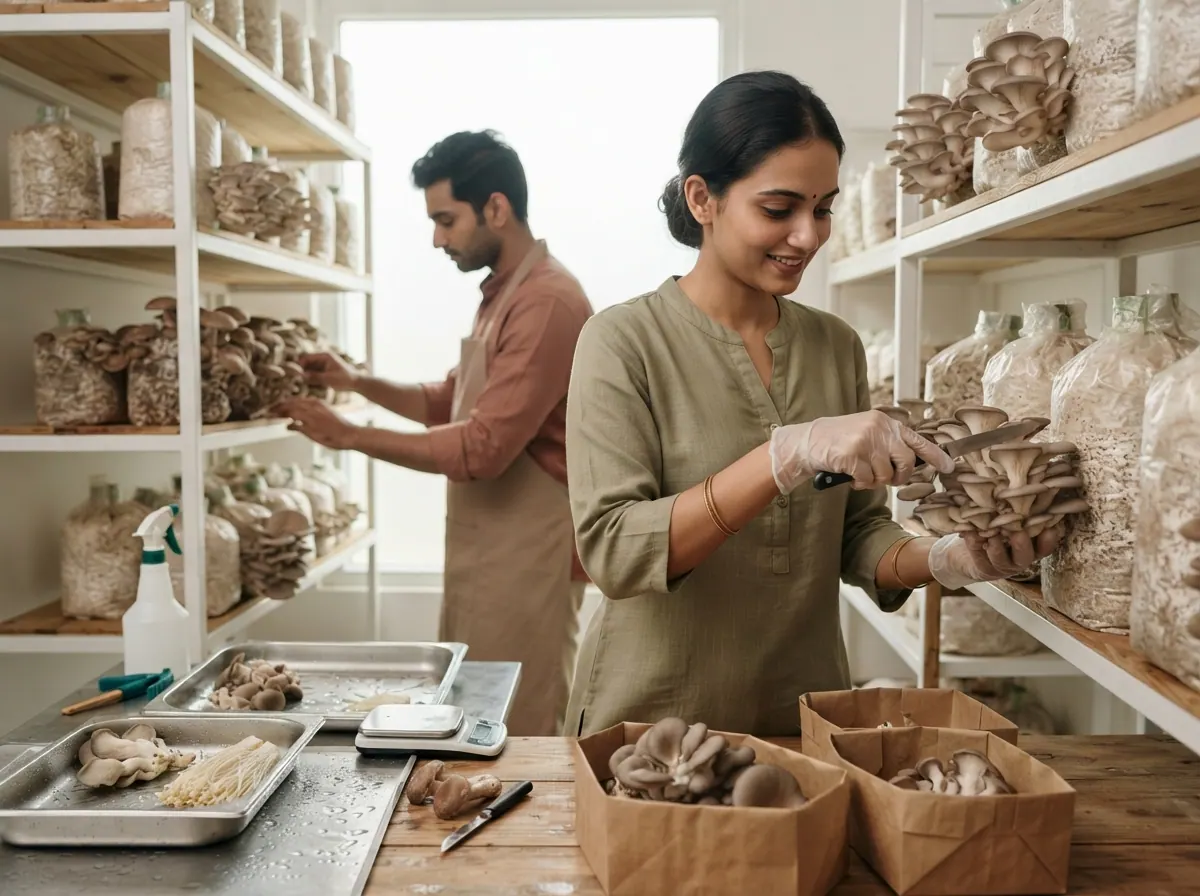
To start a mushroom farm in India you need a clean, shaded growing room with racks, straw, good spawn, a way to keep the room humid, and about ₹30,000–1.5 lakh for oyster mushrooms. Button mushrooms need compost and cooling, so they cost about ₹1.7–3 lakh or more. The first harvest comes within a month or two, but steady profit comes only after you learn to avoid mould.
All figures here are estimates. Check prices near you before you spend.
What does it cost?
| Item | Small oyster room (about 1,000 bags) | Button mushroom setup |
|---|---|---|
| Shed or room, with roof and floor | ₹20,000–60,000 | ₹60,000–1 lakh |
| Racks or hanging ropes | ₹8,000–20,000 | ₹20,000–40,000 |
| Boiler, drum or straw treatment tank | ₹5,000–25,000 | ₹30,000–60,000 |
| Humidifier, fogger or cooler | ₹5,000–25,000 | ₹30,000–70,000 |
| Spawn, bags and straw for first batches | ₹10,000–25,000 | ₹20,000–40,000 |
| Thermometer, hygrometer, sprayers | ₹3,000–6,000 | ₹3,000–6,000 |
| Training and spawn testing | ₹2,000–5,000 | ₹3,000–10,000 |
| Total | about ₹50,000–1.5 lakh | about ₹1.7–3.3 lakh |
You can start smaller, even with 200 bags in a spare room, which is how many people learn. Button mushroom is a different trade from oyster, with its own compost yard and a room that must stay cool, so start with oyster first.
What do you grow?
- Oyster (dhingri): the beginner mushroom. It grows on straw, takes a wide temperature range and sells fresh or dried.
- Milky mushroom: grows in warm weather, so it fits many south and plains districts in summer.
- Button mushroom: the one most buyers know, but it needs compost, a cold room and a firm sale arrangement.
How much can it earn?
Here is a small oyster farm that starts 800 bags every month, in the right season.
Mushrooms sold in a month
- 800 bags filled and seeded
- Lose about 15% to green mould and poor bags: 800 − 120 = 680 good bags
- 680 bags × about 0.6 kg fresh mushroom per bag = about 408 kg
- 408 kg × about ₹130 a kg = about ₹53,000
Costs each month
- Straw: about 960 kg × ₹6 = ₹5,760
- Spawn: 80 kg × ₹80 = ₹6,400
- Bags: 800 × ₹4 = ₹3,200
- Chemicals and cleaning = ₹2,000
- One helper = ₹10,000
- Power and water = ₹3,000
- Packing = ₹4,000
- Transport to buyers = ₹4,000
- Total = about ₹38,400
Left over: ₹53,000 − ₹38,400 = about ₹14,600 a month.
That is before any rent, and it assumes you can sell at ₹130 a kg. Fresh mushroom must be sold within a day or two, so a slow week can force you to drop the price. A family that does the work itself keeps the helper's ₹10,000 too. Every batch that gets mould costs you straw, spawn and a week of room time.
What do you need before you start?
- A room that can be cleaned. Concrete floor, walls you can wash, and a door and window that keep out flies.
- Good spawn. Buy from a government lab, agricultural university or a trusted supplier, and ask for the date it was made. Old spawn gives weak crops.
- Clean straw. Wheat or paddy straw that is dry and has no old mould.
- A buyer before the first harvest. Fresh mushrooms spoil fast, so know which sabzi mandi, hotel or shop will take them.
- Time to learn. Do a short course at a KVK or university, because humidity and cleanliness decide your crop.
Step by step
- Take a mushroom training course and see a working farm in your area.
- Prepare the room. Clean and wash it, fix gaps against flies, and set up racks with space to walk.
- Treat the straw. Soak and heat it as taught at your training, then drain it until damp, not dripping.
- Fill bags with straw and spawn in layers, tie them tight, and make a few small holes.
- Keep the bags in the dark for the spawn run, until white threads cover the straw.
- Open and mist. Cut the bag open, keep the room humid and give some fresh air.
- Harvest by twisting the mushrooms gently, before the edges curl, and pack in the cool of the morning.
- Throw out contaminated bags far away, so spores do not return to your room.
Which licences apply?
A small mushroom farm usually has little paperwork, but ask locally:
- Panchayat or local permission if you use a shed near houses.
- FSSAI registration may apply if you pack, dry or sell products under your own name. Confirm with the food safety office.
- Loans and schemes. Horticulture departments and banks have supported mushroom units in some places. Rules change, so ask your district horticulture office.
- Tax. Ask a CA how your sales are handled when they grow.
What goes wrong?
- Green mould in the bags. A dirty room, wet straw or old spawn can ruin a batch in days.
- Heat and dry air. In summer the mushrooms dry and crack. A fogger and a shaded roof matter.
- Selling fresh mushrooms slowly. They last a day or two in the open, so waiting for a better price often means losing money.
- Bad spawn. If bags do not turn white, you lose weeks and money before you find out.
- Wrong choice of mushroom. Button mushroom without cooling often fails.
- Allergy and spore problems. Heavy spores in a small closed room can bother your lungs. Wear a mask and ask a doctor if anyone coughs.
Situations you will face
What would you do? Each choice costs something.
Getting started
A seller offers spawn at half the lab price. No date or strain name can be shown.
- Buy from a lab: Costs more, reliable spawn
- Buy the cheap spawn: Lower price, weak crop risk
Button mushroom sells for more, but needs compost and a cold room. Oyster is cheaper and easier to learn.
- Start with oyster: Low cost, lower price
- Go for button: Costly, needs cooling
Your spare room has a mud floor that is hard to clean. A concrete floor costs money and a week of work.
- Lay a concrete floor: Cost now, easier cleaning
- Cover the mud with plastic: Cheap, harder to keep clean
A farmer offers old wheat straw cheap. It is dusty and a few bales look damp at the bottom.
- Buy fresh dry straw: Higher rate, cleaner bags
- Take the old straw: Cheaper, more mould chance
A three-day mushroom course is offered at the nearest Krishi Vigyan Kendra. You would lose a week of site work.
- Do the course: Small fee, a week lost
- Learn from videos: Free, mistakes cost bags
Small flies keep coming into the room. Fine net on every opening costs money.
- Net every opening: Cost now, fewer pests
- Use sticky traps only: Cheap, flies still enter
A hotel owner wants mushrooms twice a week at a fixed rate. A mandi trader offers a higher rate but pays late.
- Fix the hotel supply: Steady, lower price
- Sell to the mandi trader: Higher rate, late money
First month
Six bags out of fifty show green mould. The rest look white and healthy.
- Remove them far away: Lose six bags, protect rest
- Cut the green part off: Saves effort, spores spread
The room is dry in afternoon heat and caps are cracking. A fogger costs money and needs power.
- Buy a fogger: Cost and power, better crop
- Spray by hand more often: Cheap, tiring work
Heating the straw takes fuel and time. Cold soaking is quick but leaves more germs.
- Heat-treat the straw: Fuel and time, cleaner bags
- Soak and fill quickly: Cheap, more mould chance
Threads have covered the bags for a week but no buds are forming. The room feels warm and still.
- Cool and ventilate the room: Some cost, buds may form
- Wait another week: No cost, may lose cycle
A digital thermometer and hygrometer costs a little. Your helper says they can feel when the room is right.
- Buy the meters: Small cost, steady control
- Trust your hand: Free, crop varies
Your helper coughs after working among open bags all morning. The room is small and closed.
- Buy masks, add a vent fan: Cost now, safer room
- Wear a mask, open the vent: Small cost, safer air
Running it
Three batches fruit together and the mandi rate falls. Fresh mushrooms keep only a day or two.
- Dry the extra: Cost and effort, longer life
- Dump them in the mandi: Quick sale, poor price
A supermarket wants 200-gram pouches with your name. Packing needs a sealer and time.
- Pack in pouches: Cost and work, higher price
- Keep selling loose: Easy, lower rate
The room goes above comfortable levels by noon. Crop is dropping. A cooler costs more than a month's profit.
- Install a cooler: Heavy cost, crop continues
- Stop oyster until October: No cost, no income
The fogger stops for hours and the room dries out. A small inverter would help.
- Buy an inverter: Cost now, steady humidity
- Spray by hand during cuts: Cheap, tiring work
The hotel has taken a month of mushrooms and asks for fifteen days credit. Bags need cash every week.
- Insist on weekly payment: Safer cash, may lose them
- Give the credit: Keeps buyer, cash gets tight
A shopkeeper asks for dried mushroom packs. A dryer costs money and needs FSSAI checks if you sell under your name.
- Buy a dryer and register: Cost and paperwork, steady sales
- Stay with fresh only: No change, daily rush
A restaurant chef sent back a basket that sat in the sun during delivery. The chef may stop ordering.
- Replace it and use crates: Lose a basket, keep client
- Offer a half refund, check crates: Costs a little, honest answer
When things go wrong
Green patches have spread to half your bags in a week. The room smells musty.
- Clear out and clean the room: Big loss, fresh start
- Remove only the worst bags: Small loss, spreads again
Forty bags from one spawn lot stay yellow after three weeks. The supplier says it was your room.
- Test it and change supplier: Lose the batch, better source
- Keep the same supplier: Easy, same risk later
A buyer offers cash for mushrooms from mouldy bags, saying they will sort them. They could make people sick.
- Discard them: Lose the sale, safe name
- Sell only as compost: Small money, honest label
Heavy rain seeped under the door and wet the floor and lower racks. Some bags are soaked.
- Raise racks and drain the floor: Cost now, long fix
- Mop up and carry on: Cheap, floods again
The helper who knew the spray timing takes a factory job. A new person would need weeks of training.
- Raise pay to keep the helper: Higher wage, steady work
- Train a new helper: Cheaper, slower crop
A big farm has started sending mushrooms to your mandi. Your usual price drops by a third.
- Sell directly to shops: More effort, better price
- Reduce production for now: Lower loss, less income
Growing
Demand is steady. A second room would double bags but also your daily work and your mould risk.
- Build the second room: Heavy cost, more mushrooms
- Fix problems in the first: Small cost, steadier output
A lab technician says you can make spawn at lower cost. It needs a clean transfer area and careful work.
- Set up a small spawn lab: Cost and skill, cheaper spawn
- Keep buying spawn: No new work, higher cost
Neighbours want to buy bags ready to fruit. It earns cash but adds orders and complaints if their rooms fail.
- Sell ready bags: Extra cash, extra work
- Keep all bags for yourself: More mushrooms, no sales
Several villagers want a one-day demo for a fee. It takes your time away from the room.
- Hold a paid demo day: Extra income, lost day
- Say no and stay focused: Steady crop, no extra
Is it right for you?
Mushroom farming suits you if you can keep a room spotless, check humidity several times a day, and sell quickly. It does not suit you if you want money with no daily work, or if you are away often, because the crop cannot wait.
A good test: run 200 bags for two or three cycles before you build anything. If your losses fall and you can sell every kilo, grow bag by bag, not shed by shed.