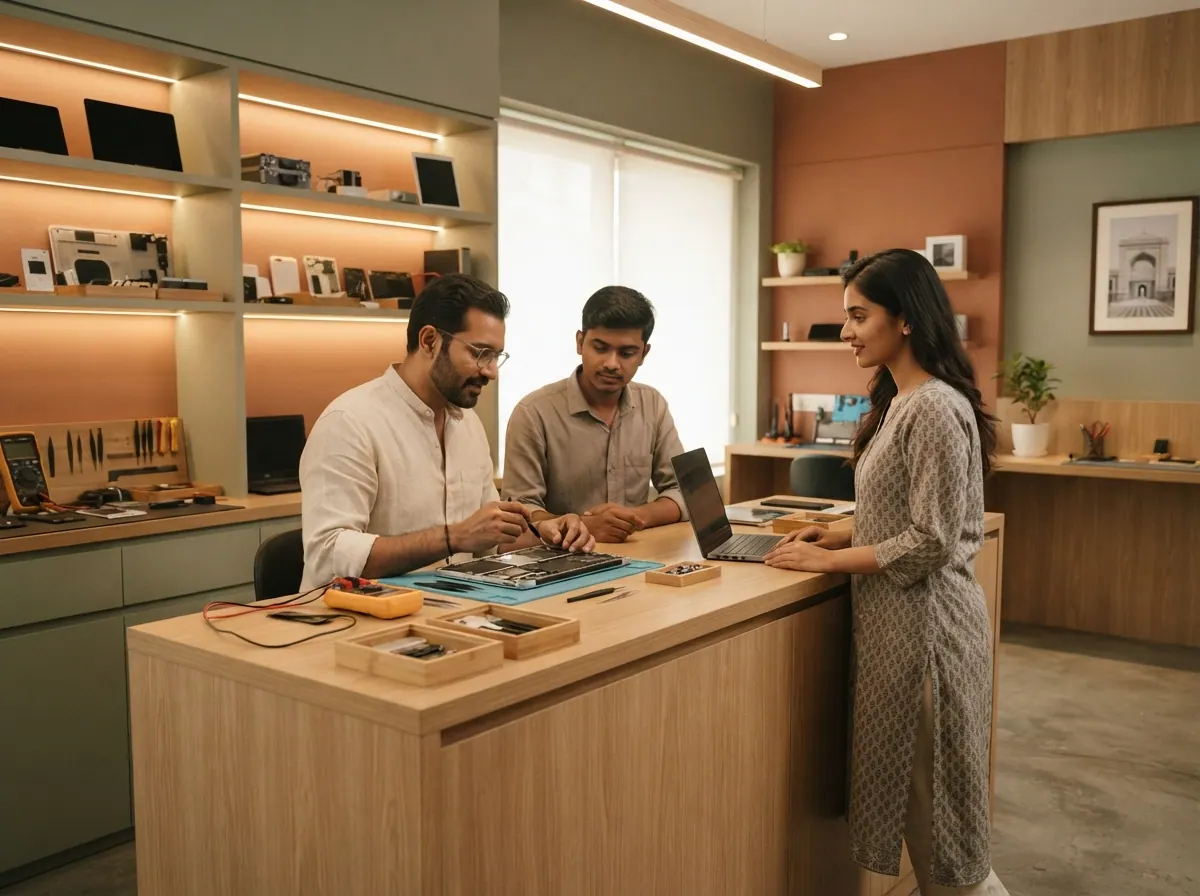
To start a laptop repair business in India you need a small shop or a bench in a busy lane, a rework and soldering setup, a stock of common parts, real repair skills, and about ₹50,000–3 lakh. Most of your jobs will be simple, such as screens, batteries, keyboards, SSD upgrades and chargers. The hard jobs on dead boards pay more, but only after you have learnt them.
All figures here are estimates. Check prices near you before you spend.
What does it cost?
| Item | Small bench (about ₹50,000–1 lakh) | Proper shop (about ₹2–3 lakh) |
|---|---|---|
| Rent advance and shop set-up | ₹15,000–30,000 | ₹60,000–1 lakh |
| Soldering iron, hot air rework station | ₹6,000–12,000 | ₹20,000–40,000 |
| Multimeter, bench power supply | ₹3,000–6,000 | ₹10,000–25,000 |
| Screwdriver sets, spudgers, ESD mat, tweezers | ₹2,000–4,000 | ₹5,000–8,000 |
| Ultrasonic cleaner, magnifier, microscope | not at start | ₹10,000–30,000 |
| Common parts stock: chargers, RAM, SSDs, batteries, keyboards | ₹15,000–30,000 | ₹50,000–90,000 |
| Software, diagnostics and OS licences | ₹2,000–5,000 | ₹5,000–12,000 |
| Board, display and furniture | ₹5,000–10,000 | ₹15,000–30,000 |
| Total | about ₹50,000–1 lakh | about ₹2–3 lakh |
Parts that rarely sell, such as a rare model's screen, should be ordered only when a customer asks. Stocking everything is the fastest way to tie up money.
What jobs will you get?
- Screen, keyboard and hinge changes: common and fairly simple, with a good margin on the part.
- Battery and charger replacement: high volume, low skill, and a steady source of repeat work.
- RAM and SSD upgrades: popular with students and offices that want old laptops to run faster.
- Software problems: Windows install, virus removal and driver errors. Customers often think these are free, so decide your rate.
- Liquid damage and no power faults: need cleaning, board-level skills and patience, and are risky for both you and the customer.
- Board-level repair: a dead motherboard that needs a chip replaced. Learn this slowly, with spare boards you can practise on.
How much can it earn?
Take a small shop doing about 60 repair jobs a month, with a margin of about ₹1,000 per job and some accessories. These are guesses, so use what your area pays.
Income
- Repairs: 60 jobs × ₹1,000 (labour plus margin on parts) = ₹60,000
- Accessories and small items: about ₹10,000
- Total = ₹70,000
Costs
- Shop rent: ₹10,000
- One technician: ₹15,000
- Power, internet and phone: ₹3,000
- Tools, solder and cleaning supplies: ₹3,000
- Loan instalment on ₹1.5 lakh: about ₹5,000
- Total = ₹36,000
Left over: ₹70,000 − ₹36,000 = about ₹34,000 a month.
If you do the repair yourself, you keep the technician's pay as well. New shops often do fewer than 30 jobs for the first months, so be ready for a slow start. One wrongly ordered board can cost a week of income.
What do you need before you start?
- Real skill first. Work with a repair shop for some months, or take a course, then practise on dead laptops you buy cheaply.
- A place with footfall. Near colleges, offices, a computer market or a mobile market, where people already look for repairs.
- A trusted parts source. A local wholesaler who gives good-quality parts and a return if they are dead on arrival.
- A written job slip. Every laptop gets a number, a note of its condition and a signed receipt.
Step by step
- Work at a repair shop for a few months, and learn to diagnose before you open a laptop.
- Practise on dead boards that you buy cheaply, before touching a customer's.
- Rent a small shop near colleges or offices, and set up a clean, well-lit bench.
- Buy basic tools first, and add the rework station when your jobs require it.
- Tie up with two parts suppliers so you have a second option when one is out of stock.
- Give every customer a job slip with the problem, price range and promised date.
- Test the laptop with the customer present before delivery, and give a short warranty on the part you replaced.
- Follow up a week later and ask if it is working well.
Which licences apply?
- Shop or trade registration with your local body.
- GST registration if your turnover needs it. Ask a CA.
- Dealer agreements if you want to sell new laptops, or to be listed as an authorised service point. Ask the brand directly.
- E-waste. Old batteries and boards should be disposed of through an authorised e-waste collector. Ask your state pollution control board what is required.
- Data privacy. There is no special licence, but customers' files are private. Do not copy or share them.
- Loans. Banks and small finance lenders may give small business loans. Confirm the terms directly.
What goes wrong?
- Customer data leaks. A technician who looks through photos or shares them can end your shop's name.
- Fake or low-grade parts. A bad battery or charger can overheat, so buy from sources you trust and test before delivery.
- Promising a price before opening. A "₹1,500 screen job" turns into a board repair, and the customer feels cheated. Quote a range, and call before extra work.
- A laptop that does not get collected. Old laptops pile up, take space and leave you with parts you have already paid for.
- Comebacks. A repair that fails in two days. Offer a short warranty and honour it.
- Falling behind on models. Laptops change quickly. If you do not keep learning, you lose to shops that do.
Situations you will face
What would you do? Each choice costs something.
Getting started
A rented shop is ready. You have repaired only your own laptop and a friend's.
- Work at a repair shop for 3 months: Slower start, stronger skill
- Open the shop now: Fast start, risky jobs
A good rework station costs ₹25,000. A cheap one costs ₹7,000 and drifts in temperature.
- Buy the good station: Costly, safer for boards
- Buy the cheap one: Cheaper, boards at risk
The college lane has students but less money. The computer market has regular business buyers.
- Take the college lane shop: Many small jobs
- Take the computer market shop: Fewer, larger jobs
A supplier offers a combo of chargers, batteries and keyboards at a discount.
- Take the combo: Cost now, quick jobs
- Order parts per job: No stock, slower jobs
A dealer sells ten dead laptop boards for ₹5,000.
- Buy and practise: Small cost, better skills
- Ask a senior to supervise: Small fee, safer for customers
A friend says slips are slow. Without one, you cannot prove the laptop's condition.
- Use a signed slip every time: Slower, safer for both
- Skip slips for known people: Fast, risk of dispute
Customers want Windows installed. Licensed copies cost money per install.
- Use legal licences and charge for them: Costs more, safe
- Offer free trial installs and be honest: Cheaper, lower income
First month
Rent is due and the bench looks empty.
- Offer a free health check: Time, builds trust
- Wait for referrals: No cost, slow growth
A student's laptop is dead after water spilled. The part could cost more than the laptop.
- Open it and quote honestly: Time spent, trust earned
- Quote a fee, warn it may fail: Honest, smaller income
A freelancer wants the laptop reinstalled and has not backed up work files.
- Back up files with consent: Takes time, safe for the owner
- Ask for a backup first: Slower, a reinstall fee follows
A customer says the charger you sold last week does not work.
- Replace it and test the next lot: Small cost, trust held
- Refuse a replacement: Saves cash, angry customer
Running it
Customers ask if you give any warranty on a new screen.
- Give a 30-day warranty: Builds trust, some free redo
- Give no warranty: No cost, fewer trusting buyers
Students want batteries and chargers fast before exams.
- Stock extra batteries: Cost now, quick sales
- Order only on demand: No stock risk, slow orders
A small office with 12 laptops wants a yearly care plan.
- Sign the yearly plan: Steady income, many calls
- Repair only per visit: Higher rate, uneven work
A seller offers batteries at half price. They are unbranded and untested.
- Buy only tested batteries: Lower margin, safe
- Buy a small trial lot and test: Moderate risk, small saving
You find your technician scrolling through a customer's private photos.
- Warn staff, make a data rule: Safe shop, awkward talk
- Keep that technician off customer devices: Awkward, protects privacy
A dealer offers refurbished laptops. You can add a display shelf.
- Start selling used laptops: Costly stock, more income
- Stick to repair: No spend, steady income
A customer says another shop charged ₹800 less for the same screen.
- Show your part quality and price: Lose some, keep quality
- Match the price: Keep the customer, thin margin
Many people ask you to open on a holiday. Your technician wants the day off.
- Open with a paid extra shift: Costs pay, more jobs
- Stay closed: Rest for team, lose jobs
When things go wrong
The screen does not fit the model. The customer is waiting.
- Admit it and reorder: Costs time and money, trust holds
- Admit it, offer a small discount: Costs now, honest answer
A solder bridge shorts a board and the laptop is worse than when it came.
- Tell the customer and offer a fix or refund: Costly, honest
- Offer a half-price repair, explain: Costs now, honest answer
Three laptops sit on the shelf for months. Their owners do not answer calls.
- Write notices and hold for a fixed date: Time, fair process
- Send a final notice: Small cost, fair process
A surge damages your bench power supply and two customer chargers.
- Buy a stabiliser and replace chargers: Costs money, builds trust
- Claim insurance, pay part yourself: Costs now, fair to customers
A customer whose laptop you could not fix posts a bad review.
- Reply politely and offer a recheck: Time, calms things
- Argue in the comments: No cost, hurts name
A new shop charges half your rate and promises one-day work.
- Match on simple jobs only: Keeps customers, thin margin
- Stay at your rate with warranty: Lose some, keep trusting ones
Growing
A course costs ₹25,000 and takes a month. Board repair pays three times a screen job.
- Do the course: Costly, higher-paying work
- Send board work to a specialist: Low cost, small commission
Jobs wait three days because only one person works.
- Hire a second technician: Costs pay, more jobs
- Work longer hours yourself: No cost, tired
Offices ask whether you can come to them.
- Start pick-up and drop: Costs a rider, more jobs
- Stay shop-only: No cost, miss busy buyers
A laptop brand offers a service-point agreement with fixed rates and rules.
- Sign the agreement: Steady jobs, fixed rates
- Stay independent: Freedom, no brand jobs
A busy college area across town has no good repair shop.
- Open a second counter: Costly, wider reach
- Stay with one shop: Safe, limited growth
Is it right for you?
Laptop repair suits you if you like fixing things, can stay patient over a small fault, and can explain a problem to someone who does not know computers. It suits you less if you want a fast income without learning, or if you dislike detailed work.
A good test: spend two months at a busy repair counter. Watch the types of jobs that arrive, how many customers argue about price, and how the owner decides when to say no. Then decide whether you want to run your own.