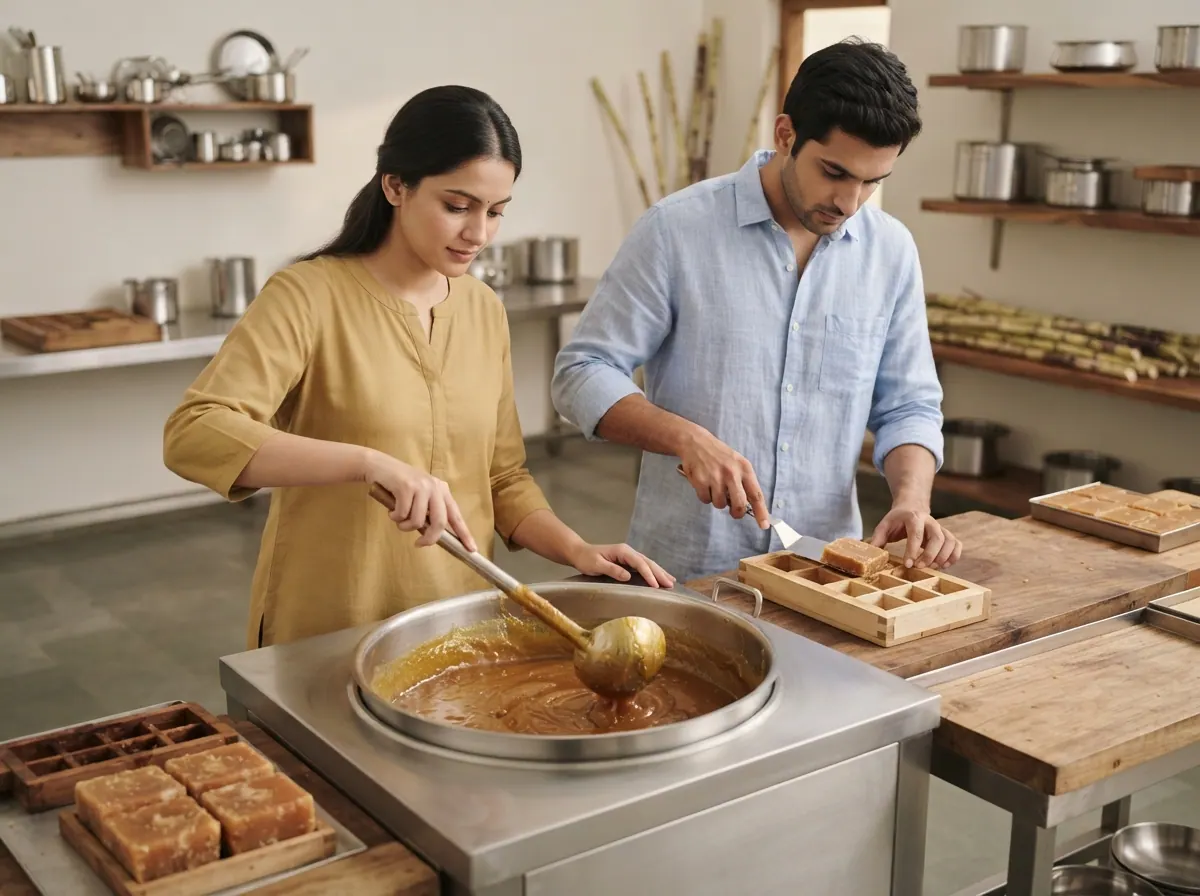
To start a jaggery unit in India you need a steady supply of good sugarcane, a power crusher, a set of boiling pans with a furnace that burns the leftover cane (bagasse), a clean shed, and about ₹5–15 lakh. The unit earns only in the crushing season, and your profit depends mostly on what you pay for cane and how much jaggery you get from each tonne.
All figures here are estimates. Check prices near you before you spend.
What does it cost?
| Item | Small unit | Larger unit |
|---|---|---|
| Shed and floor (drainage, clean walls) | ₹1.5–3 lakh | ₹3–5 lakh |
| Cane crusher with motor or engine | ₹1–2 lakh | ₹2–4 lakh |
| Furnace and boiling pans | ₹50,000–1.5 lakh | ₹1.5–3 lakh |
| Juice filter, storage tank, moulds | ₹30,000–70,000 | ₹70,000–1.5 lakh |
| Weighing scale, packing table, sealer | ₹20,000–50,000 | ₹50,000–1 lakh |
| Working capital for cane and wages | ₹1.5–4 lakh | ₹3–6 lakh |
| Licences and registration | ₹10,000–25,000 | ₹15,000–30,000 |
| Total | about ₹5–10 lakh | about ₹10–15 lakh |
Many farmers already have some of this, such as land and a shed, and then the cost drops. The furnace design matters more than people expect, because a well-built one burns your own bagasse and saves a large fuel bill.
How much can it earn?
Take a small unit crushing about 5 tonnes of cane a day, for 25 days in a month, in season. These are rough figures.
Each day
- Jaggery made: 5,000 kg of cane × about 10% = about 500 kg
- Sales: 500 kg × about ₹48 a kg = ₹24,000
- Cane bought: 5 tonnes × about ₹3,200 = ₹16,000
- Wages for about 8 workers: 8 × ₹500 = ₹4,000
- Power or diesel, packing, small repairs = ₹1,500
- Left over: ₹24,000 − ₹16,000 − ₹4,000 − ₹1,500 = about ₹2,500 a day
Each month
- 25 days × ₹2,500 = ₹62,500
- Less loan interest and rent for the month, about ₹10,000
- Left over: about ₹52,500 in a working month
The unit does not run all year, so divide the season's profit across the idle months too. The margin is thin: if cane costs ₹3,600 instead of ₹3,200, you lose ₹2,000 a day and nearly all your profit disappears. The same thing happens if your jaggery comes out at 9% instead of 10%.
What do you need before you start?
- Cane within a short drive. Cane loses sweetness the longer it waits after cutting, so crush it within a day or two. A tie-up with farmers near you matters more than the machine.
- A competing factory in mind. A sugar mill nearby pays growers and may pull cane away from you. Know its rate before you set yours.
- Clean water and drainage. Jaggery making is wet and sticky, and a dirty floor leads to spoilage and complaints.
- A buyer plan. Local mandi traders buy in bulk at a lower rate, while shops and online buyers pay more for clean packed jaggery in small packs.
- Working capital for the season. Cane is bought at once, but jaggery payments may come later.
Step by step
- Visit two working units in your area and ask what recovery they get and which months they run.
- Fix your cane supply with local growers before you order any machine.
- Build the shed and furnace so smoke leaves through a chimney, and so juice and finished jaggery stay away from dust.
- Install the crusher and test it with a few tonnes to check your juice yield and boiling time.
- Learn the boiling. The right temperature and skimming of the scum give you a good colour and a hard block. Learn from an experienced boiler, because this is a skill.
- Make blocks or small cubes in moulds, and pack them in clean, dry packaging.
- Store in a dry room. Jaggery takes moisture and can go soft or mouldy in monsoon.
- Find buyers before the first batch, such as traders, sweet makers and shops.
Which licences apply?
Rules vary by state, so confirm each of these with the local office:
- FSSAI registration or licence. Jaggery is food, so a small unit usually needs at least registration.
- Udyam registration. It is free and useful for bank loans and some schemes.
- GST. Check with a CA whether your sales need it.
- Pollution and fire rules. A furnace with a chimney may need consent from the state pollution board at some sizes. Ask them.
- Panchayat permission for the building, and electrical safety for the motor.
- Loans and schemes. Banks and some state schemes support food processing units. Ask your district industries centre what is open now.
What goes wrong?
- Paying too much for cane. A rise of a few hundred rupees a tonne can remove your entire profit.
- Old cut cane. Cane that waits for days gives less and darker jaggery.
- Dark, soft jaggery. Over-boiling, under-boiling or a damp store ruins a batch and the price falls.
- Adding colour or chemicals to look bright. Buyers and food officers can reject it and you may be fined. Sell it as it is, a little darker, with honest labelling.
- Furnace trouble. A badly built furnace wastes bagasse and fills the shed with smoke.
- Idle months with a loan to pay. The EMI continues when the machine does not.
Situations you will face
What would you do? Each choice costs something.
Getting started
Farmers near you offer steady cane if you fix the rate for the whole season. The mill's rate may rise or fall.
- Sign a fixed-rate deal: Steady cane, pay advance
- Buy day by day: Keep cash, supply uncertain
A used crusher costs half as much. Its rollers are worn and may leave juice in the cane.
- Buy a new crusher: Costly, better juice yield
- Buy the used one: Cheaper, lower juice yield
The mason builds a simple furnace cheaply. A better design burns the leftover cane well and saves fuel.
- Pay for the better furnace: Costly now, less fuel bought
- Build the simple one: Cheaper, smokier, buy extra fuel
A tiled floor with a drain is easy to wash. A mud floor costs almost nothing but gets sticky and dirty.
- Lay the tiled floor: Costly, cleaner jaggery
- Keep the mud floor: Cheap, dust and flies
A trader asks if your jaggery has an FSSAI number. The registration takes some days.
- Register before selling: Fee and wait, safe sales
- Sell first, register later: Faster, risk of a fine
An experienced boiler knows the right moment to pour. The boiler asks for a high daily wage.
- Hire the expert: Higher wage, good blocks
- Train a local worker: Cheaper, a few bad batches
First month
The jaggery from your trial boil is soft and sticks to the mould. You do not know if it is the cane or the boiling.
- Boil longer, discard the batch: Lose cane, learn the timing
- Sell it as soft jaggery: Sells cheap, may soften more
A grower brings cane cut four days ago. It is dry and gives less juice, but the grower offers a lower price.
- Refuse the trolley: Keep quality, lose supply
- Buy it at the low rate: Cheaper, darker jaggery
A mandi trader will buy your whole output every week, but pays well below shop rates and pays after ten days.
- Sell to the trader: Steady, low rate, late pay
- Hunt for shop buyers: Better rate, slower sales
Shops will pay more for clean 1 kg packs. A sealing and weighing set costs money and time every day.
- Make 1 kg packs: Costs more, higher price
- Sell in loose sacks: Easy, lowest price
A worker splashes hot juice on a hand at the pan. It is a bad burn and the worker cannot work for a week.
- Pay treatment and wages: Costs money, workers trust you
- Pay only the clinic bill: Cheaper, workers talk
A shopkeeper says your packs weigh a little less. You have never had the scale checked.
- Get the scale certified: Small fee, trusted weight
- Ignore the complaint: No cost, trust falls
Running it
A big harvest floods the mandi and rates drop by a few rupees a kilo. Your cane price has not fallen.
- Hold stock for a month: Storage cost, maybe higher rate
- Sell at the low rate: Cash now, thin margin
A trader pays more for light, shiny jaggery. Making it that bright usually means adding chemicals that food rules do not allow.
- Keep it natural: Darker colour, lower rate
- Explain and find another buyer: Time lost, clean name
The sugar mill raises its rate and growers start sending cane there. Your furnace sits idle some days.
- Raise your cane rate: Keeps cane, cuts profit
- Run fewer days: Saves cost, fewer sales
A seller online wants regular 500 g packs with a label and batch date. It means new packing work.
- Set up labelled packs: Spend now, better price
- Stay with trader sales: No extra work, same low rate
Early rain wets the corner where blocks are stacked. Some are soft on the bottom.
- Repair roof, move the stock: Repair cost, keeps most stock
- Cover with plastic sheets: Cheap, damp may return
The wage at the mill nearby is higher. Your pan crew says they may leave in the middle of the season.
- Raise wages a little: Higher daily cost, crew stays
- Hold the wage: Saves cost, may lose workers
An officer asks to see your licence, water source and storage. Your drain is blocked and the store is untidy.
- Clean up and show papers: Spend a day and some cash
- Argue the rules are unfair: No cost, notice likely
Families next to the shed say the chimney smoke and flies are too much. They may go to the panchayat.
- Raise the chimney, clean daily: Cost and effort, calmer village
- Promise and do nothing: No cost, complaint grows
When things go wrong
A stack kept through the damp weeks shows white mould on many blocks. Some are fine on the inside.
- Throw out the mouldy blocks: Heavy loss, safe sales
- Hold the batch for review: Delay, wait for lab advice
The furnace wall splits in the heat. You can patch it quickly or stop and rebuild the lining.
- Stop and rebuild: Lose days, lasting fix
- Patch and keep running: No lost days, may crack again
A trader who took four loads has not paid for a month. The trader promises next week, again.
- Stop supplying until paid: Lose sales, protect cash
- Keep supplying the trader: Sales continue, more risk
A voltage spike kills the motor on a busy day. Cane trolleys are waiting outside.
- Rent a motor, repair later: Costs more, keeps running
- Wait for the repair: Cheaper, cane may spoil
The season ends and the bank instalment is due. There is little cash until crushing starts again.
- Sell some stored stock cheaply: Cash now, lower price
- Ask the bank to reschedule: Eases the burden, extra interest
A pest damages cane in nearby fields. Growers bring thinner stalks that give less juice.
- Buy cane from farther villages: Transport cost, better cane
- Pay less for the thin cane: Cheaper, lower recovery
Growing
A shop asks for ginger jaggery and powder in small packs. It needs extra equipment and careful drying.
- Add a grinder and drier: Spend now, higher price per kg
- Stay with plain blocks: No spend, no new price
Cane waits in the yard for your pans most evenings. A second furnace line would clear it.
- Build the second line: Big spend, more output
- Add a night shift instead: Wages, less spend
A few acres nearby are on lease. Growing cane yourself fixes your cost, but you take the farming risk.
- Lease the acres: Spend now, steadier cost
- Keep buying from growers: No farming risk, rate swings
Shops ask for a named pack with an FSSAI number and batch date. Design and printing cost money.
- Launch your own brand: Printing cost, better rate
- Keep selling unbranded: No spend, low rate
Is it right for you?
A jaggery unit suits you if you live in a cane area, know cane growers, can be at the furnace during the season and can handle seasonal income. It suits you less if you need the same salary every month, or if you plan to buy all your cane at the mandi.
A good test: spend a week at a working unit during crushing. Weigh the cane that comes in and the jaggery that goes out for a few days. If the numbers still work with your own cane price, start small and grow after one good season.