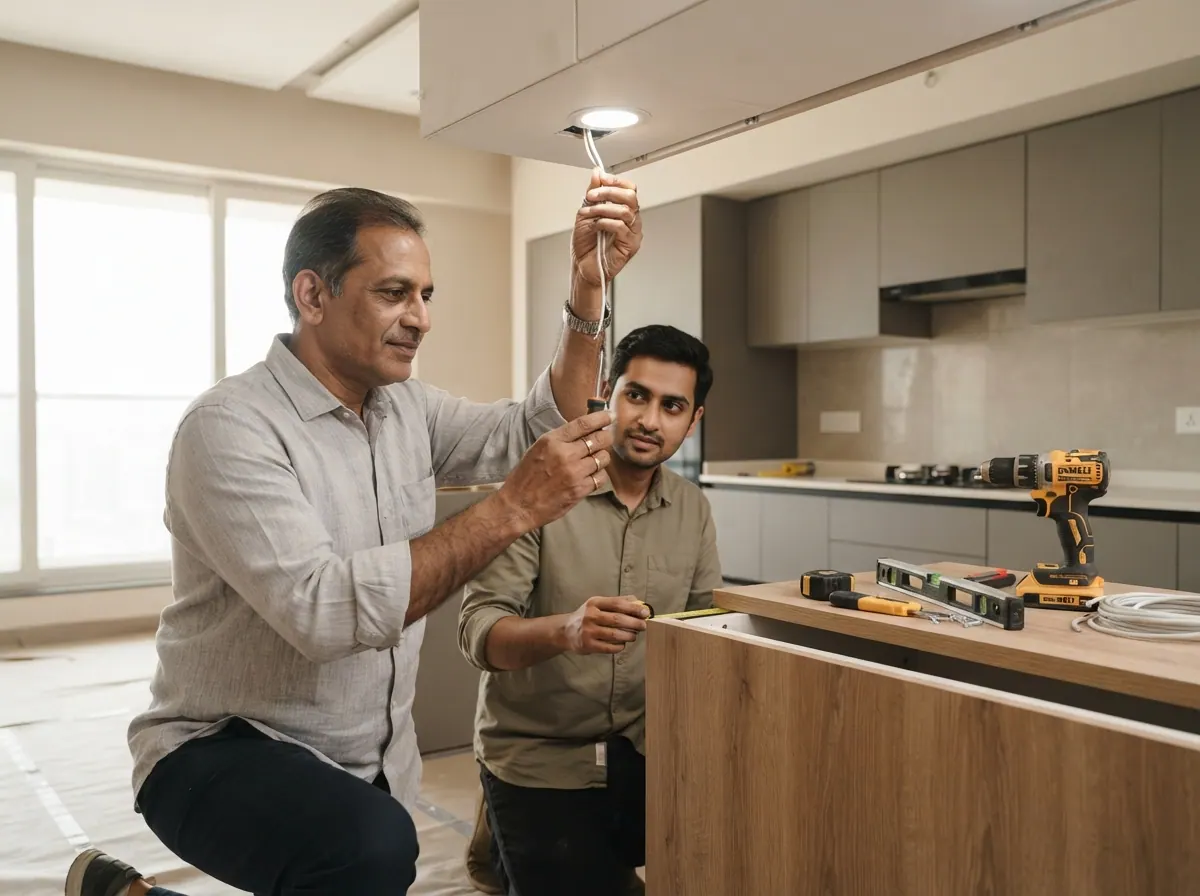
To start an interior contractor business in India you need design and measuring skill, a reliable carpenter team, relationships with plywood, laminate and hardware suppliers, a portfolio, and about ₹1–5 lakh in working money. A designer who works from home with a laptop can begin at the low end. Money is made on the gap between what you quote and what material and labour cost you. It is lost on measurement mistakes, rework, stage payments that do not arrive and a carpenter who leaves midway.
All figures here are estimates. Check prices near you before you spend.
What does it cost?
For a small contractor with a modest workspace:
| Item | Estimate |
|---|---|
| Small office or workspace deposit | ₹15,000–50,000 |
| Laptop and design or 3D software | ₹10,000–60,000 |
| Laser measure, drill, cutters, basic carpentry tools, ladder | ₹15,000–80,000 |
| Sample boards: laminates, hardware, ceiling profiles, handles | ₹10,000–50,000 |
| Cards, portfolio photos, simple website, listing | ₹5,000–30,000 |
| Cash to pay carpenters and buy material before customers pay | ₹45,000–2.3 lakh |
| Total | about ₹1–5 lakh |
The last row is the one that decides whether you survive. Customers pay in stages, and your carpenters and suppliers will want money before the next stage comes.
How much can it earn?
A month in which two small flats are finished, about ₹3 lakh each:
Billed
- Two projects (false ceiling, wardrobes, TV unit, small kitchen) × about ₹3 lakh = ₹6,00,000
Costs
- Plywood, laminate, boards, channels and hardware = ₹3,30,000
- Carpenters and fitters = ₹1,35,000
- Electrician, painter and other trades = ₹30,000
- Site supervisor = ₹20,000
- Rent = ₹12,000
- Transport = ₹8,000
- Phone and marketing = ₹6,000
- Rework and small losses = ₹9,000
- Total = ₹5,50,000
Left over: ₹6,00,000 − ₹5,50,000 = ₹50,000 for the month, and this has to pay you as well.
This is a month with two completed jobs. A month with none can show a loss, since rent, supervisor pay and advances to suppliers still go out. Keep a larger cash cushion than you think you need.
What do you need before you start?
- The ability to measure and read plans. A false ceiling that is 2 inches out or a kitchen cabinet that does not fit a pipe costs more than the margin of the job.
- A team of carpenters and fitters you trust. One strong lead carpenter who manages helpers is worth more than five average workers.
- Material knowledge. Plywood grades such as BWR and BWP, MDF, particle board, laminates and edge banding, hinges and channels, and gypsum or POP ceiling systems. A customer who finds a cheap board in a wet kitchen will blame you in a year.
- A portfolio. Even your own home or a friend's flat, photographed well, is a start.
- A written quotation. List the scope, material grade and brand, size, price and payment stages. Most disputes begin with an unclear quotation.
Step by step
- Work under an interior contractor for a few months and watch how they measure, quote, order and hand over.
- Visit plywood, laminate and hardware dealers. Ask about grades, credit terms and delivery times.
- Make a sample set of laminate, boards and hardware to show clients on a table.
- Do one or two small projects such as a wardrobe or a TV unit for people you know. Photograph every stage.
- Quote by item, not by one lump sum: ceiling, wardrobes, kitchen, panelling, electrical.
- Take an advance that covers at least the cost of main material.
- Check the site daily. A supervisor or you should visit, measure, and sign off each stage with the customer.
- Do a handover list. Walk through the work, note small fixes, and finish them before the last payment.
Which licences apply?
- Udyam registration is free and helps with loans.
- GST depends on your turnover and how you bill. Ask a CA.
- Society permission. Apartments may ask for a renovation permit, a deposit and set working hours. Ask the committee before you start.
- Trade or contractor registration. Some larger or government work asks for registration. Ask what applies to your project.
Confirm all of this with your local office or a CA, since rules vary by state.
What goes wrong?
- Measurement mistakes. A cabinet made to the wrong size is cut from a full board of plywood. Measure again after the walls are finished.
- Cheap board in wet areas. Kitchen and bathroom units made from the wrong board swell. Use water-resistant board and edge banding there.
- Carpenter leaves midway. The job stops and the customer blames you. Keep a second carpenter you can call.
- Customer keeps adding work. A new wardrobe, a changed layout and a new ceiling design after the quote add cost. Write extra work down with a price before you do it.
- Delay by other trades. If the electrician is late, the false ceiling has to wait. Plan the order of work.
- Stage payments that stop. A customer who is happy with progress still holds back the last 20 percent. Keep the last payment clearly tied to the handover list.
- Supplier delay. A laminate shade not in stock stops a kitchen for weeks. Confirm stock before you promise a date.
Situations you will face
What would you do? Each choice costs something.
Getting started
Clients like to see samples and a proper desk. A small office costs rent, a deposit and a signboard.
- Rent a small office: Trust, fixed rent
- Meet at their site, work from home: No rent, less credibility
A skilled carpenter offers to lead your team if you pay a monthly wage even in slow weeks.
- Pay a fixed wage: Reliable, fixed cost
- Pay per project: Flexible, the carpenter may leave
A dealer gives credit if you buy only the dealer's brand of plywood and laminates.
- Take the credit: Cash freed, limited choice
- Buy from many dealers: Choice, uses cash
Clients choose faster when they can touch laminate, hinges and ceiling profiles. A good set costs ₹25,000.
- Buy a full sample set: Costs now, faster closes
- Show photos only: Cheap, slower decisions
A client wants one total price for a 2BHK. An item-wise quote takes a day to prepare.
- Write an item-wise quote: Slower, fewer disputes
- Give a lump-sum price: Quick, change disputes later
A couple asks for free 3D images before they decide. You may get the job or lose a week of time.
- Do a small paid design fee: Fewer free requests
- Do it free to win the job: Time lost if they refuse
A client offers 20 percent advance. Your main material alone will cost about 40 percent of the job.
- Insist on 40 percent: Protects cash, may lose job
- Accept 20 percent: Job won, you fund the gap
First month
The carpenter cut the base cabinets using old measurements. They do not fit around the water pipe.
- Remake the cabinets: Costly, correct fit
- Trim and patch to fit: Cheaper, visible joints
For a kitchen, your dealer says BWR is as good as BWP and costs less. You doubt it near the sink.
- Use BWP near water: Costs more, lasts
- Use the cheaper grade: Saves now, swelling later
The family wants a new wardrobe and a layout change after the quote. They expect it for little extra.
- Quote the extra in writing: Fair, the client may grumble
- Do it at your cost: Keeps the client happy, costs you
The shade your client picked will take three weeks. The kitchen is halfway built.
- Wait and tell the client: Delay, same finish
- Suggest a close shade: No delay, the client may dislike it
The carpenter joined another contractor for more money. Two wardrobes are half done.
- Hire a day team, pay more: Costly, finishes on time
- Delay the handover: Cheaper, client upset
Running it
False ceiling work cannot close until wiring is done. The client's family moves in on Sunday.
- Call a second electrician: Extra cost, on time
- Wait for your usual one: Cheap, late handover
Three clients want work done before the festival. Your team can finish two on time.
- Hire extra fitters and pay overtime: Costly, all three finish
- Finish two, delay one: Calmer, one client upset
The society allows noisy work only 10 am to 5 pm and asks a ₹10,000 deposit.
- Pay and plan around hours: Slower work, rules followed
- Ask client to settle it: Friction with client
A freelance designer brings clients but wants a share of your margin and pays you late.
- Share 8 percent margin: Steady leads, thinner profit
- Decline, get your own clients: Full margin, slower
A builder wants ten flats finished with basic wardrobes and ceilings at a tight rate.
- Take ten flats at their rate: Volume, thin margin
- Take four at a higher rate: Safer, smaller
The client wants a deep false ceiling for lights. You know the room will feel low.
- Suggest a peripheral design: Honest advice, less work
- Build as the client asked: More work, later regret
Clients pay parts by UPI to you and your supervisor. By month end you cannot tell which project each payment was for.
- Use one account and a ledger: Small cost, clean records
- Keep using both phones: Free, confusion continues
When things go wrong
The flat is handed over but the client says small fixes are pending and delays the final payment.
- Finish the fixes, ask again: Costs time, may get paid
- Send a legal notice: Firm, may lose goodwill
A kitchen you built last year has swollen bottom doors. The client says the board was wrong.
- Replace the doors at cost: Costs money, saves name
- Inspect and share the cost fairly: Costs money, honest finding
Soft-close hinges and channels have not arrived. Three kitchens are waiting.
- Buy locally at a higher price: Costs more, work goes on
- Wait for the supplier: Cheap, delay
A client shows a cheaper quote. You suspect thinner ply and no edge banding.
- Match with a lighter spec: Win it, lower margin
- Explain material and keep price: May lose, builds trust
Two clients are late with stage payments and your carpenters want their weekly pay.
- Borrow from a supplier at a cost: Interest cost, work continues
- Pause one site for a week: Saves cash, client unhappy
Joints in a gypsum false ceiling have cracked. The fitter says the tape work was rushed.
- Redo joints at your cost: Costs time, clean fix
- Charge for a patch: Cheap, client unhappy
Growing
A photographer offers to shoot your finished flats. Good photos bring enquiries but cost money.
- Hire the photographer: Costs now, better leads
- Shoot on your phone: Cheap, plainer results
A factory will build kitchens to your drawings with faster finish, but at a higher cost than your carpenters.
- Use the factory for kitchens: Neat finish, thinner margin
- Keep site carpentry: Better margin, uneven finish
You are handling five sites at once. A second supervisor would help but costs a monthly wage.
- Hire a supervisor: Fewer mistakes, fixed cost
- Visit sites yourself: No wage, tired and slow
A dentist wants a clinic fitted out in six weeks. It is larger than your usual flats and pays well.
- Take it with staged payments: Good income, bigger risk
- Stay with home interiors: Familiar, smaller jobs
A client wants a GST invoice for the office fit-out. You are not yet registered.
- Register and bill properly: Fee and paperwork, bigger jobs
- Decline the business job: Simple, lose bigger work
Is it right for you?
Interiors suit you if you enjoy spaces and detail, can stay calm with clients who change their mind, and are good at managing a small team. It helps to be firm about the quotation and flexible about small things.
It suits you less if you want steady monthly income early on, or if you dislike chasing payments. Work comes in lumps, and cash is tight between stages. Try this first: complete one small project, such as a wardrobe and a false ceiling in one room, from quote to handover, and write down every rupee that came in and went out.