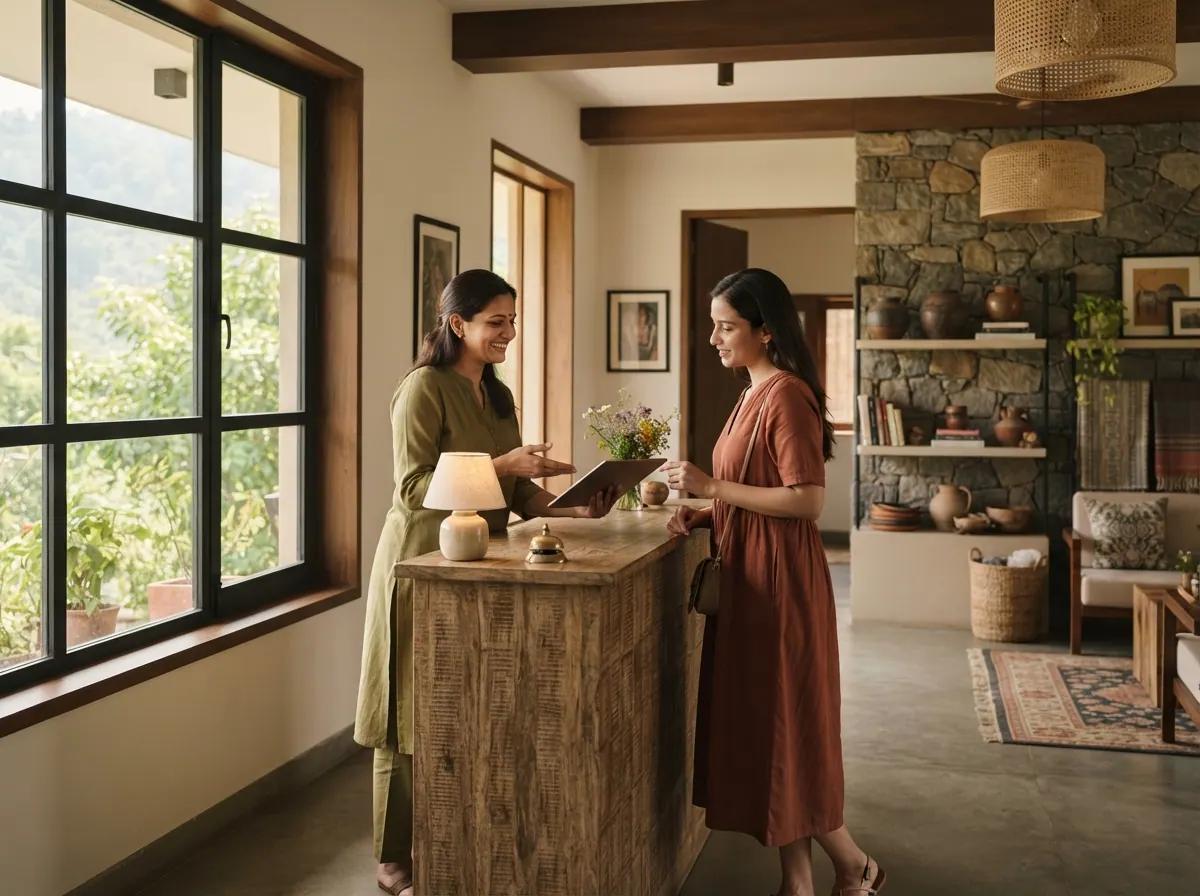
A small hotel or lodge means you rent or own a building with 10 to 20 rooms, furnish it, and charge guests by the night. About ₹25–50 lakh sets up a 12-room lodge in a leased building. A very small guest house can start from about ₹20 lakh, and buying the building takes it to ₹1 crore or more. Your rooms are a product that goes bad every night they are empty. So the business is occupancy, rate and cost, in that order.
All figures here are estimates. Check prices near you before you spend.
What does it cost?
For a 12-room lodge in a leased building, in a town with steady visitors:
| Item | Estimate |
|---|---|
| Beds, mattresses, furniture for 12 rooms | ₹7–12 lakh |
| 12 air conditioners | ₹4.5–6 lakh |
| Bathrooms, plumbing, geysers | ₹2–4 lakh |
| Reception, CCTV, booking software, Wi-Fi | ₹1–2 lakh |
| Linen, towels, laundry and small kitchen items | ₹1–2 lakh |
| Fire safety, inverter or generator | ₹2–6 lakh |
| Licences and approvals | ₹1–2 lakh |
| Lease deposit | ₹3–10 lakh |
| Photos, signboard, listing on booking sites | ₹50,000–1 lakh |
| Three months of rent, wages and power as cushion | ₹3–5 lakh |
| Total | about ₹25–50 lakh |
Many owners take a building that already has bathrooms and wiring, since rebuilding is the biggest hidden cost. Ask a civil engineer to check the building, lift, water supply and fire exits before you sign.
How much can it earn?
Assume 12 rooms, rent ₹70,000, five staff costing ₹75,000, and no loan. Add the booking sites' commission and card charges.
A good month (55% occupancy, ₹1,600 a night)
- Room nights: 12 × 30 × 0.55 = 198
- Income: 198 × ₹1,600 = ₹3,16,800
- Rent ₹70,000 + staff ₹75,000 + power ₹50,000 + laundry and toiletries ₹18,000 + repairs ₹10,000 + internet and software ₹8,000 + booking-site commission ₹25,000 = ₹2,56,000
- Left over: ₹3,16,800 − ₹2,56,000 = ₹60,800
A slow month (40% occupancy, ₹1,500 a night)
- Room nights: 12 × 30 × 0.40 = 144
- Income: 144 × ₹1,500 = ₹2,16,000
- Rent ₹70,000 + staff ₹75,000 + power ₹42,000 + laundry ₹13,000 + repairs ₹8,000 + internet ₹8,000 + commission ₹16,000 = ₹2,32,000
- Left over: ₹2,16,000 − ₹2,32,000 = −₹16,000
Over a year (7 good months, 5 slow)
- 7 × ₹60,800 = ₹4,25,600
- 5 × −₹16,000 = −₹80,000
- Total: about ₹3.5 lakh, or about ₹28,800 a month
That is before any loan. A ₹10 lakh loan with an EMI of about ₹21,000 would take ₹2.5 lakh out of the year. If you live on site and run the desk yourself, you can cut a manager's pay of ₹20,000 a month, or ₹2.4 lakh a year. The numbers move fast with occupancy. At 70% in the busy months, the same hotel earns much more. At 35% all year, it loses money.
What do you need before you start?
- A reason guests come to your town. A temple, a hospital, an industrial area, a bus stand, a college, a tourist spot or a highway stop. No reason, no guests.
- A building near that reason, with parking and a clear entrance.
- A clear guest type. Pilgrims and families want cleanliness and a cheap rate. Business visitors want quiet, Wi-Fi and a bill. Highway guests want parking and late check-in.
- A manager or you on site every night. Guests arrive late and complaints cannot wait.
- Cash for slow months. Plan for at least three of them.
Step by step
- Stay in five local hotels as a guest and write down their rates, rooms, problems and what they do well.
- Check the building for water, power, fire exits, parking and lease terms before any interior work.
- Set up approvals from the municipal body, fire department and tax office early, because they can take weeks.
- Fit rooms with good beds, clean bathrooms and strong water pressure. Guests judge a hotel by its bed and bathroom.
- Choose two or three room types at clear prices. Keep one cheap room for the guest who asks first for price.
- Open an account on booking sites with real photos, and ask each guest for a review.
- Keep a guest register and ID copies as your local rules require.
- Track occupancy every day, and change your rate by season. A weekday room sold at a low rate is better than an empty one.
Which licences and papers apply?
- Trade licence or shop and establishment registration from your local body.
- Fire safety clearance. Check what is needed for the number of rooms and floors. In 2026 inspections after hotel fires, places without clearance were sealed or served closure notices.
- GST registration. Rooms up to ₹7,500 a night carry 5% GST without input tax credit, and above that 18% with credit. Registration is needed above ₹20 lakh of turnover. Ask a CA.
- Food licence if you serve food, and a separate permit if alcohol is involved, which is a different and much more complex matter.
- Guest register and police rules. Lodges are asked to keep guest records and report every foreign guest, including OCI holders, in Form-III within 24 hours, with a penalty of ₹50,000 per case. Ask your local police station.
- Tourism department registration is required or helpful in some states. Ask the state tourism office.
- Music or event permissions if you host functions.
What goes wrong?
- Empty weekdays. Rooms sell on Friday and Saturday and sit empty from Monday to Wednesday.
- Booking-site commission. It takes a slice of each booking, and the guests never become yours.
- A single bad review about a dirty bathroom, a wrong bill or a noisy night.
- Staff who leave without notice, so linen and rooms are not ready for guests who are on the way.
- Power and water failure on a full night. Without a backup, you lose guests and refunds follow.
- Guests without proper ID, or with a story that does not fit, which can bring police trouble to your door.
- Lease problems. A landlord raises rent or asks you to leave after you have spent on interiors.
Situations you will face
What would you do? Each choice costs something.
Getting started
Twelve rooms spread fixed costs better when full. Eight rooms need far less to furnish and are easier to fill.
- Open twelve rooms: Big fit-out, more rooms to sell
- Open eight rooms: Smaller bill, less to sell
Guests in your town ask for AC first. Non-AC rooms cost far less to fit and run, and some guests prefer the low rate.
- AC in every room: Heavy cost, higher rate
- Half AC, half fan rooms: Saves money, mixed guests
Owning stops rent rises, but ties up your savings. A lease keeps cash for rooms, with a risk of rent rises later.
- Take a long lease: Lower cost now, rent risk later
- Buy the building: Huge spend, no rent worries
The fire office asks for extinguishers, a second staircase marker and a safety plan. Opening day is two weeks away.
- Complete fire safety first: Cost and delay, papers right
- Open now, apply later: Earn now, big risk if caught
Guests judge a hotel by its bed and bathroom. Good mattresses and fittings cost almost double the cheap ones.
- Buy good beds and fittings: Costly, better reviews
- Buy the cheaper set: Saves money, weaker reviews
Booking sites bring guests quickly but take a slice of each booking. Walk-ins and phone calls build slowly.
- List on booking sites: Fast guests, lower margin
- Rely on walk-ins and calls: Full rate, slow start
Power fails several times a week. A generator runs the whole hotel at a high cost, an inverter runs only lights and fans.
- Buy a generator: Costly, full backup
- Buy an inverter: Cheaper, no AC in cuts
First month
A tired couple arrives after midnight without photo ID. They offer to pay extra and promise to show it in the morning.
- Insist on ID first: Lose the room, papers right
- Wait in the lobby for ID: Slow night, rules kept
A review says the bathroom smelled and the water was slow. It is true, and the review is the first thing new guests see.
- Fix it and reply honestly: Repair cost, trust slowly returns
- Ignore it: No cost, bookings slip
The tank ran dry at 10 pm with every room booked. A tanker costs more than usual and takes two hours.
- Order an emergency tanker: Costly, guests stay happy
- Offer water buckets and a discount: Cheaper, guests annoyed
A guest at 9 pm asks for the room at half the posted rate. Three rooms are empty tonight and may stay empty.
- Give a small discount: Some income, a fair rate
- Hold the posted rate: Maybe an empty room
Your night clerk says the hours are too long and asks for a rise or to go. A new clerk needs weeks to train.
- Give a raise: Higher wage, steady desk
- Hire someone new: Same wage, shaky weeks
Eight towels and four sheets are missing this month. Guests may be taking them, or the laundry may be careless.
- Count every room, change laundry: Costs effort, losses drop
- Just buy more linen: Easy, losses go on
Running it
Local fair guests ask for rooms at triple the usual rate. Regular customers who booked early will lose their rooms if you overbook.
- Raise rates, keep bookings: Big money, regulars protected
- Cancel regulars, sell high: More money, hurt trust
Weekend is full and weekdays are empty. A weekday offer would fill rooms, but guests may expect it every day.
- Run a weekday offer: Fills rooms, lower rate
- Keep rates fixed: Better rate, empty rooms
A factory wants six rooms a week through the year at a lower rate. That fills weekdays but fixes your price.
- Sign the corporate rate: Steady rooms, lower rate
- Stay with open rates: Better rate, unsure rooms
Guests keep asking for breakfast. A small kitchen costs money and needs a food licence, but guests pay extra.
- Start a small breakfast: Kitchen cost, extra income
- Tell guests to eat out: No cost, plainer offer
Four rooms have non-working AC in peak summer. A full service of all units costs a lot, repairing four costs less.
- Service all units now: Bigger bill, fewer breakdowns
- Repair only the four: Cheaper, more breakdowns
A bigger hotel with a lift opened two lanes away. Some of your regular guests asked about its rates.
- Cut your rate for a while: Keep guests, thinner margin
- Improve rooms and service: Costs more, better stay
A wedding family wants ten rooms for three nights at a discount, but a loud party can upset other guests.
- Accept the wedding block: Big booking, noise risk
- Offer six rooms only: Less money, calmer hotel
A booking site offers top placement for a fee. More guests may see you, but its commission also goes up.
- Pay for the premium listing: More guests, lower margin
- Stay on the standard listing: Keep margin, fewer guests
When things go wrong
A guest who ate in your small dining room says they were ill overnight. They want money, and may post online.
- Refund and check the kitchen: Costs money, safer food
- Deny and ask for proof: Keep money, angry guest
Officers ask for last month's register. Three entries have no ID copy, and a guest name is badly written.
- Admit gaps, fix the process: Awkward now, safer later
- Hand over what you have: No fix, gaps are noted
A transformer blew at 9 pm and every room is full. Guests are upset, and some want their money back.
- Run backup, give small refunds: Costly, guests calmed
- Ask guests to wait it out: Cheaper, many leave angry
Your landlord sees your full rooms and asks for ₹20,000 more a month. Moving a hotel is nearly impossible.
- Agree to a smaller rise: Thinner margin, stay put
- Refuse and look elsewhere: Risk losing your hotel
A guest has stayed ten days and owes ₹15,000. They keep saying a payment is coming and want to stay longer.
- Stop the stay until paid: Chance of money, room lost
- Let them stay, wait: Room used, debt grows
Growing
On weekends you turn guests away. A new floor adds eight rooms but costs a lot and needs approvals.
- Build the new floor: Big spend, more rooms
- Raise weekend rates instead: No building, limited growth
Guests and neighbours ask where to eat. A restaurant brings income and footfall, but also licences, staff and waste.
- Open a restaurant: Big setup, new income
- Tie up with a nearby eatery: Small income, no setup
Booking sites take a slice of each room. A simple website, a phone number and a guest list could bring repeat guests free.
- Build a site and guest list: Cost and effort, better margin
- Stay on booking sites: No effort, margin stays low
A nearby guest house is offered on lease. It would double your rooms, but you cannot be at both places each night.
- Lease the second property: Big spend, stretched attention
- Perfect your first hotel: Lower risk, slower growth
Is it right for you?
This suits you if you can be there at midnight, enjoy solving small problems for strangers, and can watch costs like power, laundry and linen without being asked. It helps if you have worked in a hotel or lodge before, and know the town's visitors.
It suits you less if you want a hands-off investment, or if your town has few reasons for people to stay overnight. Before you sign, stay in the lodges nearby on a weekday and a weekend, and count the cars and bags at the door. That count tells you more than any hotel brochure.