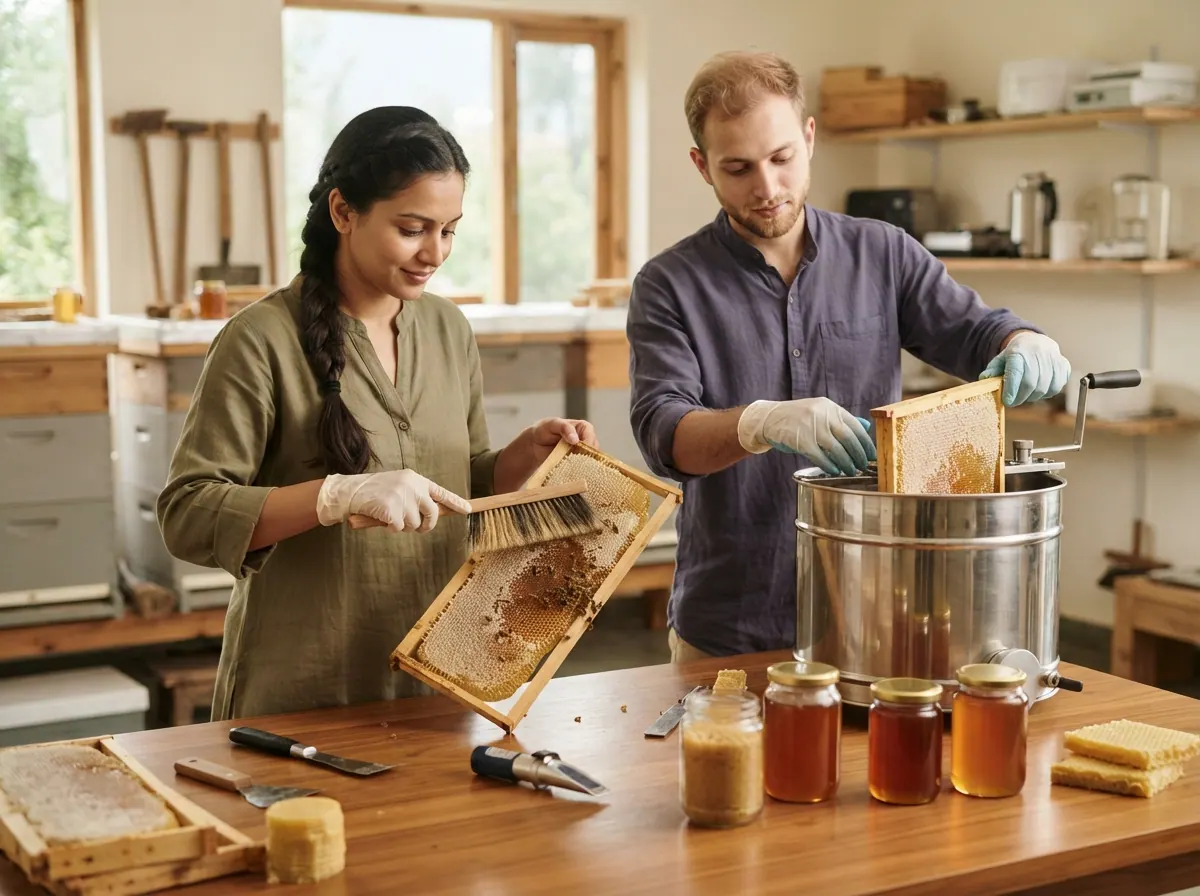
To start a honey business in India you need bee boxes with healthy colonies, flowers within a few kilometres, a honey extractor, a clean place to pack, and about ₹40,000–80,000 for 10 boxes or ₹2–3 lakh for 50 boxes. The honey itself costs little to make. What you pay for is the boxes, the bees, and the travel to follow the flowers, and a bad season can wipe out a lot of the income.
All figures here are estimates. Check prices near you before you spend.
What does it cost?
| Item | 10 boxes | 50 boxes |
|---|---|---|
| Wooden boxes with frames | ₹20,000–35,000 | ₹1–1.6 lakh |
| Bee colonies (or swarms) | ₹10,000–20,000 | ₹40,000–70,000 |
| Hand extractor | ₹8,000–15,000 | ₹12,000–25,000 |
| Bee suit, smoker, hive tool, veil | ₹3,000–6,000 | ₹6,000–10,000 |
| Sugar for feeding in lean months | ₹3,000–5,000 | ₹10,000–20,000 |
| Jars, labels, a filter and strainer | ₹3,000–6,000 | ₹10,000–20,000 |
| Total | about ₹40,000–80,000 | about ₹2–3 lakh |
The colonies are the part to buy carefully. A weak box with an old queen costs you a season.
Which bees and boxes?
- Apis mellifera (Italian bee): gives more honey where there are large crops like mustard, and is kept in Langstroth boxes. It needs more care against mites and robber bees.
- Apis cerana (Indian bee): smaller colonies and less honey, but it copes better in hills and forest areas.
- Stingless bees: give very little honey, so they are kept more for pollination and special honey.
Most new commercial beekeepers use Langstroth boxes because honey can be spun out without destroying the comb.
How much can it earn?
Honey depends on flowers more than on skill. Here is a settled unit of 50 boxes in a decent year. These are example numbers.
Honey sold in a year
- 50 boxes × about 25 kg a box = 1,250 kg
- 1,250 kg × about ₹250 a kg sold in bulk = ₹3,12,500
- ₹3,12,500 ÷ 12 = about ₹26,000 a month
Costs each month (yearly cost ÷ 12)
- Sugar and feeding in lean months: ₹30,000 a year = ₹2,500
- New queens, medicine and replacing lost colonies: ₹20,000 a year = ₹1,700
- Transport to move boxes to flowers: ₹40,000 a year = ₹3,300
- A helper for the season: ₹60,000 a year = ₹5,000
- Jars, labels and testing: ₹30,000 a year = ₹2,500
- Total = about ₹15,000
Left over: ₹26,000 − ₹15,000 = about ₹11,000 a month.
If you pack and sell in small jars yourself at a retail price, you can earn more per kg, but you take on selling and testing. A poor flowering year or a mite attack can cut honey to a fraction.
What do you need before you start?
- Flowers. Check what blooms near you and when: mustard, sunflower, eucalyptus, litchi, jamun, wild forest flowers. Many beekeepers move boxes to follow bloom.
- A site. Boxes need shade, water nearby, and a place away from people and cattle paths.
- Training. Spend time with a local beekeeper. Your horticulture or agriculture office, or a Krishi Vigyan Kendra, may run a short course.
- Safety. Allergy to bee stings can be serious. If you get swelling or breathing trouble after a sting, get medical help and think hard before going on.
Step by step
- Work a season with an experienced beekeeper, including a honey harvest and a dearth period.
- Start with 10 boxes and learn to read a colony: brood, queen, stores.
- Place boxes in shade, facing away from strong wind, with a water source close.
- Feed sugar syrup when no flowers are out, as advised by your trainer.
- Harvest only capped honey from the supers, and leave enough for the bees.
- Strain, settle and pack in clean, dry jars and label them properly.
- Divide strong colonies to make new ones instead of buying more.
Which licences apply?
- FSSAI: honey is a food, so you would normally need FSSAI registration or a licence. Ask the FSSAI office which applies at your size.
- Labelling and purity: honey has quality standards and adulterated honey is a real issue. Ask FSSAI for the label rules.
- Schemes: the National Beekeeping and Honey Mission and state horticulture departments support the trade. Confirm what is open now.
- Moving boxes: ask the local office and the panchayat if there are rules on placing boxes in other areas.
- Tax: ask a CA how your sales are treated.
What goes wrong?
- Dearth. In months with no flowers, colonies starve or leave. Feeding costs money and effort.
- Varroa mites and diseases. Italian bees are hit by mites, and Indian bees can face Thai sacbrood virus. Check boxes regularly and ask a trainer for current advice.
- Absconding. Colonies can fly away after heat, smoke or disturbance.
- Pesticide spraying. Spray near your boxes can kill foragers in a day. Talk to nearby farmers.
- Selling cheap honey. Buyers who suspect adulterated honey will pay less for everyone. Honest labelling takes time to pay off.
Situations you will face
What would you do? Each choice costs something.
Getting started
A beekeeper sells proven colonies. A farmer says you can catch free wild swarms in the season.
- Buy proven colonies: Costly, steady start
- Catch swarms yourself: Cheap, weak and uncertain
Langstroth boxes cost more and let you spin honey. A local carpenter offers cheaper boxes with fixed comb.
- Order Langstroth boxes: Higher price, easy harvest
- Take the cheaper boxes: Lower cost, comb is lost
One spot has shade and a pond nearby but is beside a cattle path. Another is quiet but dry and open.
- Use the shaded pond spot: Fence cost, bees stay cooler
- Use the quiet dry spot: No fence, hot boxes
A local beekeeper offers a week of hands-on training for a fee. Your boxes are ready and the bloom is starting.
- Pay for the training: Fee and lost days
- Start and learn by doing: No fee, early mistakes
Your helper's face swells after a few stings. They say it is nothing and want to keep working.
- Send for a doctor's check: Fee, lost workdays
- Stop their hive work: Need a new helper
A full bee suit and gloves cost money. A cloth veil and old shirt are free.
- Buy proper suits: Costly, fewer stings
- Use veil and old shirt: Cheap, more sting trouble
A hand extractor lets you reuse comb. Pressing honey out is free but destroys the comb.
- Buy the extractor: Costly, comb reused
- Press the comb: Free, bees rebuild comb
First month
Fields have been cut and nothing blooms. Your colonies look thin and stores are low.
- Feed sugar syrup: Sugar cost, colonies survive
- Move boxes to flowers: Transport, better forage
- Wait for rain: No cost, may lose colonies
One colony is restless and has no eggs. The trainer says it needs a new queen soon.
- Buy a mated queen: Cost, quick recovery
- Merge with a neighbour box: Free, lose one colony
Bees from strong boxes are raiding a weak colony after you left a box open too long.
- Reduce entrances, work at dusk: Extra work, saves colony
- Leave them to sort it out: No effort, colony may die
Ants are entering your boxes and bothering the colonies.
- Put stands in water cups: Small cost, ongoing refills
- Skip it for now: No cost, weaker colonies
Running it
A box is crowded and the bees are building queen cells. A swarm would leave with half your bees.
- Split it into two boxes: New box cost, more colonies
- Add a super and watch: Cheap, may still swarm
A beekeeper says mustard is in full bloom far away. A truck costs money and boxes must travel at night.
- Truck the boxes there: Costly, heavier honey
- Stay with local flowers: No cost, lighter harvest
A farmer next to your site will spray the crop in two days. Open boxes could lose many foragers.
- Move boxes for the week: Transport cost, bees safe
- Close the entrances for a day: Cheap, heat risk
- Ask for dusk spraying: Goodwill, may be refused
Frames are capped and heavy. A neighbour says to cut them now before rain.
- Harvest only capped frames: Takes longer, ripe honey
- Wait one more week: Rain risk, heavier supers
A trader pays a bulk price today. Selling in labelled jars takes time but pays more per kilo.
- Sell in bulk to the trader: Quick cash, lower price
- Pack in labelled jars: Jars cost, slower, higher price
You have a block of clean wax from cappings. A candle maker wants to buy it.
- Sell wax to the candle maker: Small extra income
- Make foundation sheets: Tool cost, saves later
Temperatures climb and bees travel far for water. Some boxes look overheated.
- Set up water pots and shade: Cost and daily refilling
- Do nothing extra: No cost, weak colonies
A shop wants proof that your honey is pure before ordering regularly.
- Pay for a lab test: Fee, trust with buyers
- Offer free samples instead: Cheap, buyer stays unsure
When things go wrong
You see mites and crumpled wings in several Italian bee boxes.
- Treat all boxes as advised: Medicine cost, saves colonies
- Treat only the worst boxes: Cheaper, mites spread
Larvae look sunken and dark. The horticulture officer says it may be sacbrood virus.
- Ask the officer for a visit: Time lost, correct advice
- Merge weak colonies and watch: Cheap, some colonies lost
Someone opened several boxes at your remote site and took frames.
- Hire a watchman at night: Wages, safer boxes
- Move boxes nearer your house: Transport, less forage
A news clip about adulterated honey makes buyers doubt all small sellers, including you.
- Show the harvest, label batches: Time and costs, trust builds
- Drop the price: Quick sales, thinner profit
Heavy rain floods the field and wets several boxes. The ground is soft.
- Move boxes to higher ground: Labour and transport
- Wait and dry them in place: No cost, colony losses
Your only trained helper leaves just as the flow begins.
- Offer a harvest bonus: Costs cash, keeps helper
- Train a new person: Slower harvest
Growing
Your colonies are strong. You could divide them and buy more boxes.
- Divide your own colonies: Box cost, slow growth
- Buy ready colonies: Costly, faster
A store will stock your honey if your jars carry a food licence number.
- Get registration with a CA: Fee, access to shops
- Sell only at local fairs: No paperwork, small reach
Buyers pay more for single-flower honey, like litchi or eucalyptus. It means separate boxes and records.
- Keep batches by flower: Work and records, better price
- Mix all honey together: Simple, lower price
Neighbours ask you to run a weekend class on bee keeping.
- Run a paid weekend class: Time off hives, small income
- Decline and stay on hives: Focus, less goodwill
Customers in town ask for honey by message and want to pay by UPI. Courier costs eat into the price.
- Start courier orders: Packing and courier cost
- Sell only by hand in town: No courier, smaller reach
Is it right for you?
Bee keeping suits you if you are patient, comfortable around bees, and happy to travel and work outdoors. It suits you less if you want steady monthly income, because honey comes in one or two harvests and depends on flowers and weather.
A good test: spend a harvest season with a beekeeper. If you still like it, start with 10 boxes, learn to keep colonies alive through the lean months, and grow by dividing your own colonies.