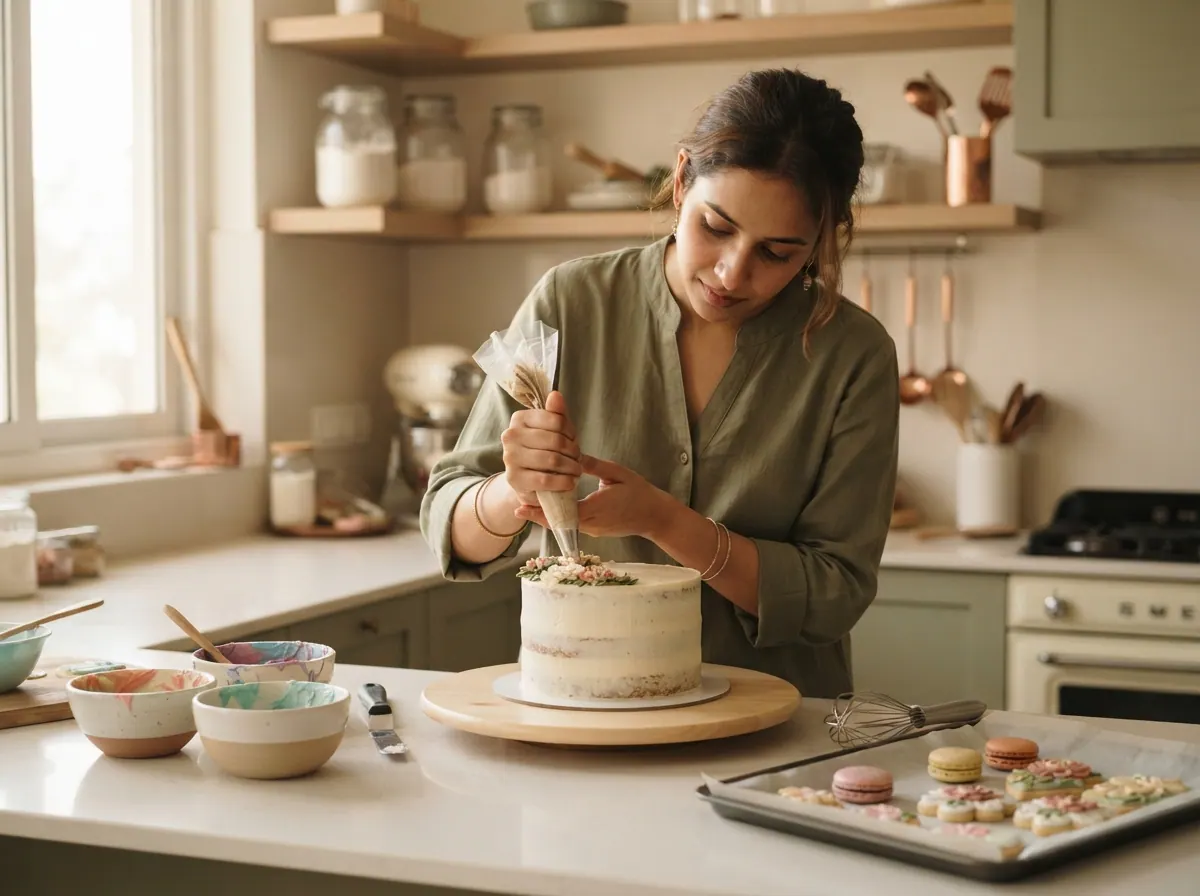
To start a home bakery in India you need a reliable oven, a mixer, baking tins and tools, a clean kitchen routine, two or three recipes you can repeat, FSSAI registration, and about ₹20,000 to ₹2 lakh. The low end is an oven and basic tools in your home kitchen. The high end is a convection oven, a bigger mixer, a fridge and a good photo and packing setup. Home baking sells by taste, looks and trust, and nearly all of your orders will come by word of mouth and Instagram.
All figures here are estimates. Check prices near you before you spend.
What does it cost?
| Item | Basic setup | Fuller setup |
|---|---|---|
| Oven (OTG or convection) | ₹6,000–15,000 | ₹25,000–70,000 |
| Mixer (hand or stand) | ₹2,000–6,000 | ₹12,000–45,000 |
| Tins, moulds, turntable, piping tools | ₹4,000–10,000 | ₹10,000–25,000 |
| Scale, thermometer, bowls, spatulas | ₹2,000–4,000 | ₹4,000–8,000 |
| Fridge space or a second fridge | ₹0 (use your own) | ₹15,000–30,000 |
| Cake boxes, boards, ribbons, labels | ₹3,000–6,000 | ₹8,000–15,000 |
| FSSAI registration | ₹1,000–3,000 | ₹1,000–5,000 |
| First ingredients | ₹5,000–10,000 | ₹15,000–30,000 |
| Photos, a simple logo, a phone stand | ₹1,000–3,000 | ₹5,000–12,000 |
| Total | about ₹24,000–60,000 | about ₹95,000–2.4 lakh |
You can start by baking only on order, with one oven and hand tools. Buy a better oven and mixer when orders prove your demand, since an oven that heats unevenly burns cakes and your money.
What can you sell?
- Custom birthday cakes: the high-margin item, from a half-kilo to three kilos, with buttercream or whipped cream and a simple design.
- Cupcakes and jar cakes: good for small gifts and party boxes.
- Brownies and cookies: long-lasting, easy to pack and good for tea-time orders.
- Eggless cakes: many families ask for eggless, and some need it for a festival.
- Festival boxes: Diwali, Christmas and Valentine boxes bring good spikes in orders.
How much can it earn?
Here is a home bakery that gets about 25 orders a month with an average bill of ₹1,200, working part-time from a home kitchen.
Sales
- 12 custom cakes × ₹1,800 = ₹21,600
- 8 cupcake or brownie boxes × ₹700 = ₹5,600
- 5 cookie or festival boxes × ₹600 = ₹3,000
- Total = ₹30,200 a month
Costs each month
- Flour, butter, cream, eggs, chocolate, sugar: about 35% of sales = ₹10,600
- Boxes, boards and packing = ₹2,500
- Gas or power for the oven = ₹1,500
- Delivery charges and your travel = ₹2,000
- Ads, phone and small items = ₹1,500
- Total = ₹18,100
Left over: ₹30,200 − ₹18,100 = about ₹12,100 for your own time and effort.
That is the honest figure for a part-time baker in the first few months. If you work with 50 orders a month, sales double to about ₹60,000, costs rise to about ₹35,000, and you could keep about ₹25,000. But time is the limit: a three-kilo custom cake can take six hours from baking to decoration.
What do you need before you start?
- A reliable oven. Learn its hot spots with a thermometer, and bake the same cake ten times before you take orders.
- Recipes you can repeat. Weigh everything in grams, not cups.
- A clean routine. Hair tied, hands washed, kept apart from household pets, and clean utensils.
- A cold storage plan. Cream, cheese and fresh fruit cakes need a fridge and a short delivery time.
- A way to take advance orders. Fix a lead time, take a part-payment and write down the design in a message.
Step by step
- Choose three products and bake each at home until you can do it blindfolded.
- Cost each item: ingredients, packing, gas and your time. Price at about three times ingredient cost.
- Register with FSSAI and check local rules for home food businesses.
- Take photos in daylight on a clean plate, and set up an Instagram page and a WhatsApp business number.
- Offer a limited menu with a clear price list and a lead time of two days.
- Take advance payment of about half for custom cakes, so a cancelled order does not leave you with a cake.
- Ask every customer for a photo and a short review.
Which licences apply?
- FSSAI registration or licence. Which one depends on your yearly sales, on the FoSCoS portal.
- Local permission. Some housing societies and municipalities have rules about running a food business from a home. Ask before you start.
- GST only after sales pass the limit. Ask a CA.
- Labelling. Packaged items like cookies may need a label with name and date. Ask the food safety office.
- Rules vary by state and city, so confirm each with the local office.
What goes wrong?
- Underpricing. Many home bakers forget to charge for their time, gas and packing. A cake sold at cost is a loss.
- Cakes that collapse in the heat. Whipped cream and buttercream melt in summer. Keep cakes cold and deliver fast.
- Oven problems before an event. An uneven oven burns the top. Test your oven and keep a backup plan.
- Orders without clear details. A customer who changes the design a day before can cost you an evening. Fix the design in writing.
- Weddings and festivals crush you. Taking too many orders at once ruins quality. Cap the number of orders per day.
- Allergy and eggless mix-ups. A cake that contains egg when the customer asked for eggless is a serious problem. Keep tools and bowls clearly separate.
Situations you will face
What would you do? Each choice costs something.
Getting started
An OTG oven is cheap but heats unevenly. A convection oven costs more and bakes cakes evenly.
- Buy a convection oven: Costly, even bake
- Buy a good OTG: Cheaper, hot spots
A hand mixer handles one cake at a time. A stand mixer frees your hands and handles bigger batches.
- Buy a stand mixer: Costly, bigger batches
- Keep the hand mixer: Cheap, slower work
You can start taking orders now, but your sponge cake sinks one in four times.
- Bake ten test cakes first: Waste ingredients, steady cakes
- Start taking orders: Earn sooner, risk bad cakes
Neighbours already ask for cakes. Your FSSAI registration will take a few days.
- Wait for registration: Small delay, safe start
- Bake gifts for friends only: Goodwill, no sales yet
Friends say offer cakes, cookies, brownies and breads from day one. A single oven limits what you can do.
- Offer three items: Better quality, less choice
- Offer ten items: More choice, more waste
Good photos sell cakes. A light box and backdrops help but cost money, while daylight is free.
- Buy a light box and backdrops: Costly, steady photos
- Use window daylight: Free, uneven photos
First month
A neighbour wants a two-kilo birthday cake for Saturday and asks for a low price as a first customer.
- Give a small discount: Goodwill, tight margin
- Charge full price: Better margin, less warmth
After counting gas, packing and your time, a one-kilo cake you sold at ₹700 barely covered cost.
- Raise prices on new orders: Fewer orders, real margin
- Keep prices low to grow: More orders, no profit
A customer asks for a new theme the evening before delivery, and you have already baked the cake.
- Redo the decoration, charge extra: Late night, keeps customer
- Refuse the change: Save time, upset the customer
A whipped cream cake has to travel 10 km at 3 p.m. in summer. It may sag on the way.
- Use a cool box, fast delivery: Extra cost, safe cake
- Ask to deliver at 6 p.m.: Free, customer may refuse
Half of your enquiries are for eggless cakes. Eggless needs a tested recipe and clearly separate tools.
- Develop eggless recipes: Testing cost, more orders
- Bake only with egg: No cost, lose enquiries
A short video of a cake being decorated is popular in your area. Making it takes an evening and good lighting.
- Make and post reels weekly: Time cost, more enquiries
- Post only photos: Easy, slower growth
Running it
Offices and families ask for cookie and brownie boxes for Diwali. Orders are big but must be ready on set dates.
- Take limited box orders: Good sales, cap workload
- Take every order: More money, quality risk
Butter and cream rates rise for the festival season. Your price list was set months ago.
- Raise cake prices ₹100: Margin safe, fewer orders
- Hold prices: Keep buyers, thin margin
A customer cancels a custom three-kilo cake the night before. You took no advance and have already baked.
- Sell it cheaper to others: Recover some money
- Take half advance from now on: Eat the loss, avoid repeats
A small office wants 30 cupcakes every Friday at a lower rate. It means steady money but fixed hours.
- Accept the weekly order: Steady income, lower price
- Decline, keep custom focus: Higher prices, uneven income
A family asks for a three-tier wedding cake. It needs tall supports, a bigger oven and two days of work.
- Accept with extra equipment: Big income, big effort
- Decline politely: Safe workload, miss a chance
A friend starting a new bakery asks for your best cake recipe and your supplier list.
- Share the supplier list only: Friendly, keep your recipe
- Share everything: Goodwill, new competitor
Power cuts for three hours while two cakes are baking and a cream cake is due that evening.
- Rent a generator for the evening: Fee now, save the order
- Bake the cake the next morning: Cheap, late delivery
Customers ask for heart-shaped cakes and brownie boxes for Valentine's week, all due on the same day.
- Cap at 15 boxes: Good quality, some refused
- Take every order: More money, rushed work
When things go wrong
You realise the same bowl was used for an egg batch before an eggless order. The customer has not yet collected it.
- Bake a fresh eggless cake: Pay again, safe for customer
- Bake fresh and label every tool: Extra cost, fixes the cause
A customer messages that a family member felt sick after eating your cream cake.
- Refund and review your cold chain: Pay now, protect trust
- Ignore the message: Free, rumours spread
The housing society says delivery riders crowd the gate. They ask you to stop home pickups.
- Move to doorstep delivery only: Extra cost, keeps peace
- Rent a small pickup spot: Costly, stays flexible
A customer posts that the cake was dry. You remember the oven ran hot that day.
- Apologise and offer a replacement: Cost, wins back trust
- Argue in the comments: Free, looks bad
The oven thermostat sticks and burns three cakes for a Sunday party. Time is short.
- Rebake all night and deliver late: Ingredient cost, saves order
- Refund and replace the oven: Bigger loss, fixes cause
Growing
Orders are growing. A separate small room for baking would keep your kitchen free but costs for fittings.
- Set up a baking room: Costly, more capacity
- Keep using the kitchen: Free, limits growth
You lose weekends to decoration. A helper can do boxing and cleaning but needs training.
- Hire a part-time helper: Wage, more orders handled
- Do everything yourself: No wage, tired and capped
Printed boxes and tags look premium and are shared in photos. They cost more per order.
- Order branded boxes: Costly, strong recall
- Keep plain boxes: Cheaper, no recall
A tiny shop near your area is available. Rent and fitting are a big step from a home kitchen.
- Rent the shop: Big cost, walk-in sales
- Stay home-based: Safe, capped sales
Neighbours ask you to teach a weekend class. It brings money and followers, but takes weekend baking time.
- Run a paid workshop: Income, less baking time
- Stay with orders only: Focused, no extra income
Is it right for you?
A home bakery suits you if you love baking, have patience for detail and can manage orders and deadlines on your own. It suits you less if you want regular daily income from the first month, because orders come in waves around birthdays and festivals.
A good test: take five paid orders from friends for a month, weigh and cost everything, and see how many hours each one takes. If you still enjoy it and the money makes sense, buy better equipment and grow slowly.