To start a goat farm in India you need a raised shed, a year-round fodder plan, a vet you can call, and about ₹3.5–5.5 lakh for 20 does and a buck, or ₹8–12.5 lakh for 50 does and two bucks. That is on land you already have. The farm makes money by selling grown kids, not by selling milk, and the first real income usually comes more than a year after you buy your first animals.
All figures here are estimates. Check prices near you before you spend.
What does it cost?
| Item | 20 does, 1 buck | 50 does, 2 bucks |
|---|---|---|
| Does | ₹1.6–2.4 lakh | ₹4–6 lakh |
| Breeding buck | ₹20,000–30,000 | ₹40,000–60,000 |
| Raised shed with slatted floor | ₹70,000–1.2 lakh | ₹1.8–3 lakh |
| Fencing, water, kid pen | ₹15,000–30,000 | ₹30,000–50,000 |
| Chaff cutter | ₹25,000–40,000 | ₹25,000–40,000 |
| Feed reserve for the first months | ₹40,000–60,000 | ₹1–1.5 lakh |
| Vet visits and vaccines | ₹8,000–12,000 | ₹15,000–25,000 |
| Insurance and ear tags | ₹8,000–12,000 | ₹20,000–30,000 |
| Total | about ₹3.5–5.5 lakh | about ₹8–12.5 lakh |
The does are the biggest cost, and the price depends on the breed. A good Sirohi or Beetal costs far more than a local non-descript goat. Pure Boer animals cost much more again, so most small farms only try Boer through a cross.
Your feed bill depends on land. If you can grow napier, subabul or moringa on an acre or two, feed costs far less than buying everything.
Which breed should you keep?
Choose the breed your local buyers already pay well for, and one your nearest vet knows:
- Sirohi: a Rajasthan meat breed that suits stall feeding, so it is popular on commercial farms.
- Barbari: small, from the Uttar Pradesh side, and often gives twins. It fits a small shed.
- Jamunapari: tall and strong, but it eats a lot and needs tree leaves.
- Beetal: a large Punjab goat that gets good prices for both meat and milk.
- Osmanabadi: a hardy breed common in Maharashtra.
- Black Bengal: small, with often two or more kids, and well known in eastern India.
How much can it earn?
Income comes in lumps, mostly when you sell a batch, and often around Bakrid. Spread over a year, here is a settled farm with 50 does in its second or third year.
Kids sold in a year
- 50 does × 1.5 kiddings a year = 75 kiddings
- 75 kiddings × 1.4 kids = 105 kids born
- Lose about 15% to illness and cold: 105 − 16 = 89 kids
- Keep 9 females as future does: 89 − 9 = 80 kids to sell
- 80 kids × about ₹8,000 each = ₹6,40,000 a year
- ₹6,40,000 ÷ 12 = about ₹53,300 a month
Costs each month
- Feed for about 100 animals × ₹9 a day × 30 days = ₹27,000
- One paid worker = ₹12,000
- Vet and medicine = ₹3,000
- Power, water and repairs = ₹2,000
- Total = ₹44,000
Left over: ₹53,300 − ₹44,000 = about ₹9,300 a month.
That is a thin number, and it is the honest one for a farm that buys its fodder and pays a worker. If your family does the work, add back ₹12,000 and you keep about ₹21,300. Kid deaths matter most: every kid that dies takes away about ₹8,000 after you have already fed its mother for months.
What do you need before you start?
- Land and distance. A shed set back from houses, because of smell and flies. Talk to neighbours early.
- Fodder in the ground first. Plant your fodder plot a few months before the goats arrive, because napier takes time to be ready for cutting.
- A vet relationship. Find the government veterinary centre and a private vet who visits farms. Ask them for a vaccination plan for PPR, enterotoxaemia, goat pox and foot-and-mouth disease. Ask about deworming too.
- Money for over a year of feed. This is what most new farmers forget.
Step by step
- Visit three working farms of the breed you like, including one that has been running for over five years. Ask how many kids they lost last winter.
- Build the shed. A raised slatted floor keeps goats off wet ground and makes it easy to collect droppings. Keep separate pens for bucks, kidding does and young kids.
- Buy does from breeders or farms, in small lots. Ask about their age and kidding history, and check the teeth and udder. Do not buy your whole herd in one trip from a weekly market.
- Keep new animals apart from the rest for the time your vet advises, then vaccinate them.
- Tag and record every animal: date of birth, mother, weight, sale price. These records also help with insurance claims.
- Plan breeding around your market. Work back five months for kidding, and avoid kids being born in the coldest weeks. For Bakrid, you need good male kids from the year before.
- Find two kinds of buyers: local butchers and traders for steady sales, and other farmers who will pay more for good breeding stock.
Which licences apply?
A small farm usually has less paperwork than a shop, but this varies by state:
- Panchayat or local permission for the shed, and possibly pollution rules at a larger scale. Ask your panchayat and district office.
- Loans and schemes. Banks give livestock loans, and Kisan Credit Card has been extended to animal husbandry. The National Livestock Mission has supported goat breeding units. Rules and amounts change, so confirm with your district animal husbandry office before you plan around them.
- Livestock insurance usually needs ear tags, and a vet's report if an animal dies. Read the conditions before you need them.
- Selling meat yourself is a different business, with food licences and slaughter rules of its own. Moving animals by truck has rules too. Confirm with the licensing office.
- Tax. Ask a CA how your sales are treated before your income grows.
What goes wrong?
- Buying at the weekly mandi. Sick or old goats often end up there, and one bad animal can infect your whole herd.
- Too many kids die in winter. Cold, wet floors and pneumonia take young kids fast. A dry pen and a warm corner save more money than a price rise.
- Disease moves through the shed. PPR can spread quickly, which is why vaccination and keeping new animals apart matter.
- Feeding for growth without fodder. Bought concentrate can look cheap until you add it up over a year. Sudden feed changes can also cause bloat, so change slowly.
- Mating the same buck with its daughters. Change or swap your buck on time, or your kids come out weaker.
- Waiting for Bakrid with everything. Prices usually rise, but so does the supply, and you have fed those animals for months. Keep a few steady buyers too.
Situations you will face
What would you do? Each choice costs something.
Getting started
A trader offers does well below the breeder's price. Nobody can tell you their age or history.
- Buy from the mandi: Under budget, unknown health
- Pay the known breeder: Over budget, healthier stock
Sirohi does cost more but grow well in a shed. Local goats are cheaper, hardy and smaller at sale time.
- Buy Sirohi does: More upfront, heavier kids
- Stay with local goats: Saves money, lower sale weight
The mason gives you two prices. A slatted floor stays dry, but earth costs far less.
- Build the slatted floor: Costly, fewer sick kids
- Keep an earth floor: Saves money, wet in monsoon
Ten new does arrive tomorrow. The vet said to keep them apart, but your isolation pen is not built.
- Build a pen first: Pay now, protect your herd
- Mix them straight away: Saves work, risks infection
You have one spare acre. Planting costs money now and gives nothing for weeks.
- Plant the napier: Pay now, cheaper feed later
- Buy fodder for now: Keeps cash, goats stay lean
Using the neighbour's buck saves buying one. You do not know what diseases their herd has had.
- Borrow the neighbour's buck: Saves money, disease risk
- Buy your own buck: Costly, you control the line
Two families ask the panchayat about your shed before it is built. The paperwork will take time.
- Get panchayat permission first: Fee and delay, safer later
- Build now, apply later: Faster, a complaint can hurt
First month
A doe has kidded on a freezing night and both kids are shaking. The vet charges extra for night calls.
- Call the vet tonight: Night fee, better chance
- Warm them, wait till morning: Saves the fee, may lose one
The government camp comes next month and costs little. A private vet can come this week.
- Wait for the camp: Cheaper, weeks unprotected
- Pay the private vet: Costs more, covered now
You bought a cheap load of gram husk and switched overnight. Now three goats have swollen bellies.
- Return the load: Take a loss, goats settle
- Mix it in slowly: Uses the feed, slower growth
One first-time mother keeps pushing the newborn kid away. It needs milk every few hours.
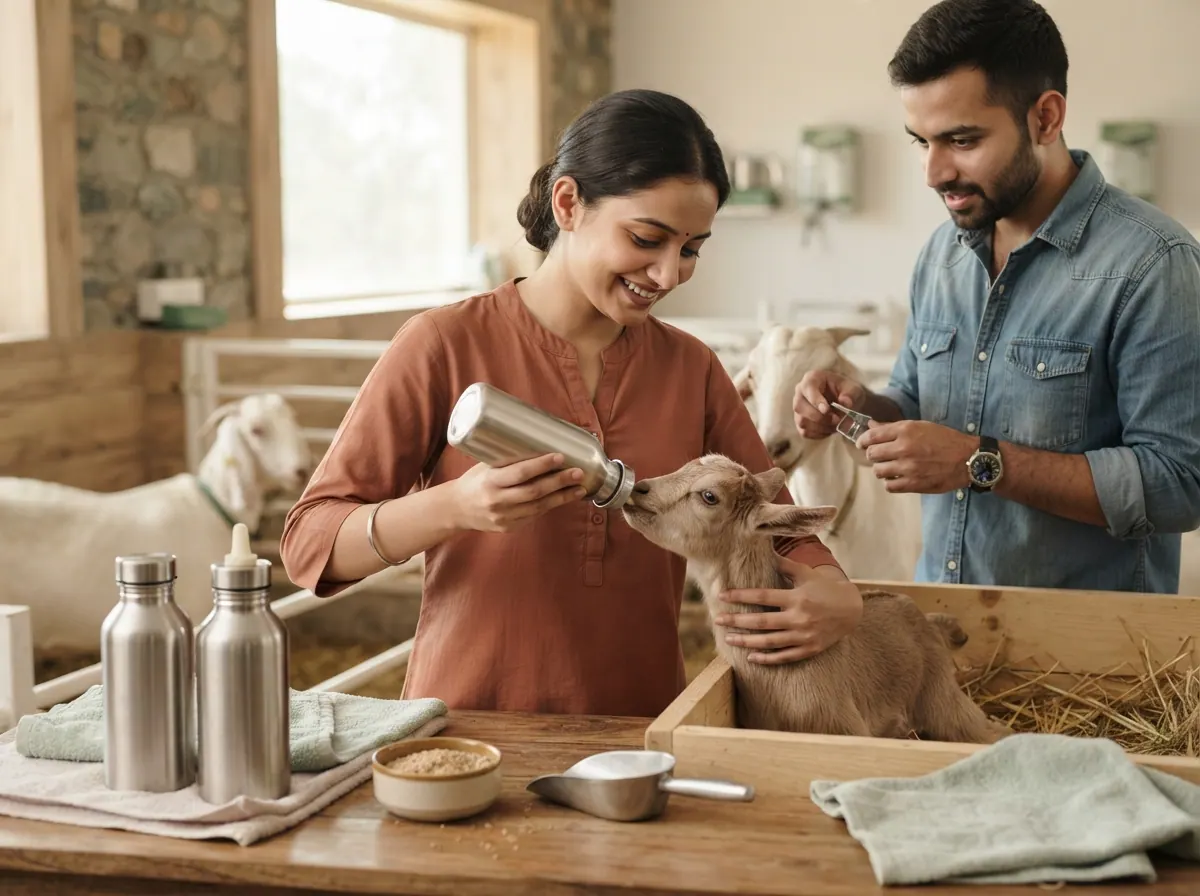
- Bottle-feed it yourself: Milk and sleepless nights
- Try it on another doe: Cheap, it may be rejected
You have 25 goats and can still tell them apart. Your insurance form asks for tag numbers.
- Tag and record every goat: Small cost, claims go easier
- Remember them by face: Saves money, weak records
Running it
Your regular butcher offers one price per goat without weighing. You think they are heavier than that.
- Insist on the scale: Better price, a sour buyer
- Accept the offer: Less money, buyer stays happy
A trader offers cash today for your male kids. Bakrid is six weeks away, and they will eat a lot until then.
- Sell to the trader today: Sure money, lower price
- Feed them for Bakrid: More feed, a better market
The yard has turned to mud and several goats are limping. The vet suspects foot rot.
- Fix the yard drainage: Costly, solves the cause
- Treat only the lame goats: Cheap, it may come back
The vet suspects worms and asks to test the droppings. A full round covers every animal.
- Treat the whole herd: Costs more, per vet's advice
- Treat only the thin ones: Cheaper, worms may remain
Groundnut and gram straw prices are rising fast before winter. You have three weeks of stock.
- Stock up today: Big bill, steady growth
- Cut the daily ration: Saves money, lighter kids
The gate was left open and your herd ate part of a neighbour's crop. The farmer is at your door.
- Pay for the crop: Cash gone, peace kept
- Offer manure, not cash: Costs little, farmer may refuse
A nearby orchard owner offers cash for every load of droppings. You were using it on your napier.
- Sell the manure: Extra cash, weaker fodder plot
- Keep it for fodder: No sale, stronger napier
When things go wrong
Three goats are sick and the next village has PPR. A trader is coming tomorrow with cash.
- Isolate, call vet, tell buyers: Costly, your name stays clean
- Sell a batch quickly: Cash now, a big risk
Dogs came under the fence at night. Each of those kids would have sold for thousands.
- Chain-link the whole yard: Big bill, lasting protection
- Keep a guard dog: Cheap, neighbours may complain
The lock was cut and tyre marks lead to the road. Thefts often rise before festival markets.
- File a report, add cameras: Costly, a record and a deterrent
- Just buy a stronger lock: Cheap, you stay exposed
An insured doe died, but the tag was lost and no vet saw the body. The claim is on hold.
- Gather papers and appeal: Effort and fees, a chance
- Drop the claim: Saves fees, lose the payout
Half a delivery of groundnut cake smells musty and has green patches. The dealer will not take it back.
- Throw the bad bags: Lose the money, safer goats
- Use the cleaner top layer: Saves feed, may cause illness
Your biggest buyer owes for the last load and says the rest will come after the festival. They want another load now.
- Cash only from now on: Safer money, fewer sales
- Give one more load: More owed, buyer stays
Growing
New farmers offer a good price for breeding does. Those are also the mothers of your next crop of kids.
- Sell your top does: Good cash, fewer kids later
- Keep them breeding: Feed cost, more kids later
The bank will fund a larger shed. Your vet says you could also keep far more of the kids you already have.
- Build for 30 more does: Heavy loan, more to sell
- Improve the kid pens: Small spend, slower growth
A breeder says the cross gives heavier kids. Your regular buyers know your Sirohi line and may not pay more.
- Buy the Boer-cross buck: Costly, heavier kids maybe
- Stay with your Sirohi line: Small spend, buyers trust it
A city group asks to book goats by WhatsApp and have them delivered. It means advance payments, photos and truck trips.
- Take the bookings: Transport cost, better prices
- Stay with your trader: Easy money, no extra margin
The district office mentions support for breeding units. It needs a project report, and nothing is promised.
- Apply with a CA's help: Fees, cleaner records, no guarantee
- Skip it, use own money: Saves fees, no outside help
Is it right for you?
Goat farming suits you if you already have land, can be on the farm most days, and can wait over a year for real income. It suits you less if you need a monthly salary from day one, or if you dislike dirty, early and night work, because kids do not wait for office hours.
A good test: before spending, work on someone's goat farm for two weeks during kidding. If you still want to do it after those nights, start with 20 does, get kid deaths down, and grow from your own female kids instead of buying more animals.