You cannot simply start a gas agency in India. LPG distributorships are given by the oil companies, so the path is to watch for a vacancy in your area, apply, arrange land for a godown and an office, buy delivery vehicles, and have about ₹5–30 lakh ready. Once appointed, you earn a commission on every cylinder you deliver. The business is steady but slow and carries real safety duties. Profit comes from a large number of regular homes, not from big margins.
All figures here are estimates. Check the oil companies' current terms and local prices before you spend.
How does an agency start?
Indian Oil (Indane), Bharat Petroleum (Bharatgas) and Hindustan Petroleum (HP Gas) publish notices when they want a new distributor in a place. Each notice describes the location, the category of applicant allowed and what you must bring, such as land for a godown and an office and a showroom, and the application fee and conditions. The company then selects applicants through its own process.
Do not pay anyone who promises to get you an agency. Only the oil company can appoint you. If you are not selected, you can try again when the next notice comes.
What does it cost?
These are rough heads, because the company sets its own conditions for each vacancy:
| Item | Estimate |
|---|---|
| Land or rent deposit for godown and office | ₹2–10 lakh |
| Godown construction or fit-out to safety norms | ₹2–8 lakh |
| Delivery vehicles (small trucks or three-wheelers), used or new | ₹1.5–6 lakh |
| Deposit or security with the oil company, where asked | ₹1–5 lakh |
| Fire safety, scales, office and computer | ₹50,000–2 lakh |
| Registration, licence fees and paperwork | ₹20,000–1 lakh |
| Money for staff and running costs in the first months | ₹1–3 lakh |
| Total | about ₹5–30 lakh |
The land and godown are usually the biggest items. Ask the company early what it will check, and plan the godown with that in mind.
How much can it earn?
An agency earns a commission per cylinder, which the oil company sets and changes. The numbers below use an assumed commission only to show the arithmetic. Replace them with the company's real terms.
Income
- 2,000 domestic cylinders a month × assumed ₹60 = ₹1,20,000
- Stoves, regulators, hoses and accessories = ₹15,000
- Total = ₹1,35,000
Costs
- Godown and office rent = ₹20,000
- Three delivery staff = ₹36,000
- Two office staff = ₹24,000
- Vehicle fuel and repairs = ₹20,000
- Power, insurance and phone = ₹6,000
- Small things = ₹5,000
- Total = ₹1,11,000
Left over: ₹1,35,000 − ₹1,11,000 = ₹24,000 a month, and this has to pay you as well. The answer changes a lot if the real commission is higher or lower, or if customers per delivery route are fewer.
Margins are thin and the biggest cost is staff and vehicle. Number of cylinders per delivery trip decides whether you make money.
What do you need before you start?
- Land that meets the company's conditions. Godown distance from homes and road width are checked. Ask the company before buying land.
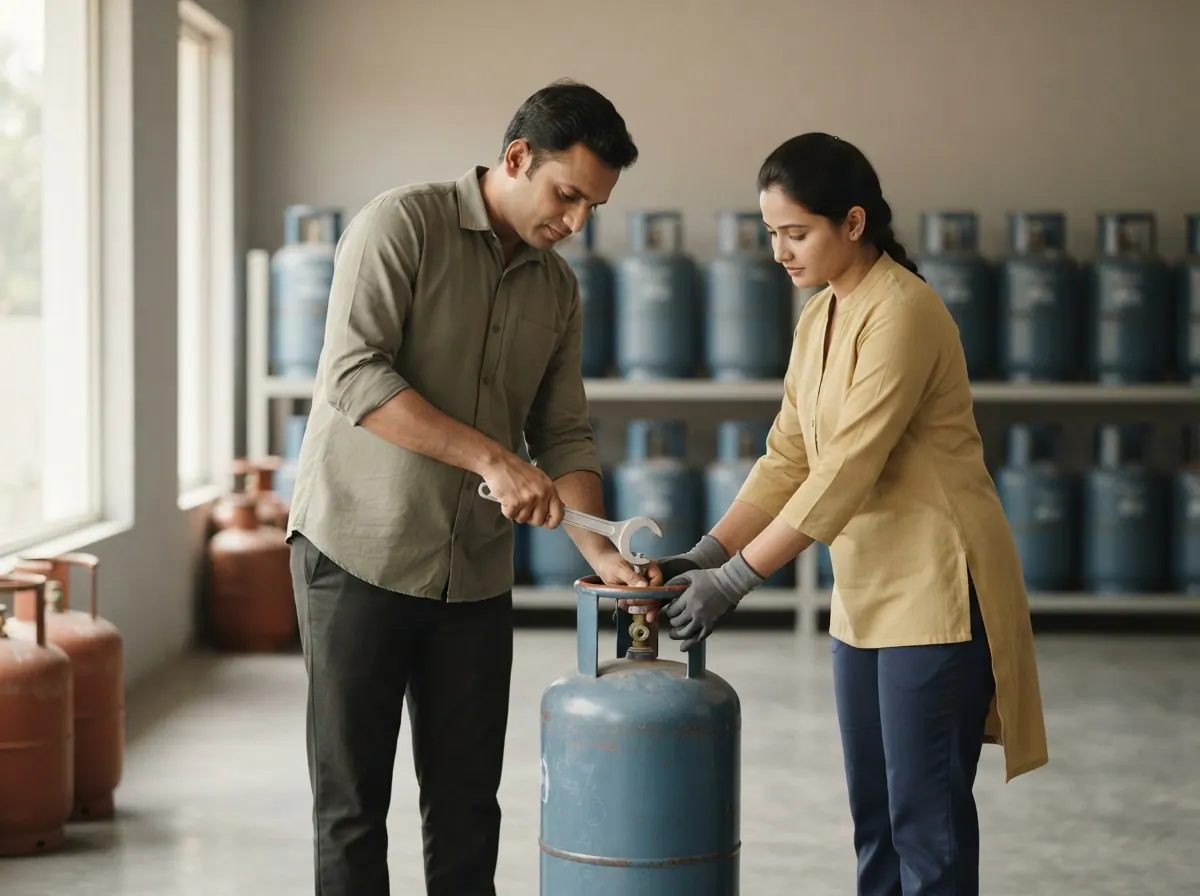
- A safety-first godown. Proper ventilation, clear space, fire extinguishers, and no sources of sparks. Cylinders should be stored upright.
- Delivery staff you can trust. They enter customers' kitchens. Each one must know how to check the seal and the connection and what to do if gas smells.
- A simple system for bookings. Customers book by phone, app and IVR. You must record each delivery and cash or digital payment.
- A solid understanding of rules. Cylinders, weights and delivery times are checked by the company and local officers.
Step by step
- Watch the company websites for vacancy notices in your area, and read the full conditions.
- Check your land or the plot you can arrange against the conditions before applying.
- Prepare the application papers with a CA. Keep your finance proof ready.
- If selected, build or rent the godown and get the safety checks and licences the company and local office tell you about.
- Hire and train delivery staff, and teach them safety checks.
- Take over the customer list and start delivery. Keep a record of every cylinder in and out.
- Deliver on the promised day. Delays and short deliveries bring complaints to the company.
- Check the weight and seal of every cylinder before it leaves.
- Add accessories and commercial customers such as hotels and canteens once home delivery runs smoothly.
Which licences apply?
- Safety licence for storing gas cylinders. Storage of LPG is controlled. Ask the oil company and your local office which licence and which authority apply to your godown, and how long it takes.
- Fire and building clearances for the godown, from local authorities.
- Shops and Establishments registration and a local trade licence where asked.
- GST depends on your turnover and the nature of your sales. Ask a CA.
- Appointment papers from the oil company, which carry their own conditions.
Confirm all of this with the oil company, your local office or a CA, since rules vary by state.
What goes wrong?
- Cylinders with a leak or damaged seal. One leak in a home can become a fire. Check every cylinder before delivery.
- Delivery delays. In festival weeks everyone books at once. Missed deliveries bring complaints and attention from officers.
- Staff overcharging customers. A delivery boy asks extra for "tips" and the complaint comes to your office.
- Cylinders going missing. Count empties and fulls every day. Unaccounted cylinders become a big loss.
- Illegal refilling and black marketing. Selling gas outside the system is dangerous and can end your agency.
- Vehicle breakdowns and fuel costs. A truck off the road for a week slows the whole route.
- Godown inspection failures. Blocked exits, no extinguishers or wrong storage can lead to a notice.
Situations you will face
What would you do? Each choice costs something.
Getting started
One plot is on a wide road far from homes but far from customers. The other is close to town on a narrow lane.
- Take the plot on the wide road: Meets rules, longer rides
- Take a mid-size plot: Moderate cost, meets the rules
The man says they know an officer and can fix your selection for ₹5 lakh. Nothing is in writing.
- Refuse and apply directly: No fee, no promise
- Ask the company office to verify: Small cost, the real route
Three-wheelers are cheaper and reach narrow lanes. Small trucks carry more cylinders per trip.
- Buy three-wheelers: Cheaper, smaller loads
- Buy a small truck: Costly, more per trip
The inspector expects extinguishers, clear exits and no-smoking boards. A full set costs a fair amount.
- Buy the full safety set: Costs money, passes the check
- Buy extinguishers and sand buckets: Cheaper now, rest within a month
Your delivery boys will enter kitchens. A two-day training costs pay time and a trainer's fee.
- Hold the training: Costs time, safer homes
- Hold a short briefing: Small cost, some safety training
A road-facing office is easy to find but costs more rent. A back-lane office is cheap.
- Rent on the main road: Visible, higher rent
- Use the back-lane office: Cheap, hard to find
The list you take over has duplicate names and wrong addresses. Cleaning it takes weeks of calls.
- Verify every customer: Time and pay, fewer failed trips
- Deliver as the list says: Saves effort, wasted trips
First month
Your delivery boy sniffs a leak before entering a customer's kitchen. The cylinder is already on the truck.
- Return it, send a fresh one: Delay and cost, safe home
- Hold it, report to the company: Slower, proper record kept
Everyone books at once before the festival. Your three delivery boys cannot clear the backlog.
- Hire two extra riders: Costs pay, on-time delivery
- Ask customers to wait: No cost, complaints rise
Two customers say your delivery boy asked for ₹50 over the price. The boy says it was a tip.
- Warn the staff and refund: Costs money, builds trust
- Display a rate card, warn staff: Small cost, fewer complaints
Your evening count is four cylinders short against the delivery book. Nobody can explain it.
- Check every route and book: Takes a night, finds the gap
- Report the gap, recount next week: Slower, honest record
Many customers call at odd hours and the office phone is always busy.
- Add a booking assistant: Costs pay, fewer missed calls
- Keep phone-only booking: Free, calls missed
A boy carrying a cylinder to the fourth floor slips and strains their back. They cannot work for ten days.
- Pay treatment and wages: Costs money, loyal team
- Pay treatment only: Less cost, staff lose trust
Running it
Apartment customers on the fifth floor with no lift ask for delivery up to the door. It takes triple the time.
- Deliver to the door for a fee: Extra pay, happy customers
- Deliver to the ground floor: Quick, complaints
A restaurant wants 40 commercial cylinders a month and asks for 45 days credit.
- Supply with 15 days credit: Good order, some risk
- Insist on cash: No risk, may lose the order
A small truck is off the road for a week. Its route has 400 homes waiting.
- Hire a vehicle for the week: Costs money, keeps schedule
- Stretch the other vehicles: Free, late deliveries
Customers keep asking for new stoves and hoses. You can stock them for a small margin but need shelf space and cash.
- Stock accessories: Small extra income
- Stay with cylinders: Simple, no extra income
An officer checks your godown, stock register and scale. Your register has small gaps.
- Fix the register and scale now: Time and cost, clean record
- Explain and promise to fix: No cost, a warning note
Two low-lying colonies are waterlogged for three days. Vehicles cannot enter.
- Deliver on foot with extra staff: Costs pay, customers served
- Wait for water to drop: Free, complaints
Rent goes up 12% from next month. A cheaper office is further away from customers.
- Pay the higher rent: Higher cost, same office
- Move to a cheaper office: Saves rent, harder to reach
They know every route and every customer and have a job offer from a bigger agency.
- Give a ₹2,500 raise: Higher cost, they stay
- Let go, train a new boy: Saves pay, routes suffer
A long weekend left 300 bookings unserved. Customers are calling the company's helpline.
- Run a Sunday delivery shift: Extra pay, backlog cleared
- Clear it over the week: No cost, more complaints
When things go wrong
A man wants to buy ten full cylinders a week at double price, off the books. Your commission is thin.
- Refuse and tell the company: No extra money, clean record
- Refuse quietly, avoid the man: No effort, may try others
Six full cylinders are gone overnight. There was no night guard and the gate lock was old.
- Hire a guard and fix the gate: Monthly cost, safe godown
- Just add a new lock: Cheap, theft may repeat
A customer says delivery took ten days and files a complaint. The company asks you to explain.
- Own up and fix the route: Costs effort, builds trust
- Apologise, promise a callback: No fix yet, complaint stays open
A neighbour burns rubbish ten metres from your stacked cylinders. It is put out, but everyone is shaken.
- Add a wall and drill your staff: Costs money, safer godown
- Clear the area, watch for fire: Small cost, lower fire risk
A customer weighs the cylinder at home and finds it lighter than marked. The customer posts about it.
- Replace and check your scale: Costs a cylinder, trust kept
- Weigh it in front of them: Small cost, honest check
Growing
Another town nearby has customers with no agency within 20 km. A branch needs a second godown and staff.
- Set up a branch: Big spend, more cylinders
- Improve your own routes: Safer, slower growth
Canteens and hotels in town want a regular commercial supply. It means more vehicles and a proper credit policy.
- Build a commercial route: Better income, tied-up cash
- Stay with homes: Simple, smaller income
You can run a free kitchen safety day with the fire service for customers. It costs staff time and some money.
- Hold the safety day: Costs money, builds trust
- Skip it: No cost, no goodwill
Is it right for you?
A gas agency suits you if you are comfortable with rules and records, can manage a team of delivery staff, and take safety seriously every day. It also helps to have land or the means to get it, because that is the first thing the company looks at.
It suits you less if you want fast money. The commission is modest, selection is not in your control, and the work is daily. Try this first: talk to an existing distributor in your area, ride along on a delivery route for a day, and ask what takes most of their time and money.