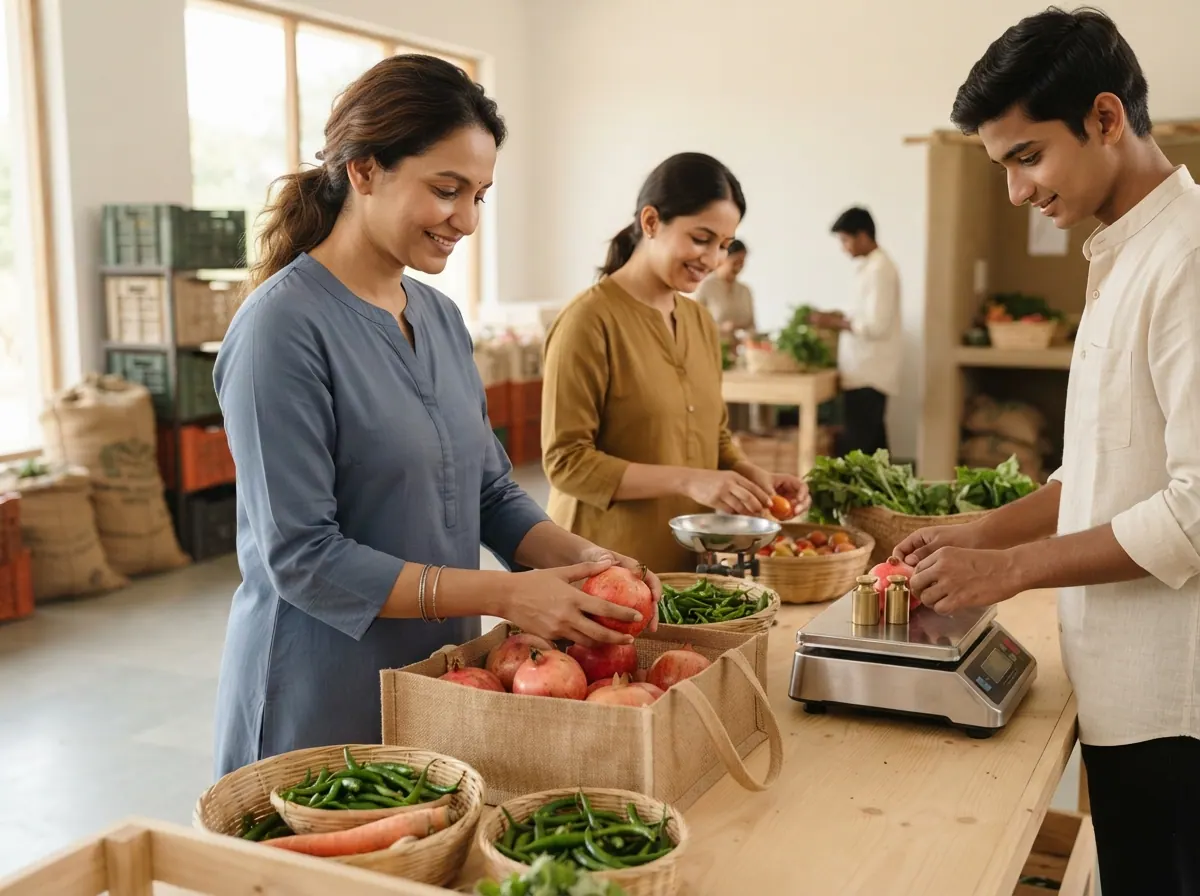
An FPO that collects produce from farmer members and sells it in bulk can start with about ₹2–15 lakh, most of it as money to buy the first lots. You also need a registered producer company, a group of committed members, a place to weigh and store produce, an accountant, and buyers who will take your grade of produce. The profit is a small margin per kilo, so volume and honest records matter more than a big building.
All figures here are estimates. Check prices near you before you spend.
What does it cost?
This is a rough picture for a small FPO of a few hundred farmers buying and selling one or two crops, such as pulses, maize or soybean.
| Item | Estimated cost |
|---|---|
| Company registration, CA or company secretary fees | ₹30,000–80,000 |
| Small office, computer, furniture | ₹40,000–1.2 lakh |
| Weighing scale, moisture meter, bags, tarpaulins | ₹40,000–1.5 lakh |
| First godown rent deposit | ₹20,000–60,000 |
| Member meetings and basic training | ₹20,000–50,000 |
| Money to buy the first lots | ₹70,000–10 lakh |
| Total | about ₹2–15 lakh |
The first lots decide how far you can go. If you buy 50 tonnes of pulses at ₹40 a kilo, that is ₹20 lakh of stock, and you will not have that in the first year. Start with a smaller crop volume and rotate the money quickly.
How does an FPO actually earn?
- Aggregation and bulk sale. You collect produce, clean and grade it, and sell it to a mill, processor, trader or institution at a better price than each farmer would get alone. Your earning is the gap, after costs.
- Input supply. Seed, fertiliser, and equipment sold to members. This needs the right licences, and a margin kept small so members stay.
- Services. Machine hire, grading and packing, or storage for a fee.
Most new FPOs earn from the first one, then add the others once accounts are steady.
How much can it earn?
Take a small FPO handling 50 tonnes of pulses a month in the buying season, with a margin of about ₹2.5 a kilo after sale.
Monthly income
- 50 tonnes = 50,000 kg
- 50,000 × ₹2.5 = ₹1,25,000
Monthly costs
- CEO or manager: ₹25,000
- Accountant and helper: ₹18,000
- Godown rent: ₹15,000
- Loading, bags and weighing: ₹10,000
- Audit, filing and office: ₹10,000
- Interest on working money, about ₹10 lakh at 12%: ₹10,000
- Total = ₹88,000
Left over: ₹1,25,000 − ₹88,000 = about ₹37,000 a month, only in months when you are buying and selling.
Many FPOs trade for only five to eight months a year. If your lean months have fixed salaries and rent but little trading, the year's profit shrinks quickly. That is why many FPOs also add services or inputs.
What do you need before you start?
- Members who will sell to you. A list of farmers is not enough. You need people who promise their produce and keep that promise even when the trader pays more one day.
- A manager you trust, ideally someone who understands accounts and can speak to buyers.
- A buyer before you buy. Talk to millers, processors and mandi agents about grade, moisture and price.
- Clean accounts. Every purchase and payment recorded, with receipts.
Step by step
- Gather founding members and choose the crop or crops your area grows well.
- Pick a promoting agency or consultant who has registered a producer company before, and ask to see their other FPOs.
- Register the producer company with the needed papers, directors and share capital, using a professional. Rules and forms change.
- Open a bank account and get PAN, GST and any needed registration.
- Set grade and moisture rules so every member knows what you will accept, and display them.
- Start small: one crop, one buyer, one season. Pay members promptly and keep the receipts.
- Review at the end of the season with members: what was bought, sold, spent and left.
Which licences apply?
Confirm each with the right office, because rules change:
- Producer company registration under the Companies Act, with annual filings and audit.
- GST registration where required, and PAN and a bank account in the company's name.
- Seed, fertiliser or pesticide licences if you plan to sell them. Ask the district agriculture office.
- FSSAI if you pack or process food. Ask the food safety office.
- Mandi licence or trader permission where your state requires a licence to buy and sell notified crops. Ask the local market committee.
- Support and loans. There are central and state schemes and bank credit meant for FPOs. Do not plan around one until the district office confirms it for you.
What goes wrong?
- Not enough working money. When a farmer wants cash on delivery and you have no money, they go to the trader.
- Members sell outside. The local trader pays a rupee more on a bad day, and your volume vanishes.
- One person runs everything. If they leave or make a mistake, the FPO stops. Share the work and keep records open to the board.
- Quality disputes. A buyer rejects a lot for moisture or stones, and you must decide who bears the loss.
- Delayed payments from buyers. You paid farmers in cash, but the buyer pays in thirty days.
- Grants not matched by business. Money for a godown or machine comes, but there is no regular produce to fill it.
Situations you will face
What would you do? Each choice costs something.
Getting started
Your members grow soybean, chana and maize. You can only afford to buy one crop well in the first season.
- Start with chana: Easy to store, price swings
- Start with maize: Bulky, quick resale, thin margin
An agency offers to register the company and train members, but its fee is high. A local CA charges less for registration only.
- Hire the agency: Costly, guidance and contacts
- Use the local CA: Cheaper, you handle the rest
Forty farmers say they will sell to you. Nobody wants to sign a paper about quantity.
- Ask for a simple signed note: Some drop out, real numbers
- Trust their word: More names, shaky volume
A dry godown near the road costs rent. A free shed from a member leaks in the monsoon.
- Rent the dry godown: Monthly rent, safe stock
- Use the free shed: No rent, damp risk
Buyers reject grain that is too damp. A meter costs money but lets you check at the gate.
- Buy a proper meter: Small cost, fewer rejections
- Judge by hand: Free, rejections later
Two directors want to buy at a higher price than you can sell. One wants to wait for cash.
- Buy at a fair price only: Fewer lots, no loss
- Pay more to win members: More volume, thin margin
Farmers are bringing more chana than you have cash for. A bank loan will take a month to come.
- Take a trader's advance: Quick cash, the trader sets the price
- Buy only what you can pay: Slower, farmers go elsewhere
First month
A dal mill offers a price that leaves you almost no margin, but the mill will take everything you have.
- Accept the sale: Clears stock, thin margin
- Hold stock for a better rate: Interest and storage cost
A truck of maize comes back. The buyer says moisture is too high. Who takes the loss?
- Dry it and resell: Labour cost, member trusts you
- Pass the loss to the farmer: No cost, the farmer stops selling
A member needs money for a daughter's school fees and asks you to pay at the gate. Normally you pay in three days.
- Pay the member today: Costs cash flow, builds loyalty
- Keep the three-day rule: Stays safe, the member may go
Running it
The mandi trader pays one rupee a kilo more than you, just for a week, to pull members away.
- Match the trader for the week: Cuts margin, keeps volume
- Hold your price: Keep margin, lose some lots
Members want you to supply seed and fertiliser at a fair price. You do not yet hold the licence.
- Apply for the licence first: Fee and delay, legal sales
- Skip it for this season: No cost, members buy elsewhere
Members want to know where the money went. You made a small profit but need working capital.
- Share a small dividend: Costs cash, members stay
- Keep it for working capital: Better cash, quiet members
Members like cash. Paying by bank transfer gives you clean records but some farmers complain.
- Pay by bank transfer: Clean records, some grumbling
- Keep cash payments: Easy for farmers, weak records
A fire last month at a nearby godown scared members. Stock insurance costs a yearly premium.
- Insure the stock: Yearly premium, safer
- Skip the cover: Saves money, big risk
When things go wrong
A large buyer takes your goods and pays after forty days. You paid farmers in three.
- Borrow to bridge the gap: Interest cost, steady buying
- Pause buying for a few weeks: No interest, members upset
Your register shows 4 tonnes more than the godown holds. The accountant is new.
- Do a full stock count: Costs two days, clear picture
- Flag the gap, ask the auditor: Slower, the problem is shown openly
An early rain gets through the godown roof and wets the bottom row of bags.
- Dry and sell as lower grade: Labour cost, a lower price
- Fix the roof and move stock: Costly now, safe later
Your accountant missed a monthly return. A notice has come with a small late fee.
- File and pay the fee: Small fee, cleaner records
- Hire a CA to fix everything: Costly, set right for the year
You bought chana at a good rate and the mandi price drops by a rupee a kilo before you sell.
- Sell now and take the loss: Cash back, loss booked
- Hold for recovery: Interest cost, price may stay low
One director brings a crop and asks for a better price than other members get.
- Same price for everyone: Fair, director upset
- Give the director the better price: Keeps peace, members notice
Growing
A buyer from another district can bid for your lots through the online mandi if you list them.
- List your lots online: Setup effort, wider buyers
- Stay with local buyers: No effort, limited price
A grader would remove stones and broken grain, and buyers pay more for clean lots. It costs a lot.
- Buy a grading machine: Costly, better price per kilo
- Hire a grader per season: Lower cost, slower work
A shop chain asks for 25 kg packs of cleaned dal with your FPO's name. It needs bags and a small packing line.
- Start packing: Setup cost, better margin
- Keep selling in bulk: Simple, thinner margin
An office says a godown could get part support. You must put in the rest, and the papers take months.
- Apply and build: Big spend, own storage
- Keep renting for now: No big outlay, monthly rent
A processor wants fixed monthly quantity at a fixed rate. If the market rises, you lose that gain.
- Sign the contract: Steady sales, capped price
- Keep spot selling: Higher upside, uncertain
Members want money before sowing and promise to repay in produce. Some defaulted last year.
- Give advance with a signed note: Ties up cash, better supply
- Offer a small advance only: Less risk, less loyalty
An agri graduate offers to run the FPO but asks for a higher salary than your current manager.
- Hire the graduate: Higher pay, better systems
- Train your manager: Cheaper, slower to improve
Rain failed and members will deliver half the usual produce. Your rent and salaries stay the same.
- Trade other crops from nearby: Keeps work going, new risks
- Cut costs and wait: Saves money, slow year
A solvent plant offers a steady price for soybean in the season. You have only handled pulses so far.
- Add soybean this season: More volume, new risks
- Stay with pulses: Known trade, limited growth
Is it right for you?
An FPO suits you if you can bring farmers together, keep accounts honest and wait a few seasons before it is steady. It suits you less if you want quick personal profit, or if you do not want to answer to a board of farmers.
A good test: before registering, do one season of group selling with fifty farmers on one crop, using a simple notebook and receipts. If members trust the numbers and come back the next season, you are ready to register and grow.