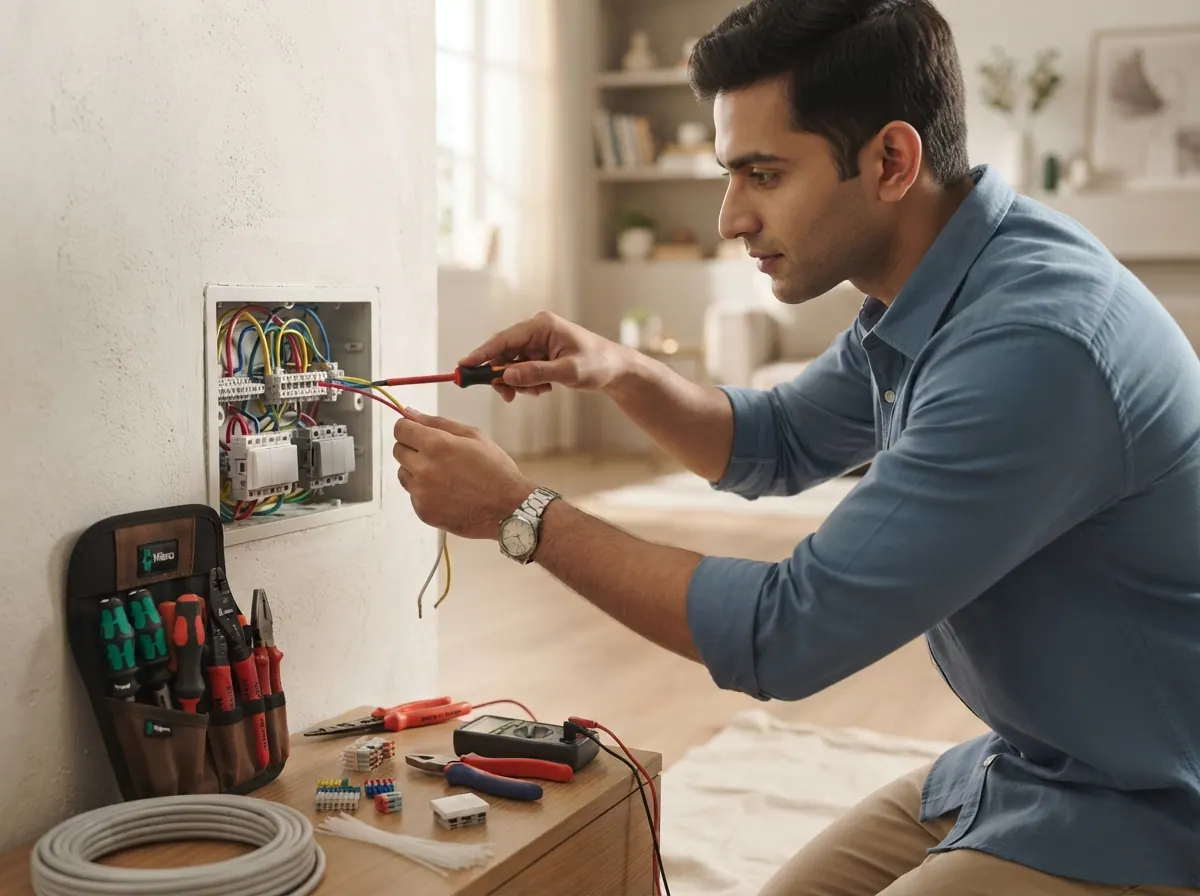
To start an electrician business in India you need proper training, a tool kit, a phone and a two-wheeler, a few steady sources of work, and about ₹20,000–2 lakh. An electrician who already owns hand tools can start with a few thousand rupees and add as jobs come. Money comes from small repair jobs every week and wiring projects now and then. It is lost on bad wire, call-backs, unpaid bills and shortcuts that become fire or shock accidents.
All figures here are estimates. Check prices near you before you spend.
What does it cost?
For a home-based electrician working alone with one helper later:
| Item | Estimate |
|---|---|
| Tool kit: drill machine, wire cutter, crimper, tester, multimeter, ladder | ₹8,000–40,000 |
| First stock of wire, switches, MCBs, holders, tape | ₹3,000–50,000 |
| Safety items: insulated gloves, shoes, proper tester | ₹1,000–5,000 |
| Cards, uniform, phone listing | ₹1,000–5,000 |
| Wireman course, exam and licence fees | ₹2,000–25,000 |
| Money for slow early weeks | ₹5,000–75,000 |
| Total | about ₹20,000–2 lakh |
Most of the range depends on whether you hold stock or take material on credit from your shop. Many electricians buy material only after the customer approves it, which keeps cash free.
How much can it earn?
A normal month for a small electrician with one helper:
Income
- 80 small jobs (fan, switch, MCB, geyser point) × about ₹400 labour = ₹32,000
- One wiring job in a flat: labour about ₹30,000
- Margin on material you supply = ₹8,000
- Total = ₹70,000
Costs
- Helper = ₹12,000
- Petrol and travel = ₹6,000
- Tool replacement = ₹3,000
- Phone, listing, cards = ₹2,000
- Small items and returns = ₹3,000
- Total = ₹26,000
Left over: ₹70,000 − ₹26,000 = ₹44,000 a month, and this has to pay you as well.
Work is uneven. A month with no wiring job looks much smaller, while summer fans and AC points and wedding season decoration lighting bring a rush. Big jobs usually bring a part payment first, which helps cash flow.
What do you need before you start?
- Real training. If you learned as a helper under a master, you know the rules of the trade. If not, take an ITI course or work under someone for at least a year before you take wiring jobs.
- A tester you trust. A cheap neon tester can mislead you. A good tester and a multimeter are not places to save money.
- A neat way of working. Customers remember straight conduits, labelled MCBs and a clean floor.
- A friendly electrical shop. The shop gives you material on credit, advises on brands and often passes you customers.
- A phone with a list. Record each job, address and date. Many calls come back after a year.
Step by step
- Spend time with a trained electrician and note how they plan a job, measure, quote and clean up.
- Buy a basic tool kit and a good tester. Add machines as bigger jobs come.
- Tell your own circle: apartment secretaries, neighbours, plumbers, painters and carpenters.
- Visit nearby electrical shops and ask what brands of wire and MCB they trust.
- Quote with a written note. List the points, wire length, brand and price. Take advance for material.
- Test every circuit before you leave and show the customer.
- Leave a card and warranty note on the DB box.
- Ask for a Google review after a good job. A listing with reviews brings more calls than a banner.
Which licences apply?
- Wireman permit and electrical contractor licence. State electrical licensing boards issue these, and the exams and eligibility differ by state. Ask your state electrical inspectorate or licensing board.
- Udyam registration is free and helps if you later go for contracts or loans.
- GST depends on your turnover and whether you supply material. Ask a CA.
- Insurance. Some electricians take simple accident cover. Ask an insurance agent about your case.
Confirm all of this with the licensing office, since rules vary by state.
What goes wrong?
- Loose connections. A poorly tightened joint heats up and burns an MCB months later. Tighten and test every joint.
- Cheap wire. A customer pushes for lower cost, and you use a thin or unbranded wire. A fire or call-back follows. Use the right gauge for every load.
- No earthing. Skipping earthing on a geyser or AC point is a hazard. Do not skip it, whatever the customer says.
- Overloaded points. Putting an AC and geyser on one old circuit trips the MCB all summer. Plan the load.
- Unpaid balance. A customer promises to pay after the work is checked and then does not answer. Take advance, and a part payment at each stage.
- Working at height without help. Falls from ladders are common. Have someone hold the ladder.
- Rain and old buildings. Wet walls and damaged wiring make a simple job dangerous. Turn off the main supply and check first.
Situations you will face
What would you do? Each choice costs something.
Getting started
A ₹80 neon tester shows live wires most of the time. A proper tester and multimeter cost ₹2,500.
- Buy a good tester set: Costs now, safer checks
- Buy a mid-range tester: Moderate cost, reliable checks
A hammer drill makes chasing and fixing quick, but costs ₹6,000. A hand chisel is slow and tiring.
- Buy the hammer drill: Faster jobs, upfront cost
- Borrow or chisel by hand: No spend, slow work
The shop owner will give wire and MCBs on 30 days credit if you buy only the shop's brands.
- Take the credit: Keeps cash, limits brands
- Buy cash from many shops: Free choice, uses your cash
The secretary will add you to the society list if you do a free safety check of the common area.
- Do the free safety check: Costs a day, steady calls
- Quote for paid check only: No free work, may be refused
A 2BHK owner wants a rewire. Writing a detailed quote takes a day; a rough rate is quick but may be wrong.
- Give a point-wise written quote: Slower, fewer disputes
- Quote a lump sum by eye: Quick, risk of loss
The course takes weeks and costs money. It lets you take larger wiring work with proper papers.
- Join the course: Time and fees, bigger jobs later
- Keep taking small jobs: Earn now, limited work
A young helper offers to carry the ladder and drill. A fixed wage is a cost even in slow weeks.
- Hire the helper on a wage: More jobs per day, fixed cost
- Pay the helper per job: Flexible, the helper may leave
First month
Two weeks after your job, the customer says the AC point sparks. A loose joint you tightened by hand may be the cause.
- Visit, redo the joint free: Costs time, saves trust
- Send a helper to retighten it: Costs a trip, the danger is removed
The owner says 1.5 sq mm is fine for the AC point. You know the load needs a thicker wire.
- Insist on the right gauge: Costs more, safe
- Walk away from the job: Lose the work, keep standards
An old ceiling fan hums and runs slow. A new capacitor costs ₹60; a fan costs ₹2,000.
- Change the capacitor: Cheap repair, may fail again
- Advise a new fan: Costs the customer, trust grows
A customer wants you to buy ₹15,000 of wire and switches first and pay at the end.
- Ask for half in advance: Protects cash, the customer may hesitate
- Buy it on your own: Customer happy, you carry risk
Running it
At 10 pm a family says all lights are out. It is a fault you may fix in an hour or it may be the whole DB.
- Go and charge a night fee: Extra income, lost sleep
- Offer to come at 8 am: Rest, but they may call another
Everyone wants AC power points installed in one week. You can take them all or cap your day.
- Hire a temporary helper: Extra pay, more work done
- Cap at three jobs a day: Neat work, some customers lost
A family wants temporary lighting and generator points for a wedding at home. The job is big but the days are short.
- Take the job with advance: Good income, tight timing
- Decline, stay with usual work: Calm, lose the money
A plumber will send you geyser and motor jobs if you pass the plumber a share of each bill.
- Agree to a small share: Steady leads, thinner profit
- Swap leads, no money: Free but slower
Many customers want an inverter fitted before summer. Doing it right means learning battery sizing.
- Learn and offer inverter work: Time and some cost, new income
- Refer it to the shop: Simple, no new income
Several customers say they will UPI later and forget. You spend evenings chasing small amounts.
- Take payment at the door: Slight friction, cash in hand
- Send reminders at night: Polite, slow
When things go wrong
After a full flat rewiring, the owner keeps promising payment next week. You have waited five weeks.
- Send a notice, stop visits: Firm, may lose the money
- Keep calling politely: Gentle, cash stays stuck
A tenant's room had a short circuit, and the landlord blames your earlier job. You used the right wire.
- Inspect free, show your work: Costs time, clears you
- Reply in writing with photos: Free, clears your name slowly
No one holds the ladder on a roof job. The helper has a sprain and cannot work for a week.
- Pay treatment and wages: Costs money, the helper stays loyal
- Pay treatment, hire a temporary helper: Costs both, the helper is cared for
A batch of MCBs from your usual shop has no clear marking. You have already fitted two.
- Replace them with branded ones: Costly, safe homes
- Stop using it, wait for stock: Slow, two jobs delayed
A customer shows you a rival's rate for the same wiring job. It is clear the rival will use cheaper wire.
- Match the rate with thin margin: Win the job, little profit
- Explain your quality, keep price: May lose, builds trust
Someone took your tool bag from the bike while you were inside a flat. Without tools, work stops.
- Rebuy the full kit now: High cost, back to work fast
- Buy essentials and borrow: Cheaper, slower for weeks
Growing
Young owners want smart switches and wifi fittings. They cost more and need training.
- Learn and stock a few: Costs stock, higher-value jobs
- Stay with regular work: No spend, miss new jobs
A contractor offers you wiring for three flats, with payment in stages and a close schedule.
- Take all three flats: Big income, tight timing
- Take one flat to test: Safer, smaller income
You get more calls than you can attend. A second electrician can work under your name.
- Hire a second electrician: More jobs, quality risk
- Raise your rates instead: Fewer jobs, higher pay
Shops and clinics will pay a fixed yearly fee if you visit every three months and attend breakdowns.
- Offer AMC plans: Steady money, fixed duty
- Charge per call only: Free of duty, uneven income
A shop owner wants a GST invoice for a wiring job. You are not registered.
- Ask a CA and register: Fee and paperwork
- Decline the business job: Keep simple, lose business jobs
A few owners ask you to connect rooftop solar. It needs approvals and training you do not have.
- Tie up with a solar installer: Referral money, shared work
- Skip solar work: No risk, no new income
Your materials fill your home. A small rented room costs monthly but keeps stock neat and ready.
- Rent a store room: Monthly cost, faster jobs
- Keep stock at home: No rent, family complains
Is it right for you?
Electrical work suits you if you are careful, patient with details, and honest about what is safe. It helps to explain faults in plain words, and to say no to a job when the wiring is beyond repair.
It suits you less if you hate being called at odd hours or dislike climbing ladders, working in heat and crawling into tight spaces. Try this first: work for three months as a helper under a trained electrician, then take small jobs from your own society before you go full time.