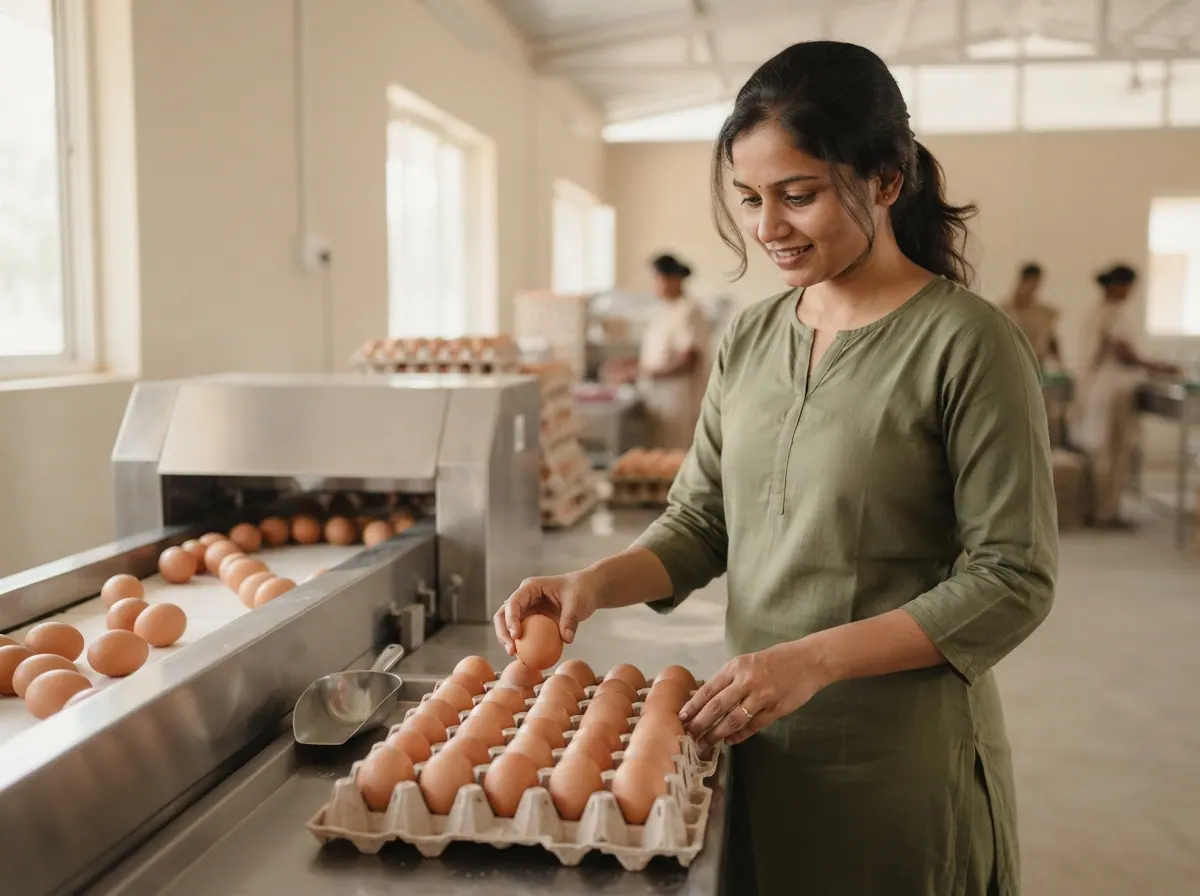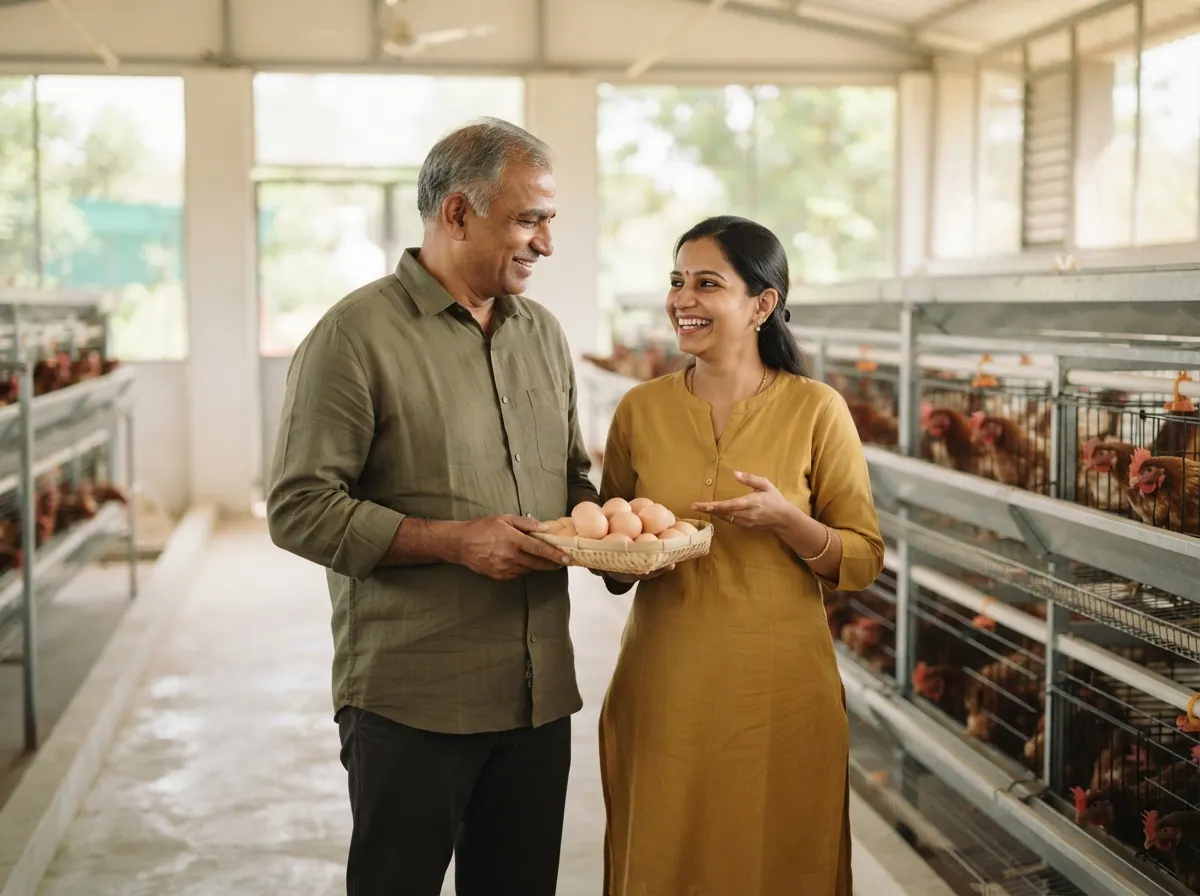
To start an egg farm in India you need a ventilated shed with cages or deep litter, healthy layer birds from a good supplier, a steady feed source, a vaccination plan, and about ₹3.5–5.5 lakh for 500 layers, or ₹13.5–22 lakh for 2,000 layers in cages. That is on land you already have. An egg farm earns every day, but the margin on each egg is thin, so a few bad weeks can eat months of profit.
All figures here are estimates. Check prices near you before you spend.
What does it cost?
| Item | 500 layers | 2,000 layers |
|---|---|---|
| Point-of-lay pullets (about ₹250–350 each) | ₹1.25–1.75 lakh | ₹5–7 lakh |
| Shed with roof, floor and curtains | ₹80,000–1.3 lakh | ₹3–5 lakh |
| Cages | ₹50,000–90,000 | ₹2–3.5 lakh |
| Feeders, drinkers, water tank | ₹25,000–45,000 | ₹1–1.6 lakh |
| Feed reserve for the first month or two | ₹30,000–45,000 | ₹1.2–1.8 lakh |
| Vaccines and medicines | ₹10,000–20,000 | ₹40,000–80,000 |
| Egg trays, scale and crates | ₹10,000–20,000 | ₹30,000–60,000 |
| Power, fans and generator | ₹20,000–40,000 | ₹80,000–1.5 lakh |
| Total | about ₹3.5–5.5 lakh | about ₹13.5–22 lakh |
If you buy day-old chicks, the bird cost is much lower, but you must feed and care for them for about 18 weeks with no income. Use deep litter, a floor system with straw or husk, if you want to spend less on cages, but expect more dirty eggs and more disease risk.
What do you keep?
- White Leghorn type layers: the common commercial birds. They give many eggs on less feed and are what most egg traders handle.
- Brown egg layers: fetch a better price in some cities, but check that your buyers want brown eggs.
- Desi or country hens: fewer eggs, but a higher rate where buyers want them. This is a different business, with small flocks and a niche market.
Ask your supplier for the breed, the age and the vaccination record on the day you buy.
How much can it earn?
Here is a settled farm with 2,000 layers laying well, in a normal month.
Eggs sold in a month
- 2,000 birds laying at about 90% = 1,800 eggs a day
- Lose about 2% to cracks and dirty eggs: 1,764 eggs a day
- 1,764 × 30 days = about 52,900 eggs
- 52,900 eggs × about ₹5.5 each = about ₹2,91,000
Costs each month
- Feed: 2,000 birds × about 115 g × 30 days = about 6,900 kg × ₹31 (layer feed was ₹30–32 a kg in 2026) = about ₹2,13,900
- Two workers = ₹24,000
- Vaccines and medicine = ₹8,000
- Power and water = ₹8,000
- Trays, transport and small repairs = ₹10,000
- Other = ₹5,000
- Cost of the birds spread over about 14 months of laying (₹6 lakh bought, about ₹3 lakh when sold as spent hens) = about ₹21,000
- Total = about ₹2,89,900
Left over: ₹2,91,000 − ₹2,89,900 = about ₹1,100 a month.
A change of 50 paise per egg moves this by about ₹26,000 a month, so a bad market can wipe out most of the profit. Feed is about 65–70% of the cost of an egg, so a few rupees on the feed price matters more than anything else. If your family does the work, you keep the ₹24,000 in wages too.
What do you need before you start?
- A feed plan. Maize and soya are the main costs, so know where you buy and when prices usually rise. Some farms mix their own feed with a nutritionist's advice.
- Land away from houses. Smell and flies are the first complaint.
- A buyer before the first egg. Local traders, shops, hostels and bakeries. Many traders refer to the daily egg rates published for your region, so ask them how they set price.
- A vet who knows poultry. Deaths can happen within a day.
- Power backup. Fans and water pumps stop in a cut, and birds suffer fast in heat.
Step by step
- Visit two working layer farms and ask about deaths, feed cost and what they would do differently.
- Build the shed with a high roof, good cross-ventilation, curtains for rain and cold, and a rat-proof floor.
- Buy pullets from a trusted hatchery and check their vaccination record. Do not buy a mixed lot from a trader.
- Follow your vet's vaccination plan for diseases such as Ranikhet (Newcastle disease) and fowl pox, and ask about others in your area.
- Feed at fixed times and keep fresh water at all times. Cut back or change feed only slowly.
- Collect eggs several times a day, clean them and store in a cool place.
- Record daily: eggs, deaths, feed used and rates. A drop in eggs is the first sign of trouble.
- Sell old hens to a buyer when production falls and plan your next batch in advance.
Which licences apply?
Rules vary by state and by size, so confirm locally:
- Panchayat or municipal permission for the shed, and in many states a pollution control board consent for larger farms. A 2021 tribunal order brought farms above 5,000 birds under the national pollution guidelines, but some sources put the consent line at 25,000 birds, so ask your state board.
- Animal husbandry department guidance on registration and disease reporting.
- Food safety (FSSAI): may apply if you grade, pack or sell eggs under your own brand.
- Loans and schemes. Banks give poultry loans and some state and central schemes have supported poultry units. Rules change, so ask your bank and the district office.
- Tax. Ask a CA how egg sales are treated as you grow.
What goes wrong?
- Feed price jumps. Maize price rises hit you straight away, and the egg rate does not always follow.
- Egg rate drops. A glut or a festival season with less meat eating can pull the price below your cost. In 2026 the Namakkal rate fell to ₹4.05 an egg in March and hit a record ₹6.55 in July, while cost rose to nearly ₹5.50.
- Disease in the shed. A sick flock can lose eggs and birds quickly. Vaccination and keeping new birds away from old ones matter.
- Heat. In summer, birds eat less and lay fewer eggs, and some die. Fans, a good roof and cool water help.
- Rats and snakes. They eat feed and carry disease.
- Bird flu news. A disease outbreak in your region can push rates down, even if your birds are fine. Follow instructions from the animal husbandry officers.
- Late payment from traders. Egg money is daily money, so a month of credit hurts.
Situations you will face
What would you do? Each choice costs something.
Getting started
A trader offers pullets well under the hatchery price. They have no vaccination record and the ages look mixed.
- Buy from a hatchery: Costs more, known birds
- Buy the cheap lot: Lower price, disease risk
Chicks cost far less but eat feed for eighteen weeks with no eggs. Pullets lay within weeks but cost much more.
- Buy point-of-lay pullets: Costly, eggs soon
- Rear day-old chicks: Cheaper, long wait for eggs
Cages keep eggs clean and make counting easy. Deep litter costs less to build but gives dirtier eggs.
- Install cages: Higher cost, cleaner eggs
- Use deep litter: Lower cost, more cracks and dirt
The contractor offers a cheaper low roof. Hot air will sit inside in summer.
- Build the high roof: Costs more, cooler birds
- Take the low roof: Saves money, heat stress
Buying maize and soya and mixing saves money in good months. Ready feed is simpler but costs more per kilo.
- Mix your own feed: Cheaper, needs a mixer and advice
- Buy ready feed: Easy, higher bill
One trader pays daily but a low rate. Another offers a higher rate but pays every ten days.
- Take the daily payer: Steady cash, lower rate
- Take the higher rate: Better price, cash gets tight
Fans and water pumps stop in power cuts. A small generator costs a lot but protects birds.
- Buy the generator: Big cost, safer birds
- Rely on the grid: Saves money, summer risk
First month
A poultry vet will plan and give your vaccines for a fee. A neighbour says you can give them yourself.
- Pay the poultry vet: Fee, proper timing
- Do it yourself: Cheaper, mistakes possible
Feed bags are chewed and droppings are near the cages. Rats can carry disease.
- Rat-proof the store: Cost now, safer feed
- Use sealed bait boxes: Safe bait, some cost
Eggs are at 78% instead of 90%. The birds look alert, but the feed was changed last week.
- Go back to the old feed: Small cost, steady recovery
- Wait and watch: No cost, may stay low
Loose handling leaves many eggs cracked by the time they reach the trader. They deduct for every broken one.
- Buy trays and proper crates: Cost now, fewer breaks
- Pack in old baskets: Cheap, more losses
The roof tank has algae and the birds are drinking less. Cleaning takes a half day and some cash.
- Clean and cover the tank: Small cost, healthier birds
- Clean the tank this week: Small cost, birds cope
Flies from the manure heap are bothering the next house. They say they will go to the panchayat.
- Clear manure daily, sell it: Labour cost, peace kept
- Cover manure, talk to neighbours: Small cost, flies reduce
Running it
The mill raises the maize rate sharply after a poor harvest. The egg rate has not moved yet.
- Stock maize now: Big bill, protects feed cost
- Buy as you go: Easy now, pay the rise
Temperatures are near 43 degrees. Eggs are dropping and a few birds have collapsed.
- Add foggers and cool water: Cost and power, birds hold
- Just give extra water: Cheap, eggs may fall
A glut of eggs pulls the rate down. A cold store owner offers to hold your eggs for a week for a fee.
- Pay for cold storage: Fee, wait for a better rate
- Sell at today's rate: No fee, lower price
A bakery wants a fixed supply every day, at a lower rate than the market, but with weekly payment.
- Sign the supply deal: Steady buyer, lower rate
- Sell on the open rate: Better some days, no steady buyer
A big hostel mess wants a month of credit. It would take a large share of your eggs.
- Give two weeks only: Safer, may lose them
- Give the full month: Big buyer, cash tied up
Production is falling in the older batch. A buyer will take them for meat now, but you have no new birds ready.
- Sell old hens, buy new batch: Costly, steady eggs
- Keep them a few more months: Feed cost, fewer eggs
The daily count is lower than the register for a week. A worker may be taking a few eggs, or birds are laying less.
- Count in front of both: Time spent, clears the doubt
- Accuse the worker: Quick, may be unfair
When things go wrong
Several hens are drooping, with green droppings and twisted necks. Eggs have fallen sharply in two days.
- Isolate and call the vet: Fees, serious but proper
- Isolate sick birds, call helpline: Free advice, vet visit later
News says a farm nearby has been culled. Egg buyers stop coming and your birds look fine.
- Tighten entry rules: Cost and delay, safer flock
- Limit visitors, keep a log: Small cost, fewer visitors
Part of a new load smells musty. The miller refuses to take it back.
- Discard the bad bags: Lose money, safe flock
- Return bags to the seller: Seller may refuse, part refund
Snake marks and missing birds are found after a rainy night. Gaps along the wall let animals in.
- Seal gaps and fit mesh: Cost now, lasting safety
- Keep a cat and watch: Cheap, still exposed
One trader has not paid for ten days of eggs and will not answer the phone. Other buyers are asking for stock.
- Stop and go cash-only: Safer, may lose volume
- Keep supplying: Hope for payment, risk grows
The vials were left on a shelf through a power cut. Two weeks later, birds are sneezing and eggs are dropping.
- Call the vet, revaccinate: Fees and new vials
- Phone the vet first: Cheap call, may need new vials
Growing
The farm has paid its way for a year. A second shed would double the birds, the feed bill and the risk.
- Build and stock a second shed: Heavy cost, more eggs
- Raise laying rate in the first: Smaller spend, steady gain
A supermarket wants graded, packed eggs. It needs a grader, boxes and a food safety registration.
- Invest in grading and packing: Cost and papers, better rate
- Keep selling loose: Simple, lower rate
Vegetable growers offer cash for manure. You can also dry and bag it for a better price.
- Dry and bag it: Labour cost, better price
- Sell loose by the trolley: Quick cash, low price
The branch will consider a loan if you show records of eggs, feed, deaths and vaccinations.
- Prepare records and report: CA fee, loan chance
- Grow from own profit: No fee, slower growth
Is it right for you?
An egg farm suits you if you can be there every morning, keep clean records and live with a thin margin. It does not suit you if you need a big profit on a small sale, or if you cannot watch feed prices.
A good test: work a few weeks on a layer farm and look at their feed bills and egg registers. If you still want it, start with 500 to 1,000 birds, find your buyers first and grow slowly.