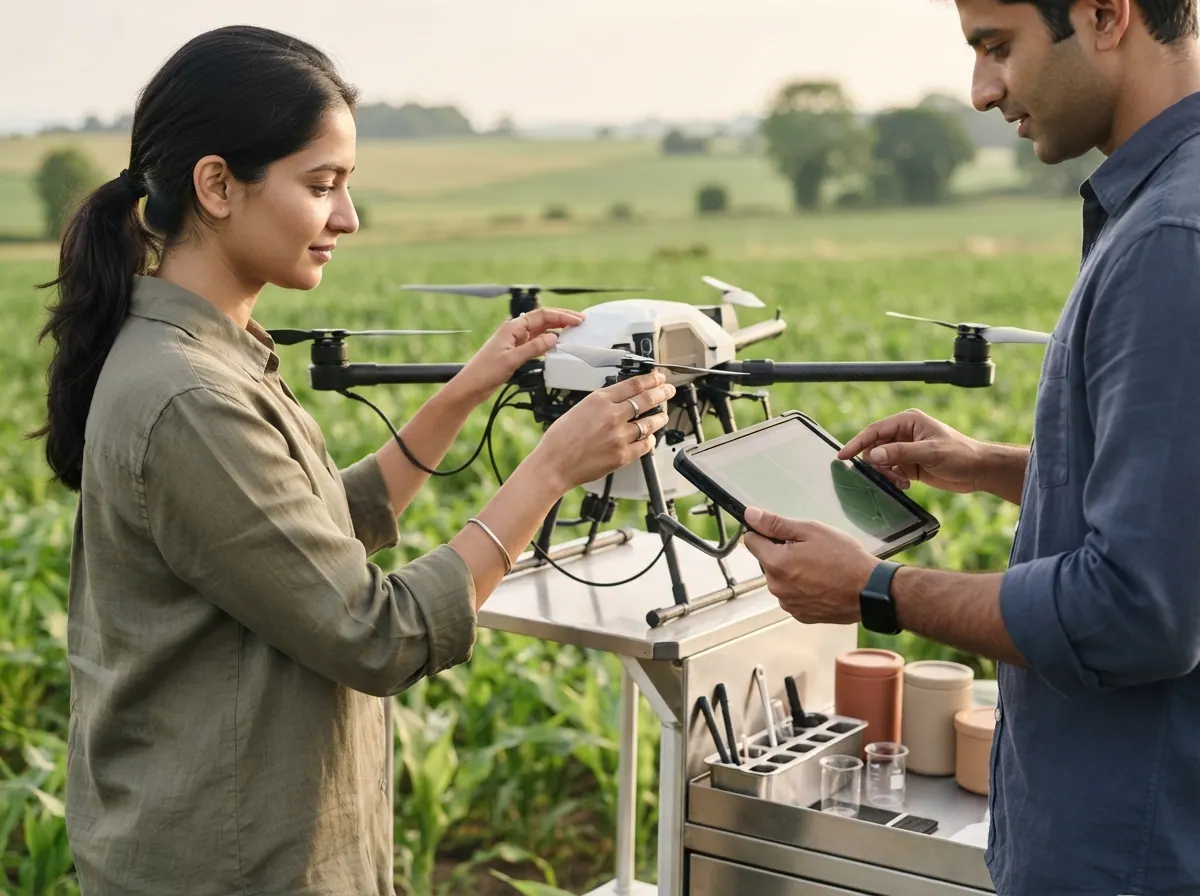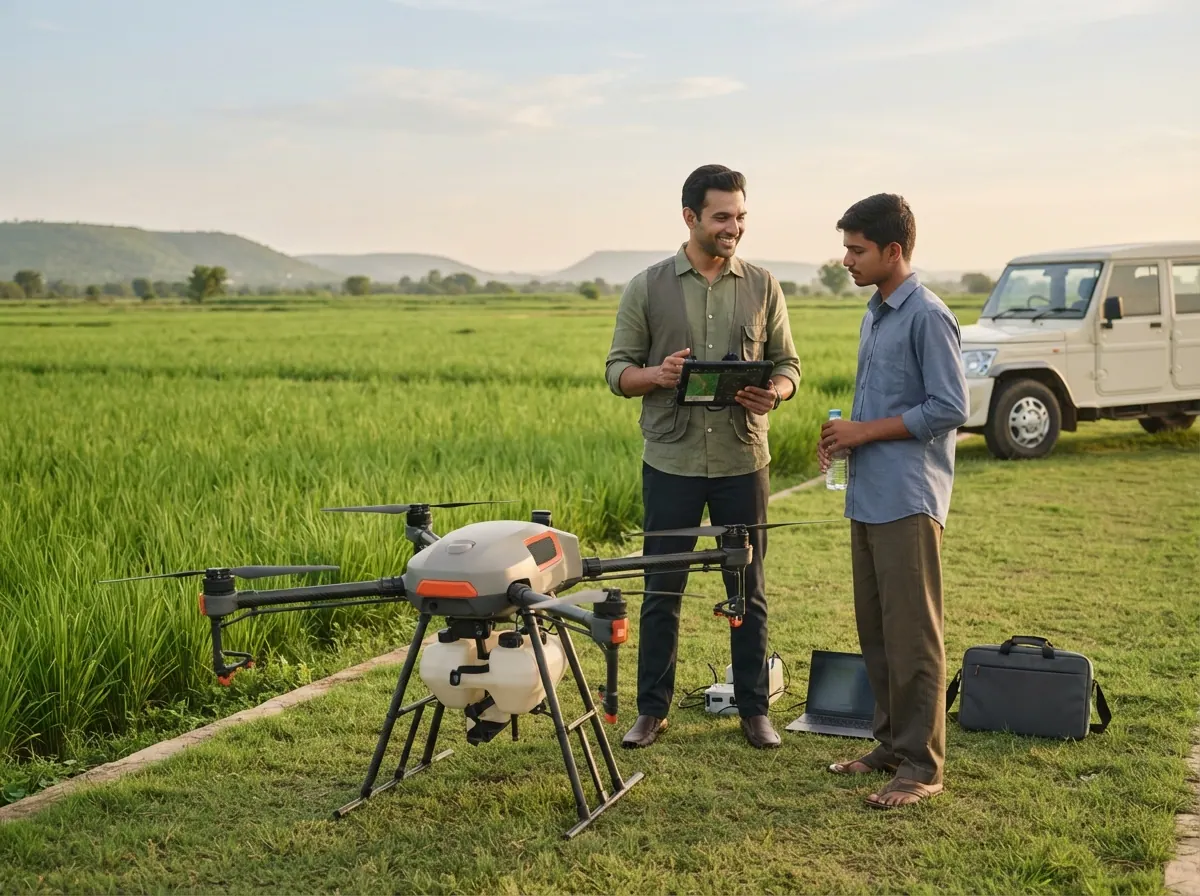
A drone spraying business in India costs about ₹7–16 lakh to start: an agricultural spraying drone, several spare battery sets, a way to charge them in the field, a certified pilot and a vehicle to move everything from farm to farm. You earn per acre sprayed, so the real question is how many acres you can spray at a fair rate in a season, and how you keep the drone flying through the dusty, wet and busy months.
All figures here are estimates. Check prices near you before you spend.
What does it cost?
| Item | Single-drone setup | Setup with extra batteries and vehicle |
|---|---|---|
| Spraying drone (about 10 litre class) | ₹5–8 lakh | ₹6–9 lakh |
| Extra battery sets and charger | ₹80,000–1.5 lakh | ₹1.5–2.5 lakh |
| Generator or inverter for field charging | ₹30,000–60,000 | ₹50,000–1 lakh |
| Pilot training and certificate | ₹30,000–60,000 | ₹30,000–60,000 |
| Registration, insurance, spare parts | ₹40,000–80,000 | ₹60,000–1.2 lakh |
| Pickup or tempo (used) | none | ₹2–3 lakh |
| Water drums, safety kit, small tools | ₹15,000–30,000 | ₹20,000–40,000 |
| Total | about ₹7–11 lakh | about ₹11–16 lakh |
The battery is the part that wears out. Ask the dealer how many charge cycles it gives, what a replacement costs, and how many battery sets you need to spray all day without waiting.
Check who gives service. A drone with no local service centre can sit idle for weeks in the middle of the season.
What will you spray?
- Pesticide and fungicide on field crops: paddy, cotton, sugarcane, wheat, soybean, maize and groundnut are common drone jobs.
- Liquid fertiliser or nano fertiliser: farmers use drones for foliar sprays.
- Orchards and plantations: drones can reach tall coconut, mango or banana, but accuracy depends on the setup. Ask the dealer for a demo on that crop.
- Seeds and granules: some models can broadcast seed or granules with an attachment.
The farmer buys the chemical and you charge for the flying. Make that clear before you start, so there are no arguments about the label dose and the damage if a crop is sprayed wrongly.
How much can it earn?
Here is a drone owned by you, flown by a hired pilot, in a year with about 100 working days.
Income
- 100 working days × 35 acres a day = 3,500 acres
- Rate about ₹400 an acre (rates differ by crop and region)
- 3,500 × ₹400 = ₹14,00,000 a year
Costs a year
- Pilot at ₹20,000 × 12 = ₹2,40,000
- Helper at ₹12,000 × 12 = ₹1,44,000
- Fuel and vehicle: 100 days × ₹700 = ₹70,000
- Battery wear set aside: ₹15,000 × 12 = ₹1,80,000
- Loan instalment on an ₹8 lakh loan: ₹17,000 × 12 = ₹2,04,000
- Repairs and propellers = ₹72,000
- Insurance = ₹36,000
- Total = ₹9,46,000
Left over: ₹14,00,000 − ₹9,46,000 = about ₹4,54,000 a year, or about ₹37,800 a month. If you fly it yourself, you can keep the ₹2,40,000 pilot cost. If you only get 60 working days, the income falls to ₹8.4 lakh and the same costs leave almost nothing. Spraying is a seasonal job, and costs run all year.
What do you need before you start?
- A certified pilot. The rules ask for a remote pilot certificate from a DGCA-approved school. Enrol before you buy a drone.
- Farmers who will book you. Speak to farmers' groups, cooperatives, input dealers and village leaders in a 30–40 km area.
- Water at the field. The drone needs clean water for each tank. Carry drums, or agree with the farmer for a water point.
- A way to charge. If the field has no power, you need a generator or inverter and enough battery sets.
- A safe plan. Know the label, the wind limit, and the no-spray zones, for example houses, water bodies and nearby crops.
Step by step
- Visit farmers and ask the rate they pay for hand or tractor sprayer service. You are selling speed and less labour, so know the number you compete with.
- Join a pilot course at a DGCA-approved remote pilot training organisation, and ask them about the legal steps for registration and flying.
- Ask three dealers for a demo on a crop in your area. Ask for a service contract and the spare part list in writing.
- Buy the drone with enough batteries to keep flying through the day. Two sets are rarely enough.
- Fly a few free or low-cost trial acres for respected local farmers, so others see it work.
- Fix a price list per crop, with a minimum visit charge, and write down terms: who brings water, who buys the chemical, and what happens in rain.
- Keep a log of acres, date, crop, chemical and pilot for every flight. It helps with disputes and with insurance.
Which licences apply?
Drone flying has more rules than most farm businesses, and they change:
- Registration and pilot certificate. Drone rules ask for registration of the drone and a remote pilot certificate for the operator. Confirm the current steps with the training school and the official drone portal.
- Flying zones. Some areas near airports, borders or sensitive sites restrict flights. Check the zone map before each job.
- Pesticides. Use only chemicals approved for the crop, follow the label, and note that a drone's spray pattern is different from a hand sprayer. Ask the agriculture officer.
- Insurance. Third-party cover for damage or injury is worth asking about.
- Schemes and loans. Government schemes, including one for women's self-help groups known as Drone Didi, have supported agri drones. Terms change, so ask the district agriculture office or your bank.
- Tax. Ask a CA about GST and how service income is treated.
What goes wrong?
- Idle months. Spraying comes in short bursts, then there is a long gap. Loan instalments do not wait.
- A crash or a hard landing. Wind, wires and trees destroy propellers, arms and sometimes the whole drone.
- Batteries die early. Heat, careless charging and rough storage cut their life.
- Wrong spray on a crop. A wrong chemical, dose or timing damages a field, and the farmer blames you.
- No service nearby. A broken motor means weeks of waiting for parts.
- Rates cut by competitors. A rival with a cheaper drone drops the rate, and farmers compare you with the tractor sprayer.
Situations you will face
What would you do? Each choice costs something.
Getting started
The dealer will demo only on a paddy plot. Your area is mostly cotton and sugarcane.
- Insist on a cotton demo: Wait weeks, right fit
- Buy after the paddy demo: Faster, crop fit unknown
Two sets come with the drone. Each set flies a short time, and field charging is slow.
- Buy two more sets: Costly, fly all day
- Start with two sets: Saves cash, wait to recharge
A certified pilot asks a monthly salary. Doing the course yourself takes weeks of your time.
- Do the course yourself: Fee and weeks, own the skill
- Hire a certified pilot: Monthly pay, quicker start
A cheaper brand has no service centre in your state. The usual brand costs lakhs more.
- Buy the serviced brand: Costly, parts nearby
- Buy the cheaper drone: Saves money, slow repairs
A used pickup is costly. A hired tempo for each job eats into each day's income.
- Buy a used pickup: Big cost, own transport
- Hire a tempo per job: Pay each day, no loan
A farmer wants you to spray tomorrow. Your registration and pilot papers are not complete.
- Finish papers first: Delay, safe and legal
- Hire a registered pilot: Fee paid, flies legally
Farmers compare you with the tractor sprayer and ask for a lower per-acre rate.
- Hold your rate: Fewer bookings, fair income
- Cut the rate: More bookings, thin income
First month
A respected farmer says that if you spray their plot free, others will book. It uses a full day and chemicals are theirs.
- Do the free trial: Lose a day, gain trust
- Charge a small rate: Some income, less goodwill
A farmer has paid the advance, but the wind is strong. Spray may drift to the next field.
- Postpone to evening: Late, farmer annoyed, safe
- Spray at first light tomorrow: Lose a day, calm air
A farmer says the pests are bad and asks for twice the label dose. They are paying and they are sure.
- Follow the label: Argument, safe crop
- Offer a repeat spray later: Extra visit, label dose kept
The farmer promised a water point but the field is far from any tap or tank.
- Bring your own drum: Extra fuel, job done
- Skip the job: Lose a day's income
On a field edge your drone clipped a branch and snapped a propeller. A spare is in the kit.
- Change it and inspect: Lose an hour, safer
- Ground it and test first: Lose a day, safe check
Running it
Spraying time is tight. All three want the first slot. You can only fly one plot first.
- Fix a fair booking rule: Some will wait, fewer fights
- Serve the biggest plot: More money, others upset
A battery pack looks puffed after a hot day. A new one is expensive and the season is busy.
- Retire it and buy new: Costly, safe flying
- Bin it, fly with fewer sets: Slower work, no swollen cell
Fields have no power, so you charge from a generator. Fuel cost is high this month.
- Buy a solar charging kit: Big cost, cheaper later
- Keep the generator: No spend, high fuel
A pest has hit the whole area. Farmers are calling at once and ready to pay extra.
- Raise the rate a little: More money, a few drop
- Keep your usual rate: Goodwill, same pay
A farmers' cooperative will give you many acres at a lower fixed rate for the season.
- Sign the cooperative deal: Steady work, lower rate
- Stay with individual farmers: Higher rate, scattered jobs
A farmer next to your job says their maize leaves are burnt. The spray may or may not have drifted.
- Visit and offer compensation: Costs now, trust kept
- Deny the claim: Keep money, lose goodwill
A new operator with a cheaper drone is offering a rate far below yours across the village.
- Match their rate: Keep jobs, thin pay
- Stay on quality: Fewer jobs, safe pay
The peak spray days are hot and long. Your pilot is flying from dawn without proper breaks.
- Add a second pilot shift: Extra pay, safer flying
- Spray early morning only: Fewer acres, safer pilot
When things go wrong
One motor stops during a job. A replacement takes ten days from the dealer.
- Pay for express parts: Costly, back sooner
- Wait for normal parts: Cheaper, lose ten days
A thin line over the field went unseen. The drone is down, one arm broken, and the farmer is shaken.
- Repair fully, add checks: Costly, safer flying
- Repair in stages, rest it: Cheaper, grounded for weeks
Several farmers say they will pay you after the crop sells. Your instalment is due this month.
- Ask for half in advance: Cash flow, lose some jobs
- Accept after-harvest pay: More jobs, money waits
A farmer's leaves are scorched after your spray. The chemical was from their own shop and may not suit the crop.
- Share part of the loss: Costly, trust stays
- Point to their chemical: Save cash, lose name
A big booking is near a restricted zone on the map. The farmer says nobody checks.
- Decline the job: Lose the booking, stay legal
- Offer a nearby legal plot: Smaller job, stay legal
Growing
Bookings are more than one drone can fly in peak weeks. A second drone needs a pilot and a loan.
- Buy a second drone: Big loan, double capacity
- Add batteries and a helper: Smaller spend, some more
A land owner asks for crop photos from the drone. It needs a camera attachment and different skills.
- Take the survey work: Extra income, new skill
- Rest the drone: No spend, no income
A self-help group wants to use your drone for training and joint work. Terms of any scheme are not clear.
- Train and partner: Time and cost, new business
- Stay on your own: No effort, less goodwill
The district agriculture office mentions support for agri drones. It needs papers and nothing is promised.
- Apply with a CA's help: Fees, cleaner records
- Skip the paperwork: No fees, no support
Your drone insurance is up for renewal. You have had no crash this year.
- Renew with third-party cover: Yearly cost, protected
- Let it lapse: Saves money, big risk
Is it right for you?
A drone spraying business suits you if you can learn a technical machine, deal with many farmers, work in the heat during peak days, and carry loan payments in the quiet months. It suits you less if you cannot afford a long wait for the first bookings or a major repair.
A good test: before buying, spend time with a working drone operator for a spraying season, and note how many days they actually fly. If their number still pays your loan and your pilot, then plan your own.