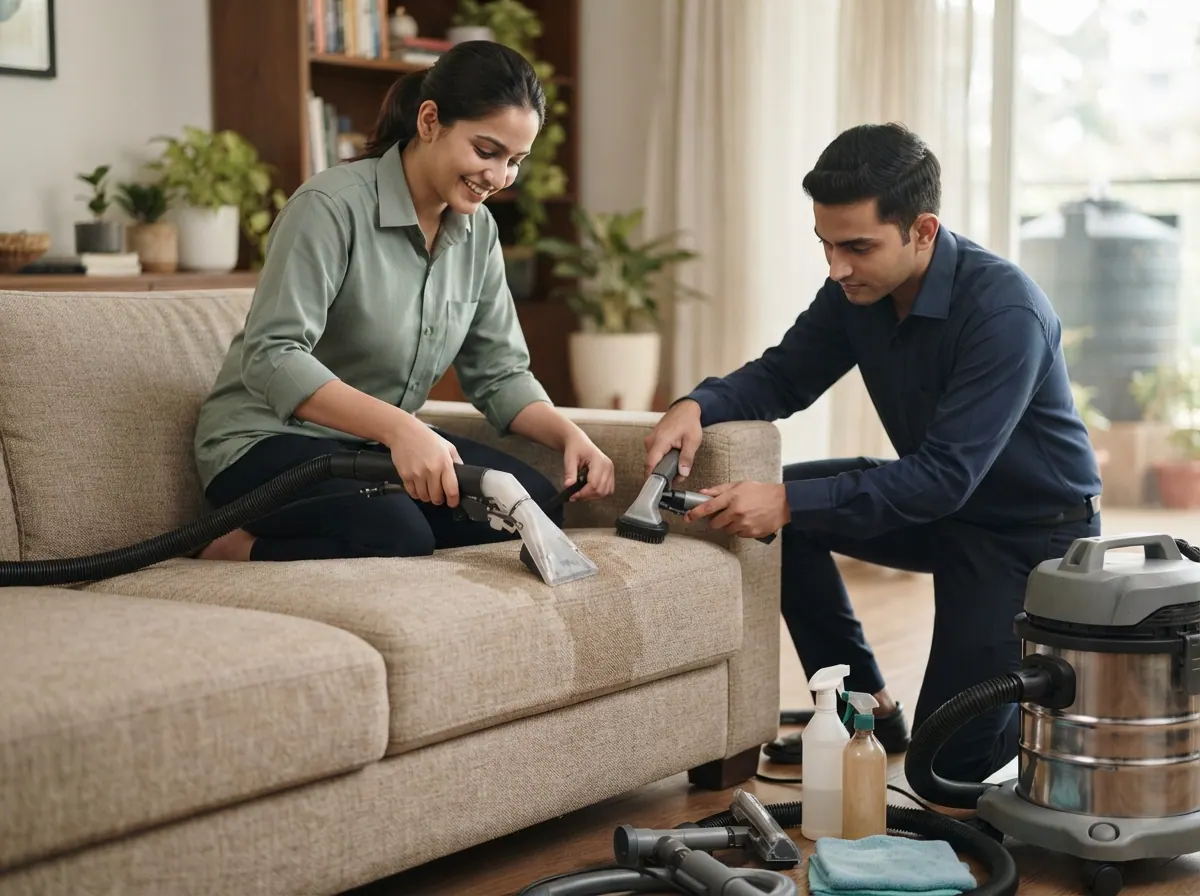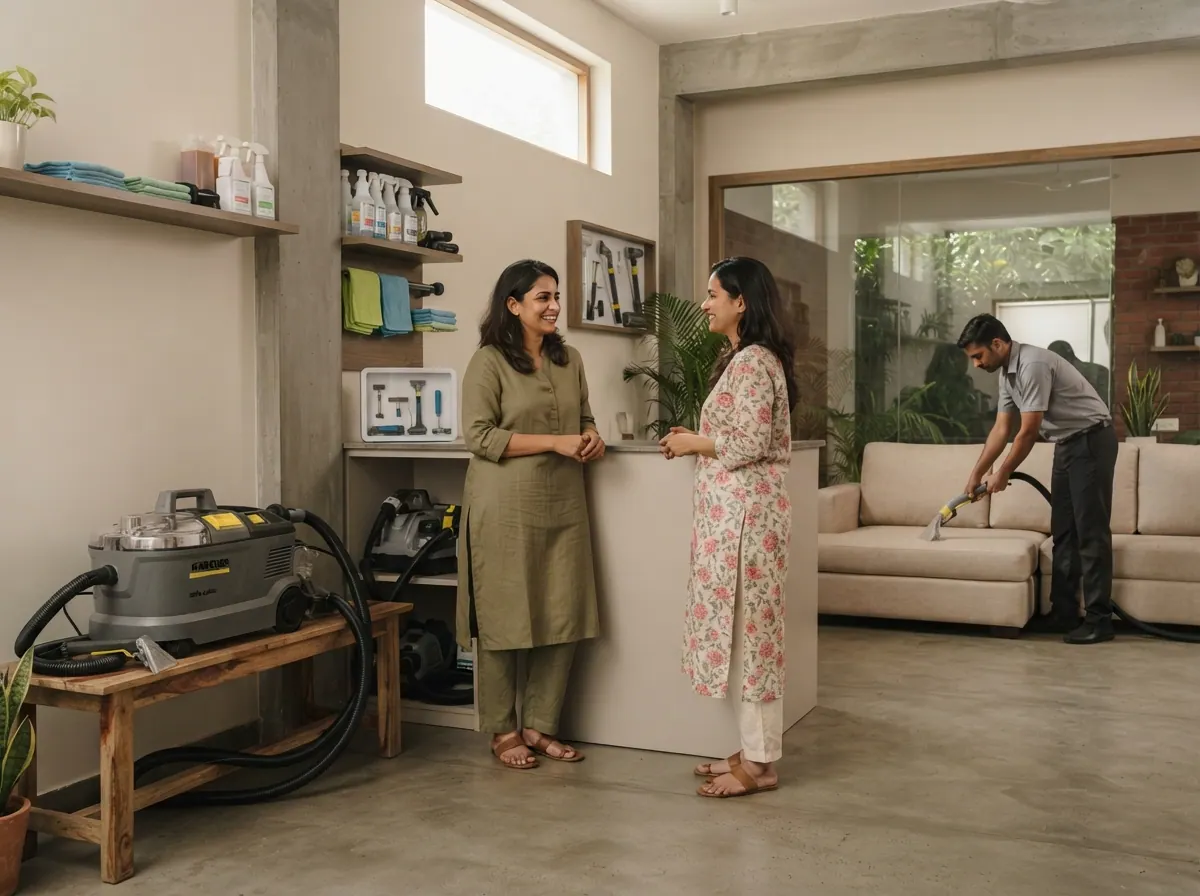
To start a deep cleaning business in India you need a wet-dry vacuum, a sofa and carpet extraction machine, a steam cleaner, the right chemicals, a team of two or three trained cleaners, a way to carry it all, and about ₹50,000 to ₹3 lakh. You earn by selling whole-home cleans, sofa and mattress cleaning, and yearly water tank cleaning. Unlike many businesses, you do not need a shop, but you do need trust, because your people work inside customers' homes.
All figures here are estimates. Check prices near you before you spend.
What does it cost?
| Item | Basic start | Fuller start |
|---|---|---|
| Wet-dry vacuum | ₹8,000–15,000 | ₹15,000–25,000 |
| Sofa and carpet extraction machine | ₹25,000–50,000 | ₹50,000–80,000 |
| Steam cleaner | ₹5,000–12,000 | ₹12,000–25,000 |
| Single-disc floor scrubber | – | ₹30,000–60,000 |
| Water tank cleaning kit (pump, brush, vacuum) | – | ₹15,000–30,000 |
| Chemicals, brushes, ladders, extension boards | ₹10,000–20,000 | ₹20,000–35,000 |
| Uniforms, bags, ID cards | ₹3,000–6,000 | ₹6,000–12,000 |
| Vehicle | Use two-wheelers or hire | ₹0–60,000 |
| Phone, listing, ads | ₹5,000–10,000 | ₹10,000–20,000 |
| Total | about ₹60,000–1.2 lakh | about ₹1.8–3 lakh |
Buy the extraction machine before anything else. Sofa and carpet jobs are quick to sell and bring in homes for a bigger clean later.
What do you need before you start?
- Training on surfaces. Marble, vitrified tiles, wood and fabric need different chemicals. A wrong acid on marble stains it for good.
- Trusted staff. Ask for ID and an address, and meet their families if you can. One theft ends a business.
- Knowing the extras. Chimney degreasing, kitchen cabinets, bathroom limescale and balcony grills all take time. Learn what to charge for each.
- Safety gear. Gloves, masks and non-slip shoes. For tanks, learn to work with air and light, and never send anyone into a tank alone.
- A way to be found. A Google Maps listing with real before and after photos, reviews and a WhatsApp number.
How much can it earn?
Here is a small team with three cleaners in its second year. These numbers are examples, not promises.
Monthly income
- 24 home deep cleans × about ₹3,500 = ₹84,000
- 8 sofa cleaning jobs × about ₹1,200 = ₹9,600
- 5 water tank cleans × about ₹1,500 = ₹7,500
- Total = about ₹1,01,100
Monthly costs
- Three cleaners = ₹36,000
- Chemicals and consumables = ₹12,000
- Fuel and vehicle = ₹8,000
- Ads and platform fees = ₹10,000
- Machine repair and other = ₹4,000
- Total = ₹70,000
Left over: ₹1,01,100 − ₹70,000 = about ₹31,000 a month.
Work comes in waves, with Diwali, move-in months and summer tank cleaning being busy and some months slow. A yearly tank-cleaning list gives you quiet-month income.
Step by step
- Work for a few weeks with an established cleaning company or crew to learn surfaces, chemicals and pricing.
- Buy the extraction machine, vacuum and steam cleaner, and start with sofas and mattresses.
- Make a price list by flat size (1 BHK, 2 BHK, 3 BHK) and by item, so customers know what they pay.
- Set up a Google Maps listing and take before and after photos, with the customer's permission.
- Visit flat associations and offer a discounted first clean for a whole building.
- Walk through before and after with every customer. List what is included and what costs extra.
- Add water tank cleaning and floor polishing once the home cleaning is steady.
Which licences apply?
Usually light, but this varies by state:
- Shop and establishment registration, even if you work from an office or home. Ask your local body.
- GST once your sales pass the limit, or if business customers ask for it. Ask a CA.
- Staff rules. If you hire several people, there may be labour rules on wages and records. Ask your local labour office.
- Insurance for damage to customers' property is worth asking about.
- Water tank cleaning is not a licensed job in itself, but your people must work safely. Ask your local body about any rules for housing societies.
What goes wrong?
- Wrong chemical on the wrong surface. Acid on marble or bleach on a coloured sofa leaves marks you pay for.
- Staff that cannot be trusted. A customer who loses a gold chain tells the whole building.
- Underquoting. A 3 BHK with grease and limescale takes twice the time you promised.
- Wet sofas that smell. Poor drying or too much water leaves mould and a sour smell.
- Unsafe tanks. Closed tanks and old ones can be dangerous. Do not go in without proper air and a person outside.
- Slow months. After Diwali and during exams, bookings dry up while wages continue.
Situations you will face
What would you do? Each choice costs something.
Getting started
Cash is tight. A sofa extraction machine opens quick jobs, while a floor scrubber suits bigger cleans later.
- Buy the sofa extractor: Quick jobs, small bills
- Buy the floor scrubber: Bigger cleans, slower start
A supplier offers a half-day demo on which chemical suits marble, tiles, wood and fabric. It costs a fee.
- Attend the demo: Fee and time, fewer damages
- Learn on customers: Free, stains risk
A man offers to work for less but has no ID or address proof, claiming experience.
- Hire only with ID: Higher wage, safer homes
- Skip this hire: No cost, a slower hiring
Customers ask for the price of a 2 BHK clean. A fixed price is clear, but homes vary a lot.
- Publish a fixed price list: Clear, loses on dirty homes
- Quote after seeing the home: Fairer, slower to book
A first customer lets you take before and after photos. The customer asks you to hide the home's face and name.
- Post photos, ask permission: Good proof, a bit of effort
- Use your own tool photos: Honest proof, less impact
Summer is near and many flats need tank cleaning. A tank kit costs money and training on safe working.
- Buy the kit, train staff: Cost now, yearly repeat jobs
- Skip tanks for now: Save cash, miss summer jobs
Your team goes by bike with machines tied on. A hired tempo for each job is costly.
- Buy a second-hand van: Big spend, easy transport
- Hire a tempo for big jobs: Cost per job, no purchase
First month
Your helper used a strong cleaner on a marble floor. A dull patch has appeared and the owner is upset.
- Pay for polishing: Costly, owner calms down
- Offer a discount only: Cheaper, owner stays angry
The flat has greasy kitchen walls and limescale in every bathroom. Your quote will not cover the extra hours.
- Ask for a fair top-up: Awkward talk, honest pricing
- Finish at the old price: Customer pleased, you lose
A customer calls to say the sofa you cleaned still smells damp. The rains have started.
- Re-visit, dry with fans: Extra visit, saved reputation
- Send a dryer team next day: Visit cost, the damp is fixed
After a clean, a customer says a gold ring is gone. It may be misplaced, but the customer suspects your team.
- Help search, check with team: Time and tension, fair process
- Deny and leave quickly: No effort, rumour spreads
Fifty homes want cleaning before the festival, but your team can do about thirty.
- Hire temporary cleaners: Extra wages, more jobs
- Take only thirty homes: Quality kept, lose bookings
Running it
An app will send you steady bookings but take a large commission on every job.
- Join the app: More jobs, lower margin
- Stay with your own leads: Full margin, fewer jobs
An association of forty flats asks for a lower rate if you clean many homes in one week.
- Give a small group discount: Many jobs, thinner margin
- Keep your normal rates: Margin safe, a few bookings
Your supplier raises prices on cleaners and degreasers. You are on fixed quotes for many customers.
- Raise prices slightly: Keeps margin, some grumbling
- Absorb the rise: Customers happy, margin falls
Your extraction machine stops working with six jobs booked this week. Repair takes four days.
- Rent a machine meanwhile: Rental fee, jobs go on
- Reschedule the jobs: No cost, some cancel
A housing society has an old tank with a narrow cover. Your helper offers to climb in alone to save time.
- Use safe method with a spotter: Slower job, safe crew
- Turn the job down: No risk, a lost booking
Bookings fall after Diwali. A 15 percent offer may fill the calendar but cuts your margin.
- Run the discount: Busy team, lower margin
- Wait for the season: Margin safe, idle team
A customer says the payment will come later, after salary day. Your team's wages are due.
- Ask for payment today: Firm, some friction
- Wait for them: Friendly, delayed money
A customer wants a flat clean quoted without the chimney, but the kitchen grease is very heavy.
- Quote chimney separately: Higher bill, clear terms
- Include it in the price: Customer happy, you lose time
When things go wrong
Your most careful cleaner leaves for a company that offers a fixed salary. Several customers ask for that cleaner.
- Offer a raise to stay: Higher wage, steady team
- Hire and train a new one: Lower cost, slower quality
A customer posts a bad review saying the bathroom was not clean. People searching for you can see it.
- Visit again, reply politely: Free revisit, review improves
- Argue in the reply: Feels fair, looks bad
A cleaner knocked over a glass table top while moving furniture. The owner asks you to replace it.
- Pay for a replacement: Costly, trust saved
- Offer half the cost: Cheaper, owner unhappy
A new crew offers deep cleaning at nearly half your price. Some old customers ask you to match.
- Match on basic cleans: Thin margin, keep customers
- Stay on quality and photos: Margin safe, lose some
Heavy rain makes people postpone cleaning for weeks. Wages still run and the van needs fuel.
- Offer a rain-day deal: Small discount, some work
- Cut hours for the team: Lower wages, risk of quitting
Growing
A small office asks for weekly cleaning, offering steady pay but a low rate and slow payment.
- Take it with advance billing: Steady income, thin margin
- Decline and stay with homes: Better rates, less steady
Bookings are rising. A second team needs machines, a supervisor you trust and more cash for wages.
- Start the second team: Big spend, many more jobs
- Raise your prices instead: No spend, fewer bookings
A builder wants new flats cleaned of cement and paint before handover. It needs a scrubber and strong chemicals.
- Buy scrubber, take the work: Big spend, big bills
- Stay with occupied homes: Familiar, smaller jobs
Customers keep asking about mattresses and curtains. It needs steam equipment and drying space.
- Add the new services: Equipment cost, bigger bills
- Do only sofas and floors: Simple, lose some bills
A customer asks for two cleans and a tank wash per year at one price.
- Offer the yearly plan: Steady bookings, lower rate
- Keep per-job pricing: Higher rate, uncertain work
Is it right for you?
Deep cleaning suits you if you can manage people, care about detail, and do not mind physical work and bargaining over prices. It suits you less if you cannot handle complaints about a missed corner, or if you dislike the idea of being responsible for people in strangers' homes.
A good test: join a cleaning crew for two weekends. If you can finish a full flat and still smile at the customer, buy the extraction machine, take your first jobs on a neighbour's sofas, and add people only when the bookings are steady.