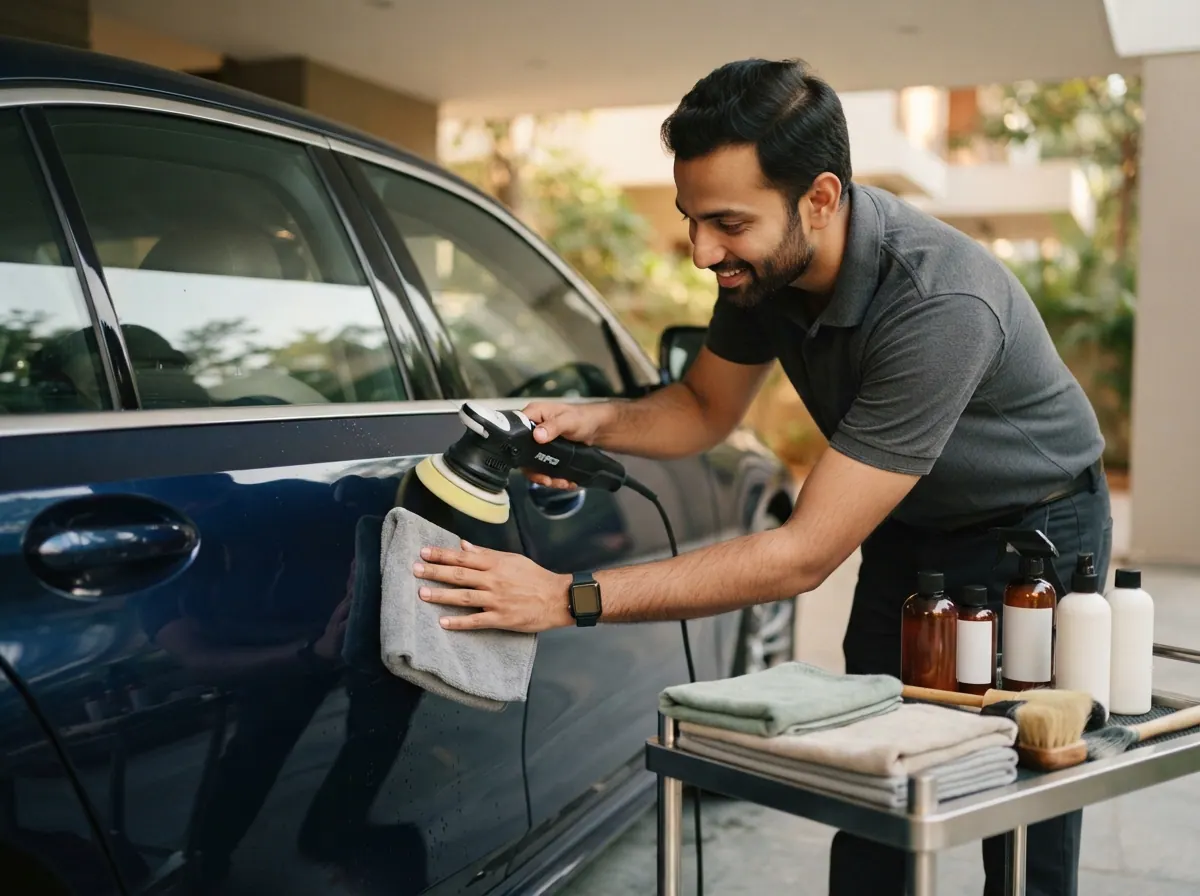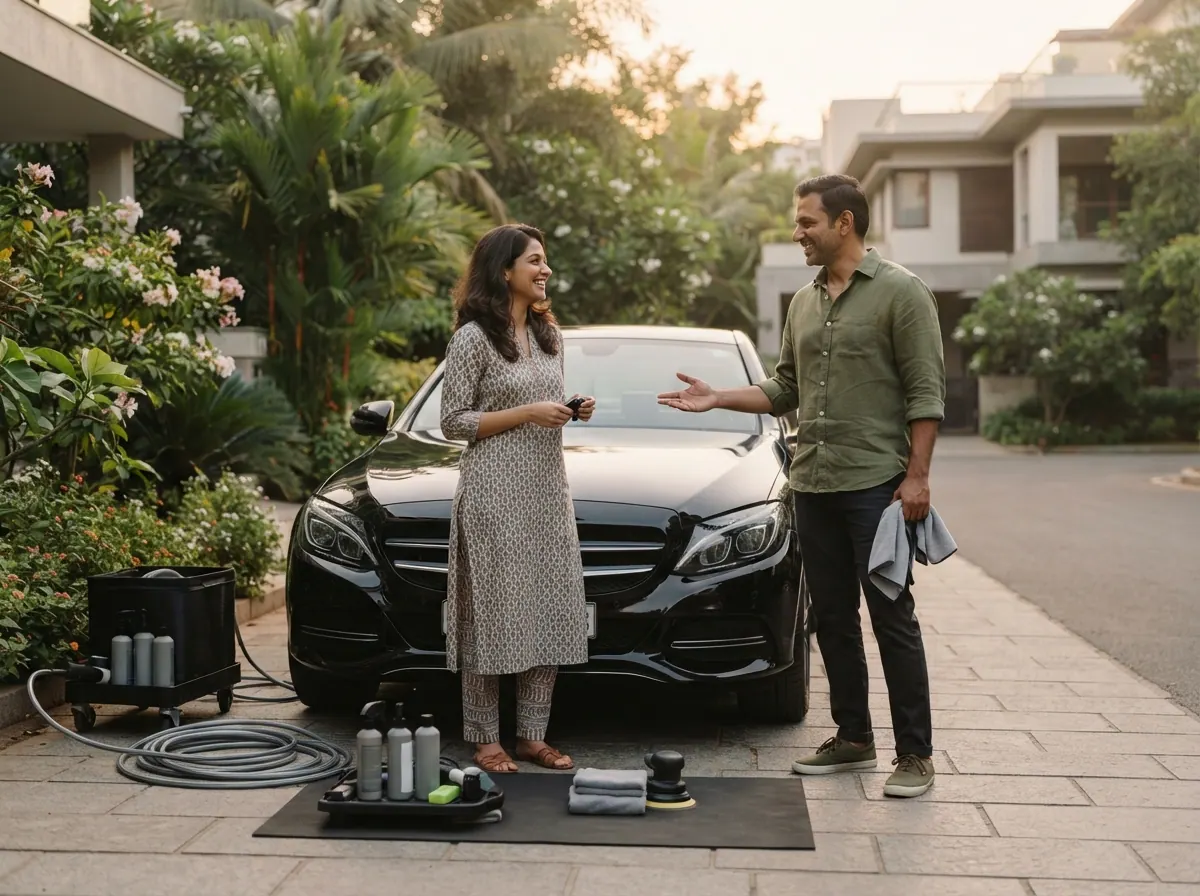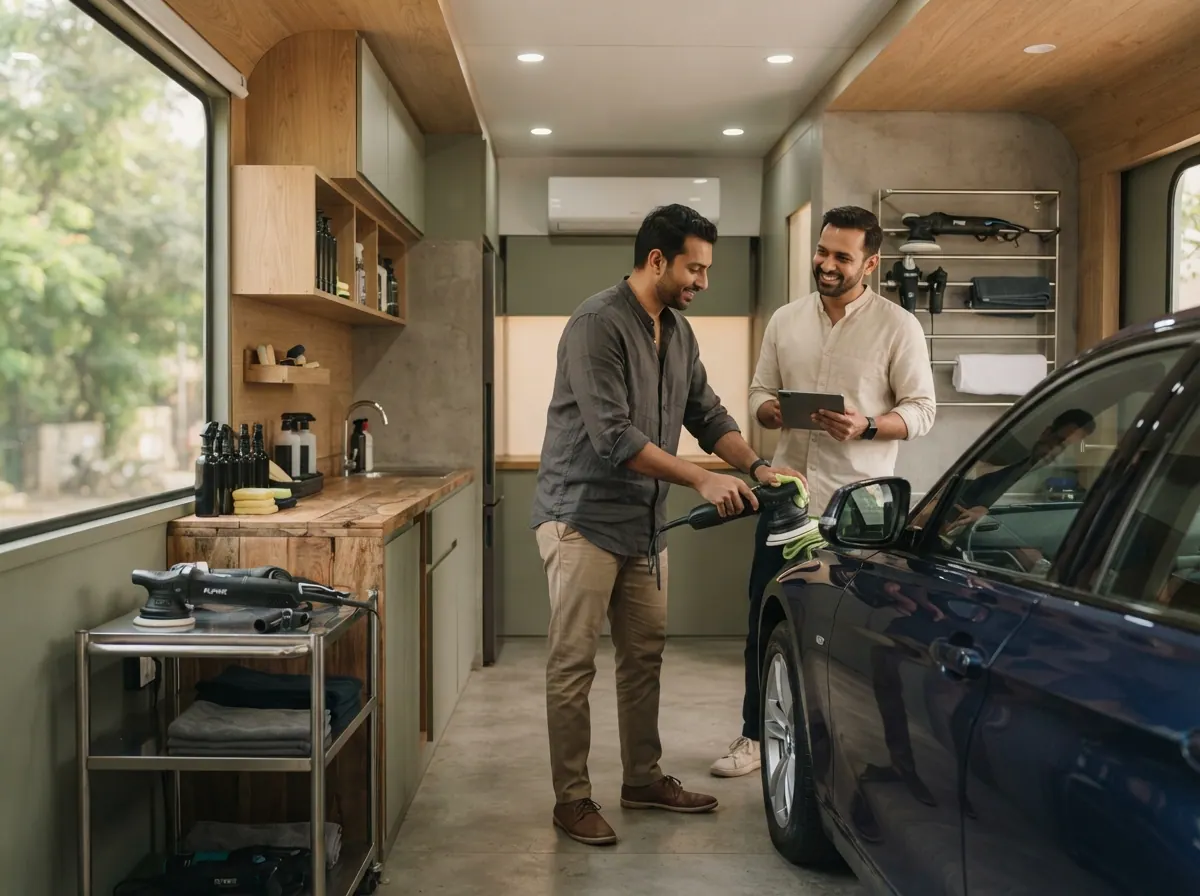
To start a car detailing business in India you need a pressure washer, a wet-dry vacuum, a polisher, good chemicals and microfibre cloths, one trained helper, and about ₹1–2 lakh for a mobile kit, or ₹2.3–4.1 lakh for a small covered studio bay. Owners of cars worth lakhs will pay to have them looked after, but only if the car comes back with no swirl marks, no wet seats and no smell. Detailing is slow, careful work that people judge up close.
All figures here are estimates. Check prices near you before you spend.
What does it cost?
| Item | Mobile kit | Small studio bay |
|---|---|---|
| Pressure washer | ₹10,000–20,000 | ₹15,000–30,000 |
| Wet-dry vacuum | ₹8,000–15,000 | ₹16,000–30,000 |
| Dual-action polisher, pads | ₹10,000–20,000 | ₹20,000–40,000 |
| Steam cleaner or fabric extractor | ₹10,000–25,000 | ₹15,000–35,000 |
| Water tank, inverter or generator, hose | ₹15,000–35,000 | ₹10,000–20,000 |
| Chemicals, microfibres, brushes (stock) | ₹15,000–25,000 | ₹30,000–50,000 |
| Lights, tools, uniform, aprons | ₹5,000–10,000 | ₹10,000–20,000 |
| Booking page, ads, cards | ₹8,000–15,000 | ₹15,000–30,000 |
| Deposit, rent, cash buffer | ₹25,000–40,000 | ₹1–1.5 lakh |
| Total | about ₹1–2 lakh | about ₹2.3–4.1 lakh |
Ceramic coating products and paint protection film are separate and expensive, and you should not buy them until you have learned how to apply them. Many beginners spend money on coating stock that sits on the shelf for months.
What services should you offer?
- Exterior wash and wax. The entry job that brings customers.
- Interior deep clean. Vacuum, steam on seats and mats, dashboard and door-pad cleaning, and a leather feed. This is often your main earner.
- Machine polish. Removes swirl marks and light scratches. It needs practice, because too much pressure or heat can burn through the paint.
- Headlight restoration. A quick job that customers love when the lens looks yellow.
- Ceramic coating. A big-ticket job. Do it only when you are trained and have a clean, dust-free bay.
- Engine bay and underbody cleaning. Do this carefully, because water in the wrong place can cause electrical faults.
How much can it earn?
Take a mobile service with you and one helper doing 30 jobs a month at an average of ₹2,600, a mix of washes, interior details and a few polishes.
Sales
- 30 jobs × ₹2,600 = ₹78,000 a month
Costs each month
- Helper = ₹14,000
- Products: 30 jobs × ₹450 = ₹13,500
- Fuel and travel: 30 jobs × ₹250 = ₹7,500
- Water = ₹1,500
- Ads and leads = ₹6,000
- Repair and replacement of pads, hoses and parts = ₹3,000
- Parking or storage rent for the kit = ₹8,000
- Phone, small items = ₹2,000
- Total = ₹55,500
Left over: ₹78,000 − ₹55,500 = about ₹22,500 a month, and you do part of the work yourself.
A single ceramic coating job can bring in more than ten wash jobs, but a failed coating can wipe out the month. Weather also matters: monsoon cuts washes, but boosts interior and anti-rust jobs, so plan your month around the season.
What do you need before you start?
- Training. Spend a few weeks at an established detailing studio or take a short course. Burning paint with a polisher is a mistake you only make once, and it costs the car owner.
- Water and power plan. A pressure washer needs a steady water source and power. Many housing societies limit washing, so ask in advance. A water tank and an inverter make you independent.
- A way to protect the car. Seat covers, floor mats, fender covers and tape for edges.
- Photos. Before and after photos on your phone are your best advert.
Step by step
- Learn on your own car first, then a friend's. Practise polishing on old panels from a scrap yard before you touch a customer's paint.
- Buy the core kit only: pressure washer, vacuum, polisher, good microfibres, and a few chemicals you know well.
- Make a price list by car size (hatchback, sedan, SUV) and by service, with a note that a very dirty car costs more.
- Take photos of the car at pickup, including any scratches that were already there. Send the customer a short checklist.
- Start with a few societies and offices. Ask the secretary or the facilities manager to let you serve cars on a fixed day.
- Use waterless or low-water products where water is limited, and tell the customer in advance.
- Add polish and coating only after your wash and interior jobs run well.
Which licences apply?
- Shop and establishment registration if you rent a bay or hire staff. Rules vary by state.
- GST. Ask a CA whether and when you need to register.
- Local permission. Societies and mall parking areas often need a written permission to wash cars. A bay in a commercial area may also need the owner's no-objection letter.
- Waste water. Many areas limit what you drain into the street. Ask your municipality about drainage and oil or chemical disposal.
- Insurance. A cover for damage to customers' cars is worth asking an agent about.
What goes wrong?
- A polisher burns the paint. It can happen near edges and panel corners, and the repaint is your bill.
- Water gets into electrics. An overspray on an engine bay or a wet seat motor causes faults that show up days later.
- A scratch you did not cause. Without pickup photos you cannot prove it.
- Wrong chemical on wrong surface. An acid wheel cleaner on painted calipers, or a strong cleaner on leather, damages it.
- Fumes in a closed bay. Coatings and solvents need good ventilation and a mask.
- Societies stop the washing. A new committee, a water shortage, and your Sunday slot disappears.
Situations you will face
What would you do? Each choice costs something.
Getting started
A detailing studio offers a two-week course for ₹12,000. You could also start today and learn from videos.
- Take the paid course: Costs, safer hands
- Learn from videos: Free, mistakes on real cars
A rotary polisher cuts fast but burns paint easily. A dual-action machine is slower and forgiving.
- Buy a dual-action polisher: Slower, safe for beginners
- Buy a rotary polisher: Faster, risk of burning paint
Many societies limit washing. A 200-litre tank and a pump cost money, but let you work anywhere.
- Buy a tank and pump: Costs now, work anywhere
- Rely on society water: Cheaper, bookings get cancelled
Some sites have no socket nearby. An inverter costs ₹15,000, and a small generator is noisy.
- Buy an inverter set-up: Quiet, costly
- Buy a small generator: Cheaper, noise complaints
A rented shed near your customers costs ₹8,000 a month. Home storage is free but your kit stays far from work.
- Rent the shed: Costs monthly, quick start
- Keep kit at home: Free, longer travel each day
A hatchback detail takes three hours, an SUV takes five. A friend says keep one price to keep it simple.
- Price by car size: Fair, needs a price list
- Keep one flat price: Simple, lose money on SUVs
An agent offers a small cover for damage to cars in your care. The yearly premium is ₹6,000.
- Buy the cover: Costs, safe against big claims
- Go without it: Saves cash, risk on every car
First month
A customer's black sedan shows swirl marks. They expect a perfect finish from a single polish.
- Set honest expectations: May lose the job
- Promise a big improvement only: Honest, smaller sale
A customer says there is a scratch on the door. You did not take pickup photos for this car.
- Take the blame and fix it: Costs ₹2,500, keeps customer
- Offer a polish, ask for proof: Small cost, fair talk
A customer's headlights are yellow. Restoration takes an hour and costs you ₹150 in material.
- Offer it at ₹1,200: Extra income, happy customer
- Skip the offer: No extra income
Your helper over-wet the seat and it smells damp. The customer calls on day three.
- Return and dry it free: Costs time, keeps trust
- Send a helper to dry it: Cheaper, they wait
The secretary says you need written permission to wash cars on society property.
- Apply and pay the fee: Slow, legal work place
- Move to a nearby road: No fee, fewer bookings
Running it
A new SUV owner wants a ceramic coating at ₹15,000. You have not yet done one on a customer's car.
- Say you are not ready yet: Lose the job, protect the paint
- Send them to a trained partner: Small commission, no risk
- Learn and do it: Training cost, big job
It rains for a week and washing orders fall. Interior detailing and underbody rust care still sell.
- Push interior and anti-rust offers: Small cost, keeps some income
- Wait for the rain to stop: No cost, income drops
While wiping, your helper cracked a side mirror cover. The car owner is nearby.
- Pay for the replacement: Costs, reputation safe
- Offer to share the repair cost: Shared cost, honest
A tyre shop owner will send you customers if you pay them ₹200 for each referral.
- Agree to the referral fee: Costs per car, more leads
- Offer them free washes: Cheaper, fewer referrals
A supplier raises prices by 15%. A cheaper brand is available but you have not tried it.
- Pay the higher price: Margin shrinks, same results
- Test the new brand first: Cheaper, takes two weeks
A few customers want weekly exterior washes at a lower rate. It brings steady money but little margin.
- Launch a monthly plan: Steady income, thin margin
- Keep per-wash pricing: Higher price, uneven bookings
A customer needs the car by 5 pm, but the interior still needs three hours of drying time.
- Say no and keep the time: Honest, may lose the customer
- Hurry with fans and a helper: Costs extra, done on time
When things go wrong
The coating solvent gives you a headache in the shed. The helper is also coughing.
- Install an exhaust fan and masks: Costs, safer working
- Pause coating jobs for now: Lose jobs, nobody at risk
You polished too hard near an edge on a customer's car. The paint now needs a respray.
- Own up, pay for respray: Heavy cost, trust kept
- Offer a discount only: Cheaper, customer angry
The pump stops on a Saturday with five bookings. A repair shop can fix it by Monday.
- Rent a washer for the day: Costs, keep the day
- Cancel the bookings: No cost, upset customers
A customer says the paint looks dull after your polish. You think it is the wrong pad for their paint.
- Offer a free re-polish: Costs, review may improve
- Defend the work online: No cost, looks defensive
A water shortage leads the committee to ban all car washing on the premises.
- Offer waterless detailing: New products, keep customers
- Move customers to your bay: Customers must travel
Someone broke into the storage shed overnight and took your polisher and pads.
- Replace it at once: Heavy cost, no lost days
- Rent one for two weeks: Smaller cost now, slower work
Growing
A covered bay would let you do coatings and polish all day. Rent and deposit total ₹1.2 lakh.
- Rent the bay: Big cost, bigger jobs
- Stay mobile for now: Flexible, small jobs only
Weekend bookings are full. A second helper costs ₹7,000 a month for four days a week.
- Hire a second helper: Costs, double capacity
- Turn away extra bookings: No cost, lose repeat customers
A car showroom wants new cars cleaned before delivery at a low rate per car, but many cars per week.
- Take the contract: Volume, thin margin
- Bid at a higher rate: Fewer cars, better margin
Online reviews bring new customers, but asking each one takes time and some may not reply.
- Send a review request each job: Small effort, more calls
- Rely on word of mouth: No effort, slower growth
A trainer offers a PPF course for ₹40,000. PPF jobs pay well but one cutting mistake wastes expensive film.
- Take the course: Costly, big jobs later
- Skip it for now: Save money, stay with polish
Is it right for you?
Car detailing suits you if you like cars, have patience for slow work, and can explain to a customer why a job costs what it does. It suits you less if you want fast volume washing at a low price, because detailing is time-consuming and depends on skill.
A good test: spend two weeks working at a detailing studio and do a full interior detail yourself under supervision. If you enjoy it and the customer's face at pickup makes the work feel worth it, buy the core kit and start with a few regular cars.