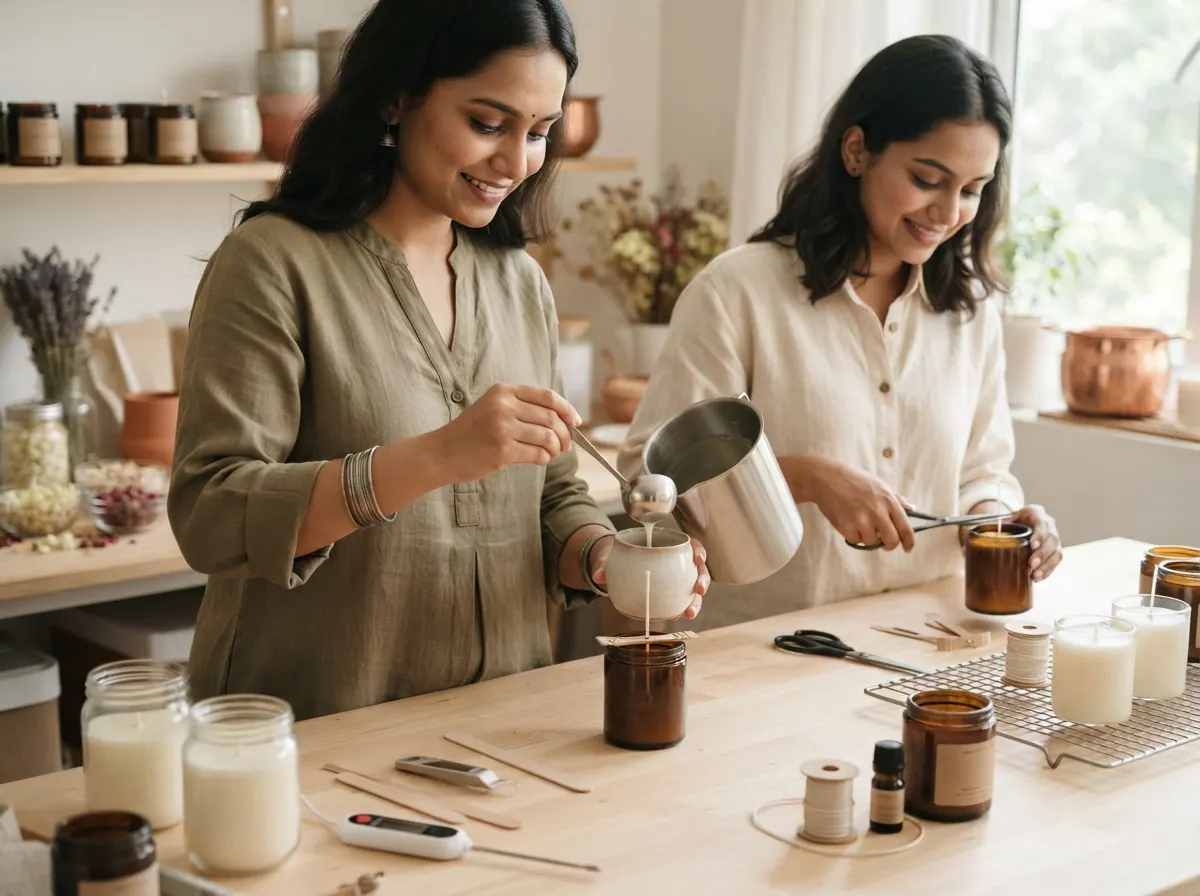
To start a candle business at home in India you need wax, wicks, moulds or jars, a double boiler, a clean room with good airflow, and about ₹10,000–1 lakh. The first sales usually come from friends, gift shops and festival fairs, and the profit is in scented and decorative candles, not plain white ones.
All figures here are estimates. Check prices near you before you spend.
What does it cost?
| Item | Basic start | Better range |
|---|---|---|
| Wax (paraffin, soy or a blend) | ₹3,000–6,000 | ₹10,000–20,000 |
| Wicks and wick holders | ₹500–1,500 | ₹3,000–6,000 |
| Moulds, jars and tins | ₹2,000–6,000 | ₹10,000–25,000 |
| Dyes and fragrance oils | ₹1,000–3,000 | ₹6,000–12,000 |
| Double boiler, thermometer, scale | ₹1,500–4,000 | ₹4,000–8,000 |
| Packaging, labels, boxes | ₹1,000–3,000 | ₹8,000–15,000 |
| Photos, samples and first marketing | ₹1,000–3,000 | ₹5,000–12,000 |
| Total | about ₹10,000–25,000 | about ₹50,000–1 lakh |
Start with one or two shapes and three fragrances. Many beginners spend on twenty moulds and then discover only four sell.
Which type of candle should you make?
- Scented jar candles. Popular for gifts, with a good margin, but they need a tested wax and wick match and good fragrance oil.
- Decorative and pillar candles. Sold by shape and colour for home decor. They need moulds and patience to get a clean finish.
- Floating candles and diyas. Sold in large numbers around festivals, at low prices.
- Plain household candles. Sold by weight, at a very low margin, with strong competition from bigger makers.
How much can it earn?
Take a home business selling scented jar candles, about 400 in a good month. These numbers are rough.
Each month
- Sales: 400 candles × an average of ₹160 (some wholesale, some retail) = ₹64,000
- Wax, wick, jar, fragrance and dye: 400 × ₹55 = ₹22,000
- Boxes and labels: 400 × ₹10 = ₹4,000
- Marketplace fees, delivery and promotion: ₹10,000
- Left over: ₹64,000 − ₹22,000 − ₹4,000 − ₹10,000 = about ₹28,000
That is a good month, often around a festival or gifting season. In quiet months you might sell far fewer, and the average over a year is lower. Your own time making and packing is not counted here, so check what each hour earns. If a candle sinks, tunnels or sweats, the jar and wax are wasted, so quality control saves more than a price rise.
What do you need before you start?
- A tested recipe. Make small test batches. A candle needs the right wick for its jar width, or it tunnels or burns too hot.
- Safe space. A separate corner with good airflow, cleared of cloth and paper, away from children.
- Reliable suppliers. Wax, fragrance and wick quality changes by supplier, so keep notes on each batch.
- A story and photos. Candles sell on look and smell. Take clear photos in good light before you list anywhere.
- A selling plan. Decide where the first fifty candles will sell before you make them.
Step by step
- Learn the basics by watching a local maker or taking a short workshop.
- Buy a small kit, with one wax type, two or three moulds or jars, and wicks sized for them.
- Make test candles and burn them fully, noting burn time, smell and any tunnelling.
- Adjust fragrance amount, pouring temperature and wick size until the results repeat.
- Photograph and label each product with its name, weight, burn time and safety note.
- Take samples to gift shops and a home decor store, and show them to friends and local groups.
- Take small first orders and watch which scents and sizes repeat.
Which licences apply?
Rules vary, so confirm with local offices:
- Udyam registration for loans and schemes, if you plan to grow.
- GST, if your sales need it. Ask a CA.
- Local permission for a workshop at home, and your landlord's permission if you rent.
- Fire safety for wax and fragrance storage in larger quantities. Ask the district industries centre.
- Labelling. Put your name, address, weight and a burn warning on each candle. Ask what is required for your packs.
- Loans and schemes. Small manufacturers can ask their district industries centre what schemes are open now.
What goes wrong?
- Tunnelling and sinking. The wick is too small, or the wax cooled too fast, and the candle wastes wax.
- Sweating and frosting. Oil beads on the surface or white patches show up in the jar.
- Weak scent. Too little fragrance or oil added at the wrong temperature leaves a candle that does not smell.
- Burn accidents. Hot wax can burn skin. Never melt it over direct flame and never leave it unattended.
- Heat in summer. Candles can soften or bend in a hot van or shop window.
- Stock that does not sell. A big range of designs, bought in bulk, can sit for months.
Situations you will face
What would you do? Each choice costs something.
Getting started
Paraffin holds scent well and costs less. Soy wax costs more and many gift buyers like it.
- Buy soy wax: Costs more, gift appeal
- Buy paraffin: Cheaper, plainer pitch
A supplier offers a package of twenty moulds at a discount. You do not yet know which shapes will sell.
- Buy the twenty-mould pack: More choice, cash tied up
- Buy four moulds: Cheaper, a small range
Wholesale jars from the city are cheaper but come in large lots. A local shop sells small quantities at a higher rate.
- Order a large lot: Cheaper each, cash tied up
- Buy small lots locally: Dearer each, low risk
A supplier sells a cheap wick that is too thin for your wide jars. A tested wick costs more.
- Pay for tested wicks: Costs more, clean burn
- Use the thin wicks: Cheap, tunnelling candles
A bazaar shop sells fragrance at a low price with no information. A candle supplier sells oil made for candles.
- Buy candle-grade oil: Costly, better throw
- Buy the cheap bazaar oil: Cheaper, weak or oily candles
The kitchen is the only space with a stove and water. Your family cooks there, and hot wax splashes.
- Set up a separate corner: Some cost, safer work
- Rent a small shared room: Monthly rent, more space
A neighbour melts wax in a pot on direct heat. A proper double boiler costs money and takes longer to heat.
- Buy a double boiler: Cost, safe even heating
- Use a pot in a water bath: Cheap, slow heating
First month
Your test candles burn a hole down the middle and leave wax at the sides. The jar is wasted.
- Test wicks and re-pour: More waste, a good recipe
- Sell them as budget candles: Little cash, weaker name
Friends like the look of your candles but cannot smell much when lit. Adding more oil may sweat or smoke.
- Test oil amounts carefully: More oil cost, better scent
- Double the oil at once: Quick fix, sweating risk
A gift shop offers a first order of fifty at a wholesale rate. It will pay only after the candles sell.
- Supply on sale-or-return: Big order, cash waits
- Ask for half in advance: Safer, shop may decline
A photographer charges for a product shoot. Phone photos in window light are free but flat.
- Hire the photographer: Costs now, better listings
- Shoot with your phone: Free, slower interest
A shopkeeper says candles should carry a clear burn warning and your address. Your labels have only a name.
- Reprint labels with a warning: Reprint cost, trusted packs
- Add a sticker by hand: Cheap, looks untidy
Candles kept in a hot room have bent and stuck to the box. Cooling space is hard to find.
- Store in a cool room: Some cost, safe stock
- Rush the stock to shops: No cost, may arrive soft
Running it
Gift shops and offices want hundreds of candles in three weeks. You work alone from home.
- Hire helpers for three weeks: Wages, keep the orders
- Take only what you can make: Safe quality, lose sales
An office wants one hundred candles with its name on the label. They want a low price and a fast date.
- Accept at a fair price: Good order, tight timing
- Quote higher, ask for advance: Better margin, may lose it
Your wax supplier raises the price. A cheaper wax would change how your candles look and burn.
- Pay more, keep the wax: Margin shrinks, same quality
- Switch to a cheaper wax: Saves cost, burn changes
A marketplace offers wide reach, but charges fees and wants fast delivery with strong packing.
- List on the marketplace: Fees and packing, more buyers
- Sell through Instagram only: No fees, smaller reach
Three parcels reach buyers with broken jars. Better packing adds to every order.
- Add bubble wrap and a box: Cost each parcel, fewer returns
- Refund and keep old packing: Cheaper now, more breakage
A fair gives you a table for a fee. Footfall is high, but the weather may turn hot.
- Take the stall: Fee and travel, many buyers
- Skip the fair: Save the fee, no new buyers
Shops ask for a seasonal scent. Making it means new oil and testing, and unsold stock if it flops.
- Make a small seasonal batch: Test cost, fresh interest
- Keep only your three scents: No spend, steady sales
A grocer asks for plain white candles in packs, for power cuts. The price is low, but orders come every week.
- Supply plain candles too: Low margin, steady orders
- Stay with decorative candles: Better margin, uneven orders
When things go wrong
A pot of hot wax tips near the stove flame and flares up for a moment. Nobody is hurt.
- Buy a heater and extinguisher: Cost, much safer
- Buy gloves and a heat-proof tray: Smaller cost, some risk left
Thirty candles show white patches after cooling too fast. They burn fine but look poor.
- Remelt and pour again: Time and wax, good result
- Sell them as rustic: Some cash, mixed reactions
A buyer reports black soot on the jar and a smoky flame. The review is public.
- Replace and fix the wick size: Cost, win back trust
- Argue in reply: Free, trust falls
A gift shop sold your candles but keeps postponing payment. It also wants a fresh order.
- Stop supply until paid: Lose a shop, protect cash
- Send a smaller order: Keep the shop, more risk
After the season ends, a large number of festival candles sit unsold in boxes.
- Run a clearance discount: Cash now, low price
- Store for next year: No cash, risk of damage
Growing
A hobby group wants a weekend class and will pay per person. It uses your time and materials.
- Run the class: Effort, extra income, new buyers
- Stay with making and selling: No new income, more focus
Buyers ask for a logo, matching jars and gift boxes. Design and printing cost money before they pay back.
- Invest in a brand look: Spend now, higher prices
- Keep plain labels: No spend, lower prices
Your home is full of wax and boxes. A rented room costs rent and a deposit but gives space to scale.
- Rent the workshop: Rent and deposit, more output
- Stay at home: No rent, slow growth
A wedding planner wants small candles in hundreds as favours. The price is low but orders are big.
- Make a favour range: Moulds and packing, big orders
- Decline favour orders: No spend, no wedding sales
Is it right for you?
A candle business suits you if you like making things with your hands, can learn from small failures, and enjoy selling on social media and at fairs. It suits you less if you want a steady monthly income quickly, since festival months bring most of the sales.
A good test: make twenty test candles, give them to fifteen people, and ask for honest feedback on smell and burn. If at least a few ask to buy more, start with a small range and grow slowly.