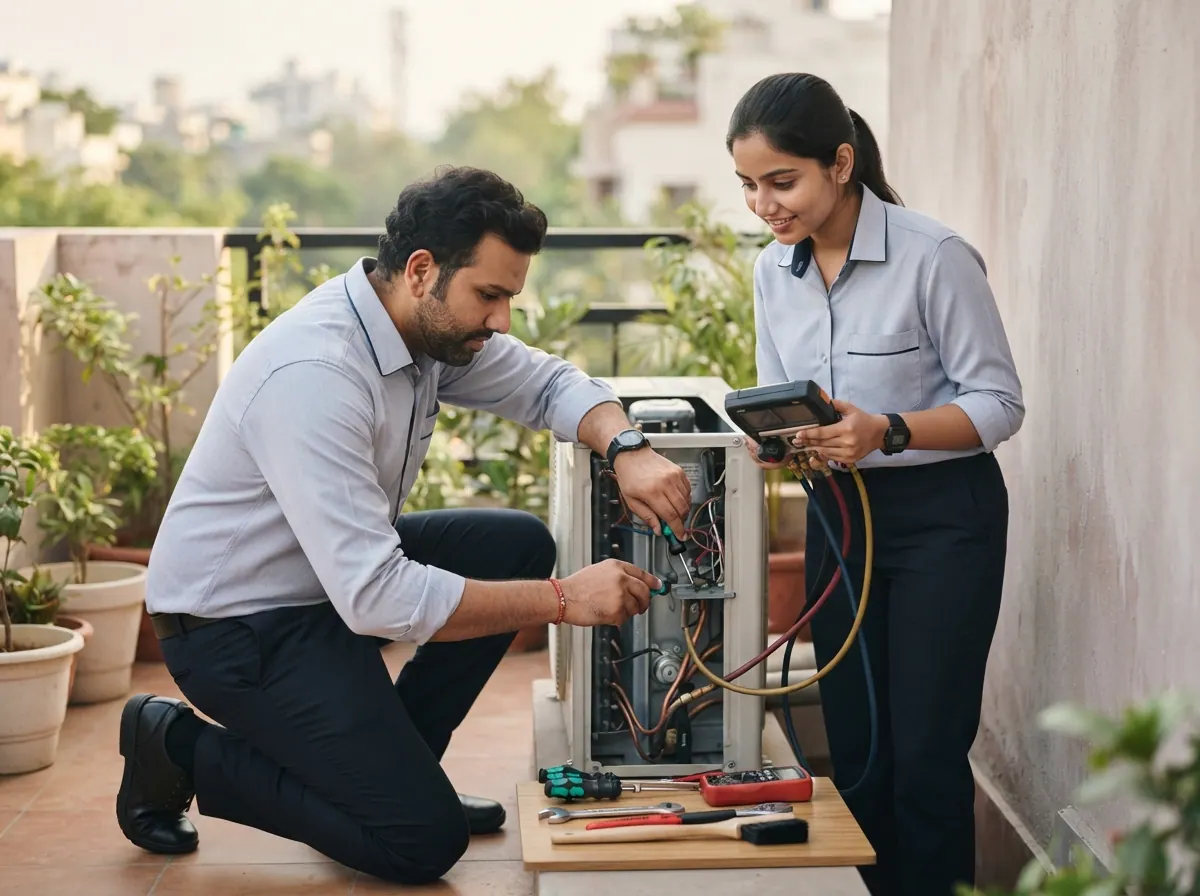
To start an AC repair business in India you need real hands-on skill, a gauge manifold, a vacuum pump, a jet washer, a brazing kit, a ladder and a helper, and about ₹90,000–1.75 lakh to begin from home, or ₹1.8–3 lakh for a small shop and two teams. The trade is busy from about March to June and quiet in winter. Customers call when their AC stops cooling on a hot day, so the one who comes first and fixes it right wins the next call.
All figures here are estimates. Check prices near you before you spend.
What does it cost?
| Item | Home-based, 1 team | Small shop, 2 teams |
|---|---|---|
| Gauge manifold, vacuum pump, basic tools | ₹12,000–25,000 | ₹24,000–45,000 |
| Jet pump or pressure washer for servicing | ₹6,000–12,000 | ₹12,000–24,000 |
| Flaring and swaging tools, tube cutter, bender | ₹4,000–8,000 | ₹8,000–14,000 |
| Multimeter, clamp meter, leak detector | ₹5,000–10,000 | ₹8,000–16,000 |
| Brazing torch kit and nitrogen cylinder | ₹8,000–15,000 | ₹8,000–15,000 |
| Ladders, drill, safety belt, helmet | ₹6,000–10,000 | ₹10,000–16,000 |
| Spares and gas, opening stock | ₹15,000–30,000 | ₹25,000–40,000 |
| Cards, uniform, phone listing | ₹4,000–8,000 | ₹8,000–12,000 |
| Training course | ₹8,000–20,000 | ₹8,000–15,000 |
| Small shop deposit and signboard | not needed | ₹30,000–50,000 |
| Cash buffer for the slow months | ₹20,000–35,000 | ₹40,000–55,000 |
| Total | about ₹90,000–1.75 lakh | about ₹1.8–3 lakh |
You also need a two-wheeler to carry tools. Buy a good gauge set and a decent vacuum pump first. A cheap vacuum pump that does not pull a proper vacuum leaves moisture in the system and brings the customer back.
Which AC jobs pay?
- Jet-wash servicing. Quick and regular. A few hundred rupees a job, but once a year per customer and good for word of mouth.
- Gas top-up or leak repair. Pays more, but a top-up without finding the leak means the AC stops cooling again in a few weeks.
- Capacitor, fan motor and sensor replacement. Common faults with a clear price.
- PCB and inverter board repair. Needs skill and often a bench. You may send it to a specialist and keep a margin.
- Installation and shifting. Pipe, bracket, drain and wiring. The usual mistakes here come back to you as complaints.
- Compressor replacement. Big ticket, so quote carefully and explain it to the customer.
- Annual maintenance contracts (AMC). Offices, clinics, shops and PGs pay a fixed price for visits and basic repairs. They smooth the quiet months.
How much can it earn?
Take a team with a technician, a helper and you. Work this out for a busy month and a slow month, since the trade is seasonal.
Peak month (about May)
- 90 services × ₹650 = ₹58,500
- 12 gas refills × ₹2,200 = ₹26,400
- 8 repairs × ₹2,500 = ₹20,000
- 6 installations × ₹2,000 = ₹12,000
- Sales = ₹1,16,900
- Technician ₹16,000 + helper ₹10,000 = ₹26,000
- Gas: 12 × ₹900 = ₹10,800; service chemicals: 90 × ₹60 = ₹5,400; spare parts: 8 × ₹1,300 = ₹10,400; installation material: 6 × ₹600 = ₹3,600
- Fuel ₹7,000, ads ₹6,000, tool upkeep ₹2,000
- Total costs = ₹71,200
- Left over: ₹1,16,900 − ₹71,200 = about ₹45,700
Slow month (about December)
- 25 services × ₹650 = ₹16,250
- 5 repairs × ₹2,500 = ₹12,500
- 4 gas refills × ₹2,200 = ₹8,800
- 1 installation × ₹2,000 = ₹2,000
- Sales = ₹39,550
- Wages ₹26,000 + gas ₹3,600 + chemicals ₹1,500 + parts ₹6,500 + installation material ₹600 + fuel ₹3,000 + ads ₹3,000 + tools ₹1,000 = ₹45,200
- Left over: ₹39,550 − ₹45,200 = about −₹5,650
So a good season month makes money and a winter month can lose money. Keep your peak earnings aside for the slow months, and add contracts or a winter service, such as geyser and water cooler repair, to cover wages.
What do you need before you start?
- Technical skill. Learn how a split AC cools, what low gas looks like on the gauges, how to read a wiring diagram, and when a compressor is dead.
- Safety habits. Switch off and discharge capacitors before touching a board. Use a safety belt at height on outdoor units, and never lean from a window with no support.
- A way to prove your work. A job card with the date, work done, gas added and a warranty period.
- Spare parts supplier. Know the nearest dealer for capacitors, motors and boards, and their prices.
Step by step
- Work under a good technician for six to twelve months. Learn through a full summer.
- Take a course in refrigeration and air conditioning, so you understand gas, pressure and wiring and not only the repair routine.
- Buy core tools first. Gauge, vacuum pump, brazing kit, meters, ladder and jet washer.
- Make a rate card for service, gas, installation and the common repairs. Show it before the work.
- Get your first 20 customers from neighbours, offices and PG owners. Ask them to send you the next call.
- Offer an AMC to shops and clinics before summer begins.
- Hire a helper, then a second technician only when calls are full for two or three weeks.
Which licences apply?
- Shop and establishment registration if you rent a shop or have staff. Rules vary by state.
- GST. Ask a CA about registration, especially if you sell parts and gas.
- Refrigerant rules. Handling refrigerants has environmental rules, such as not venting gas into the air. Ask your local office or a dealer what applies to your work.
- Electrical work. Large commercial installations may need a licensed electrician or approval. Ask the local electrical authority.
- Warranties. If you promise a warranty on repairs, write it on the job card and keep your promise.
What goes wrong?
- A gas top-up without a leak check. The AC cools for two weeks and fails again. The customer blames you.
- Wrong gas. Mixing refrigerants or using the wrong type can damage the compressor. Check what your customer's AC uses.
- Falling from a window ledge. Unsafe outdoor unit work is the biggest danger in the trade.
- Skipping the vacuum. Moisture in the system leads to compressor trouble months later.
- A fake or cheap spare. A cheap capacitor fails in a week and takes your name with it.
- Summer rush errors. Rushed installations leave drain slope or pipe insulation wrong and cause water leaks.
Situations you will face
What would you do? Each choice costs something.
Getting started
A busy technician offers you a helper's job at ₹8,000 a month. Your own tools would let you start now.
- Work as a helper a season: Low pay, real skill
- Start on your own now: Earn more, risk mistakes
A good vacuum pump costs ₹9,000. A cheap one for ₹3,500 pulls a weaker vacuum and can leave moisture in the system.
- Buy the good pump: Costs, cleaner installs
- Buy the cheap pump: Saves money, repeat calls
Your gauge set works for common gases only. A newer set for newer refrigerants costs ₹4,500 more.
- Buy the newer gauge set: Costs, handles both
- Buy the basic set: Cheaper, limits jobs
A proper safety belt and hook cost ₹3,500. Your helper says a rope tied to the grill is enough.
- Buy proper belts for both: Costs, safe working
- Hire a ladder crew for heights: Costs per job, safe
Customers argue about price. A printed rate card shows servicing, gas and common repairs.
- Print and share a rate card: Costs little, fewer arguments
- Quote on the phone: Free, more haggling
Neighbours ask for cheap servicing. A PG owner offers a package of ten ACs at a low price.
- Take the PG package: Many jobs, low rate
- Charge full price to neighbours: Fewer jobs, better margin
A local dealer sells branded capacitors at a high price. A trader nearby has cheaper ones from an unknown maker.
- Buy from the branded dealer: Costs, parts last
- Buy the cheaper capacitors: Saves cash, early failures
First month
An AC has lost gas again. A top-up is cheap, but finding the leak takes an hour and costs more.
- Find and fix the leak: Costs, fixes it properly
- Do only the top-up: Cheaper now, comes back
A split AC outdoor unit leans on a weak wall bracket. The customer calls the same day.
- Reinstall with a strong bracket: Costs, safe install
- Prop it and return tomorrow: Cheaper, customer waits a day
The drain pipe slope was wrong. Water is marking a freshly painted wall.
- Fix slope, repaint patch: Costs, trust kept
- Fix the slope only: Cheaper, customer upset
The customer asks if the board can be repaired. A new board costs ₹6,500, a repaired one costs ₹2,500 but may fail again.
- Offer a new board: Costs more, longer warranty
- Offer a repaired board: Cheaper, risk of return
The customer wants a three-month warranty on a compressor repair. You are not sure about the part's quality.
- Give a one-month warranty: Honest, less appeal
- Give three months, good part: Costs more, stronger trust
Running it
Fifty calls arrive in two days. Two people cannot reach all of them in time.
- Hire day workers for a week: Costs, serve more
- Book calls over two weeks: No cost, customers go elsewhere
A clinic wants four ACs on a yearly contract with quarterly visits and basic repairs for a fixed price.
- Take it at ₹9,000 a year: Steady income, tight margin
- Quote ₹14,000 a year: May lose it, better margin
A customer's inverter AC fails after a power surge. The board needs a specialist.
- Send to a specialist: Margin shrinks, safe repair
- Tell them to call the brand: Lose the job, no risk
A new technician offers jet-wash servicing at half your rate, using no chemical.
- Keep your rate, show proof: Lose some jobs, keep trust
- Cut your rate to ₹450: More jobs, thin margin
A customer offers an old AC for ₹6,000 as part of a swap. You could repair and resell it.
- Buy and test it first: Costs, small resale gain
- Decline: No risk, no gain
A compressor replacement costs ₹9,000 in parts. The customer's AC is eight years old and they want a cheaper fix.
- Suggest a new AC: Honest, may lose the job
- Replace it and warn about age: Steady income, risk of complaint
Your gas supplier raises the price of a cylinder by 15%. Your customers are used to your current gas rate.
- Raise your gas rate a little: Fair, a few complaints
- Hold your rate: Keep customers, thinner margin
When things go wrong
Your helper topped up an AC with the wrong refrigerant. The compressor is making noise.
- Recover the gas and repair free: Heavy cost, honest fix
- Offer a discount on the repair: Cheaper, customer angry
Your helper slips while fixing an outdoor unit and hurts an ankle. No belt was used.
- Pay the bill and buy belts: Costs, safer team
- Pay and stop high-ledge jobs: Cheaper, lose some jobs
Three capacitors from a cheap batch fail within a month. Customers call back.
- Replace all three free: Costs, trust kept
- Charge for new ones: No cost, angry customers
Your only skilled technician joins another shop in the peak month.
- Raise pay to keep staff: Costs, steadier team
- Do jobs yourself, slower: No cost, fewer jobs
A customer says the AC stopped cooling again and refuses to pay for the first visit.
- Go back and check it free: Costs, may clear the dispute
- Insist on payment: Money in, bad word spread
Calls fall by two thirds. Wages must still be paid.
- Add geyser and cooler repair: New income, new tools
- Cut hours and wages: Saves cash, team may leave
Growing
A small shop near a market costs ₹25,000 as a deposit and ₹8,000 rent. Walk-in customers will come.
- Rent the shop: Costs, more walk-ins
- Stay home-based: Saves rent, fewer walk-ins
A builder wants forty split ACs installed in a new flat project at a fixed rate per unit.
- Take it with extra workers: Steady, thin margin
- Quote a higher rate: May lose it, better margin
An AC brand offers to refer customers if you meet its standards and pay a small onboarding fee.
- Join as a partner: Costs, steady leads
- Stay independent: Free, fewer leads
Customers ask you to repair boards. A soldering station and test bench cost ₹25,000 and take training.
- Set up the bench: Costs, higher-value jobs
- Keep sending boards out: Saves cash, small margin
A second technician needs a two-wheeler and a tool set. Without it, calls cluster in the afternoon.
- Buy a second set and bike: Costs, double capacity
- Share one set: Cheap, long waits
Is it right for you?
AC repair suits you if you are comfortable with tools and electricity, can work in heat and at height, and can stay calm with customers who are sweating and angry. It suits you less if you cannot manage work that is uneven through the year, or if you want to avoid physical work.
A good test: work a full summer as a technician's helper. If you can handle the heat, the climbs and the complaints, and you understand each fault you see, buy your tools and start with one team.