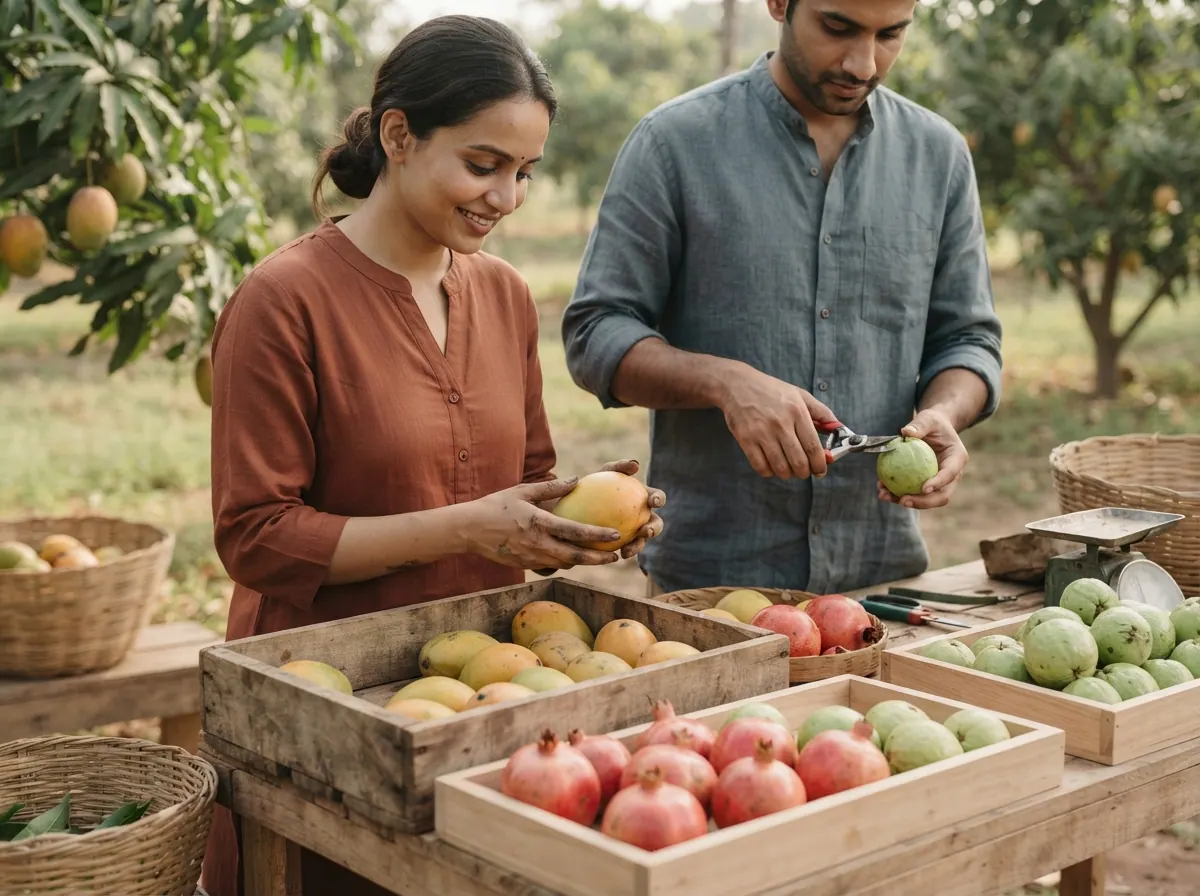
A small fruit orchard in India costs about ₹1–10 lakh to set up, depending on the fruit, the number of acres and whether you already own the land, and it gives little or no income for the first two to three years. The money in an orchard comes later and comes for years, so the real question is whether you can fund the wait.
All figures here are estimates. Check prices near you before you spend.
What does it cost?
| Item | 2 acres guava | 2 acres pomegranate |
|---|---|---|
| Land levelling, pits, farmyard manure | ₹20,000–40,000 | ₹25,000–45,000 |
| Grafted plants or tissue-culture plants | ₹30,000–60,000 | ₹40,000–80,000 |
| Drip system with tank or pump | ₹60,000–1 lakh | ₹70,000–1.2 lakh |
| Fencing around the plot | ₹40,000–90,000 | ₹40,000–90,000 |
| Fertiliser, sprays, first two years | ₹50,000–90,000 | ₹70,000–1.2 lakh |
| Labour for pruning and care, first two years | ₹40,000–80,000 | ₹50,000–90,000 |
| Crates, small tools, sprayer | ₹15,000–30,000 | ₹15,000–30,000 |
| Total (excluding land) | about ₹2.5–5 lakh | about ₹3.2–6 lakh |
A mango orchard of the same size has cheaper plants but needs more space between trees and takes longer to fruit. Costs rise quickly if you add a borewell, a farm pond or a shed.
Which fruit should you plant?
- Guava: fruits early, often within two to three years, and sells in most markets. It needs pruning and a watch for fruit fly.
- Pomegranate: does well in dry areas with good drip. It brings good prices, but bacterial blight and fruit borer are real risks, and plants need close care.
- Mango: a long game. Choose a variety your local mandi already buys, such as Dasheri, Kesar, Alphonso, Langra or Totapuri, depending on your region. Trees live for decades and give the most from the sixth or seventh year.
- Sweet orange, lemon, custard apple and others: each does best in some regions. Ask the nearest orchard owner what survived a bad year.
How much can it earn?
Here is a settled two-acre guava orchard in its fourth year, with drip, on your own land.
Income
- Yield: about 6 tonnes an acre × 2 acres = 12 tonnes (this varies with variety and care)
- Average farm-gate price: about ₹25 a kg
- 12,000 kg × ₹25 = ₹3,00,000 a year
Costs a year
- Manure, fertiliser and sprays = ₹40,000
- Water and power = ₹15,000
- Pruning, weeding and general labour = ₹30,000
- Harvest labour = ₹40,000
- Crates and transport: 12,000 kg × ₹1 = ₹12,000
- Total = ₹1,37,000
Left over: ₹3,00,000 − ₹1,37,000 = ₹1,63,000 a year, or about ₹13,600 a month. That is before any loan payment and before the first two or three years with no sales. If bad weather ruins one crop, the year can be much lower. Prices also drop in the peak season, when every farm sells together.
What do you need before you start?
- Soil and water tests. Pomegranate and guava react badly to waterlogging or very salty water. Test before buying plants.
- A money cushion. You will pay for plants, drip, fertiliser and labour for two or three years before real sales. Keep that money aside or arrange a loan with a long gap before repayment.
- A nursery you can trust. Buy grafted or tissue-culture plants with the variety name written down. A wrong variety costs you years.
- A buyer in mind. Visit the mandi and a nearby fruit processing unit or pulp maker to see what grade and what price they want.
Step by step
- Visit three orchards of your fruit, including one that is over five years old. Ask what their worst year looked like.
- Test soil and water, and ask the horticulture office or a Krishi Vigyan Kendra for suitable varieties and spacing.
- Prepare pits well before the rains, fill them with manure and topsoil, and let them settle.
- Plant at the right spacing and fit drip from day one. Young plants die fastest in their first dry summer.
- Train and prune the young trees, which matters more for guava and pomegranate than most new owners expect.
- Use the gaps for short crops in early years, if your horticulture officer agrees, to earn something while the trees grow.
- Plan the first harvest with a buyer. Do not wait for ripe fruit to start looking for one.
Which licences apply?
An orchard has little licensing, but you will meet some rules:
- Land and water. A borewell, farm pond or electricity connection may need permission. Ask the local office.
- Subsidy and loans. The Mission for Integrated Development of Horticulture and state schemes have supported planting material, drip and some structures. Banks also lend for orchards. Rules and amounts change, so confirm with your district horticulture office before you buy.
- Pesticides. Buy from licensed dealers and follow the waiting period on the label before you pick.
- Selling pulp, juice or dried fruit yourself is a food business and needs its own food licence. Ask the licensing office.
- Tax. Ask a CA how your income and any subsidy are treated.
What goes wrong?
- Wrong variety. You find out in year three that the fruit is not what the mandi wants.
- Young plants dying in the first summer. No drip, or a gap in watering, and a year is lost.
- Waterlogging. One heavy monsoon can kill pomegranate roots in poorly drained soil.
- Pests and disease. Fruit fly in guava, blight in pomegranate and hoppers in mango flowering can cut a crop.
- Everyone sells at once. In the peak season prices fall. Tree-ripe fruit needs quick selling.
- Running out of money in year two. Many orchards fail not from bad trees but from no cash to keep them cared for.
Situations you will face
What would you do? Each choice costs something.
Getting started
The nursery pushes a new variety. Your local mandi buys only the old, known kind.
- Plant the known variety: Sure buyer, ordinary price
- Try the new variety: Costly plants, unknown buyer
Guava fruits in two to three years at lower prices. Pomegranate pays more but needs closer care.
- Plant guava: Earlier income, steady care
- Plant pomegranate: Higher price, disease risk
The drip system costs a lot at planting time. Your labourer says each plant can be watered by pot.
- Fit drip from day one: Costly, plants survive summer
- Hand-water this year: Saves money, plants may die
Rains are close and the pits are not ready. Digging in a hurry leaves no time to fill with manure.
- Hire a machine, fill them: Extra cost, ready for rain
- Plant straight in raw pits: Cheap, weaker first growth
The nursery quotes both. Tissue-culture plants cost more and grow fast. Grafted ones are cheaper and older.
- Buy tissue-culture: Higher cost, uniform plants
- Buy grafted: Lower cost, uneven growth
Stray cattle and nilgai keep entering the field. A proper fence is a large bill.
- Build the fence now: Big bill, plants protected
- Guard the young plants: Cheap, some will be eaten
Plants are in but nothing will sell for two years. The bank offers a loan with a gap before repayment.
- Take the loan: Cash for upkeep, interest
- Use only your savings: No interest, thin cushion
First month
A neighbour grows moong between young guava plants. It earns a little but needs water and care.
- Grow the short crop: Extra income, water share
- Leave the gaps empty: No income, plants get all water
A heatwave is scorching the new plants. Shade nets and extra watering both cost money.
- Put up shade nets: Costly, plants live
- Water more, no nets: Cheaper, some will die
Eight plants died in the first months. New ones cost money and will lag the older ones.
- Replace the plants: Cost now, full rows later
- Leave the gaps: Save money, fewer trees
Termites are eating roots of a few young plants. A soil treatment costs money.
- Treat the whole plot: Costly, protects all
- Treat affected plants only: Cheaper, may spread
A skilled pruner wants a high daily rate. Your regular labourer will do it at half, but poorly.
- Pay the skilled pruner: Higher cost, better shape
- Use your labourer: Cheaper, uneven trees
Running it
Maggots are showing in ripe fruit. Traps cost money, and so does picking early.
- Set traps and bag fruit: Costly, cleaner fruit
- Pick early and sell fast: Cheap, lower grade
Black spots and cracking are appearing after the rains. A full spray programme is costly.
- Follow the spray plan: Costly, saves grade
- Spray only the worst trees: Cheaper, loss of fruit
Every orchard is selling at once and the mandi price has halved. Cold rooms are costly.
- Hold fruit in cold storage: Fee, better price later
- Sell now at the low price: No fee, thin return
Hoppers are attacking the flowering. A timely spray helps, but spraying at the wrong stage hurts fruit set.
- Call a horticulture officer: Small fee, right timing
- Spray what the shop says: Cheaper, timing guess
A pulp unit will buy all your lower-grade fruit at a fixed rate, but lower than the mandi on a good day.
- Sign with the pulp unit: Steady money, lower rate
- Keep selling at the mandi: Higher highs, wasted fruit
A trader offers a lump sum for the whole standing crop. You would skip picking and selling, but the trader sets the price.
- Sell the standing crop: Quick cash, lower total
- Pick and sell it yourself: More work, better return
The borewell gives half its flow in summer. A deeper bore or a farm pond are both expensive.
- Dig a farm pond: Costly, steady water
- Cut water to each tree: Free, smaller fruit
Farm power supply hours changed. Your pump runs at night, and drip needs checking at 2 am.
- Buy a solar pump: Big cost, daytime water
- Use night supply: No cost, tiring checks
When things go wrong
Flocks come each morning. Nets are costly, and scarecrows work only a few days.
- Net the best trees: Costly, saves fruit
- Use scare devices: Cheap, losses continue
A storm marked half the fruit. Traders will pay only for undamaged pieces.
- Sort and sell by grade: Labour, saves some value
- Sell all at one low rate: Fast, poor money
A buyer took two loads on credit and keeps delaying. The buyer wants a third load tomorrow.
- Cash only from now: Safer, may lose the buyer
- Send the third load: More owed, sales continue
A buyer is waiting for fruit. The last spray label asks for several days before picking.
- Wait the full period: Delay, risk of buyer leaving
- Pick only unsprayed trees today: Less fruit, safe for buyers
Several mango trunks show sawdust and holes. Treating each tree is slow work.
- Treat every trunk: Labour cost, trees survive
- Treat the worst only: Cheaper, losing some trees
Growing
A neighbour offers two acres on lease. Your first plot is only just earning.
- Lease and plant them: Big spend, income later
- Improve the first plot: Smaller spend, better yield
A city fruit shop pays more for graded, boxed fruit. You need a small packing room and crates.
- Set up the packing room: Cost, better price
- Keep selling in crates: No spend, regular price
Families nearby ask to buy fresh fruit directly. It takes your time and needs weighing and change.
- Open a weekend farm stall: Better price, your time
- Stay with the trader: Less work, lower price
A buyer pays more for fruit grown with no chemicals. Yield may drop, and they want proof and records.
- Switch to organic: Lower yield, premium price
- Keep present methods: Usual yield, usual price
The district office mentions support for new orchards and drip. It needs papers and nothing is promised.
- Apply with a CA's help: Fees, cleaner records
- Skip it for now: No fees, no support
Is it right for you?
An orchard suits you if you own or can lease land for many years, can fund two or three years with little income, and enjoy steady outdoor work. It does not suit you if you need regular monthly income, or may have to sell the land soon.
A good test: spend a week on a working orchard during harvest, and ask the owner for their worst-year numbers. Then plant a small plot first, keep the plants alive through one summer, and add acres only after that.